Thank you!
Your support is sustaining the future of local news in our communities.

Student or Visitor?

This essay was a second-place winner in a high school essay contest sponsored by the Connecticut Foundation for Open Government.

In March 2025, a Tufts University doctoral student from Turkey had her visa stripped away after constructing an opinion piece critical of her university’s position on the war in Gaza. The administration’s argument is that a visa is a privilege, not a right, and that non-citizens do not enjoy the same First Amendment protections as Americans. This view is flawed; it misunderstands the nature of a student visa and the values America claims to uphold.

Legally, the F-1 student visa frames its recipient as no more than a temporary visitor. Federal standards state that students have to maintain a foreign residence they have no intention of abandoning. This suggests someone visiting, not putting down roots. But the reality of a doctoral program tells a different story. Graduate students can spend around seven years on American campuses. They teach undergraduates, conduct research, serve on committees, and become key parts of their university communities. They do not come to America to visit attractions. They come with the intent of changing the world.

Starting in elementary school every kid is taught that America is a ‘melting pot’. A nation where people from all walks of life are invited to become part of a shared civic life. The melting pot assumes that newcomers will engage, debate, and contribute their voices to the national conversation. A student who writes an op-ed in the school newspaper is doing exactly that. She is acting like a citizen in every meaningful sense, even if her passport says otherwise. So when the government punishes her for speaking, it sends a contradictory message: “We want you to join our community, but only if you lose your voice.” They strive to strip them of any authentic thought.

There is a deeper constitutional principle at play. The First Amendment does not say “citizens” have freedom of speech. It says “the people” do. Courts have long recognized that non-citizens within the United States are among “the people” entitled to constitutional protections. Federal judges have already pushed back on the administration’s position. In a similar case regarding a revoked student visa, a judge ruled that the government likely acted in a “viewpoint-discriminatory way to chill protected speech.” Another judge, appointed by President Reagan, deduced that the administration’s choice violated the First Amendment. This matters because of what the Supreme Court has repeatedly said about laws that target specific beliefs. In cases involving religious freedom, the Court has ruled that the government cannot single out particular viewpoints for punishment. If the government only revokes visas from students who speak out on one side of the Gaza conflict, while leaving students with opposing views untouched, that is in no way neutral enforcement.

The government is correct in saying that a visa is a privilege. No one has a right to study in the United States. But once a person is here, the Constitution follows. The government cannot condition a privilege on giving up a constitutional right. It is inherently flawed, similar to a town stating “Usage of the public park is permitted as long as the individual does not criticize the mayor. “ The Supreme Court has struck down such conditions before.

America invites students from around the world to join its universities. It asks them to engage, to learn, and to contribute. When they do that, either by joining a debate or composing an op-ed, the government punishes them. A student visa may call its holder a visitor, but the Constitution treats them as a person. That protection should not depend on which side of a political argument they stand on.

Prithika Venugopal is a 12th grader at Rocky Hill High School


Connecticut Foundation for Open Governement high school essay contest

Each year, the Connecticut Foundation for Open Government sponsors an essay contest open to all high-school students in the state. The contest focuses on First Amendment and open information issues. This year, students chose from three prompts (edited here for space constraints): 1.) the potential limitations on hate speech following the fatal shooting of conservative activist Charlie Kirk; 2.) the arrest and revocation of the student visa of a Tufts University Ph.D. student from Turkey who had written an opinion piece for the school newspaper critical of the university’s position on the war in Gaza; 3.) the banning of the Associated Press from Oval Office events and Air Force One following its refusal to refer to the Gulf of Mexico as the Gulf of America, which is President Trump’s preferred name.

The Lakeville Journal has obtained permission to publish the 2026 top three winners out of 70 entries from across Connecticut. First place went to Nora Kallusky, a senior at Ridgefield High School. There was a tie for Second Place, so Mayumi Iwai, a junior at Greenwich High School, and Prithika Venugopal, a senior at Rocky Hill High School, both received that honor.


The views expressed here are not necessarily those of The Lakeville Journal and The Journal does not support or oppose candidates for public office.

Latest News

“The Divine Sister” comes to Sharon Playhouse for one-night benefit
Playwright and performer Charles Busch is “The Divine Sister.”
Provided

Continuing a popular tradition, the Sharon Playhouse will present a one-performance-only staged reading of “The Divine Sister,” another riotous comic romp by the acclaimed playwright and performer Charles Busch, on Friday, Aug. 28 at 7 p.m.

The play is a wild and witty homage to Hollywood films that feature nuns — from “The Song of Bernadette” and “The Bells of St. Mary’s” to “The Singing Nun” and “The Sound of Music.” It is classic Charles Busch: wickedly funny, gloriously over-the-top and overflowing with theatrical joy.

Keep ReadingShow less

KK Kozik sees things differently

KK Kozik sees things differently

KK Kozik in her studio

Natalia Zukerman
Maybe it takes the ability to interpret what you’re looking at to really see.
— KK Kozik

KK Kozik has a theory about getting older.

“I don’t think you have eyes to see until you have eyes to see,” said the painter. “And maybe it takes the ability to interpret what you’re looking at to really see, and maybe that’s what comes with wisdom.”

Keep ReadingShow less
Lakeville Open Horse Show returns for 69th year

Jazzmine Bone and A Stitch in Tyme power through the Gambler’s Choice run during the 2024 Lakeville Open.

Caitlin Von Graf

For nearly seven decades, the Lakeville Open Horse Show has brought riders, horses and spectators together for a day of competition and community.

This year’s show takes place on Sunday, Aug. 30, at Riga Meadow at Coole Park, 1031 Bengal Amenia Road in Millbrook.

Keep ReadingShow less
google preferred source

Want more of our stories on Google? Click here to make us a Preferred Source.

A new home for contemporary music in Connecticut

This year, the ARChive of Contemporary Music, or ARC, is moving its collection to a permanent home in Ridgefield, Connecticut.

ARC is somewhat hard to imagine. Comprised mainly of huge collections from musicians, archivists, and DJs, it has compiled more than three million sound recordings, consisting of over 90 million songs.

Keep ReadingShow less
A Vietnamese water puppet musical returns to the quarry where it began

“The Magnificent Ms. Pham” combines Vietnamese water puppetry, shadow theater, music and storytelling.

Provided

“The Magnificent Ms. Pham,” the first Vietnamese American water puppet show, is returning to the water where it was born. The perpetual motion puppet show will be at TurnPark Art Space in West Stockbridge, Mass., Aug. 28 and 29, following a sold-out New York City premiere earlier this year. The production was originally developed at TurnPark, where its puppets first danced across the surface of the quarry lake.

Created by Vietnamese American artist Tommy Nguyen and director and designer Doug Fitch, the production tells the story of Nguyen’s mother, Kim Pham, and her journey from Vietnam to the United States. The story moves between memory, Vietnamese history and mythology, and the realities of immigration, following Kim from her childhood in Vietnam through her escape as a “boat person” and eventual life in Houston, Texas.

Keep ReadingShow less
Barry Blitt draws for the Northwest Connecticut Arts Council

Cartoonist Barry Blitt created a design for a limited edition T-shirt for Northwest Connecticut Arts Council fundraiser.

Jennifer Almquist

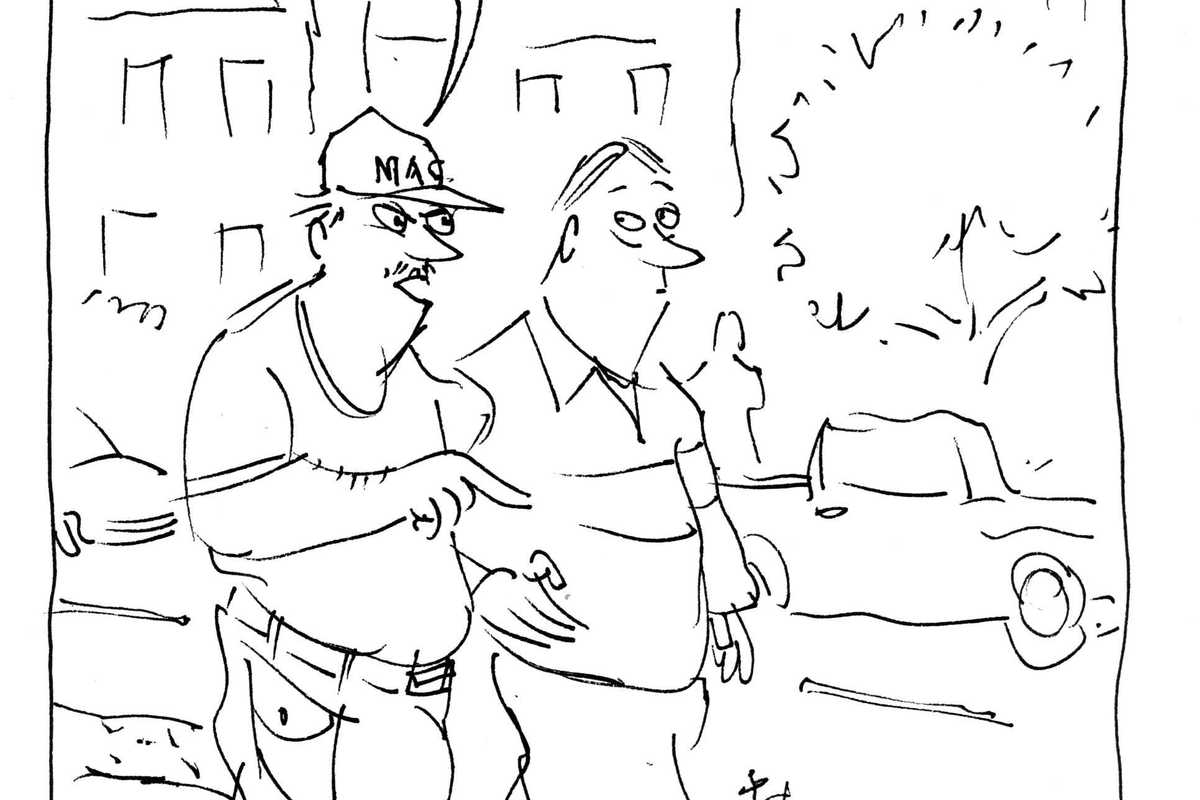
A drawing by Barry Blitt is recognizable from a distance simply for his line quality and hint of watercolor. Known for his scathing political cartoons, this longtime cover illustrator for the New Yorker has leaned his shoulder in to support the NWCT Arts Council and its Aug. 29 fundraiser at Buck’s Rock Camp in New Milford. Blitt created a design for limited-edition T-shirts that will be available for sale at the event and online at artsnwct.org.

David Remnick, editor of the New Yorker since 1998, called Blitt “One of the greatest political cartoonists of our time.” A native of Canada, Blitt won a Pulitzer Prize for editorial cartooning and has created more than 100 covers for the New Yorker since 1992. Perhaps most memorable is his 2008 iconic fist bump between Barack Obama and Michelle Obama, “The Politics of Fear.” A quarter century of his sketches and drawings are collected in “Blitt: In One Eye and Out the Other,” published by Penguin Putnam. He has created books for children, including “George Washington’s Birthday” and “Once Upon a Time, the End, (Asleep in 60 Seconds).”

Keep ReadingShow less
google preferred source

Want more of our stories on Google? Click here to make us a Preferred Source.

google preferred source

Want more of our stories on Google? Click here to make us a Preferred Source.