The True Story of A Fabricated Life

Mark Chiusano
Photo by Charlotte Alter

Mark Chiusano, a journalist who has written for NPR, The Atlantic, and The Paris Review, will read from his new biography, “The Fabulist: The Lying, Hustling, Grifting, Stealing, and Very American Legend of George Santos,” at The Colonial Theatre in North Canaan, Conn., on Sunday, Dec. 10. He discussed his new book during a phone interview from his home in Brooklyn, N.Y.
Alexander Wilburn: I could not have dreamed of a more suitable day to dive into George Santos. To give readers context, it’s Thursday, Nov. 16, and just hours ago the House of Ethics Committee unveiled a 56 page report outlining a litany of alleged misconduct involving, of course, accusations of embezzling funds from his campaign, as well as, and I’m going to quote The Washington Post here, “deceiving donors about how contributions would be used, creating fictitious loans, and engaging in fraudulent business dealings.” Have you had a chance to look at the report, and did anything surprise you?
Mark Chiusano: Nothing surprised me, because this is kind of what my whole book is about: the kind of grifty, schemy behavior he’s been engaged in for a really long time. My book includes some of the mooching and scamming he did off his grandmother and his aunt. He’s been doing these low level things for a long time. What I think is so great about this report, though, is that they had subpoena power, and they were able to get bank records. So they nailed down some things that we only wondered about or assumed or questioned, right? So they were able to see where the money actually went as opposed to where Santos said it went or where it came from.
AW: Speaking of where the money went, The Financial Times discussed his use of campaign dollars for expenses like Botox, shopping at Sephora and Hermes, and then thousands of dollars used on OnlyFans. Obviously, I don’t have to explain what Botox is to Connecticut readers, but for those who don’t know, OnlyFans is an online social-media-slash-commerce platform where users pay a monthly subscription to view media content from freelance sex workers. Is George Santos’ payments to OnlyFans the making of a sex scandal or just another strange detail?
MC: Another strange detail. I would say that he’s been spending money on strange and sort of luxurious things that he that he enjoys for a long time, like he kind of has lived this… I think the report called it “a high roller lifestyle” for a long time. So this is like one more thing there that he decided to shell out for.
AW: Do you see any difference between his funding here and the spending of another disgraced gay Republican, Aaron Schock, who was notable for spending funds on his private jets and Downton Abbey inspired office?
MC: I think that what sort of sets Santos apart from a lot of these other people is that he… like the sort of brazenness and the kind of laziness and covering his own tracks, you know? There was a lot of stuff in here that raised questions well before he was elected and well before he was know famous for being a liar. I wrote stories about his FEC filings during his first campaign. So did other journalists, but unfortunately we didn’t pull it all together and didn’t understand the largeness of what he was doing.
AW: He took to X today, formerly Twitter, to say that “becoming a public figure was never [his] goal.” Is this his biggest lie?
MC: I mean, let’s put it this way: he’s definitely been interested in politics in a very serious way since the Trump era, since 2016 era. So that’s a pretty long time. I don’t know if it was a childhood dream of his, but he’s been into this for a while. As part of my book, I went through a lot of his social media, including a look at a lot of his deleted tweets from early in life. Back then he was very interested in celebrities, the kind of Paris Hilton figures, and was interested in being famous and being a celebrity. So I think that a little bit of that translated over into politics, especially after 2016, when politics was like, the hot thing that everyone was interested in. He quickly kind of made that jump from interest in celebrity to interest in celebrity politics.
AW: You wrote that he had this group text with his family where he stated that his main platform was going to be illegal immigration. Yet that never really transpired into his public platform. Does he have any set politics?
MC: There’s a really great line that was in the report that a bunch of his campaign staff did on him a while back where they uncovered this line where he said something to the effect of, “I’m no right winger.” And then he was running as a very intense right winger, like one of the more extreme candidates of that cycle. So he says many things in different settings. He’s flip-flopped on abortion, he’s flip-flopped on COVID precautions. I think his governing thesis is just say whatever makes sense in the room, “I’m in.” And so it makes it kind of hard to trace what does he actually believe politically.
AW: He represent of two groups put together. On one hand, as a gay Republican, as a Republican who is a child of immigrants, it’s really nothing new. We’ve seen right-leaning figures who campaign against the self-interest of the groups that they supposedly represent. We’ve also seen a lot of people who fabricate backgrounds to get ahead. But he combines these two. Do you think that’s essentially what makes him such an interesting figure or is it some third ephemeral thing?
MC: I think it’s a little bit of those two things. And I think it’s just his absolute gratuitousness. His story is a real version of the somewhat fictional story that the “Catch Me If You Can” guy told about himself, you know. Frank Abagnale pretended to be a pilot and did all these other cons. Santos is living this wild, wild, chameleon-like life, where he pretended to be many, many things over the years. I think, to me, it’s a little bit of a sad story that he felt the need to kind of go to these lengths in order to get ahead. I think it says a lot about where we are in this country, that someone who was ambitious, who wanted to be famous and wealthy, felt that this was the only route available to them. Finally, he’s been very threatening to victims of his and has certainly done a lot of nasty things in his life that I report on in the book. But he, as far as we know anyway, he hasn’t been violent, he’s not a warlord or something. So I think that’s another reason that people can feel okay being fascinated in this guy, because he’s a liar, but in some ways he’s mostly hurting himself.
AW: On the other hand, he has attempted very sloppily to capitalize on these extreme tragedies by citing that his mother died in 9/11, that his grandparents survived the Holocaust.
MC: He isn’t an immediately sympathetic figure. I write in the book about how there was this veteran, a dog owner, who Santos scammed. People probably heard this story before. I spent a lot of time with that gentleman, Rich. The night after Santos was sort of uncovered, Rich the dog owner called Santos and just kind of like ripped into him. And Santos picks up the call and they have this very bizarre conversation. That just struck me as very sad. Here’s Santos alone, picking up the phone, getting sort of yelled at by one of his victims. It’s almost like The Ghost of Christmas Past.
AW: I wanted to read a quote from the book, on page 111, where you write, “Politics has always provided a cover for alienated people, for those who feel a little like they don’t fully belong. That microphone can be a shield before it is a weapon. And there’s an intoxication that comes from the sound of your voice that commands a total and respectful silence.”
MC: I do think that sometimes we kind of assume that people running for office — well, we either ignore them entirely or we think that they’re so much better than us, so special that we can’t criticize them. I think none of those things are true. They are us. It’s representative democracy and we should be like thinking very critically about these people and think of them as peers. That’s their point as representatives.
AW; Are we as the public culpable of not being more scrutinizing of George Santos before he got as far as he did?
MC: I would not say this is the voters’ fault. I think that there’s a large nexus of reasons for why Santos was able to slip through. There were lots of people who made small mistakes including reporters like myself who like didn’t bring the whole picture to bear. The voters didn’t have the chance to sort of see how sleazy he was at the time. That’s a factor of just the lack of strength of local media now. There’s not as many outlets and reporters as there used to be in a lot of places. There has been a change in the way candidates campaign. It used to be that there would be tons of these debates, there would be lots of in-person interviews where it’s often actually very easy to tell if someone’s lying. And so it’s a shame. I think that the voters didn’t really… they didn’t have all the information in front of them.
AW: He announced today that he’s not going to be running in 2024, so not in the political arena, but in the larger culture, is there a path to redemption, even a sort of like ironic “Dancing with the Stars” redemption for George Santos?
MC: I think for sure, that’s what this country is, you know. There’s always kind of a second act. “Dancing with the Stars” is definitely one I’ve thought of too. I could totally see him doing that. Because again, I mean, barring us finding out new information, he hasn’t been sort of violent in his crimes. I mean, tons of people who have done arguably worse things than he has, have come back into public light. So I think that’s on his mind as well, like “what is my second act?”
To register for this free event go to www.canaancolonial.com





Want more of our stories on Google? Click here to make us a Preferred Source.
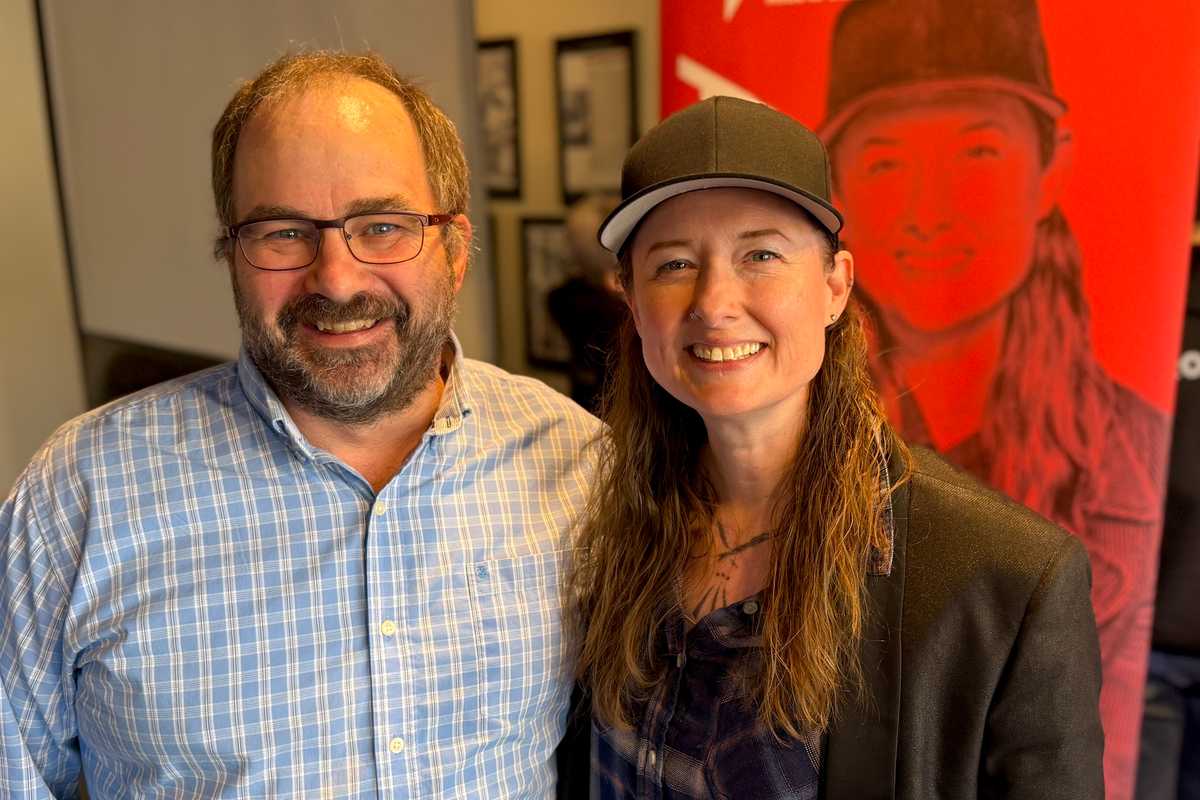

Marge Parkhurst with a collection of historic nails recovered from wall cavities during restoration work.
“At first it just looked like old paint,” said Parkhurst, who has been painting and restoring historic homes in Litchfield County for decades. “Until I realized it was a stencil, a beautiful pattern that repeated.”
She kept going carefully — a wet sponge, hot water, a little fabric softener — peeling back until she could see it clearly. A climbing vine emerged, applied in vertical runs to give the wall the look of wallpaper. Someone had signed it. The signature was faint, tucked above the baseboard in the corner, not fully legible. But the date was clear: 1870.
Parkhurst, owner of Cottage & Country Painting Co., has worked in enough old houses to develop a practiced eye for what they conceal — understanding that layers of paint, paper and plaster in a 19th-century New England home form a kind of compressed archive of the people who lived there.
The stencil bore a strong resemblance to what historians call Moses Eaton-type stenciling — a tradition of itinerant craftsmen who traveled New England in the early 1800s with portable kits of cut-pattern stencils. Their trade flourished because imported wallpaper was expensive. Stenciling offered the same visual effect at a fraction of the cost.
“These stencilers typically worked for a combination of cash, food and lodging,” Parkhurst said. “Their compensation was modest by any standard.” She paused, “He was a tradesman. But the work he left behind — that’s art.”
The vine pattern was dull with age but still legible. One section had survived intact beneath the layers of paper. The homeowners chose not to paint over it — instead building a wooden frame around it, a small window into 1870.
“Preservation means protecting something to prevent further deterioration,” she said. “Restoration means returning something to a previous state. In that room, we preserved what was there.”
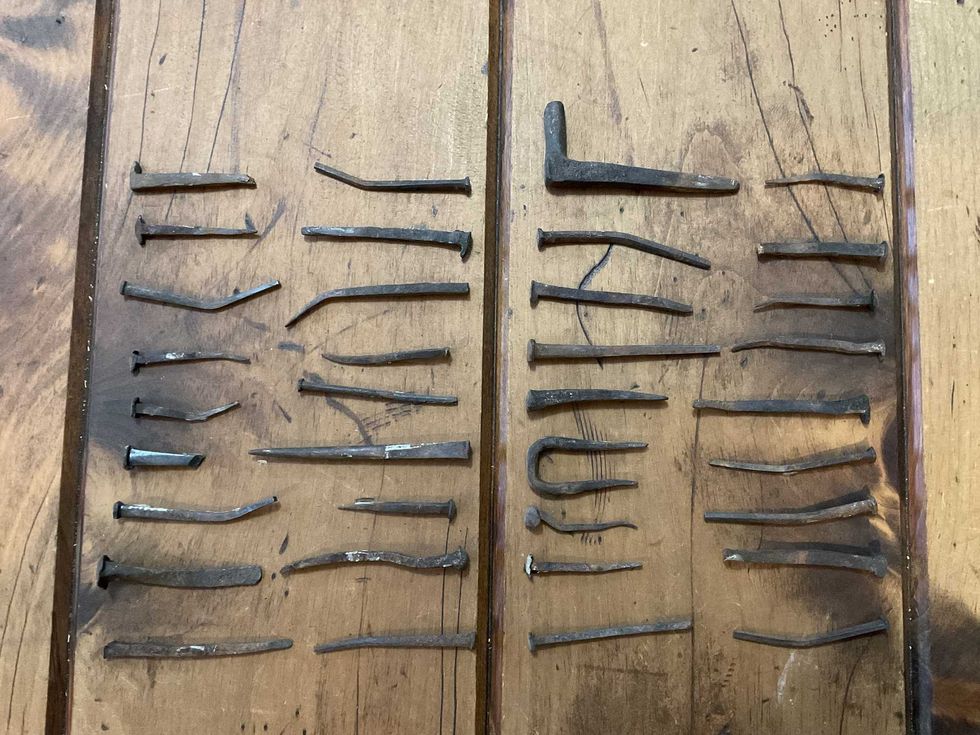 A collection of historic nails recovered during restoration work.Photo courtesy of Marge Parkhurst/Cottage & Country Painting Company
A Station’s Secrets
Not every discovery is decorative. Some are written into the bones of a building.
Parkhurst’s own home in Colebrook is a former railroad outbuilding moved from Canaan in 1920. Scraping the trim revealed it had once been sage green — and beneath that, a warm orange-brown soaked into the wood grain. “Old paint was made more like a stain back in the 1800s,” she said. “It penetrated the wood rather than sitting on top of it — so there’s never a shine.”
Up in the attic, eye bolts still anchored in the framing mark where cables stabilized the building during its move a century ago.
The most memorable find came by accident. Cutting open a wall under the stairs, she found a clear glass bottle sealed with a glass stopper held by a rusted wire. The label read: Hartmann Brewing Co., Bridgeport, Conn. It took days of careful oiling to free the stopper. Inside: a handwritten list of sandwiches and drinks, a postage stamp still attached. Not treasure. But a treasure just the same.
“I worked for days to get that thing open — and it was just somebody’s lunch order.”
Newspapers stuffed into wall cavities, hand-wrought nails, paint layers thin as stain — over 50 years, Parkhurst has cataloged the details that tell a trained eye when a house was built and by whom. Litchfield County’s architecture is unusually varied: Georgian and Federal-style houses on Litchfield’s Main Street, industrial buildings along the rivers in Torrington and Winsted. “Each town has its own fingerprint,” she said.
The most consequential mistake she sees is changing a home’s character. “When you paint over stained woodwork, you hide the details. You can’t get them back.” She has talked more than a few owners out of it. Some have listened.
Not long ago, Parkhurst and her grandchildren gathered a few small objects, wrote a letter and tucked it into a wall of her Colebrook home. Someone will find it — a record of people who were once here.
“Walls still surprise me,” she said. “If you look hard enough, you can find buried treasure.”
In a county full of houses whose walls hold untold stories — stenciled by traveling tradesmen, nailed together by farmers, papered over by housewives following the fashions — Marge Parkhurst has spent a lifetime reminding us that history doesn’t only live in museums. Sometimes it’s hiding just behind the wallpaper.
Sarah Belzer is a writer, editor and creative director whose career has crossed journalism, advertising, film and cultural commentary. Managing Editor of The American Rant and founder of Jump Advertising, she has spent three decades shaping narratives for media and national and global brands. Marge Parkhurst is the owner of Cottage & Country Painting Co. She can be reached at marge@cottageandcountryct.com or 860-379-4748.

Want more of our stories on Google? Click here to make us a Preferred Source.