Latest News
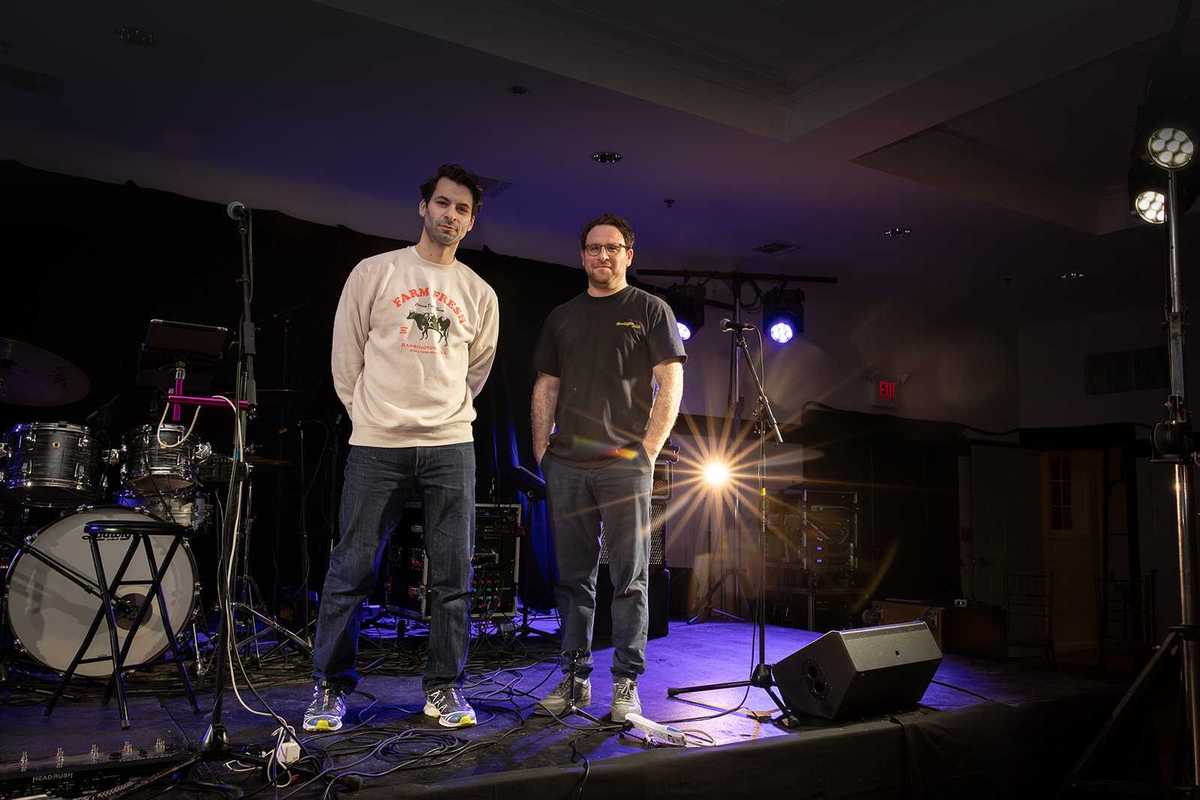
Dan Baker, left, and Daniel Latzman at Barrington Hall in Great Barrington.
Provided
The partnership behind Barrington Hall began long before the building itself. Both Baker and Latzman grew up on Long Island, spent more than a decade in New York City, and eventually found their way to the Berkshires, drawn by the desire for something different. What they didn’t realize at first was just how closely their lives had already mirrored one another.
They were born in the same hospital, a year apart. Their families had distant connections. They even played on the same soccer team — never meeting, but moving through the same spaces. It wasn’t until they became neighbors in Egremont about five years ago that those parallels came into focus.
“In hindsight, it feels inevitable,” Latzman said. “But it was actually extremely random that we ended up here.”
From the beginning, Barrington Hall was meant to be a place people return to, not for any one event, but for the experience of being there. On any given week, the space might host a jazz performance, a dance party, a songwriter circle or a children’s event. Some nights bring in touring acts. Others highlight local creatives. The variety is intentional and so is the atmosphere.
“It’s about people,” Baker said. “It’s about being present.”
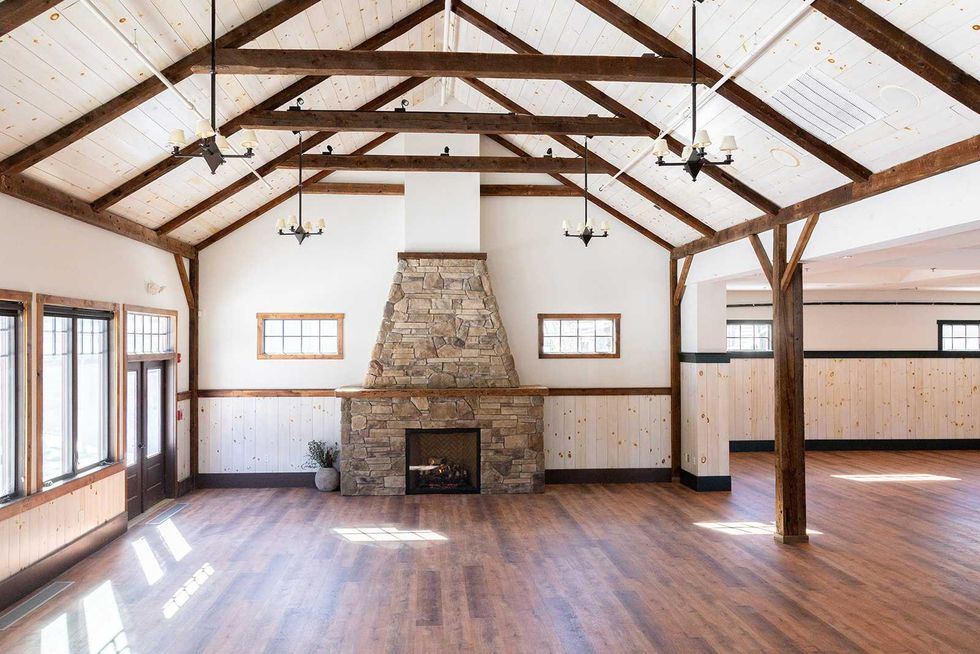 Inside Barrington Hall.Provided
Baker and Latzman are keenly aware of the world outside with its constant barrage of information, political conflicts, a culture that pulls people deeper into their screens. Barrington Hall offers a way out of that noise.
“A little bit of a bubble,” Latzman said. “A place to step away from everything else.”
During a recent event, they noticed something telling: a full room of people dancing, talking, engaged — and almost no one on their phone.
“That’s when you know something is working,” Baker said.
Taking over a beloved local space comes with responsibility, one Baker and Latzman have met by honoring the building’s traditions while also expanding them.
“We didn’t feel obligated,” Latzman said. “We felt honored.”
Part of what makes the space distinct is its versatility. Large enough to host more than 250 people, yet intimate enough to feel personal, it fills a gap in the local landscape, serving a wide range of people and bringing different groups together in the same space.
“We want people to feel like, if something’s happening here, it’s worth checking out,” Latzman said.
They are carefully balancing community access with the realities of running a business, with an eye toward the long term.
“We want this to be here in 20 years,” Latzman said.
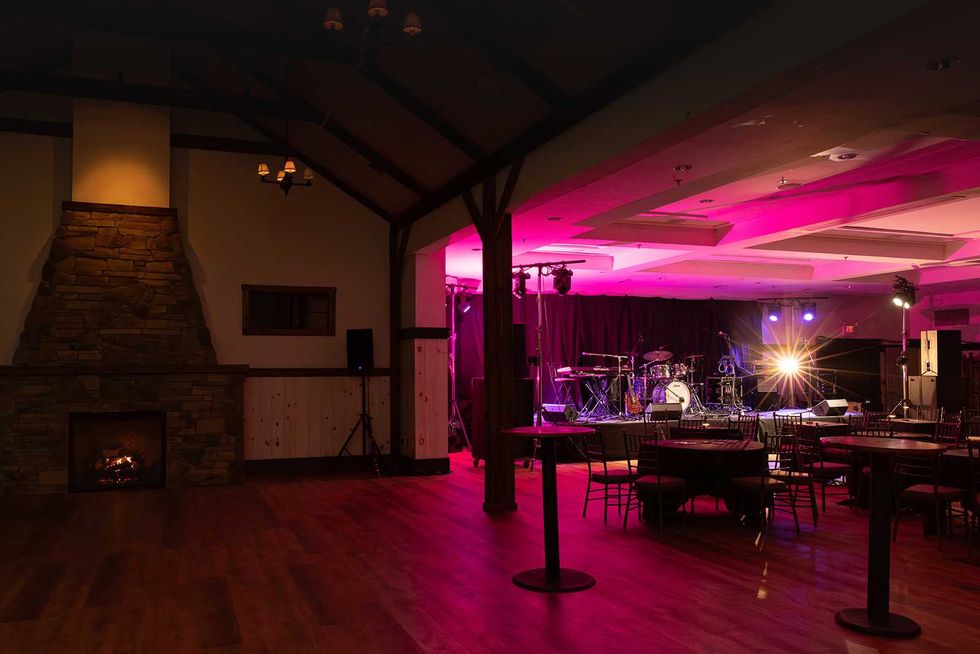 Inside Barrington Hall.Provided
That vision extends beyond the building itself — future collaborations, expanded programming, a growing role in shaping the cultural life of the Berkshires. But at its core, the mission remains simple: to create a place where people can gather, a place that feels alive.
And perhaps most importantly, to create a place where, if only for a few hours, people can step away from the noise of the world and enjoy being together.
When asked who they’re most excited to host next, their answer was immediate: The Mammals on April 10 and Lee Ross, a one-man party band from Massachusetts, scheduled to perform on May 1.
For more information and tickets, visit
barringtonhallgb.com
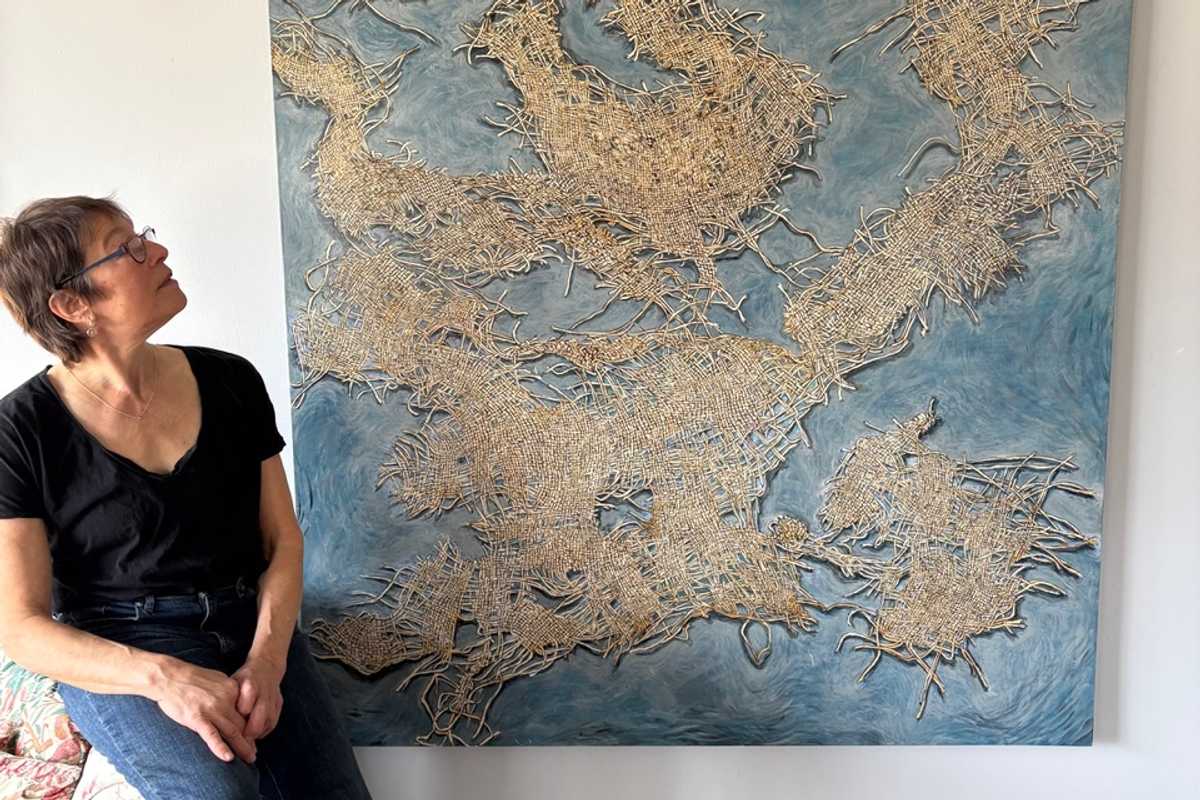
Gail Rothschild with her painting “Dead Sea Linen III (73 x 58 inches, 2024, acrylic on canvas.
Natalia Zukerman
Her work begins, often, with something small: a scrap of linen from the Judean desert, dating “to a time before the notion of ‘Israel’ or ‘Palestine;’” a fragment so diminished it barely registers as an object; or a rare indigo-dyed child’s head cloth from Tutankhamen’s tomb.
“I call them portraits of ancient linen,” she said.
Rothschild grew up in Greenwich and studied drawing and painting at Yale University. “That was kind of my first love,” she said. But she quickly veered toward something more collective, working with Peter Schumann at the Bread and Puppet Theater, building papier-mâché puppets and participating in a kind of performance-based activism that blurred art and politics.
“After Yale, I got out of school and thought‘Wait a second. I don’t want to paint anymore. I need to work with people in communities and make things.’”
She moved to Brooklyn and began working in public schools, developing projects rooted in collaboration and local history. The projects were ambitious, research-driven, and often confrontational. At the University of Massachusetts, she recalled asking students: “Did you know that Amherst was named for Jeffrey Amherst, who was responsible for giving blankets infected with smallpox to Native Americans? Why don’t we look into that?’”
There were sculptures, letters to watchdog groups, installations. She worked on four such projects a year, she said, until the pace became unsustainable. “At some point I just said, ‘I’m exhausted. I’m going back to the studio.’”
What brought her back was a book, “Prehistoric Textiles ” by Elizabeth Wayland Barber. Inside, she encountered an image of a 7,000-year-old textile, unraveling.
“It said to me, ‘this could be a great big abstract painting’,” she said. “What does it mean that this textile, this thing that used to be a Cartesian grid and over time has gone back to nature?”
That question became a kind of axis for her work. “There is this cusp between nature and culture,” she said. Early on, she avoided textiles with imagery, drawn instead to the raw language of fiber itself. But eventually, even that boundary softened. A project with the Godwin-Ternbach Museum introduced her to Egyptian textiles — Christian, pagan, Greek, Roman influences colliding in woven form.
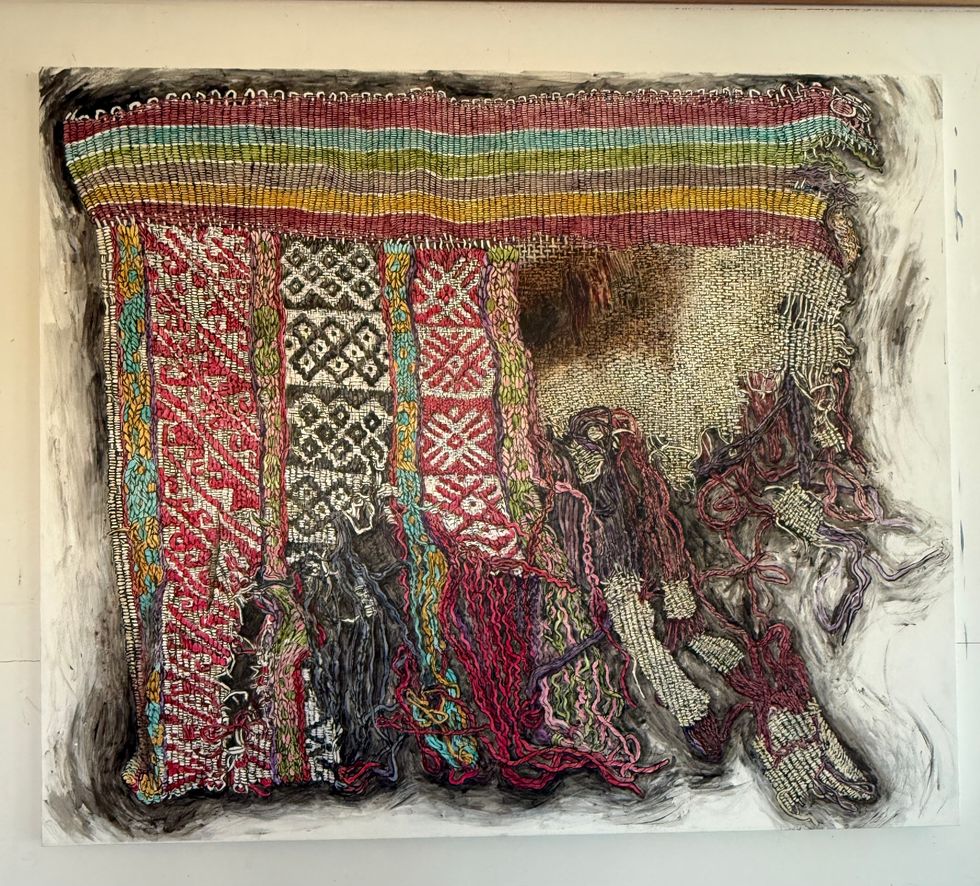 Gail Rothschild’s “Esquina Decorada” (52 x 52 inches, 2022, acrylic on canvas)Gail Rothschild
What followed was a deepening relationship with museums and, crucially, with conservators. Institutions like The Metropolitan Museum of Art and collections in Berlin and Paris began sending her images of textile fragments, sometimes pieces she has still never seen in person.
“It’s almost easier for me to transform it when I haven’t seen it,” she said.
Her process is both precise and intuitive. She grids the canvas and the source image, drawing freehand to “honor what the object is.” For a time, she works closely from the photograph. Then something shifts. “At some point I’ll say, ‘It’s a painting. It’s got to talk to itself,’ and then I stop looking at the photograph.”
What emerges is layered, luminous and muscular. “Sometimes people say, ‘Do you miss making sculpture?’ and I say, ‘I never stopped.’”
You feel that in the surfaces: the tension of threads pulling apart, the sense that something is both forming and dissolving at once. Even the backgrounds — often ambiguous, atmospheric — are not neutral. “It’s really more about feeling the space around the object,” she said, especially as she considers how ancient fragments are mounted on modern fabrics. “I get to invent an entirely other language.”
Some of her most arresting work is on the monumental textiles of The Met Cloisters, where medieval tapestries, some towering more than a dozen feet, are slowly, painstakingly conserved. It’s in the conservation labs that Rothschild has observed the physical reality of these works: their own weight pulling them apart, threads breaking under centuries of strain. Conservators insert new threads to stabilize them and Rothschild documents this process. “There’s a kind of poignancy to their work,” Rothschild said, “because as hard as we work to conserve the objects of our past, in the greater cosmic scheme of time, it’s only temporary. There’s something beautiful about that.”
Time operates on multiple levels in Rothschild’s work. There is the time of the object —thousands of years, in some cases — and the time of the painting, which unfolds over months. “Once I start working on something, I can’t stop,” she said. “But then it’ll rest for a while and I may change it, add layers.”
And then there is the time of attention itself, the way looking can tip into obsession, into pattern-seeking that doesn’t quite turn off. Rothschild is aware of that edge.
“I have to make myself stop or I just see patterns everywhere and I can’t stop, really,” she laughed. “That’s why I’ve built in other things I need to do in my life like take the dogs for a hike or, you know, volunteer at the Sharon Land Trust… otherwise I go a little nuts. And it wouldn’t be good painting either.”
A painting session, for her, has its own its own arc. “There’s kind of a trajectory for every work session. I might be repeating something and suddenly it looks linear. The language I started painting with may change by the end and I think, ‘Oh God, I’m gonna have to go back and repaint that.’”
But then, she said, there is a pause.
“I kind of step back and say, ‘No, this painting can hold both. That’s part of its history. There’s the history of the object but then there’s the history of the painting.’”

Want more of our stories on Google? Click here to make us a Preferred Source.