Latest News
Arts Connected fundraiser celebrates Northwest Connecticut’s creative community
Natalia Zukerman
Aug 12, 2026
MOMIX is one of the featured performers at this year’s Arts Connected fundraiser on Aug. 29.
Provided
The Northwest Connecticut Arts Council will celebrate the region’s vibrant arts community with Arts Connected 2026, its annual fundraising event, on Saturday, Aug. 29, from 5 to 8 p.m. at Buck’s Rock Camp in New Milford.
More than a fundraiser, Arts Connected is designed as a celebration of the artists, performers and organizations that make the Northwest Corner’s cultural landscape thrive. Guests can enjoy live music and performances, a curated gallery of artwork by regional artists, local food and drinks, and opportunities to connect with fellow arts supporters. Tickets include hors d’oeuvres, an open bar and all entertainment.

The evening will feature live plein air painting by artists from Plein Air Litchfield, performances by Our Culture Is Beautiful (OCIB), fire performer Cinderfella, and Susan Becker Aziz’s monumental humpback whale puppet, originally created for Paul Winter’s “Missa Gaia.” Guests will also have the opportunity to purchase artwork from a curated exhibition, with proceeds supporting the Arts Council’s mission to strengthen and promote the arts throughout Northwest Connecticut.
This year’s honorary host committee includes Meryl Streep, Diane von Furstenberg, Tim Daly, Téa Leoni, Maria Horn, Patti LuPone, Jack O’Brien, Sam Waterston and Paul Winter. Creative cocktail attire is encouraged, and attendance is limited. The event is open to guests 21 and older.
For more information or to purchase tickets, visit artsnwct.org
Keep ReadingShow less
At 90, artist Robert Cronin still finds new ways to paint
Robin Roraback
Aug 12, 2026
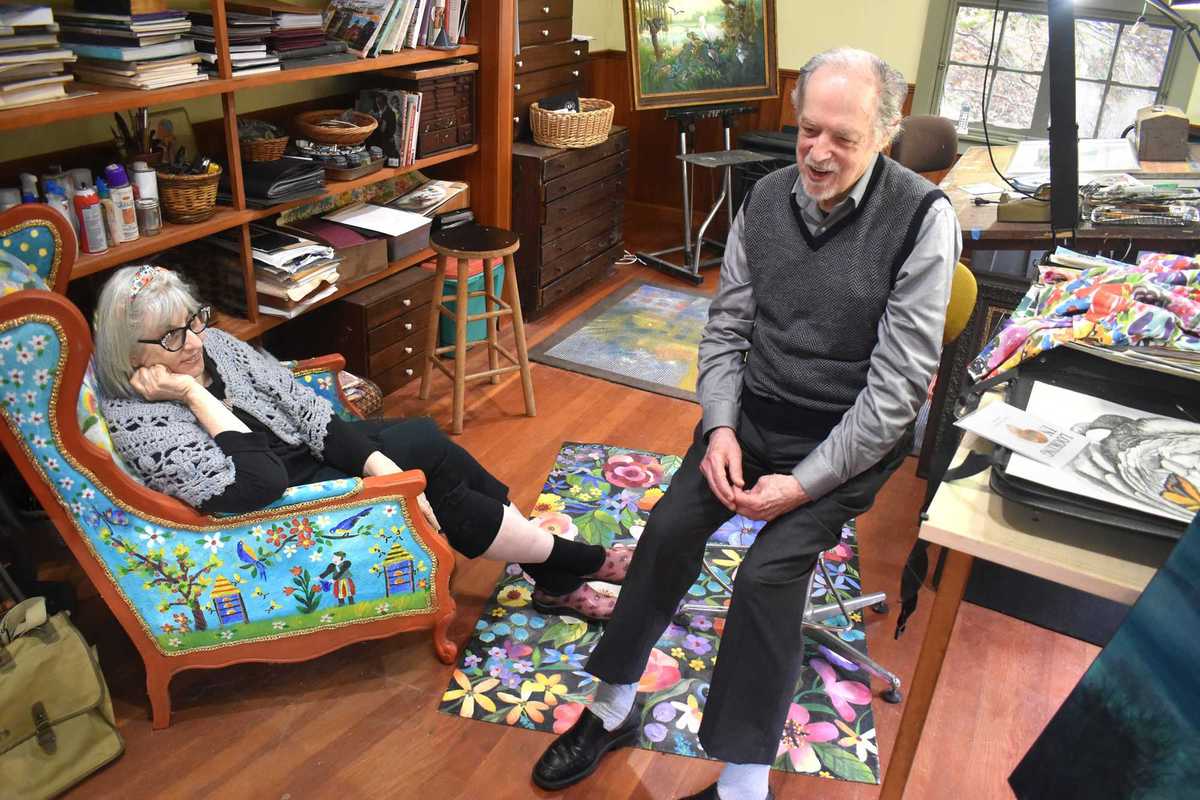
Falls Village Artist Robert Cronin describes his process, from drawing to painted canvas.
L. Tomaino
Once I get all the colors in, they change. Who knows? I might consider more radical colors and then bring it back a little.
— Robert Cronin
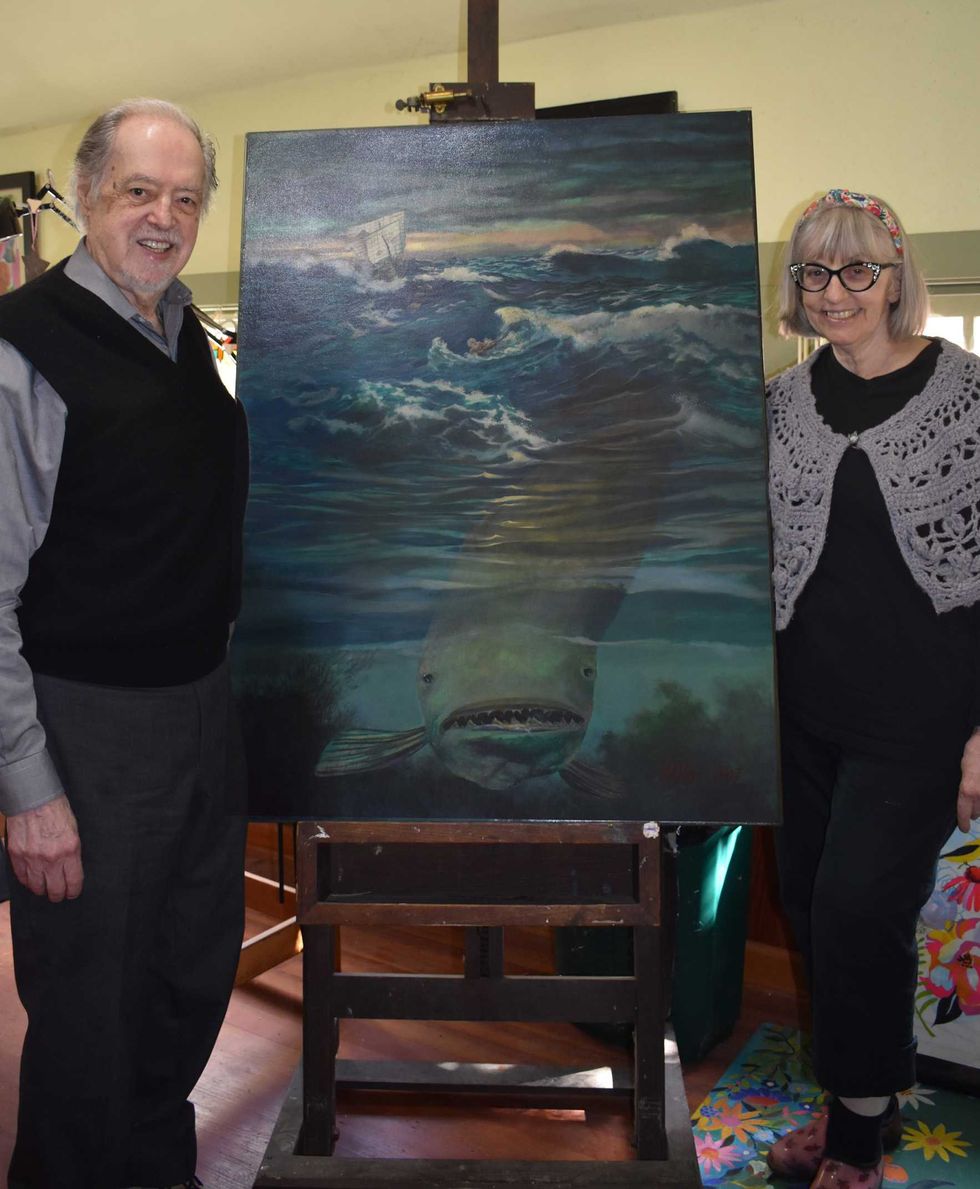
Renowned painter Robert Cronin of Falls Village celebrated his 90th birthday with an exhibition, “Robert Cronin: New Paintings,” at the Hunt Library in Falls Village which opened Aug. 8 and will be on view through Sept. 11.
Cronin paints most days in his home studio. He keeps his work fresh by trying new things and has had different phases of work, including figure paintings, paintings on paper, a modular, circle and enclosure series of paintings, as well as a tinplate sculpture series.
Cronin said he never expected to pursue art as a career. He started out at Boston College pursuing another degree but, luckily for him, flunked out and enrolled at the Rhode Island School of Design.
At first, he thought he’d pursue industrial design. But once he was immersed in drawing and painting, he realized he had a natural talent for it. “I fell in love with basic stuff. I had never owned a set of paints.” While at RISD, “In 1958, I instinctively fell into abstract work.”
After graduating from RISD and working for a time as a cleaner at Massachusetts General Hospital while painting whenever he could, he was awarded a full scholarship to an MFA program at Cornell University, along with a living stipend.
He went on to teach for 18 years at various schools, including Brown University, Bennington College and the School of the Worcester Art Museum, which he said he enjoyed the most. “I love my memory of that more than academic places. Whether Brown or a certificate program like Worcester, when you’re good, you’re good.”
After leaving Worcester in 1980, he moved to New York City to pursue his art career. He found success and exhibited his work in several galleries in New York City and around the world.
In 1990, Cronin moved to Connecticut, settling in Falls Village, where he left his tinplate sculpture phase behind and concentrated on painting again.
He explained his current approach to painting. “Everything in this show,” he said, “had a preliminary drawing. Most of my life has been starting from scratch, with no preliminary drawings.”
He makes many small sketches. “One out of 20 drawings may become a painting.” He enlarges the sketch on a copier, transfers it using a grid and paints it on a 16-by-20-inch canvas.
“Once I get all the colors in, they change. Who knows? I might consider more radical colors and then bring it back a little.”
Of starting a new painting, he said, “You don’t know what you are getting into, but it’s terrific.”
To learn more about Cronin and his work, visit robertcroninart.com.
The exhibition will be on view at Hunt Library in Falls Village through Sept. 11. Cronin will give an art talk Thursday, Aug. 13 at 5:30 p.m.
Keep ReadingShow less
All aboard the Litchfield County Clipper
Allison Gollenberg
Aug 12, 2026
The Litchfield County Clipper runs between Thomaston and Torrington.
Allison Gollenberg
Every Sunday until the end of August, passengers can ride back in time on the Litchfield County Clipper, a scenic train running between Thomaston and Torrington on the county’s only passenger rail line.
The train, operated by the Railroad Museum of New England and the Naugatuck Railroad, follows the Naugatuck River through Mattatuck State Forest and along the Thomaston Dam, making it the only railroad in the country that operates over the face of an active dam. For $26.50 passengers can ride all day, boarding or disembarking at any of the train’s three stops, which include two stops in Torrington and one in Thomaston.
Scott Becker, chair of the Celebrate 30 Committee at the Railroad Museum of New England, said he hopes the project increases local tourism and helps people appreciate the cities as they have in the past.
“The railroad is not just a tourist railroad or heritage railroad. It links the two towns, just like it did in 1849, 177 years ago,” Becker said. “History is repeating itself. The railroad was always an economic development generator.”
In Torrington, there are stops at Market Street Creatives, an artisan market housing 230 vendors, and the newly restored Railroad Square, a short walk from the city’s downtown. Some local businesses offer passengers discounts if they bring their ticket.
Market Street Creatives opened in August 2025, in the building that housed Turner and Seymour Manufacturing Co. from 1870-2009. Owner Eric Royer wanted to create a space that gave small businesses a chance to showcase their work without expensive, long-term rental commitments.
“I had a big manufacturing company in town. I just got tired of it,” Royer said, “When I turned 50, I decided I wanted to start a business that was going to make a difference locally, in our community. I wanted to be able to help small businesses start and grow.”
The market recently partnered with the railroad museum, even programming and installing its own departures board to keep visitors apprised of the train’s whereabouts. Royer said it’s brought in a good bit of business.
“It brings in a couple hundred people over the weekend,” Royer said. “No other vendor market around that I know of has train access.”
Railroad Museum of New England Board of Trustees Vice President and Volunteer Coordinator Craig Czarsty said planning for the Litchfield County Clipper started back in December and was inspired by the revitalization projects happening in Torrington.
Today, the railroad offers scenic excursions, but for more than a century after opening in 1849, it was a vital transportation corridor, carrying passengers, mail and freight. The line stretched from Bridgeport to Winsted and even offered express service to New York City. Clock manufacturers, including Seth Thomas, relied on the railroad to ship their products.
“One of the things that’s fascinating to me is that more clocks were made in the Naugatuck Valley than anywhere else,” Becker said, referring to Thomas’ company, Ansonia Clock Company and Waterbury Clock Company. “You had all these clock companies, and they had to get their clocks to market, and the railroad was central to the whole thing.”
All that came to an end in 1955, though, after hurricanes Connie and Diane flooded much of the region. The floods wiped out sections of the railroad, destroyed factories and washed away the local manufacturing industry.
“That’s why they built Thomaston Dam, so that if they had future storms, they’d be able to keep the storm surge from going down the river into those towns,” Becker said. “It’s interesting, the river brought life to the area for manufacturing, but also, when the hurricane came, it caused a lot of devastation. Hurricanes really ripped the heart out of Connecticut’s manufacturing.”
Becker, who’s been involved with the museum since 1984, has seen the Thomaston station grow from a burnt-out building beside an overpass to the scenic attraction it is today.
Passenger service to the Thomaston station ended in 1958, and the building had various uses before being partially destroyed by arson in 1993. The museum purchased and restored it in 1996 and 1997.
The museum runs various seasonal trains, including an autumn colors train, a holiday train and a tequila train, which Czarsty said is very popular. Last year, he said, their holiday trains saw 27,000 visitors in about a month.
While the Naugatuck Railroad’s employees restore and maintain the trains, the museum is a nonprofit and train service is run entirely by volunteers.
On Sept. 26, the museum will celebrate 30 years in Thomaston, operating special trains all weekend in commemoration, including a newly restored locomotive from the New Haven Railroad. Becker said the past 30 years wouldn’t have been possible without volunteer and community support. It’s expensive to run a rail line, Czarsty said, and fundraising keeps it all chugging.
For more information and train schedules, visit rmne.org/excursions/countyclipper
Keep ReadingShow less

Want more of our stories on Google? Click here to make us a Preferred Source.
Grief, madness and great views—Hudson Valley Shakespeare’s ‘King Lear’ is a sight to behold
Alec Linden
Aug 12, 2026
The pavilion-style theater at Hudson Valley Shakespeare.
Alec Linden
Theater works by transforming a stage. But can it transform a landscape?
Hudson Valley Shakespeare, which this summer debuted its 6,800-square-foot, 451-seat open-air Samuel H. Scripps Theater in Garrison, says yes.
During a recent performance of “King Lear” on a spectacular July evening, actors materialized from and faded into the stunning backdrop as if it were no longer the Hudson Highlands, but the wild hills and dales of Celtic Britain.
The company opened its satisfyingly direct rendition of Shakespeare’s dark and expansive meditation on love, family and human nature on June 12, and will run the show through Sept 17.
A much lighter Shakespeare classic, “As You Like It,” is also running through Sept. 18, as is the non-Shakespearean late-20th-century classic “Les Misérables,” which runs until Sept. 28.
In “King Lear,” the audience was not so much transported as localized by the performance, which takes place on the floor-level stage and expansive lawn behind it, both of which boast one of the best views lower New York State has to offer.

The pavilion-style theater, with naturalistic curves and a low profile, mirrors the topography of the prominent hill it sits atop. The landscape that frames it all, centered on the dramatic passage of the Hudson River as it meanders between peaks of Storm King Mountain and Breakneck Ridge, serves not just as a background, but as a living, breathing part of the action as Lear and his kingdom descend into madness. When darkness fell across the ridges in the distance, the body count rose.
It’s not all doom and gloom at Hudson Valley Shakespeare, though. Just hours before the murders and betrayals, the same lawn hosted dozens of happy picnickers enjoying the evening in true high-summer fashion, complete with live music. As is tradition at the theater, which was previously hosted at nearby Boscobel House and Gardens for 34 years under a tent, guests are invited to arrive early and enjoy the grounds with a meal.
For those who’d rather not pack their own food, pre-made picnic sets are available for advance order. Alternatively, theatergoers can dine at the expansive, regionally-sourced buffet offered at the venue’s restaurant, aptly named Folio ($35 for adults, $25 for children 5-12 and free for children under five).
For schedules, tickets and more information, visit hvshakespeare.org.
Keep ReadingShow less
Skip Fredericksen and the magic of giving
D.H. Callahan
Aug 12, 2026
Skip “Whitecap” Fredericksen at his trail magic setup in Sharon. Whitecap keeps a log of the thru-hikers who stop for refreshments.
D.H. Callahan
You could be having a really rotten day, and there are a lot them, cause it can feel like the trail is just there to beat you down. But you turn a corner and find somebody who’s passing out free food, and it brightens your whole outlook.
— Skip “Whitecap” Fredericksen
Across the 2,190 miles of the Appalachian Trail, there are wondrous sights to behold, incredible friendships to make and experiences that have the potential to shape the lives of the young adventurers who take on the challenge. And every so often on that fabled path, thru-hikers encounter something called trail magic.
At its essence, trail magic is the practice of local residents along the trail supplying free goods and treats for weary travelers who might not have access to more frivolous creature comforts. Skip Fredericksen, or “Whitecap,” as he’s known on the trail, wants to make Connecticut the Trail Magic state.
Since 2022, Whitecap has been a volunteer with the Appalachian Mountain Club, clearing downed trees and other debris from his designated section of trail. It’s an assignment that’s proving particularly challenging this year, with the Northwest Corner’s Fourth of July storm requiring an estimated 130 hours of sawing alone. But Whitecap doesn’t let persistent obstacles get in the way of his role. In fact, he sees the increased challenges as a reason to give more. And Whitecap knows a thing or two about challenges.
In 2021, at the age of 67, Whitecap and his two daughters, whose trailnames are Nocs and Zazu, hiked the entire Appalachian Trail together, from Georgia to Maine. As a senior hiker, Whitecap faced obstacles with a patience and grace that weren’t required of the younger, faster kids. It was early in their journey when Whitecap first felt the power of trail magic for himself.
“You could be having a really rotten day, and there are a lot them, cause it can feel like the trail is just there to beat you down. But you turn a corner and find somebody who’s passing out free food, and it brightens your whole outlook.”

Throughout his 2021 hike, Whitecap encountered countless run-ins with trail magic, including a couple of men who hiked out to a campsite far from the nearest road carrying a big camp stove and enough hot food to feed several tired thru-hikers. People have set up RVs with phone charging stations and flush toilets, while others bring homemade cookies and granola bars in individual baggies to pass out on day hikes. No matter the method, the act of giving is always magic.
A year after his 205-day hike, he and Zazu decided to give back to the trail. They set up tables and chairs at an AT road crossing in Sharon and laid out bags of chips, fruit, water, Gatorade and a little camp stove to make hot dogs and veggie dogs for exhausted hikers. Though his offerings are carefully considered, he knows full well that the specifics are secondary.
“It doesn’t even matter what the food is,” he said. “It’s the kindness of people who really care about the hikers, and that’s what makes the difference.”
You might think trail maintenance and trail magic would be enough of a tribute to the challenges and community of the Appalachian Trail, but Whitecap doesn’t stop there. He’s turned his love of the trail into a musical slideshow performance, with tongue-in-cheek songs about his journey set to musical classics. He calls it “AT: The Musical.” It’s just another way he’s spreading the gospel of kindness and nature throughout Connecticut.
Get a preview of “AT: The Musical” at bit.ly/4wEb09v
Keep ReadingShow less
Books, dinner and thoughtful dialogue at literary salon at Swyft
D.H. Callahan
Aug 12, 2026
A full table at House of Books’ Salon at Swyft in Kent.
D.H. Callahan
The act of sitting down with like-minded individuals to share food, and talk with each other is at once calming.
Fiction is a funny thing. There are so many ways to interpret how an author built a story, or what the meanings are behind characters, events and specific word choices. Even a novel’s title and dust jacket can garner pages of comments in online forums and book clubs.
If you’re lucky, every once in a while, you might get the opportunity to sit in on a discussion between an author and a scholar about a specific book, or even a body of work. The House of Books in Kent hosts author events on a regular basis, but the store manager Benjamin Rybeck finds value in more intimate conversations so in 2022, he started the Salon Series at Swyft.
The series is based on the 19th-century tradition of the artistic and academic salons, which were seen as cultural hubs for the upper echelons of society. There, writers, artists, dancers, musicians and actors would gather in intimate settings, often the parlors of the wealthy and aristocratic patrons. While House of Books isn’t exactly equipped for such an event, the restaurant it is affiliated with, Swyft, certainly is. Known throughout the region as being one of the most consistently delicious and innovative restaurants, Swyft shares a common owner with House of Books, making for some seamless collaborations.

After pausing for a few years, Rybeck believed the time was right to revive the series, so he invited Hannah Lillith Assadi, author of the new novel “Paradiso 17,” for the first Salon of the season. The novel is based on the story of her late father’s life, beginning with his family’s expulsion after the Nakba of 1948.
Israeli-Palestinian relations are a particularly sensitive subject these days, often leading to passionate arguments between opposing sides. But the well-read literature enthusiasts at the salon weren’t interested in the politics of the book so much as they were the art of it. Over a family-style dinner of fresh salads, pizza and specialty cocktails, the conversation was surprisingly civil and curious. The group discussed structure and narrative, sense of place and the feeling of transience.
The whole evening was a wonderfully refreshing departure from the vitriolic divisiveness of today’s online discourse. While the anonymity of the internet can frequently lead to heated rhetoric, the act of sitting down with like-minded individuals to share food, and talk with each other seems to do the exact opposite. It’s at once calming, intellectually satisfying and culinarily enriching.
The next Salon on Aug. 27 will feature Natasha Stagg, author of the new novel “Grand Rapids,” and painter Sam McKinniss, whose art is featured on the book’s cover.
Keep ReadingShow less

Want more of our stories on Google? Click here to make us a Preferred Source.
loading