SALISBURY — Austin “Mac” Francis warned the audience at the Scoville Memorial Library that they were heading into dangerous waters.“Fly-fishing is a dangerous sport,” he said sternly. “You should be aware that you may become ... addicted.”Francis, author of “Catskill Rivers” and “Land of Little Rivers,” covered theory, practice and history during his 45-minute talk Saturday, April 30. He explained the difference between fly-casting and other angling methods. Unlike a spinning rod, where the weight of the lure carries it to the desired location, fly-casting relies on the weight of the line to deliver the almost weightless fly. “Try throwing a feather,” he said cryptically.“There’s a power stroke to the front and the rear” in fly-casting, he explained. “In golf, tennis and baseball, the power stroke only goes forward.He described learning to cast as “a combination of initiation fee and dues.”Even a cursory look at fly-fishermen in the Housatonic River will show the layman the hold that casting has on anglers — some of whom go on to participate in distance casting competitions with equipment that really isn’t designed for, well, fishing.“Some people spend so much time casting they forget to fish.” This gentle rebuke was delivered with a smile.Francis demonstrated with a gizmo designed for practicing indoors — about three feet of an old rod with a long piece of thick yarn attached. (It was apparent to the anglers in the audience what he was doing, but to the uninitiated it must have looked a little odd.)Francis traced the development of fly fishing from England to the U.S. The English chalk streams, relatively young rivers at 40 to 160 million years old, meander slowly over a layer of chalk formed from eons of prehistoric critters.The chalk “acts as a giant sponge” and ensures constant flows and temperatures — about 50 degrees F — that are ideal for bugs and the trout that feed on them.An angler on these streams must do a lot of creeping, but the trout “are almost lazy” because of the abundance of insect life.Frederick Halford developed dry fly-fishing on the chalk streams in the late 19th century. A dry fly floats on the surface and, as Francis noted, is popular with fishermen because it’s the most exciting way to catch a fish.Paraphrasing an American fishing writer, John McDonald, Francis said the allure of the dry fly is due to the fact that “all the moves in the game are visible” — the cast, the float, the anticipation and the strike. (Or the refusal.)Alas, trout take about 80 percent of their meals below the surface. Of the dry fly enthusiast, Francis said, “Sometimes the angler becomes kind of an idealist. You should try not to be so seduced by the dry fly.”American Theodore Gordon read Halford’s work and the two corresponded — most notably in the famous Halford Letter of 1890, in which Halford enclosed 50 flies for Gordon’s benefit. (The letter, with the flies, is owned by the Angler’s Club of New York City.)“British insects differ from American insects,” Francis said. “It’s the difference between chalk streams and freestone.”Gordon redesigned Halford’s patterns to imitate American bugs and “to float on our turbulent streams.”Citing McDonald again, Francis said with the arrival of the Halford Letter “the dry fly winged its way to the New World.”Gordon experimented with his flies in the Neversink, Beaverkill and Willowemoc rivers, and thus the Catskills are considered the birthplace of American fly-fishing, Francis said.His slide show included spectacular photographs from New Zealand of impossibly fat rainbow and brown trout — and a grouchy Maori who gave Francis’ group (who had arrived by helicopter) a hard time until he was satisfied with their bona fides on the tribal land. (He subsequently became a good friend.)And then there was Bob Jacklin’s 10-pound brown trout, caught on an inchworm imitation on the Madison River in Montana. In the photo, Jacklin, a boss fisherman who runs a tackle shop in West Yellowstone, is communing with a gigantic brown trout. Francis said a television crew had been filming Jacklin all day, with middling results. They were just packing it in when Jacklin chucked the inchworm fly — about an inch and a half of lime-green material on a size 14 hook — into the seam between slow and fast-moving water.Francis said it took Jacklin 45 minutes to land the fish. “He couldn’t horse it because he was using very fine tackle.“Bob Jacklin probably never kept a fish in his life before this one. It’s on his wall now.”
Latest News

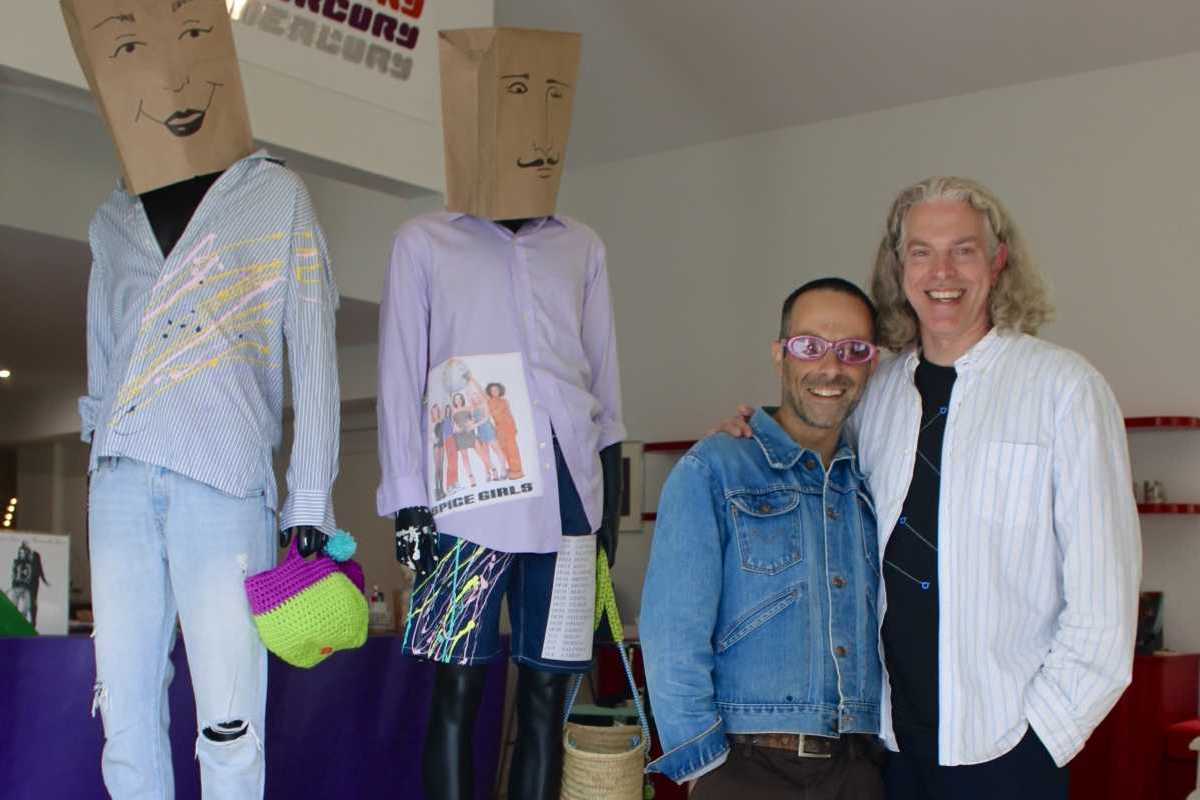
Greg Fricke and James Boehmer, co-owners of Peggy Mercury in Kent, recently launched their first fashion line, “Imaginary Concerts.”
Provided
Fricke and Boehmer are not there to stock their shelves with the same products customers find at standard makeup retailers. They’re there to help customers find what works for them. That usually means asking customers about themselves and learning about their beauty habits, skin, style and the way they like to present themselves. Fricke and Boehmer believe it’s their job to help customers bring out the qualities that suit them and determine what works best for their look.
So much of the Peggy Mercury world is about emboldening people to become more creative, and possibly bolder, versions of themselves. Some of this comes through the store’s creative collaborations with artists, designers and stylists.
It’s part of an ethos that encourages them and their friends to use the shop as a kind of laboratory, trying out new creative experiments without knowing how they might turn out. Whether in fashion, painting, fiber arts or photography, the projects almost always turn out marvelously.
A line of sterling silver charms they sell started as a small project by their friend Nolan Percival. In the beginning, the pieces were for close friends and loved ones. But Boehmer and Fricke encouraged Percival to get a little more serious about the project and create a whole line for the store. Today, it’s one of their top-selling collections.
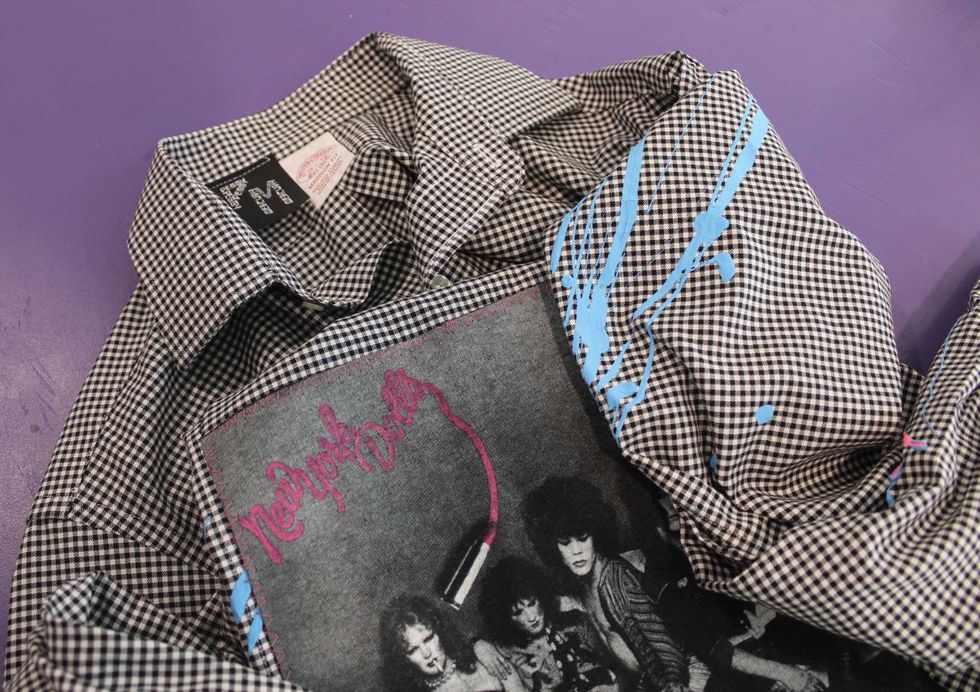 Classic styles, bold colors, and creative concerts make up the “Imaginary Concerts” line at Peggy Mercury.Provided
“Imaginary Concerts” has the duo taking their own advice.
The project started as a way for Boehmer to connect with his mother, who had been diagnosed with Alzheimer’s disease. Taking old concert shirts from his own collection, Boehmer and his mother began cutting out the graphics with the idea that they would make a quilt together. Unfortunately, she died before they could complete the project in 2025. The pieces, which were ready for production, were put on the back burner as Boehmer and Fricke dealt with their loss and the whirlwind of projects that never seemed to cease at Peggy Mercury.
But the harsh winter of 2026 presented an opportunity to take some time and focus on themselves. Part of that meant revisiting and redefining the concert T-shirt project. This time, instead of looking to the warmth and comfort of a quilt, they turned to another passion — fashion.
Taking a page from their own book, they wanted to create something that felt comfortable to them. They took two disparate loves — one rooted in simple preppy style, with clean lines and classic silhouettes, and the other in the nitty gritty worlds of punk rock and pop — and blended them together to create something entirely new. Pulling from the staples of vintage Brooks Brothers and Charvet collections, they applied the graphic elements with bold stitching reminiscent of punk jackets of the ‘70s and ‘80s, but with a much more sophisticated air.
But the remixing isn’t just the pairing of prep and punk. The pieces are not canon. They take liberties with the realities of concert tours, combining one band’s dates with another band’s logos, mixing them all up until the reality is lost and imagination is the only truth.
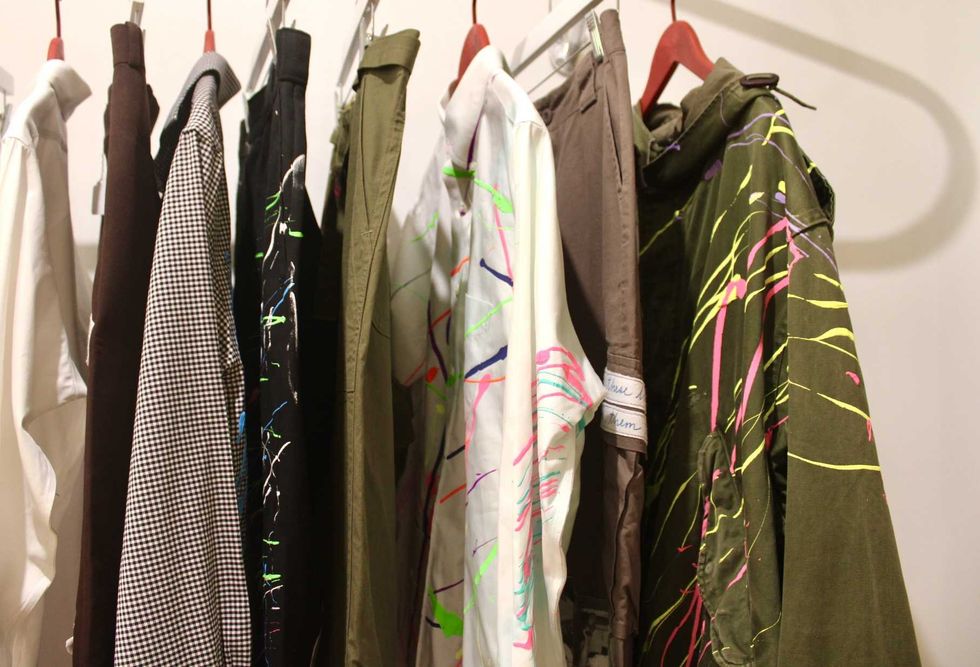 Shirts from Peggy Mercury’s first fashion line, “Imaginary Concerts,” hang on display.Provided
Adding to the mix is an element of perpetual creativity. Art can be messy, both figuratively and literally, and many of Fricke and Boehmer’s artist friends carry evidence of their work on them at all times. As a nod to these tireless creatives, the duo added haphazard splashes of bright color, giving the line an even more distinctive feel.
For them, “Imaginary Concerts” passes the “Peggy Test.” The mythical Peggy Mercury is a fictional figurehead for the company, a character who thrives on creativity and change. The name, much like the clothing line, is a mixture of interests: Mercury is a planet, a deity and an elusive, transformative element, while Peggy is the wonderfully stylish and boundary-pushing Peggy Guggenheim.
Everything Fricke and Boehmer put in their store has to pass this test: Would Peggy Mercury approve? For their first collection, the answer is a resounding yes.
Peggy Mercury is at 9 Maple St., Unit 2, Kent.


Want more of our stories on Google? Click here to make us a Preferred Source.