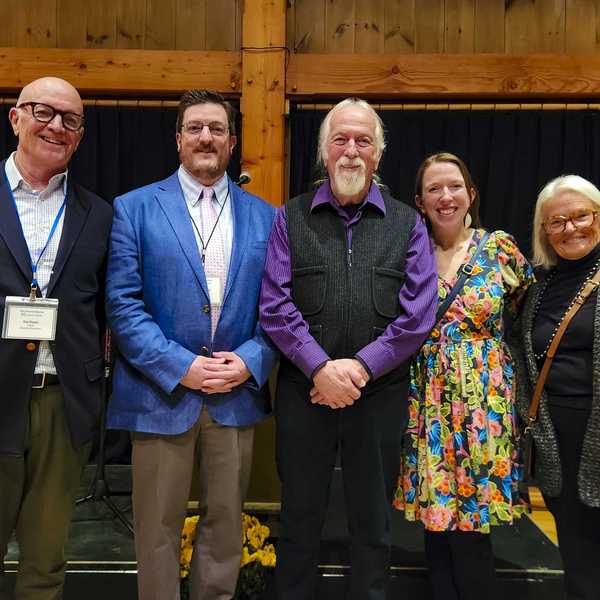
SALISBURY — Author David Levinson visited the Scoville Memorial Library Saturday, Feb. 18, to tell the story of Mumbet, or Elizabeth Freeman, a slave who won her freedom, whose court case was critical in ending slavery in Massachusetts and who went on to become indispensable to one of the most influential families in New England.
Levinson’s talk was part of the Salisbury Association Historical Society’s series. Levinson, along with Emilie S. Piper, wrote “One Minute a Free Woman: Elizabeth Freeman and the Struggle for Freedom.” The book was published in 2010 by the Upper Housatonic Valley National Heritage Area/African American Heritage Trail.
Levinson said Freeman’s story is unique for an African-American woman of the time. She lived through three distinct social, economic and political situations: slavery, servitude (politically but not economically free) and freedom.
“She was important because she became a role model,” Levinson said. “She was known as an upright citizen that everyone knew and could count on in Stockbridge and Sheffield.”
Levinson said the goal for the book was to tell the Mumbet story as accurately as possible — not an easy task, as Freeman left no written records of her life except an “X” on her will.
“The task was to tell the story based on other people’s accounts,” Levinson said.
He said he and Piper resisted the urge to fill in the gaps. “It’s not a novel. There is some guessing, and we subsequently discovered we got a couple of things wrong, which is what happens when you guess.”
The 1781 court case, Brom and Bett v. Ashley, and the story of Mumbet standing up to armed rebels during Shays’ Rebellion are sufficiently well-known that the authors put them to the side, Levinson said.
Her early life
Freeman was probably born in 1740 in Claverack, N.Y., the daughter of slaves belonging to a wealthy Dutchman, Pieter Hogeboom. Levinson said Hogeboom had at least 10 slaves, and when his daughter Hannah married John Ashley of Sheffield, Mass., the teenaged Freeman (known then as Bett) went with her.
Levinson said slavery under Dutch owners was considered harsher, and the Dutch when they died did not free their slaves, as English settlers often did.
Arriving in Sheffield, Levinson said, Bett probably spoke Dutch.
Ashley was the wealthiest man in the area, with more than 2,000 acres of land and diverse business interests. He had five slaves; Bett worked in the house, cooking, cleaning and serving.
Not surprisingly, Ashley was also politically well-connected, and the story has it Bett, listening to conversations about the new Massachusetts constitution, which contained the phrase “all men are created equal,” began to formulate the idea of suing for her freedom.
A wish for freedom
Bett had a daughter around 1775. Levinson said the father might have been the male slave Brom, later a fellow plaintiff in the freedom lawsuit, but added that slaves at that time generally did not formally marry, with common-law marriages being the norm, or no marriage at all.
In any event, in 1781 Bett decided she’d had enough of slavery, Levinson said.
“She took it on herself to go to the law office of Theodore Sedgwick [in Sheffield]. She sued for her freedom in Great Barrington [where the court was] and the jury found in her favor.
“We think the situation was set up by Sedgwick and Ashley, who were both members of the legislature. Sedgwick thought slavery was disruptive to the future union. There is no record of Ashley’s thoughts on the matter, but he was a businessman. It was more economical to have hired help than slaves, and his agricultural operation was not dependent on slave labor — he had white tenant farmers.”
There had been several legal attempts to end slavery, but Brom and Bett v. Ashley was unique in invoking the state constitution, Levinson said. By 1783 slavery was over in Massachusetts, and an African-American community formed in Sheffield, with people coming from other states.
“The only record of the case is the jury finding, so how Sedgwick argued it is unknown,” Levinson said.
A woman in the audience asked about the story that Hannah Ashley was about to use a red-hot iron implement on Bett’s daughter, when Bett intervened, and that was the catalyst for Bett’s meeting with Sedgwick.
“We took a hard look at that story,” Levinson said.
He and Piper found that Hannah Ashley certainly had a cruel streak, tried to strike the daughter and Bett took the blow.
“But as far as being a last straw, it happened at least a year before going to Sedgwick.”
Levinson said there were contant battles within the household. A woman on the run from an abusive husband was turned away by Hannah Ashley, but Freeman went over her head to John Ashley, who assisted the woman.
Levinson said the idea of a fed-up Bett marching a long distance to the lawyer is overblown. Bett regularly either walked or rode a horse to Sheffield’s town center.
Bett also developed a following as midwife and nurse, Levinson said. In 1775 there is a record of her nursing a man with typhoid fever in North Canaan. Bett knew about medicinal plants, and her status as what would today be called a nurse practitioner was not unusual among female slaves, whose knowledge was passed along through the generations.
After winning her freedom, Bett, who took the name Elizabeth Freeman, went to live with the Sedgwicks, who moved in 1785 from a modest home in Sheffield to a mansion in Stockbridge.
Sedgwick was now politically powerful — a member of the state legislature, a U.S.congressman and senator, a judge and the fifth speaker of U.S. House of Representatives.
“There are letters from George Washington,” in the Sedgwick Papers, Levinson said.
Sedgwick spent much of the year away from Stockbridge. “Sedgwick was no fool. From 1790 to 1802 he was only home from spring to fall,” the historian said.
“Reading his letters to his children, we were struck by how caring he was.”
Bett becomes Mumbet
The Sedgwicks had 10 children of whom seven survived to adulthood. The household took its toll on Pamela Sedgwick.
“Pamela was not up to the task,” said Levinson. The long cold winters and isolation caused a profound depression, and she was institutionalized three times. She couldn’t run the house, which fell to Freeman, who also raised, effectively, the youngest children. This period is when the name Mumbet evolved.
Catharine Sedgwick wrote that Mumbet was the only one of her mother’s friends who could deal with her “states.” Treatment at the time consisted of locking the afflicted person in her bedroom.
Levinson told another story that illustrated how critical Mumbet was to the Sedgwick family. When Charles Sedgwick was born in 1790 he was sickly and weak. Theodore was ready to write the infant off, but Mumbet asked for three months, and nursed the child to health. In gratitude, Theodore Sedgwick gave Mumbet a $5 gold piece — a small fortune at the time — which she still had when she died.
To give an idea of the status Mumbet enjoyed in the Sedgwick family, an 1825 letter from Charles Sedgwick, now an attorney, to his wife mentions that Mumbet had spent a week visiting. “She was vacationing in Lenox.”
Mumbet was also close to Catharine Sedgwick, who was one of the best-known authors of the 19th century and a contemporary of Cooper, Bryant, Hawthorne and Melville. Critics rediscovered beginning in the 1950s and now credit her with being an important part of the development of an American literature. Catharine Sedgwick wrote from the point of view of white settlers — and of the Indians they displaced. She incorporated aspects of Mumbet’s life into her novels and wrote directly about Mumbet in “Slavery in New England” in 1853.
Levinson said that as the children grew up and left, Mumbet kept on with her midwifery and “seemed to want to get out of the Sedgwick house.”
In 1807 Pamela Sedgwick died; Levinson said there was some speculation that Mumbet helped her commit suicide. Theodore remarried, and the children all disliked their new stepmother.
“We assumed Mumbet felt the same way,” Levinson said. In 1803 she had bought a small parcel of land and a house for her daughter and her family; Mumbet joined them in the small African-American neighborhood. Eventually Mumbet had 20 acres, a house and a barn, but it was still subsistence farming and a rough life.
“The Freeman house is gone now; Catharine Sedgwick describes it as a hut, but most houses would look like that to her,” Levinson said.
Shays’ Rebellion
When Freeman died in 1829 she left three apple trees, cows, 20 acres, the house and barn, $300 cash and no debt.
Which gets us to the Shays’ Rebellion story.
In 1786-87 an insurrection broke out in central and western Massachusetts, called Shays’ Rebellion after Daniel Shays, a farmer and Revolutionary War veteran who found himself in court after the war, unable to pay his debts. This was a common problem among small farmers, and they organized for debt relief. There was some violence, and the authorities took steps.
So feelings were running high, and most of the Sedgwicks — an obvious target for the rebels — got out of town. But Mumbet, one Sedgwick child and the servants were left behind, and when the rebels came she “ran them off.”
“She was really working against her own interests, because the high taxes worked against black farmers too,” said Levinson.
Levinson said Mumbet left her property in trust for her daughter, Betsy, and Betsy’s two children because she felt Betsy was unreliable. But within 10 years the property was sold — Levinson said he is not sure why. By 1860 all the descendants of Freeman had left western Massachusetts for Connecticut — Norfolk, Hartford, and points farther south.
Freeman is buried in the Sedgwick “pie” — a circular family burial plot in Stockbridge —with the same level of prominence as the Sedgwick children.
She was independent to the last. Levinson said the family, hoping for a deathbed conversion, sent the Unitarian minister in to see her.
“She said it was between her and God.”

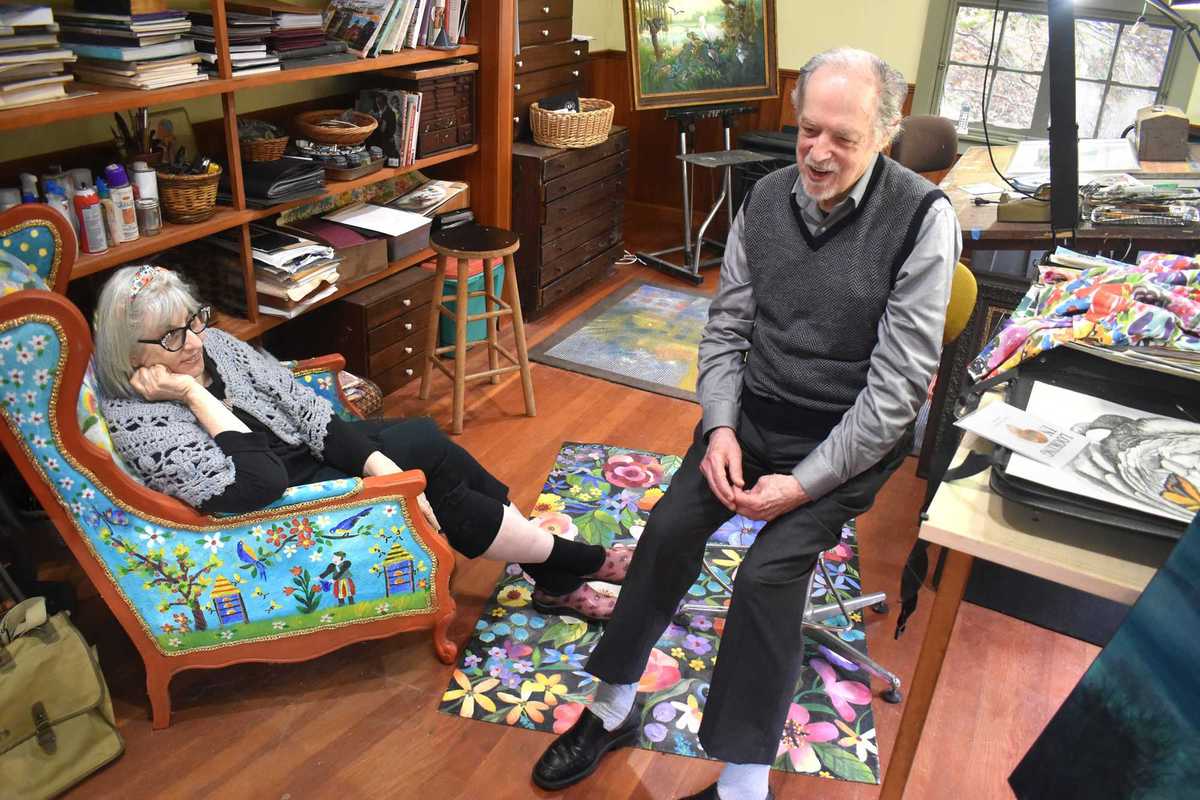
 Justine and Victor Valla in their studio with a painting of Victor’s,”Jonah and the Whale.” Robin Roraback


 A ceramic vase by Kathleen Heidemann.Provided
 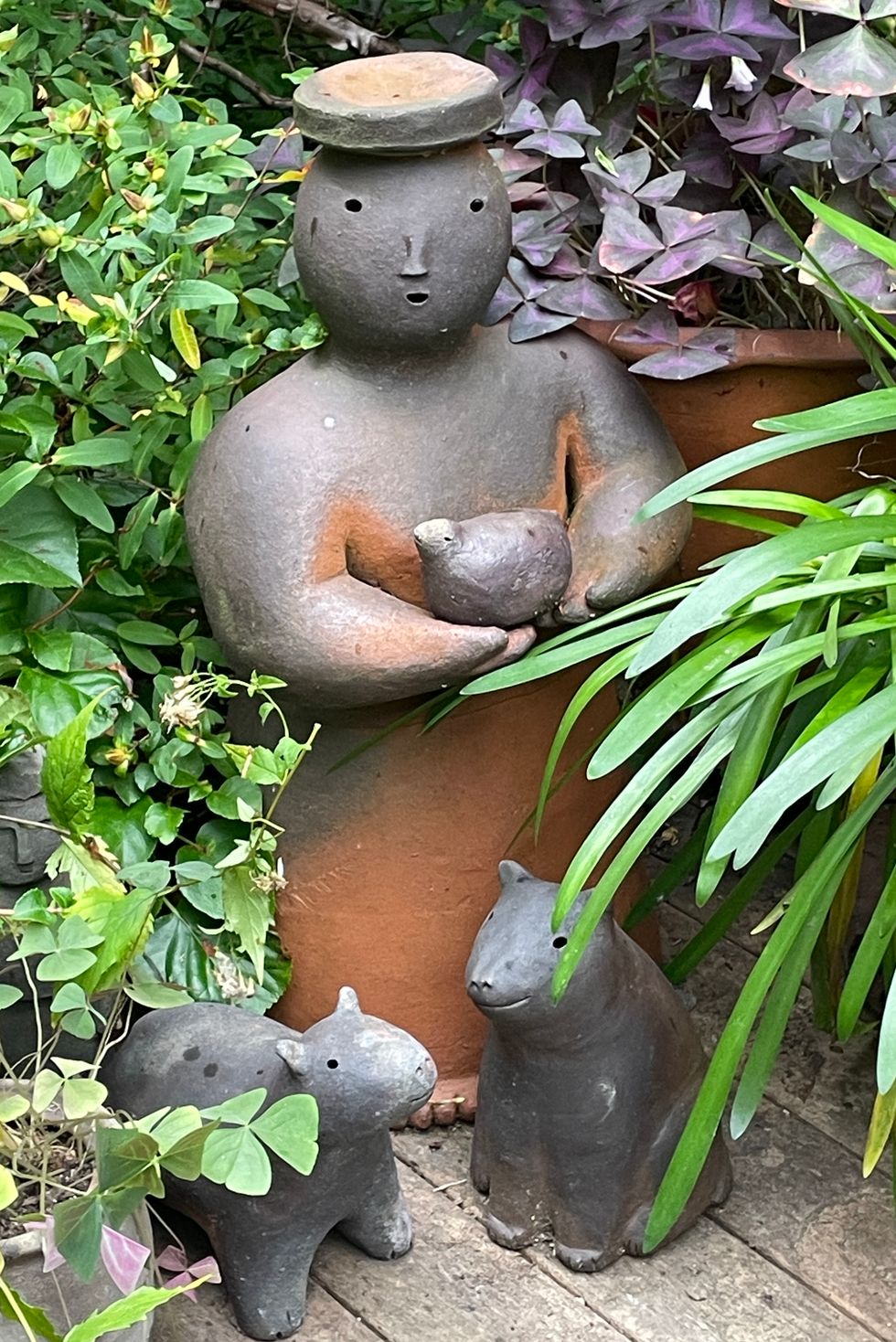 Joy Brown’s delightful ceramic sculptures.Provided