Free, family-friendly celebration of bird migration featuring live bird encounters, guided walks, aviary tours and children’s activities, 12 to 3 p.m. Suggested donation supports conservation programs.
Latest News
Affordable housing gains highlighted at Kent summit
Ruth Epstein
Sep 30, 2026
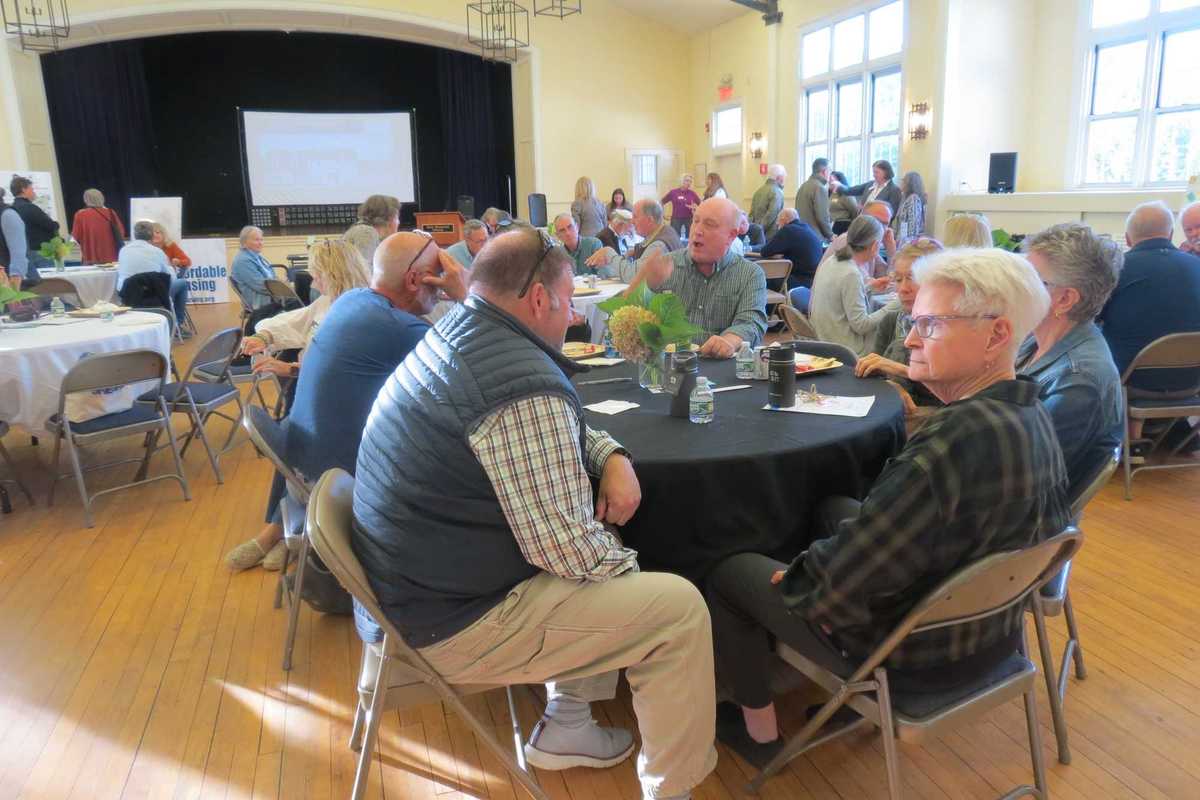
Attendees at the Litchfield County Housing Affordability Summit on Sept. 24 in Kent.
Ruth Epstein
KENT — Since 2019, 583 affordable homes have been completed or are under construction in Litchfield County, state housing officials said Thursday, Sept. 24, at the fifth Litchfield County Housing Affordability Summit.
The summit brought volunteers from affordable housing groups in 12 towns to the Kent Community House. Exhibits ringed the room as volunteers described their projects.
Speakers emphasized the cooperation needed to move those projects forward and encouraged the groups to keep going.
David Rich, who is stepping down after 20 years leading The Housing Collective, which works to address homelessness and expand affordable housing, praised the local groups’ persistence.
“You are catalysts for housing in northwest Connecticut,” he told attendees.
Rich said progress requires tenacity and grit. Despite uncertainty surrounding homelessness and the housing shortage, he said, “working in the Northwest Corner gives me hope.”
Jocelyn Ayer, director of the
Litchfield County Center for Housing Opportunity, urged the volunteer groups to share ideas and celebrate what they had achieved. The center works with towns and nonprofit groups to develop affordable housing.
State Housing Commissioner Seila Mosquera-Bruno, who provided the figure of 583 homes, pointed to progress in the region, including the groundbreaking for Salisbury’s Holley Place and the development of 10 net-zero homes at Haystack Woods in Norfolk.
She said the 583 affordable homes completed or under construction in the county since 2019 have received $49 million in department funding and another $100 million in public and private investment. Developers of five proposed projects, totaling 93 additional homes, have been invited to apply for financing.
“For a rural region, that is remarkable momentum,” Mosquera-Bruno said. “Litchfield County continues to show what rural communities can accomplish when collaboration leads the way.”
Nandini Natarajan, CEO of the Connecticut Housing Finance Authority, said rural communities face challenges involving the scale and cost of housing projects that call for flexible solutions.
“I’m struck by the commitment and energy of the affordable housing groups,” she said.
Natarajan cited the authority’s role in financing a Sharon project to rehabilitate six homes as affordable residences and create four units in the former Community Center building.
After the speakers, attendees broke into groups for “Table Talks.” Representatives of the local housing groups were stationed around the room to explain their projects and answer questions. Groups from Barkhamsted, Cornwall, Falls Village, Goshen, Kent, Litchfield, Morris, Norfolk, Salisbury, Sharon, Winchester and Washington took part.
State Rep. Maria Horn, D-64, closed the program with a discussion of state and federal housing legislation.
Ayer sent attendees off with a call for community: “Let’s put the us back in housing.”
The summit was hosted by the Center for Housing Opportunity in partnership with The Foundation for Community Health and The Lakeville Journal. Torrington Savings Bank and Northwell Health sponsored the event.
Keep ReadingShow less
Salisbury commits $113,000 to Holley Place cleanup
Patrick L. Sullivan
Sep 30, 2026
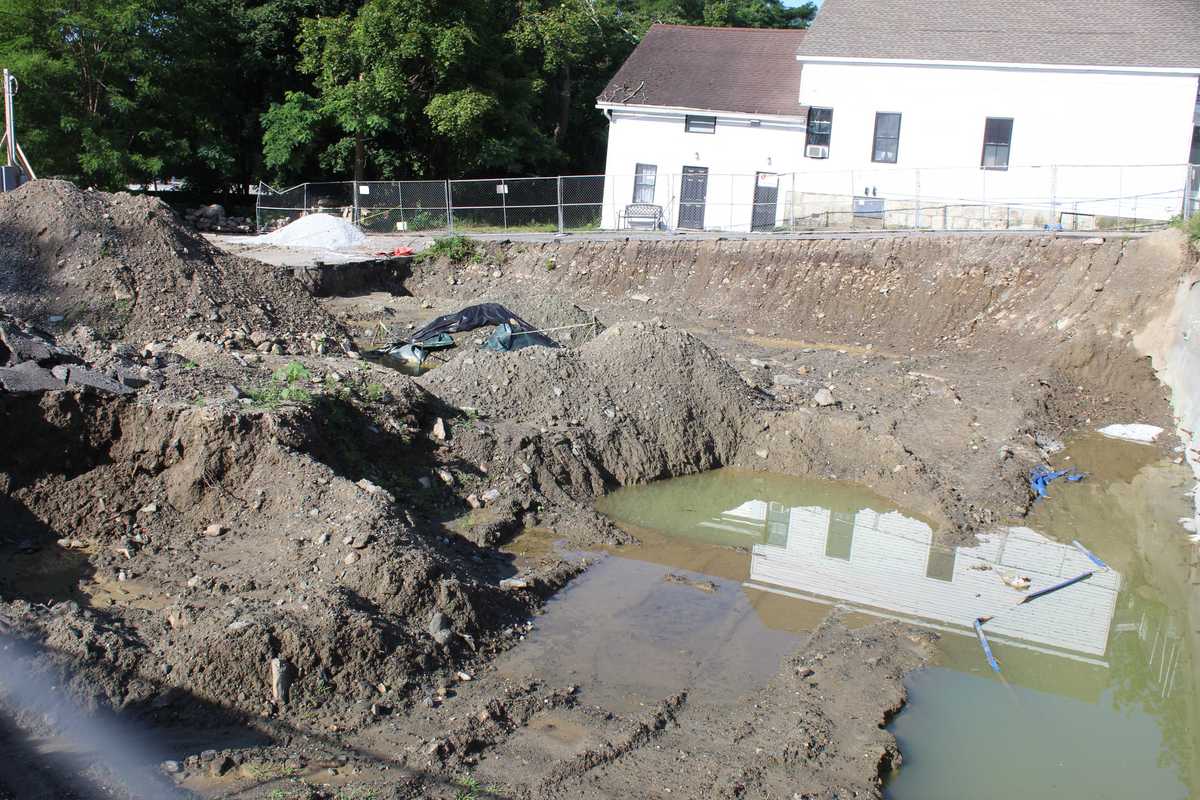
The Holley Place affordable housing site.
Patrick L. Sullivan
SALISBURY — The Board of Selectmen voted Tuesday, Sept. 22, to put $113,000 in available Small Cities grant funds toward cleaning up contaminated soil at the Holley Place affordable housing site in Lakeville.
Construction of the planned 14-apartment building at 11 Holley St. stopped after crews digging the foundation detected the smell of heating oil in June. First Selectman Curtis Rand told the board early last month that the cleanup was expected to cost between $165,000 and $175,000.
The developer, the Salisbury Housing Committee, is responsible for raising the balance.
Rand said the town has some responsibility for the cleanup because it owns the property.
The Holley Place allocation was one of four motions approved unanimously at the special meeting.
The selectmen also assigned $81,600 from the current budget’s affordable housing line to the Salisbury Housing Trust to renovate a two-bedroom house at 51 Bostwick St. in Lakeville. The trust bought the property in August and plans to sell the renovated home to a family.
The selectmen also designated $100,000 from the current budget’s affordable housing allocation for the Salisbury Housing Committee’s proposed Dresser Woods development, which would bring 20 affordable units to Railroad Street in Salisbury.
In a separate vote, they made what Rand called a “verbal, philosophical commitment” to earmark another $100,000 for the Dresser Woods project in next year’s budget. That second amount has not been appropriated.
Keep ReadingShow less
P&Z weighs hotel moratorium after Wake Robin controversy
Alec Linden
Sep 30, 2026
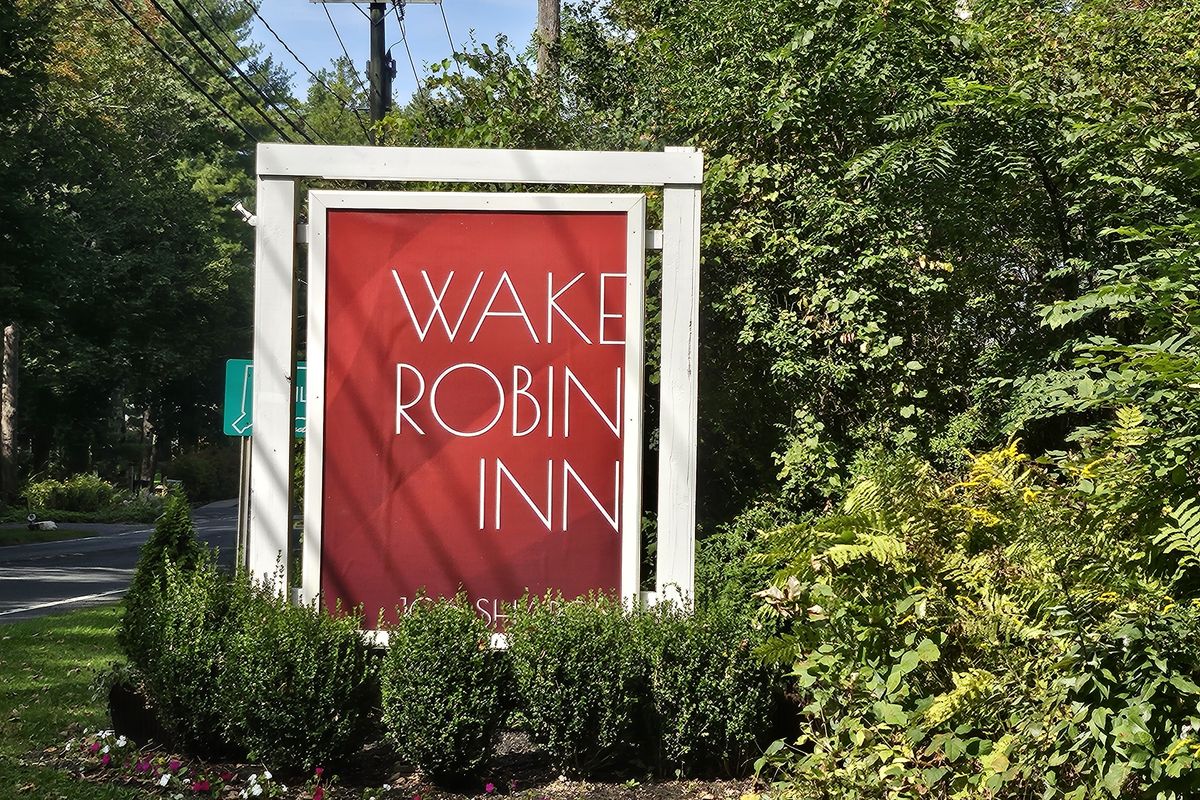
Wake Robin Inn is located on Sharon Road in Lakeville.
Photo by John Coston
SALISBURY — The Planning and Zoning Commission is considering a nine-month moratorium on new hotel applications in the town’s Rural Residential Zone while it reviews the controversial zoning regulation that allowed the expansion of the Wake Robin Inn.
“The idea is to give you three-quarters of a year to work on new language related to hotels in residential zones,” said Jeremy DeCarli, a land use professional who has consulted for the town since the departure of former Land Use Director Abby Conroy, during the commission’s Sept. 21 meeting.
The proposed nine-month moratorium was part of a series of amendments to the town’s zoning regulations discussed during the meeting, although most of the other proposed changes were minor revisions intended to improve clarity and consistency.
The regulation under scrutiny resulted from a 2024 amendment affecting the Rural Residential Zone, known as RR-1, that allows hotel development by special permit.
The amendment cleared the way for an application from New York City-based developer Aradev LLC to redevelop the historic Wake Robin Inn, which sits within the RR-1 zone between Wells Hill Road and Route 41 in Lakeville.
The project, which calls for expanding the room count and adding a restaurant, an event space and other facilities, became the focus of more than a year of deliberations and public hearings. It drew strong opposition from neighbors who argued that the proposed redevelopment was too large and intensive for the area.
The plan was eventually approved by P&Z in a 4-1 vote in October 2025. Current Chair Cathy Shyer, who was vice chair at the time, was the only member to vote against it, maintaining throughout the application process that the project was too intense for the neighborhood.
The 2024 zoning amendment itself also became the focus of public controversy and litigation. A lawsuit challenging the regulation was dismissed by a judge in February.
While residents argued that the zoning change unfairly favored Aradev’s interests over those of neighbors of the inn, P&Z members and town land use staff have repeatedly said the amendment was intended to address longstanding zoning issues involving hotels already operating in the district. Along with the Wake Robin Inn, the nearby Interlaken Inn also sits within the RR-1 zone.
Shyer reiterated that position during the Sept. 21 public hearing.
Darrell Peck, who has been a vocal opponent of the Wake Robin project, was the only resident to speak.
“Why are we not just undoing the change that was made in 2024 that led us down this road?” Peck asked.
Shyer replied that the purpose of the moratorium is to give the commission time to evaluate the issue in a way that takes into account the interests of residents as well as the hotels.
“We want to now just take a look and say ok, what is really required here to allow the hotels in that area to improve and come up to the standard that the owners would like and make them conforming?” Shyer said.
The proposed moratorium includes an exemption for existing hotel development approvals that remain valid, meaning the Wake Robin Inn project would not be affected if the moratorium is adopted. No other hotel applications are currently pending.
Since its approval, the Wake Robin project has been delayed by litigation over the 2024 zoning amendment as well as an appeal of the special permit approval itself. Both actions were brought by Wells Hill Road residents William and Angela Cruger, who also participated as intervenors during P&Z’s public hearing process.
The Crugers withdrew their appeal against the special permit on Sept. 9, leaving the Wake Robin project with no outstanding legal challenge. Salisbury’s Land Use Office said the developers have not yet applied for the additional building permits required for construction.
The public hearing on the proposed moratorium and other zoning changes was left open following the Sept. 21 meeting. Residents will have another opportunity to comment when the hearing continues at P&Z’s next meeting on Oct. 15 at 6:30 p.m.
Keep ReadingShow less

Want more of our stories on Google? Click here to make us a Preferred Source.

Salisbury portrait heads to New York museum
Patrick L. Sullivan
Sep 30, 2026
Caleb Von Gardey (kneeling) and Paul Guerino carefully fit the 1844 portrait into a custom-built crate.
Patrick L. Sullivan
SALISBURY — The Salisbury Association is loaning a painting to the American Folk Art Museum in New York, but first the portrait had to come off the wall of the Academy Building.
On Tuesday, Sept. 22, Caleb Von Gardey and Paul Guerino of Northeast Transit Fine Art Services of Waterville, New York, arrived to collect the 1844 portrait of Maria Birch Coffing and Jane Elizabeth Winslow, painted by Edwin White.
The painting shows Maria Coffing in the foreground and, behind her, a young Black woman looking out from a doorway. Both women lived in Salisbury. Maria’s husband, John Churchill Coffing, was an ironmaster; Winslow, known as Jennie, came to live with the Coffings as a child and remained with the family for decades.
The museum selected the portrait for an exhibition on how girls and young Black women were represented in early American art. It aims to draw attention to their often-overlooked lives.
“We are honored by this special opportunity to share Jane Winslow’s representation and her story with our visitors,” said Emelie Gevalt, the museum’s deputy director and chief curatorial and program officer.
The Salisbury Association acquired the portrait in 2012. It was restored by Val Michalski of Egremont, Massachusetts, who had previously restored a companion portrait of John Coffing. It was a difficult task. At the time, Michalski described the painting’s condition as “quite appalling.”
At some point, the painting had been revarnished with a substance that resisted Michalski’s array of solvents.
“I was stymied,” he said. “I had one technique left.”
He used a very small scalpel to physically lift the varnish off. As he painstakingly worked the size 15 scalpel under the layer, “Lo and behold — the varnish just shattered.”
From that point, the process went fairly quickly. He was able to use a bigger scalpel, a size 20.
“You could take a leg off with that one.”
The shattered varnish came off easily, but it left a faint gray haze and a couple of damaged areas that had been touched up with black wax.
Removing the varnish made the young woman in the background easier to see. Michalski called Katherine Chilcoat of the Salisbury Association, who was also Salisbury’s town historian.
Regina Madigan had researched and appraised the painting for the association before the restoration.
“I almost fainted” when she saw the clearer image of the young Black woman, she said.
Madigan said Black people were included in some American portraits of the period, but were usually both thematically and literally apart from the main subject — working in a field in the background, for example.
In this painting, Winslow is physically close to Maria. Michalski described her expression as “very caring but also commanding.”
The association’s research identified her as Jane Elizabeth Winslow. Orphaned at about age 5, Jennie joined the Coffing household around 1830. The 1840 census lists a free Black person in the household whom the association believes was Winslow.
The 1850 and 1860 censuses list her by name. She stayed in the Salisbury house for several years after Maria died in 1865 and later married Egbert Lee.
According to Chilcoat, John Coffing was 37 and a widower with four children when he married Maria Birch, a 30-year-old schoolteacher, in 1813. Coffing made the first move in the courtship with a letter.
“Miss Birch, as the first advance belongs to the part that I am, this is to directly inform you madam that I have it in contemplation to make some pertinent propositions to you,” he wrote.
Maria replied: “I am bound to tell you that my heart is buried with a man who lies I know not where, but if you still wish it, I will marry you, and be a mother to your children to the very best of my ability.”
Getting her portrait to New York began with a slight detour caused by faulty internet directions. There was another delay when the transporters reached the Academy Building and realized they did not have the right wrench.
Regular human directions to Herrington’s hardware store in Lakeville were supplied, and they returned in 15 minutes.
The men carefully lifted the portrait off the wall, placed it on thick plastic sheeting and bundled it up. Outside on Academy Street, a specially built crate lined with black foam awaited.
The painting fit snugly inside.
Von Gardey said the truck’s cargo area is controlled for temperature and humidity. The men strapped in the crate and were on their way to New York by 11 a.m.
The portrait will be part of Locating Girlhood: Place and Identity in Early American “Schoolgirl” Art, which runs from Oct. 9 through Feb. 28.

Keep ReadingShow less
Region One widens public role in school study
Ruth Epstein
Sep 30, 2026
FALLS VILLAGE — Seeking broader community input on Region One’s organizational study, the ABC Committee plans to recruit residents from each of the region’s six towns to take part in the process.
At the committee’s Sept. 23 meeting, Sharon’s Philip O’Reilly said he had heard concerns from constituents that the study needed greater public involvement. The ABC Committee is made up of the chairs of the region’s seven boards of education.
Last spring, Superintendent Melony Brady-Shanley proposed a comprehensive kindergarten-through-grade-12 study examining the region’s school structure amid declining enrollment and rising operating costs, including potential consolidation or regionalization options. The study is expected to continue through May 2027, with findings presented in June.
All six Region One towns agreed to participate. Brady-Shanley has emphasized that the study is intended to provide data and identify possible options, rather than recommend a mandatory course of action.
O’Reilly said he has heard concerns that if the study is conducted primarily by Region One’s central office, it may not be viewed as objective. He stressed the need for public support and proposed having representatives from each town participate, with the central office serving as a clearinghouse.
“That’s a wonderful idea,” Brady-Shanley said. “I know there is lots of interest in the community. I’m absolutely open to that. I feel strongly it’s not just my voice, but townspeople should be heard.”
Iris Hermann of Cornwall agreed, saying, “Getting to people ahead of time will make it easier on us.”
Brady-Shanley suggested that each town’s board of selectmen and board of education name a representative. Interested residents could submit their names to the boards for consideration.
Patricia Mechare of Falls Village questioned having boards of selectmen choose. “They don’t really know what we’re doing,” said Mechare, a former first selectman.
Hermann disagreed. “Our Board of Selectmen has a real grasp of who is interested.”
When asked whether towns could determine their own method of selecting representatives, Amy Dodge of North Canaan said the process should be consistent throughout the region.
The committee agreed that each board of selectmen and board of education would seek a representative, preferably someone who does not serve on either board. Brady-Shanley said she would develop a plan explaining what would be expected of the representatives and hopes to have them named in October.
The discussion came as Region One awaits results of a survey sent to residents throughout the region seeking their views on the school system and the organizational study. The deadline for responses has passed, and Brady-Shanley said the findings will be released shortly and used to help determine which issues the study examines more closely.
“The results will drive the next steps,” she said.
Kent’s Heather Brand said some residents have concerns about the distance to Housatonic Valley Regional High School. Brady-Shanley said she has heard those concerns and welcomes community input.
“The more I can update, the better it will be to address concerns,” Brady-Shanley said. “The more information, the better.”
Brady-Shanley said she will provide updates at monthly board meetings and post information about the study on the Region One website.
Mechare also stressed the importance of involving school staff, whose perspectives, she said, may differ from those of parents.
“Their views may not be the same as parents,” she said.
“That’s why we’re taking a year,” Brady-Shanley replied. “This can’t be done overnight.”
Asked whether teachers would be represented, Brady-Shanley said educators from the elementary, middle and high school levels would provide input.
“Absolutely,” she said.
Brady-Shanley said the study’s findings will be driven by the data and that there are no preconceived conclusions about what Region One should ultimately do.
Keep ReadingShow less
Connecticut heating oil prices climb 86% from a year ago
Christian Murray
Sep 30, 2026
Connecticut households that heat with oil are facing sharply higher costs as winter approaches.
The statewide average price was $5.91 a gallon on Sept. 21, compared with $3.18 during the same week last year, according to the Connecticut Department of Energy and Environmental Protection. That is an increase of about 86%.
At those averages, a 200-gallon delivery would cost about $1,182, compared with $636 a year ago — roughly $548 more.
The amount a household pays depends on its supplier, delivery size and payment terms.
Prices advertised by Litchfield County suppliers over the weekend were somewhat lower than the state survey average.
HomeHeat, a service that tracks advertised cash-on-delivery prices, listed an average of $5.69 a gallon among 17 county suppliers on Sept. 27.
Its listed prices ranged from $5.30 to $6 a gallon
The rise in heating oil prices comes alongside a surge in diesel prices stemming from the conflict with Iran.
The two fuels are closely related and face many of the same pressures on supply and price.
Connecticut’s average diesel price reached a record high last week, according to AAA figures. The price was $6.49 a gallon.
Heating oil was high at the outbreak of the Ukraine war in 2022. DEEP recorded a statewide average of $6.37 a gallon in May 2022.
For low income residents, applications are now open for the 2026-27 Connecticut Energy Assistance Program, which helps eligible residents pay their home heating costs Details are at CT.gov.
Keep ReadingShow less

Want more of our stories on Google? Click here to make us a Preferred Source.
loading