Thank you!
Your support is sustaining the future of local news in our communities.

Salisbury portrait heads to New York museum

Salisbury portrait heads to New York museum

The restored 1844 painting by Edwin White is in New York.

Provided

SALISBURY — The Salisbury Association is loaning a painting to the American Folk Art Museum in New York, but first the portrait had to come off the wall of the Academy Building.

On Tuesday, Sept. 22, Caleb Von Gardey and Paul Guerino of Northeast Transit Fine Art Services of Waterville, New York, arrived to collect the 1844 portrait of Maria Birch Coffing and Jane Elizabeth Winslow, painted by Edwin White.

The painting shows Maria Coffing in the foreground and, behind her, a young Black woman looking out from a doorway. Both women lived in Salisbury. Maria’s husband, John Churchill Coffing, was an ironmaster; Winslow, known as Jennie, came to live with the Coffings as a child and remained with the family for decades.

The museum selected the portrait for an exhibition on how girls and young Black women were represented in early American art. It aims to draw attention to their often-overlooked lives.

“We are honored by this special opportunity to share Jane Winslow’s representation and her story with our visitors,” said Emelie Gevalt, the museum’s deputy director and chief curatorial and program officer.

The Salisbury Association acquired the portrait in 2012. It was restored by Val Michalski of Egremont, Massachusetts, who had previously restored a companion portrait of John Coffing. It was a difficult task. At the time, Michalski described the painting’s condition as “quite appalling.”

At some point, the painting had been revarnished with a substance that resisted Michalski’s array of solvents.

“I was stymied,” he said. “I had one technique left.”
He used a very small scalpel to physically lift the varnish off. As he painstakingly worked the size 15 scalpel under the layer, “Lo and behold — the varnish just shattered.”

From that point, the process went fairly quickly. He was able to use a bigger scalpel, a size 20.
“You could take a leg off with that one.”

The shattered varnish came off easily, but it left a faint gray haze and a couple of damaged areas that had been touched up with black wax.

Removing the varnish made the young woman in the background easier to see. Michalski called Katherine Chilcoat of the Salisbury Association, who was also Salisbury’s town historian.

Regina Madigan had researched and appraised the painting for the association before the restoration.

“I almost fainted” when she saw the clearer image of the young Black woman, she said.
Madigan said Black people were included in some American portraits of the period, but were usually both thematically and literally apart from the main subject — working in a field in the background, for example.

In this painting, Winslow is physically close to Maria. Michalski described her expression as “very caring but also commanding.”

The association’s research identified her as Jane Elizabeth Winslow. Orphaned at about age 5, Jennie joined the Coffing household around 1830. The 1840 census lists a free Black person in the household whom the association believes was Winslow.

The 1850 and 1860 censuses list her by name. She stayed in the Salisbury house for several years after Maria died in 1865 and later married Egbert Lee.

According to Chilcoat, John Coffing was 37 and a widower with four children when he married Maria Birch, a 30-year-old schoolteacher, in 1813. Coffing made the first move in the courtship with a letter.

“Miss Birch, as the first advance belongs to the part that I am, this is to directly inform you madam that I have it in contemplation to make some pertinent propositions to you,” he wrote.
Maria replied: “I am bound to tell you that my heart is buried with a man who lies I know not where, but if you still wish it, I will marry you, and be a mother to your children to the very best of my ability.”

Getting her portrait to New York began with a slight detour caused by faulty internet directions. There was another delay when the transporters reached the Academy Building and realized they did not have the right wrench.

Regular human directions to Herrington’s hardware store in Lakeville were supplied, and they returned in 15 minutes.

The men carefully lifted the portrait off the wall, placed it on thick plastic sheeting and bundled it up. Outside on Academy Street, a specially built crate lined with black foam awaited.

The painting fit snugly inside.

Von Gardey said the truck’s cargo area is controlled for temperature and humidity. The men strapped in the crate and were on their way to New York by 11 a.m.

The portrait will be part of Locating Girlhood: Place and Identity in Early American “Schoolgirl” Art, which runs from Oct. 9 through Feb. 28.
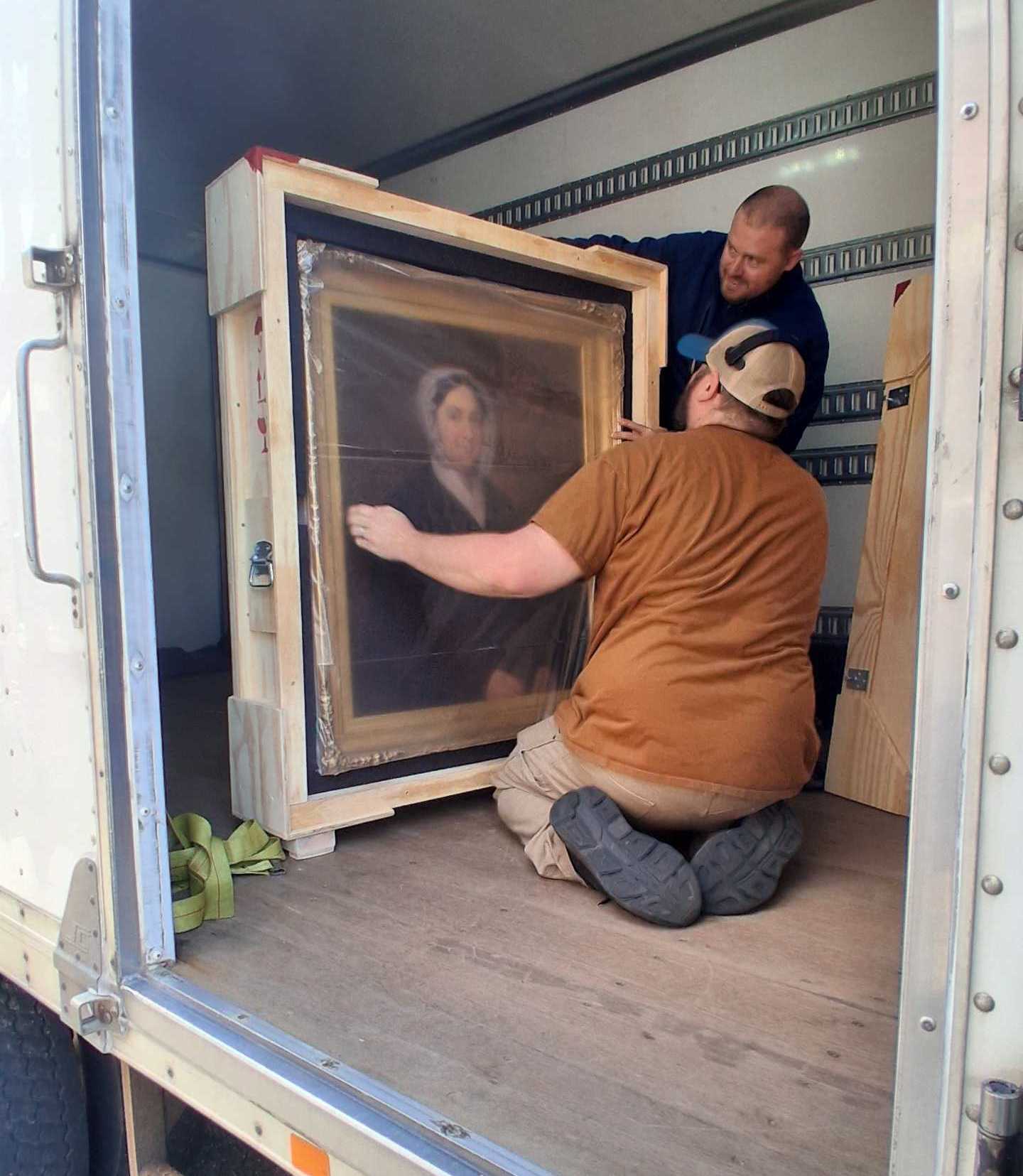
Caleb Von Gardey (kneeling) and Paul Guerino carefully fit the 1844 portrait into a custom-built crate.Patrick L. Sullivan


Latest News

Doug Tallamy’s work in progress: saving the planet one backyard at a time

Windacre, a 25-acre property in Millerton will be the site of “Work in Progress,” an afternoon with acclaimed entomologist, New York Times bestselling author and Homegrown National Park co-founder Doug Tallamy.

Provided

For nearly three decades, Doug Tallamy, a professor at the University of Delaware and co-founder of Homegrown National Park, has studied the intricate relationships between native plants, insects, birds and the ecosystems that sustain them. His books, including “Bringing Nature Home” and “Nature’s Best Hope,” have helped shift the conversation about conservation from something that happens primarily in parks and preserves to something ordinary people can practice on the land around them.

On Sunday, Oct. 4, Tallamy will bring that conversation to Windacre in Millerton for “Work in Progress: Toward Native Fields,” an outdoor gathering exploring both the possibilities and the complications of restoring private land for biodiversity.

Keep ReadingShow less
Celebrating Dick Hermans’ life built around community

Dick Hermans in the Oblong Bookstore on Millerton\u2019s Main Street in 1985.

Provided
No matter what I’ve done, I’m trying to be useful to the communities I’m associated with.
— Dick Hermans

When Dick Hermans receives the Estabrook Community Leadership Award on Oct. 11, he will accept it for a lifetime of work that has taken many forms: bookseller, radio host, school board member, advocate for the Harlem Valley Rail Trail, business owner, volunteer and, perhaps most importantly, a person who has consistently looked for ways to be useful to the communities around him.

The Lakeville Journal and The Millerton News will present Hermans with the 2026 award at the annual Jubilee celebration at the Sharon Playhouse. The award honors outstanding leadership in community service and was inspired by Mary Lou and Robert Estabrook, former owners of the newspapers who believed that strengthening a community extended well beyond the work of publishing a newspaper.

Keep ReadingShow less
Tending the Fire: Homelands PowWow brings Mohican culture home to the Berkshires

Members of the Stockbridge-Munsee tribe at Homelands PowWow in 2025.

Joeseph Plante New Media Storytellers
Our goal is to continue building an annual gathering that honors the history, culture and traditions of the Stockbridge-Munsee Band of Mohicans in their original Homelands.


For the Stockbridge-Munsee Mohican people, the Berkshires are not simply a place to visit. They are ancestral homelands.

Keep ReadingShow less
google preferred source

Want more of our stories on Google? Click here to make us a Preferred Source.

Ancram Center’s “A Number” doubles questions of identity
Ledbetter (left) and Wojda (right) on the set of “A Number” at Ancram Center for the Arts.
Jeff Mousseau

How would you feel if you found out you weren’t the only you — if there was an exact replica of you? What if you found out that you’d been cloned? Would you believe that you’re the real you? Would you suspect you might be a copy of the original? How could you be sure anything about your life was real? These are some of the questions posed in Caryl Churchill’s play “A Number,” opening at the Ancram Center for the Artson Oct. 1.

Churchill was born in London in 1938 and has been hailed by the theaterl world as one of the strongest voices of her time to take on sexual politics and feminist themes. Her works garner pointedly considered analysis from the highest levels of theatrical intellectualism. Basically, it’s about as far from “The Lion King” as you can get. While she’s experimented with dance theater in the past, “A Number” is much more stripped down, highlighting Churchill’s chosen themes and the skills of both actors on stage.

Keep ReadingShow less

Dispatches from the Farm

Dispatches from the Farm

Adamah Farm crew members planning out the day’s tasks on a late September day.

Janna Siller

“Dispatches from the farm” is a new, periodic column offering a firsthand look at the rhythms, challenges and rewards of farming through the eyes of a local farmer.

The thing about plants is that they can’t get up and move. When a storm like last weekend’s nor’easter threatens to roll through, you can’t just round everybody up and settle them safely on the sofa for movie night.

Keep ReadingShow less
Pinchas Zukerman brings an all-Beethoven program to Hotchkiss

Pinchas Zukerman to perform at Hotchkiss Oct. 4

Cheryl Mazak

The passion, drama and energy of Beethoven will fill Katherine M. Elfers Hall at The Hotchkiss School on Oct. 4, when world-renowned violinist Pinchas Zukerman is joined by pianist Shai Wosner for a special recital.

The 4:30 p.m. program at the Esther Eastman Music Center will feature three of Beethoven’s celebrated violin sonatas: Violin Sonata No. 4 in A minor, Op. 23; Violin Sonata No. 5 in F major, Op. 24, “Spring”; and Violin Sonata No. 7 in C minor, Op. 30.

Keep ReadingShow less
google preferred source

Want more of our stories on Google? Click here to make us a Preferred Source.

google preferred source

Want more of our stories on Google? Click here to make us a Preferred Source.