SHARON – For residents of the Housatonic River watershed, heritage is as much about the landscape as it is about those who populated it.
For the opening weekend of the 24th annual Housatonic Heritage Walks, the Sharon Land Trust showed that the forest holds many secrets for those who know what to look for. Over the course of a two and a half mile loop through the secluded Sharon Mountain Preserve on the sunny morning of Sept. 5, SLT Land Steward Sophie Lake-Ginouves pointed out telltale signs of bygone industries that have left their mark, helpful herbs and plenty of fungi.
“This year has been really exceptional for mushrooms because of all the rain,” she said, just before the group came across a vibrant orange cluster of chicken of the woods—a wood-hosted fungus famed for its similarity to chicken both in taste and texture—growing from a birch tree on the bank of a stream.
“They’re completely delicious,” she told the group, but said she would rather let the colony be.
It was one of many mushrooms that were easily spotted trailside throughout the two hour hike. A luminous violet coral mushroom, nearly hidden amongst leaf debris on the forest floor, was one of several that stopped the group in its tracks for a closer look and some photos.
Beyond the fungi, Lake-Ginouves also pointed to a number of understory plants with features that most casual forest-goers would miss.
The American hog-peanut, which is often mistaken for poison ivy, she said, blooms with not just one, but two flowers—one above ground, and one below. “It’s just a really wacky plant that most people don’t notice but it’s really cool,” she said.
While Lake-Ginouves explained the explosive method with which witch hazel, a common shrub in New England woods, disperses its seeds, one of the hikers chimed in with her own experience with the plant, which shoots its seeds from a pressurized pod.
“I got a bunch of them for my son’s birthday,” said Sharon resident Kate Farrell, “and when we were about to eat, there was all this popping like something was on fire!”
She said they initially thought there might be an electrical issue, but their son, who is an ecologist, immediately identified the culprit when he returned. The popping went on for several days, Farrell said.
While current ecology featured prominently in the walk, Lake-Ginouves also drew attention to subtle signs of the now densely-forested landscape’s not-so-distant past. Not long ago, Lake-Ginouves said, almost all the land would have been cleared for agriculture and the once-thriving charcoal industry in northwest Connecticut.
Some vestiges of that era are obvious, like the broad stone walls used to border pastures, but others are more subtle. Lake-Ginouves pointed out two old charcoal mounds, once used by laborers called colliers to burn wood into charcoal that powered the formidable iron production business which lasted in New England until the early 20th century.
Marked by a flat, elevated circle or semi-circle only identifiable by a practiced eye, the mounds were carefully watched by the colliers for weeks as they smoldered to produce quality wood charcoal.
It was a difficult vocation, Lake-Ginouves said, and workers were regarded poorly in society. One term that caught on across New England for the charcoal burners has a local origin.
“Colliers were also called raggies, which is a derogatory term derived from Mount Riga,” she said, where many of them lived high in the hills apart from the townsfolk.





 Justine and Victor Valla in their studio with a painting of Victor’s,”Jonah and the Whale.” Robin Roraback


 A ceramic vase by Kathleen Heidemann.Provided
 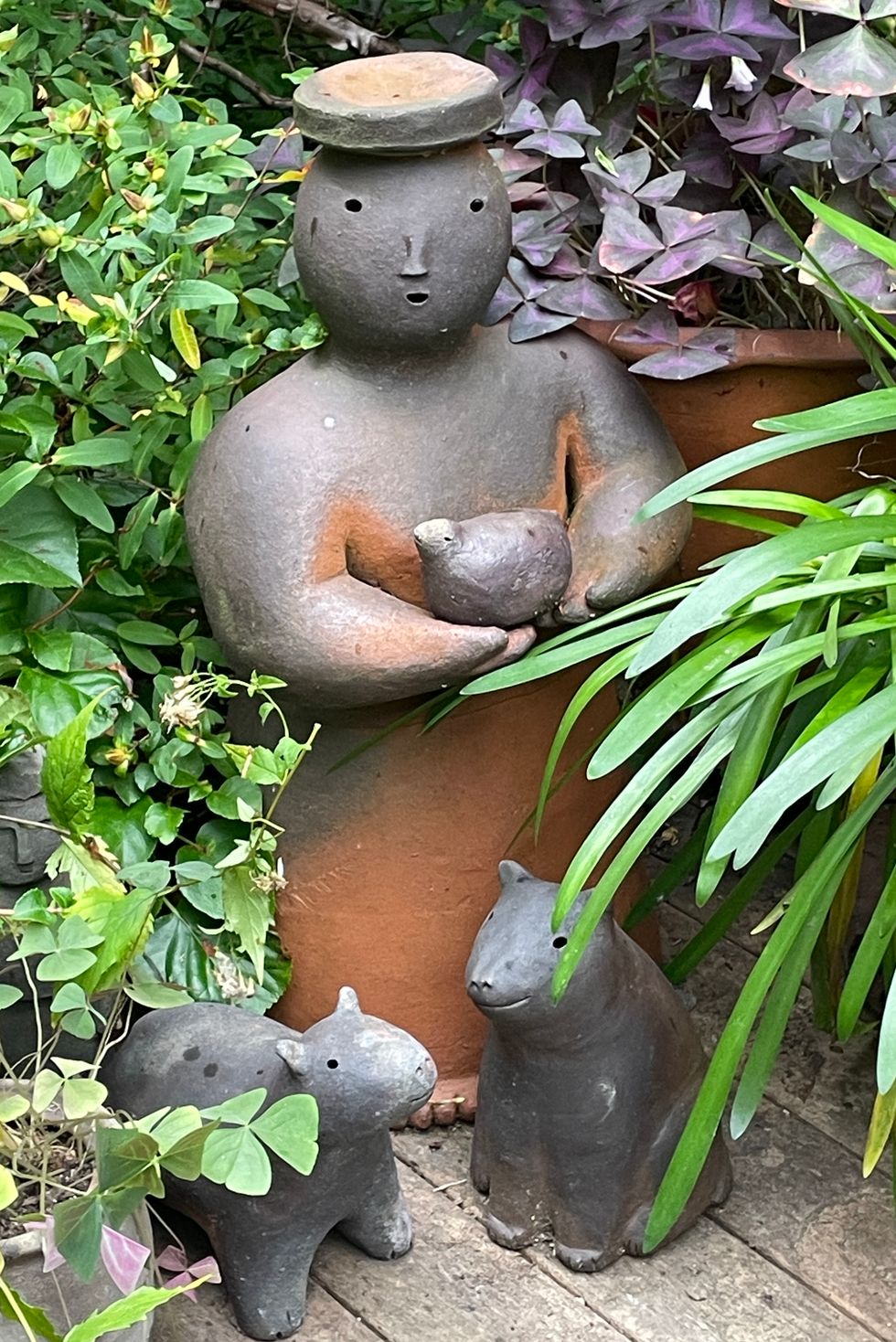 Joy Brown’s delightful ceramic sculptures.Provided