Century-old rummage sale returns with rare finds and old treasures

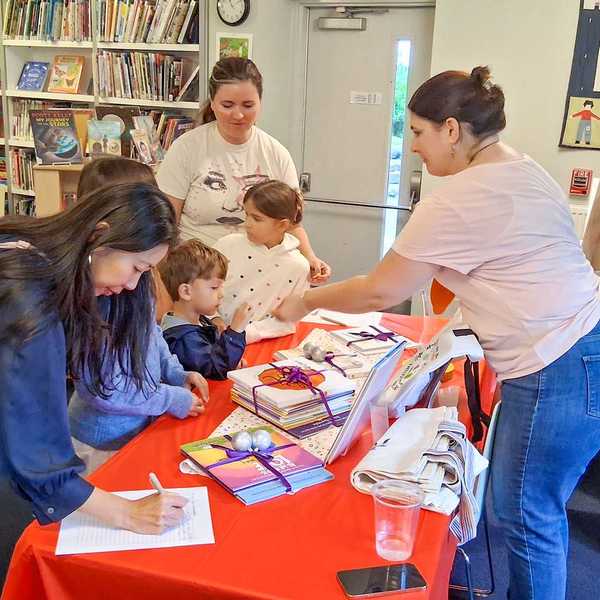
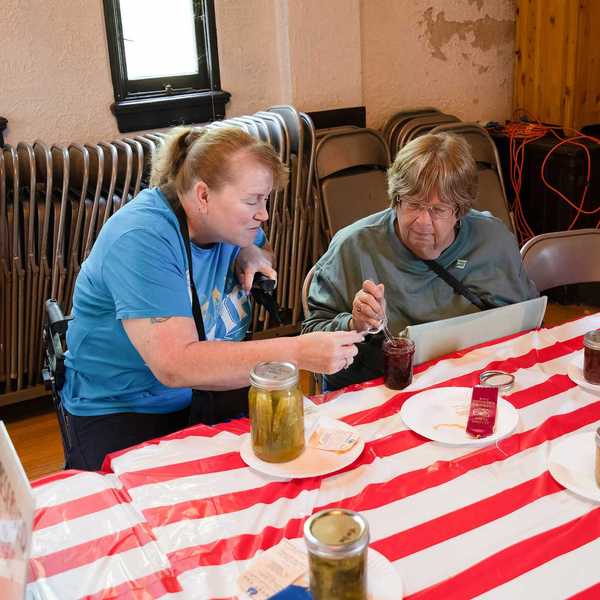
Tom Windas and Betsey Mauro try to decide on a price for a houseware item in preparation for the Cornwall Woman’s Society Rummage Sale that will be held July 18-20.
Ruth Epstein


Tom Windas and Betsey Mauro try to decide on a price for a houseware item in preparation for the Cornwall Woman’s Society Rummage Sale that will be held July 18-20.
CORNWALL– Residents are already sorting, pricing and arranging hundreds of donated items at the Mohawk Mountain Ski Area lodge as preparations begin for the Cornwall Woman’s Society’s annual Rummage Sale, a community tradition dating to 1924.
But this event is so much more than racks of clothing, tables of dishware, trays of jewelry and toys and crafts. It represents generations of Cornwall residents who have come together to support local students and nonprofits while bonding with one another to ensure the sale’s success.
Scheduled for July 18 to 20, the Rummage Sale has been held since 1924. The major event is held at the ski area, but there are satellite sale locations at Town Hall, where bargain hunters can find furniture, lamps and fine art, and the United Church of Christ Parish House, often stocked with books, small electronics and stationery.
Many volunteers sorting donations, pricing merchandise and hanging clothing shared stories of their families’ history with the sale.
Lory Bevans has vivid childhood memories of her grandfather giving her $20 and leaving her to shop for three or four hours. For years she would arrive at 5 a.m. when tickets were distributed so she could receive #1.
“I always would buy an antique suitcase to store all my purchases in,” Bevans said. “One year I was so excited to buy a calico dress. When I got home, my grandmother told me she had donated it.”
Betsey Mauro said the sale has been part of her life since infancy. Her mother, Cilla Mauro, and Thalia Scoville ran the event for many years. “I was in a playpen when I came to my first sale,” she said.
Spencer Markow also began attending the sale at a young age. His mother, Jennifer Markow, said he was born during one of the sales and spent many of his childhood birthdays there. For many years, Jennifer Markow brought cupcakes for everyone to celebrate his special day.
Cheryl Thibault is the current organizer and another who has taken the baton from her mother, Patricia Thibault, who served as the treasurer for years. It’s a real family affair with her mother, daughter and grandchildren helping out this year.
“I love being here,” she said, looking around at all the volunteers busy at work. “We raise money for important causes. This year we’re giving 10 educational gifts to students who have graduated from Cornwall Consolidated School, as well as money to a list of nonprofits.”
She spoke of the wide popularity of the sale. Many people schedule their summer vacations around it, she said.
The sale will be held Saturday, from 9 a.m. to 2 p.m., Sunday, from 11 a.m. to 2 p.m. (half priced), and Monday from 9 a.m. to noon (fill a bag for $5).
Lakeville Journal
Meet the next generation of community journalists. Eight interns joined The Lakeville Journal and The Millerton News this summer. Below, each shares a brief note on their experiences.

My name is Mia, and I will be a freshman at Northwestern University this fall, where I will be majoring in journalism. I first began working with The Lakeville Journal through the revival of Housy’s student newspaper, HVRHS Today, last spring. There I first discovered journalism as a career, and The Lakeville Journal’s Summer Internship program. What began as a fun extracurricular has turned into a passion and career path in journalism I can’t wait to pursue.
I am relatively new to this area, having moved here from Long Island five years ago. I feel that writing for The Lakeville Journal helped me really get to know this community. From going hula-hooping at the Hunt Library to discussing how to dispose of 55 gallons of melted ice cream with Grassland’s owner, I’ve learned so much about local journalism and the people that make up this area.
Not only this, but the chance to have articles published opened doors for me that I could never have dreamed of. From a summer academy with the New York Times in the city last summer, and now my dream school to study journalism in Chicago, I’ve found that local journalism has a much farther reaching impact than just this community. The experiences and opportunities I’ve had here were the focus of my senior year capstone project, which won the Pinnacle Award for Capstone Excellence. None of this would have been possible without the skills and values I learned from working at The Lakeville Journal.
I’d like to thank The Lakeville Journal’s staff for all their work with the internship program. Local journalism is incredibly important, and I will always be grateful to have gotten to be a part of this paper.

My name is Allison Gollenberg, and this fall I’ll be a senior journalism major at the University of Connecticut. There, I’ve written about everything from tick populations to tactical urbanism. I decided to study journalism because I love to learn, and with this kind of job, every day I get to research something new. I get to talk to all sorts of people, to make sense of an eclectic selection of topics each week, and it’s super fulfilling to share what I learn with the world as a writer.
Growing up here in the Northwest Corner it sometimes felt like I was from the sleepiest place on earth. But looking at it with a journalistic eye has made me realize there’s a lot going on everywhere I go. This summer I could be found zipped inside of an inflatable whale, traipsing through a rail yard in the rain, dancing to colonial era music or at board of selectmen meetings where I was the only attendee who wasn’t also a selectman—and I got to do it all in pursuit of a good story. It was a great reminder that you have to keep your eyes wide to the world around you. Once you do, you see there’s a story behind everything.
I’ve spent a long time trying to figure out what exactly I want to do with my life— the only things I’m really able to say about myself are that I get bored easily and I think people are the most fascinating thing we’ve got. In a selfish way, I love this work because it lets me try on a bunch of different hats, to be nosy for a paycheck. In a less selfish way, I love this work because it keeps me in touch with the workings of the world around me, and I get to keep others informed through what I write.

Hi, my name is Annie Prinz, and I’ve lived in Lakeville full-time for almost 12 years. This fall, I will be starting my senior year at The Hotchkiss School. Before attending Hotchkiss, I spent my ninth-grade year at Indian Mountain School, after graduating from Salisbury Central School, where I attended middle and elementary school.
From a very young age, I’ve maintained a love for reading. As I’ve gotten older, that love has also translated into an enjoyment of writing. Whether through journaling or more academic forms of writing in my humanities classes, I’ve found that it’s where I feel most engaged and excited. To be honest, apart from watching Rory in Gilmore Girls, I hadn’t thought much about journalism.
However, when I found the information for this program back in the fall, it sparked my interest. I love the town I’ve grown up in, I enjoy writing, and I love meeting new people, so I figured what better way to do all of that than through this program? Six weeks ago, I was intimidated entering a room where I was the one with the least amount of experience, but it ended up being the greatest opportunity for me to grow and learn.
My time at The Lakeville Journal has shown me some of the most important components of what it means to be a journalist, specifically in a smaller community like ours. I can confidently say that I am walking away from this experience feeling so much more connected to the place I call home. Throughout this program, I’ve been able to work on my ability to build connections with strangers, ask important questions, look at a story from a completely different perspective, and so much more.
I know that all of the experiences and conversations I’ve had because of this program are uniquely meaningful, and I feel very grateful for that.

My name is Phoebe Tobin, and I’m a rising senior at Loomis Chaffee in Windsor, CT, though I live in Lakeville. Prior to Loomis, I attended Indian Mountain School, where I revived the school newspaper, formally discontinued in the 50s, entitled Le Scoop, and served as editor-in-chief. At Loomis, I write for our student-led publication, The Loomis Chaffee Log.
I’ve always been someone who loves writing, though throughout the earlier years of my life I was drawn to creative rather than journalism, writing fantastical stories about creatures of my own invention and journeys through time. At IMS, within my idea and eventual execution for the newspaper, I found the stories that happen on earth with the people around us. A curiosity for the stories of those I saw every day, and seeking out what could count as “newsworthy” solidified my love for journalism and is what brought me to spending my summer with The Lakeville Journal.
Interning at The Lakeville Journal gave me a new insight into the community I thought I understood just by existing around it in a bubble of my own convenience, speaking only to a circle of people I knew and few beyond that. In six weeks, I’ve attended many events I truthfully never would have known about beyond a posted sign, like Sharon’s 4th of July Celebration and the Jane Lloyd Fund Clambake, and experienced the greater depth of my community through the stories of those I talked to. Additionally, showing up at big events alone, bugging total strangers with questions as I practically shoved a recorder in their face is not something that necessarily came naturally. But as I did it more and more, I improved significantly and will take a new confidence from it back to Loomis and beyond.
This internship confirmed for me that journalism is something I hope to keep exploring, no matter what I choose to study down the road, and I’m so grateful for the chance to spend my summer getting to know my community a little better.

I am a rising senior at Ithaca College studying television, photography and digital media production with a concentration in photography and a minor in journalism. On campus, I have worked with our independent, student-led newspaper, The Ithacan, as a writer, videographer and photo editor. Photography has always been important to me as someone who loves storytelling, and from a young age I knew I loved documenting moments of time through the camera. I find it fascinating that we can show so many perspectives through one series of images. At Ithaca College, I knew I wanted to be involved in something that could further my passion. Joining The Ithacan was one of the best decisions I have made. Being a part of the newspaper not only taught me more about photography, but it introduced me to journalism, where I can hear and share more stories with the local community.
I grew up in Dover Plains, New York, and have truly cherished the opportunity to report on my hometown this summer. While growing up, I did not know much about my town or the news surrounding it. Through this internship program, I have learned so much about my home while talking to people in the community. I was also given the opportunity to write for Compass, where I wrote stories about music performances, art showings and vibrant members of our community.
While being a part of the internship program this summer, I gained so much knowledge from the incredible editors and reporters. My love for storytelling only grew, and I am so grateful to Nathan Miller, Natalia Zukerman, Christian Murray, and everyone at the Lakeville Journal for their support and kindness.

I was born and raised in West Hartford and am a rising senior at Marist University. On campus I am a Managing Editor and City/National Section Editor for the Marist Circle. My time at Marist has been essential to my development as a writer and a journalist. However, my connection to Dutchess County is not new. My dad was raised in Poughkeepsie, meaning I grew up making frequent trips to the area to visit my grandparents or my aunt and uncle, who still live in town. When the time came to decide where to attend college, Poughkeepsie felt like a second home and one I knew I could thrive in.
I have always considered myself a writer but was unsure how best to use my skills. I didn’t know much about journalism, let alone consider it a possible career path until my senior year of high school. The part of the job that I didn’t anticipate was the social interaction, though it has quickly become my favorite aspect.
This summer I have had the pleasure of exploring a different side of the area during my time with The Millerton News. I was assigned the Town of North East and Village of Millerton as my coverage area and have since had the privilege of meeting many new people and exploring the beautiful area. From The Moviehouse to zoning board meetings, I have learned so much both about the town and journalism itself.
This internship has taught me so much about the triumphs and tribulations of being a journalist. Learning how to apply what I have learned in classes has been an irreplaceable opportunity. I want to give a huge thank you to the entire Lakeville Journal/Millerton News staff but particularly Nathan Miller and Graham Corrigan for their incredible guidance during this experience.

My name is Sophie Gardiner and I’m from New York City. I’m a rising sophomore at Northwestern University, where I study Journalism, Classics and Political Science. At school, I’m a reporter on the city desk for The Daily Northwestern and a member of the College Democrats. As a person deeply interested in the intersection of communications and politics, I also work on political campaigns in the broader Evanston area.
This summer, I’ve had a great experience diving deeper into journalism, particularly because of how local and community-focused The Millerton News is. I’ve had a strong passion for journalism for as long as I can remember, both because of its purpose as the Fourth Estate and because of my love for writing. Interning with The Millerton News has solidified my conviction in journalism as essential to a thriving community and it’s been really rewarding to gain hands-on experience in such a meaningful way. I’ve also learned a lot about how a newsroom operates, which makes me excited to continue exploring the industry in all its capacities – from social media to publishing and law.
My skills have undoubtedly improved from my time at the paper: always keeping my eyes open for a good story, asking the right questions and more. When I return to Northwestern in the Fall, I’m excited to bring my sharpened skills to the Daily. I’m also excited to join more magazine-style publications, where I’ll focus on the type of long-form feature writing I’ve enjoyed so much here. I’m so grateful for my experience this summer and I cannot thank everyone at The Lakeville Journal and Millerton News enough.
When I’m not in a newsroom or library, you can typically find me curled up with a good book, trying new restaurants with friends or going on long walks with a good playlist.

I’m Florida born and raised and a rising senior at Loyola University New Orleans. Salisbury has been a summer destination for me since 2010. Every July for as long as I can remember, we packed our bags and escaped the brutal Florida heat staying with family.
I’ve been studying journalism and working at Loyola’s paper, The Maroon, for three years now. The highlight of my college newsroom has been serving as the paper’s editor-in-chief for the last year. During that year, we were awarded finalist for the Society of Professional Journalist’s Best All-Around Student Newspaper for colleges under 10,000 students. I was thrilled.
When it was time to search for summer internships, my great-aunt and Salisbury resident proposed The Lakeville Journal. So, I applied and kept my fingers crossed. I was elated when the internship offer hit my email.
Being a student journalist in a big city, I was excited to have the opportunity to learn in a small town setting, and I did learn so much. I’ve spent the summer writing for The Millerton News, and working mainly out in Millbrook. Under the guidance of fantastic editors and surrounded by talented student journalists, the educational experiences I’ve gained this summer are immeasurable.
Not only have I learned more about the mechanics of writing, I’ve learned how to be a better listener and reporter. I made real connections. I got to know the owner behind the store, the planning behind the project, and the people behind the community.
If you had told me in March that I’d know more about aerated concrete than the average person, I would have laughed in your face. But, I was fortunate to meet two talented men who taught me about the extremely interesting building material.
I’m excited to bring all the knowledge I’ve learned this summer back to New Orleans, where I’ll finish my final semester of college this fall. I cannot express enough gratitude to this program and all the people involved for giving me the most interesting and educational summer I’ve ever had.
Natalia Zukerman
Curator Deborah Goodman Davis reads the Emily Dickinson poem “The Grass So Little Has to Do.” Spencer Finch’s “Following Three Bees (Zinnias)” buzzes in the background.
“The Grass Has So Little to Do,” on view at James Barron Art in Kent, takes its title from Emily Dickinson’s poem “The Grass So Little Has to Do,” written in 1862:
“The Grass so little has to do—
A Sphere of simple Green—
With only Butterflies to brood
And Bees to entertain—”
Curated by Deborah Goodman Davis, the exhibition borrows Dickinson’s meditation on the natural world as both its title — with a subtle shift — and guiding principle. The exhibition gathers more than 30 contemporary artists whose work examines flowers, leaves, insects, landscapes and changing light — not through scientific observation, but through memory, imagination and deep attention.
“I started spending so much time in the country that I began seeing things differently,” said Davis, a Montreal native. “I became drawn to artists who were also looking at nature.”
Davis has spent decades working in museums, galleries and as an art advisor, including positions at the Art Institute of Chicago, Yale University Art Gallery and with influential dealer Jeffrey Deitch, before returning to curatorial work in recent years. This is her third exhibition with James Barron Art, following last year’s “Boundless Color.”
The exhibition’s emotional anchor is Dickinson’s poem, which marvels at grass, butterflies, bees and sunlight while imagining a life devoted simply to existing in the natural world. The poem, and its simple and reverent message, echoes throughout the exhibition.
Spencer Finch’s drawing titled “Following Three Bees (Zinnias)” tracks the movement of three bees as they moved from flower to flower in the artist’s garden. Standing on a ladder, Finch patiently followed their movements, recording each insect’s path with a different line.
Montreal-based painter Veronika Pausova’s luminous moth paintings next to Finch’s work carry a thread — literally. Whether Pausova was familiar with Finch’s drawings before creating her painting “Cabin’s Moon,” commissioned by Davis for this show, is unknown, but the placement is certainly intentional. Davis’ thoughtful curatorial approach creates conversations, quiet whispers and surprisingly funny moments throughout the space.
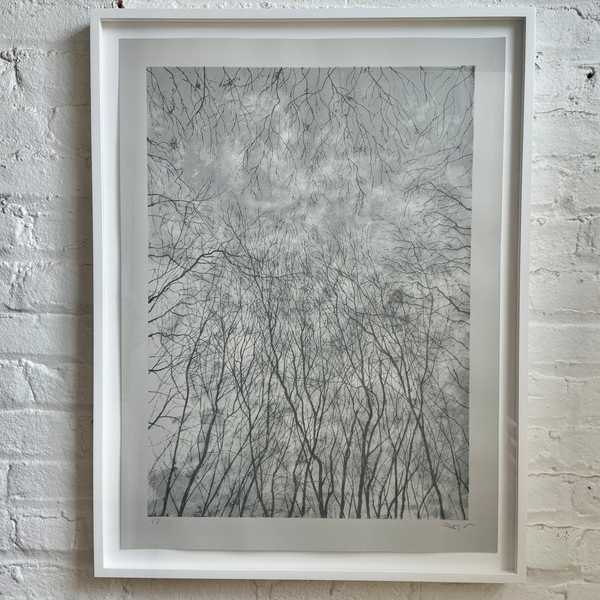
Toba Khedoori, an Australian-born artist of Iraqi-Jewish heritage, contributes exquisitely detailed mezzotints that transform ordinary grasses into monumental landscapes. “Imagine rolling in the grass before ticks,” Davis said with a laugh. One is left longing for such a simple pleasure, the work inviting viewers to imagine a connection to the natural world that feels both familiar and increasingly distant.
One of Wassaic Project co-founder Eve Biddle’s ceramic snakes slithers up a nearby side wall, while internationally recognized artists including Ellsworth Kelly, Alex Katz, Lois Dodd, Kiki Smith and Charles Gaines offer their own interpretations of leaves, flowers, trees and changing seasons.
The exhibition also highlights several artists with local ties. Yale Norfolk School of Art co-director Byron Kim contributes one of his contemplative “Sunday Paintings,” documenting the sky over Norfolk alongside personal diary-like observations.
One of the show’s most unexpected works isn’t visual at all.
Inspired by Dickinson’s line, “And even when it dies to pass / In odors so divine,” Davis commissioned Brian Goeltzenleuchter, an interdisciplinary artist working at the intersection of olfactory art, social engagement, and image making to create a scent for the exhibition. “The grass so little has to do, I wish I were the hay!” wrote Dickinson, so Goeltzenleuchter created the scent of fresh hay specifically for the exhibition. Fragile glass vials sit in a bed of marble, waiting to be broken to release the scent, which also lives under a glass enclosure dewy with its fragrance. The faint odor permeates the gallery, adding an immersive sensory layer that extends the show’s meditation beyond sight alone.
There are quieter surprises throughout: concrete casts preserving cherry blossoms that will slowly fade over time by Japanese artist Motohiro Takeda; carvings of owls in Arctic marble by Sam Akesuk, an Indigenous artist from Kinngait (Cape Dorset); paintings of moonlight; the intricacy of spider webs placed next to a graph-like drawing of a tree; and Kiki Smith’s shadow of birds by the windows overlooking the majestic scenery of Barron’s property.
For Davis, the idea for this show has been growing since she began spending more time in the Northwest Corner.
“It’s been percolating for six years,” she said.
The resulting exhibition rewards viewers willing to do the same.
“The Grass Has So Little to Do” is on view at James Barron Art in Kent through Sept.12. By appointment only. Email maria@jamesbarronart.com or call (917) 514-3762. For a catalog of the exhibition, visit jamesbarronart.com.
D.H. Callahan
One hundred and twenty years ago, Carl and Ellen Stoeckel commissioned New York architect E.K. Rossiter to design The Music Shed in Norfolk, Connecticut. After nearly a decade of entertaining their friends and neighbors with the finest music of the day, they built a permanent home for their beloved Litchfield County Choral Union.
The commission and full funding of the construction was not unheard of in an era when great fortunes led to public enrichment. Railroad tycoon John D. Rockefeller was instrumental in funding institutes of higher education. Steel baron Andrew Carnegie was building libraries all over the country, and famously said that a man who dies rich is a disgrace, challenging his peers to give their fortunes back to the people.
But the Stoeckels went even further. They took it upon themselves to pay for everything from trains and coaches for American musicians to trans-Atlantic crossings for European composers, and even rented instruments when needed. They never told anyone what it all cost and worked hard to keep their names off the buildings and mastheads, instead directing all credit to the Litchfield County Choral Union.
Upon her death in 1939, widowed Ellen Battell Stoeckel bequeathed the entire operation to the Yale School of Music. Since then, Yale has operated the Norfolk Chamber Music Festival at the iconic property, with only modest renovations made in 2024.
This year, the Festival is looking to the past for inspiration as it presents its “Anniversaries” program, featuring performances dedicated to celebrating history. On Saturday, Aug. 1, the Festival looked back 200 years with pieces written in 1826 by Schubert, Beethoven and a 17-year-old Felix Mendelssohn. The previous evening focused on the Music Shed itself, with repeat performances of works by Sibelius, Coleridge-Taylor and even Rachmaninoff, all of whom graced the shed with their presence.
On Aug. 8, the festival will celebrate its final anniversary of the season: America’s 250th. The program will feature a world premier by Juilliard-trained composer and pianist Nahre Sol. The piece is part of the Festival’s Musical Bridges project, which commissions music inspired by the American West.
Apart from the anniversaries, there’s still more music to come. Friday, Aug. 7 will feature pieces by Haydn, Holcomb, Schoenberg and Shostakovich. On Aug. 14, works by Beach, Childs and a little more Haydn will be performed with Melvin Chen on piano. Oboeist Stephen Taylor will join William Purvis and the Norfolk Fellows for an evening of Johann Sebastian Bach’s Brandenburg Concertos on Saturday, Aug. 15. The culmination of the season happens on Saturday, Aug. 22 with a musical tour of choral masterworks from the Renaissance through today, featuring the Norfolk Festival Chamber Choir and Orchestra.
Of note is the Festival’s new collaboration with locally based fashion brand BODE. While no robber barons — or even modern-day rocketship billionaires — it’s nice to know the spirit of musical altruism lives on in Norfolk.
To learn more, head to norfolkmusic.org.

Want more of our stories on Google? Click here to make us a Preferred Source.
D.H. Callahan
Henry Klimowicz with his sculpture, “Partial Pillar 1”
On Saturday, Aug. 1, Geary Gallery opened its doors in Salisbury for two unique shows in its first- and second-floor gallery spaces. Art lovers flooded both floors over the course of the afternoon, giving the events a vibrant feeling that enhanced the importance of the art.
On the first floor is a show by Chicago-born, Colorado-based photographer Summers Moore, titled “Lobitos: Pueblo Fantasma,” or “Lobitos: Ghost Town.” The work centers around her daughter’s current hometown in Peru. Moore herself found a home away from home in Colorado in the mid-1980s and encouraged her children to seek out new places outside of their comfort zones.
Her daughter found Lobitos, a small surfing village on Peru’s coast that has taken on multiple identities throughout its history, including a booming era as an oil town in the 1800s and later as a military outpost before becoming the small fishing and surfing community it is today.
While visiting her daughter, Moore befriended a local artist named Inti. The bulk of the photos on display are of murals Inti painted on Lobitos’ crumbling infrastructure, as well as the horses who live at the equine therapy retreat where Moore’s daughter works and lives.
Directly above Moore’s photography exhibition is “Methods of Proceeding,” a show by local multi-disciplinary artist and curator, Henry Klimowicz. Coming from a room full of photographs of easily decipherable places, people and animals, Klimowicz’s work is anything but obvious.
The room is carefully populated with amorphous structures made from shreds of cardboard and hot glue. The cardboard was sourced from a furniture shop in Millerton, just down the road from Klimowicz’s own art space, the Re Institute.
The Re Institute is known for making the inaccessible accessible. Its “gift shop” features a wide variety of artworks, all priced under $750. “Methods of Proceeding” seems to do the opposite — taking one of the most common materials available in our modern era of online shopping, and the shipping waste that comes with it, and making it less accessible by forming it into curious structures that can resemble a panoply of ideas depending on the viewing angle.
Larger structures are mostly called “Partial Pillars,” with smaller “Truffles” and “Pebbles” scattered around the ledges and corners of the room. Alongside the cardboard and glue sculptures is a series of colorful monoprints that mirror the wild patterns of the sculptures.
Both shows will remain on view at the gallery until Sept. 27, when Moore will return for a discussion about her work. For more information about the artists and the gallery, visit geary.nyc.
Natalia Zukerman
Artist Adam Van Doren and curator Donna Hassler talk to a group of visitors at the Berkshire Botanical Garden. A Stephen Proctor vessel sits to their left.
This summer, the Berkshire Botanical Garden in Stockbridge has hosted “Grounded in Nature: Paintings by Adam Van Doren,” an exhibition exploring the intimate relationship between architecture and the natural world.
On view for only a few more weeks in the Leonhardt Galleries, the exhibition features more than 35 watercolor and oil paintings by the New York-based artist, architect, author and Yale professor, curated by art historian Donna Hassler, director emerita of Chesterwood. The works span three distinct places that have shaped Van Doren’s artistic practice: New York City, Cornwall, Connecticut, and his travels throughout Europe.
Hassler first encountered Van Doren’s work years ago, when they crossed paths through their shared connection to the American Academy in Rome. Years later, when she was considering artists whose work would complement Berkshire Botanical Garden’s focus on art and nature, his paintings immediately came to mind.
“When I heard about Steve Proctor’s show, I immediately thought about Adam’s work,” Hassler said, referring to the ceramic artist whose monumental vessels and sculptures are also on view at the Garden. “Everything that is on exhibit here has some aspect of nature in it. And thinking about the built environment — buildings are not built in a vacuum. The landscape is important to the overall impression of the building in a particular setting.”
After visiting Van Doren’s New York studio and reviewing hundreds of works, Hassler decided to organize the show geographically, allowing viewers to trace how different landscapes have influenced the artist.
The first gallery focuses on Van Doren’s life in New York City, where he has maintained a studio on West 57th Street, near Central Park. His watercolors capture architectural details and urban landscapes, from Central Park bridges and fountains to Greenwich Village townhouses and the former Carnegie Mansion, now home to the Cooper Hewitt, Smithsonian Design Museum.
“He has a studio on West 57th Street, right down the block from Carnegie Hall,” Hassler said. “Within a couple of blocks of Central Park, you see a number of watercolors — a fountain, details of the balustrade, bridges in Central Park, cityscapes.”
The exhibition then moves to Cornwall, where Van Doren has spent summers throughout his life on a family farm originally purchased by his grandparents, writers Mark and Dorothy Van Doren. Surrounded by fields, streams and historic buildings, this landscape, which will be familiar to many, has become one of his most enduring subjects.
The Cornwall gallery is housed in Berkshire Botanical Garden’s historic Center House, an 18th-century building whose preserved character echoes the themes of Van Doren’s work.
“I like that they’re in here,” Hassler said. “It’s not a white gallery space. The raw material of this older building is still here.”
Many of Van Doren’s Cornwall paintings explore the interplay of architecture, land and light, including views of the Bradford homestead, an 18th-century farmhouse surrounded by weathered barns and stone walls.
The final section of the exhibition follows Van Doren’s travels abroad, particularly in Italy, France and England. Influenced by his architectural training at Columbia University and the classical watercolor techniques of the École des Beaux-Arts, Van Doren has long used watercolor to capture historic buildings within their landscapes.
“He paints mainly outdoors,” Hassler said. Working en plein air, the artist often paints with a portable stool, watercolor paper and palette, capturing changing light and atmosphere in real time.
Hassler noted the difference between Van Doren’s watercolor and oil paintings, a few of which are displayed side by side in the exhibition.
“He uses pure color,” she said of his watercolor technique. “It’s your eye that then fills in the form that he’s creating.”
The exhibition also includes works from Van Doren’s time as a visiting artist at the American Academy in Rome, where he painted ancient ruins, gardens and architectural views. His Rome paintings later inspired the poet John Tagliabue’s collection “An Artist in Rome.”
“Grounded in Nature: Paintings by Adam Van Doren” is on view through Aug. 23 at Berkshire Botanical Garden. For more information, visit berkshirebotanical.org
D.H. Callahan
Emily Gallagher, soprano, is one of the performers pairing wine with opera at Stissing Center.
When old-world elegance calls to mind both opera and fine wine, “Opera Uncorked” answers with both. On Saturday, Aug. 8, at Stissing Center in Pine Plains, carefully curated wines from Fulton and Forbes Wine and Spirits in Ancram will be paired with classical arias from beloved operas.
The wines will mostly be drawn from the regions where many famous operas were born.
Both Germany and Austria share a claim to one of the most formidable opera composers of all time. In 1791, at Schikaneder’s theatre in Vienna, Wolfgang Amadeus Mozart’s “The Magic Flute” first graced the ears of music enthusiasts. Since then, Germany has produced countless additional operatic masterpieces, including Carl Maria von Weber’s romantic “Der Freischütz,” and Richard Wagner’s epic “The Ring Cycle.”
During his lifetime, Wagner dominated the opera scene. His prolific work is known to have inspired French composer Claude Debussy to write his only opera, “Pelléas et Mélisande.” But Debussy’s work is overshadowed by the crown jewel of French opera: Georges Bizet’s “Carmen.”
Jacopo Peri was an Italian composer and vocalist working in the late 16th century, during the late Renaissance and early Baroque periods. In 1597, his opera “Dafne” premiered in Florence. It is widely recognized as the first opera ever created and performed. Since then, composers such as Puccini and Rossini have kept Italy at the forefront of opera with works like “La Bohème” and “The Barber of Seville,” respectively.
The fourth wine region is home to a majority of the performers at “Opera Uncorked”: California. Emily Gallagher, of Los Angeles, is a soprano whose work has been described as “harmonically appealing and splendiferous.” Devony Smith is a California-born, Grammy-nominated mezzo-soprano whose voice has been called “sensual” and “strong” by The New York Times.
Rounding out the performers are award-winning Puerto Rican-American baritone Brian James Myer, who has worked with the Metropolitan Opera in New York City, and Peter Lake, who recently wrapped up a tour as Old Deuteronomy in the hit Broadway classic, “Cats.”
The program will be led by accompanist and conductor Caleb Yanez Glickman, also of Los Angeles, alongside Fulton and Forbes’ Rachelle Merriam, who has carefully selected the wines.
With wine and opera paired so expertly together, there seems to be only one thing missing. But fear not: cheese and crackers will be provided by local favorite Chaseholm Farm, bringing this international evening right back to its center in Dutchess County.
For tickets, visit thestissingcenter.org

Want more of our stories on Google? Click here to make us a Preferred Source.

Want more of our stories on Google? Click here to make us a Preferred Source.