WEBUTUCK— During the Webutuck Board of Education (BOE) meeting on Monday, March 26, Eugene Brooks Intermediate School Principal Jay Curtis presented revisions to the fourth- through sixth-grade program for the 2012-13 school year.“Ms. [Margaret] Brizzie, as most of you know, is retiring, which will most likely leave us with seven sections. Three of those sections will be fourth-grade, two sections will be fifth-grade, and two of the sections will be sixth-grade,” he said.Curtis then broke down the proposed class sizes.“The fourth-grade will be approximately 18 students per section if the [enrollment] numbers stay around where they are now. Fifth- and sixth-grade will be roughly around 25 per class,” he said.Curtis added that there will still be two special education teachers.The fourth-grade was then broken down by personnel.“With the personnel we have we’re hoping that the fourth-grade will have one English language arts [ELA] teacher, one math teacher, and then one science and social studies teacher, so three teachers for fourth-grade,” he said.The fifth and sixth-grade structure will be based on the New York State Department of Education Common Core of Standard.“Based on the common core it just makes sense to have one ELA and social studies teacher and one math and science teacher. Then for the sixth-grade the same thing.”Curtis stressed that the usage of teachers’ assistants will be more efficient this year.“Schedule wise we’ll still be able to keep our 90-minute blocks of ELA and math,” he added.He then addressed concerns from parents.“I’ve heard from parents that the there is a concern that we didn’t have a science or social studies set class. This schedule fixes that problem. Another issue is our parents whose kids are coming up from third-grade, they’re used to the model where their students have a homeroom teacher and the student knows to go to that teacher if there is a problem. “The schedule this year made the parents unsure at times of who to go to if they had a problem. This schedule helps with that because now there is a team, a fourth-grade team or a fifth-grade team.” he said.The new schedule also allows for a common preparation time among teachers which will facilitate a “team-time” to schedule conferences with parents if needed.BOE member Kristen Panzer questioned Curtis’s confidence in these changes.“So over all you feel solid about this? You feel that there is a lot of alignment and there’s a lot of agreement behind this plan?” she asked.Curtis said the plan presented has been worked on by the Building Excellence Team (BET) and that all members are in agreement.“We’ve been talking about this since January. Every single one of our four through six teachers is on that team. This list is exactly what they came up with,” he said.BOE member Robert Trotta was interested in overall improvement.“In your judgment have we improved academically this year and if the answer is yes can you give me examples?”Curtis was very confident that there have indeed been improvements.“Yes, I think we have improved. A couple of examples that I can think of are that our teachers are using data-driven instruction to guide their instruction. They’re taking the data from bench-mark assessments and using that data to use flexible groupings in order to make sure we’re meeting the needs of our students,” he said.Curtis also clarified that “flexible grouping” allows students to be grouped by skill level to give those struggling more assistance while fostering those students who are grasping material quickly.Trotta also asked about the athletics program for the students.“We actually have the new intramurals program that was set up by our athletic director, Mr. [John] Zenz. That’s been going really well and is taking off. So that’s been a great change for our students,” he said.
Latest News
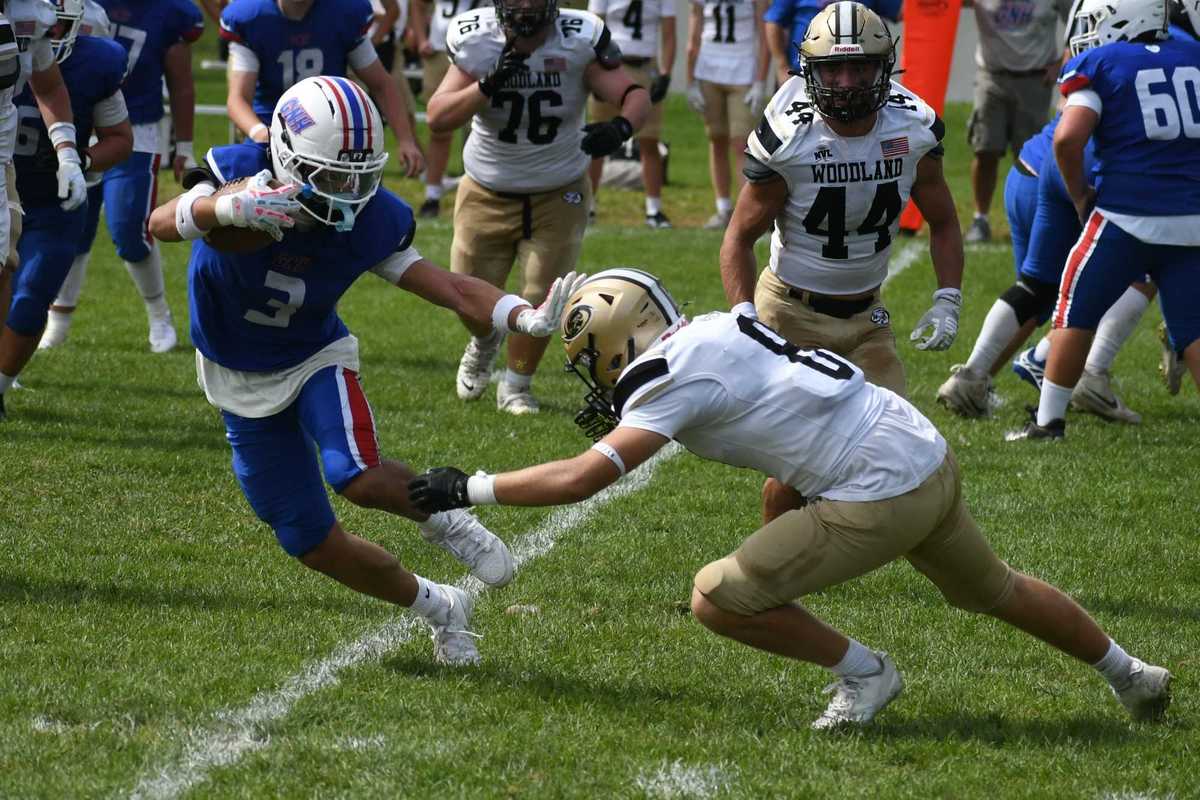
Airyn Berube stiff arms Breyden Lango
Riley Klein
The young GNH squad got valuable experience against a quality opponent in the season opener. In team totals, the Yellowjackets rushed for 208 yards and passed for 54 yards.
Woodland, coming off an undefeated regular season in 2025, took an early lead against GNH and ran up the score. Woodland's quarterback Evan Mastropietro threw two touchdowns and rushed for a third. Justin Pringle also completed a trifecta with a rushing touchdown, reception touchdown and an interception returned for a touchdown for Woodland.
The game was played at Van Why Field in Winsted on a partly cloudy afternoon. It was about 72 degrees at kick-off time.Woodland scored four unanswered touchdowns in the first 10 minutes of play, starting with a 10-yard run by Pringle, then a 59-yard interception return by Pringle, then a 15-yard rush by Colby Marsan and a 60-yard pass from Mastropietro to Ryan Kenney.
GNH got on the board late in the first quarter when Airyn Berube rushed to the right and broke away for a 56-yard dash to the end zone. GNH often used a jumbo package with a full house in the backfield -- a familiar setup for coach Scott Salius and one the team leaned on last season.
Woodland added to its total with a 55-yard QB sneak by Mastropietro to bring the score to 35-7 at the end of the first quarter.
Woodland scored a pair of touchdowns in the second quarter. First, Marsan capped off a long drive with a 2-yard run and then Pringle caught a 15-yard touchdown pass near the end of the half.
The Gilbert School marching band offered a preview of its seasonal routine at halftime, performing a steampunk‑inspired show centered around a large mechanical clock in midfield.
Due to the lopsided 49-7 score, the referees allowed the clock to run in the second half. After a scoreless third quarter, Woodland scored on the first play of the fourth quarter -- a 75-yard run by Daniel Keogh to bring the score to 56-7.
GNH strung together a long drive through the rest of the fourth quarter that brought the Yellowjackets right down to the goal line. As the clock expired, a last‑ditch throw hung over the end zone before the defense rose up for an interception.
Friday night football is coming to Falls Village for GNH's next game, which will be played at Housatonic Valley Regional High School. The Yellowjackets are scheduled to host the Granby/Canton co-op team Friday, Sept. 18, at 7 p.m
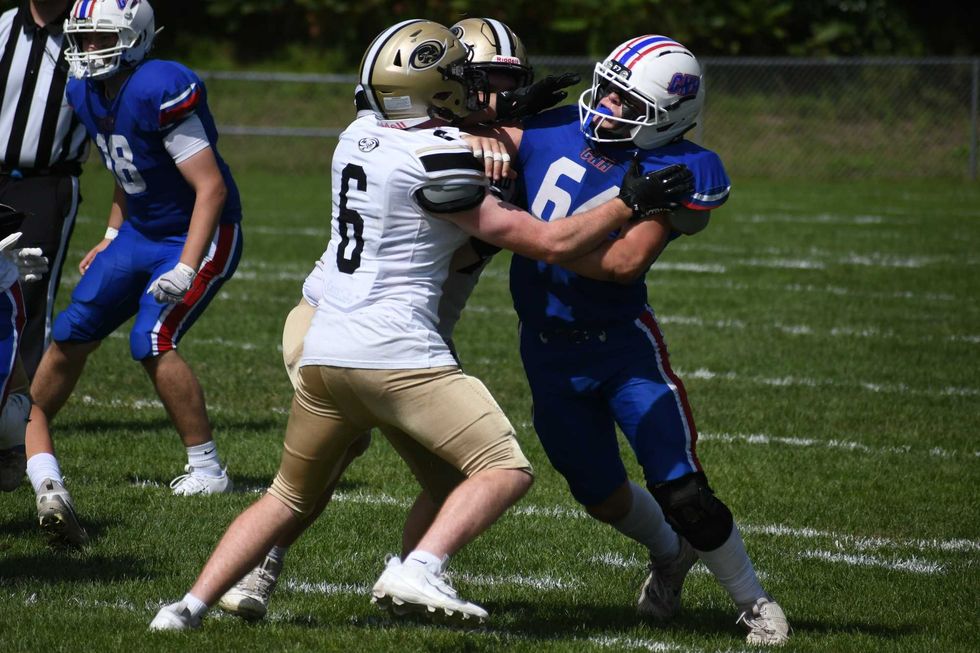 Carson Riva battles a double teamRiley Klein


Want more of our stories on Google? Click here to make us a Preferred Source.