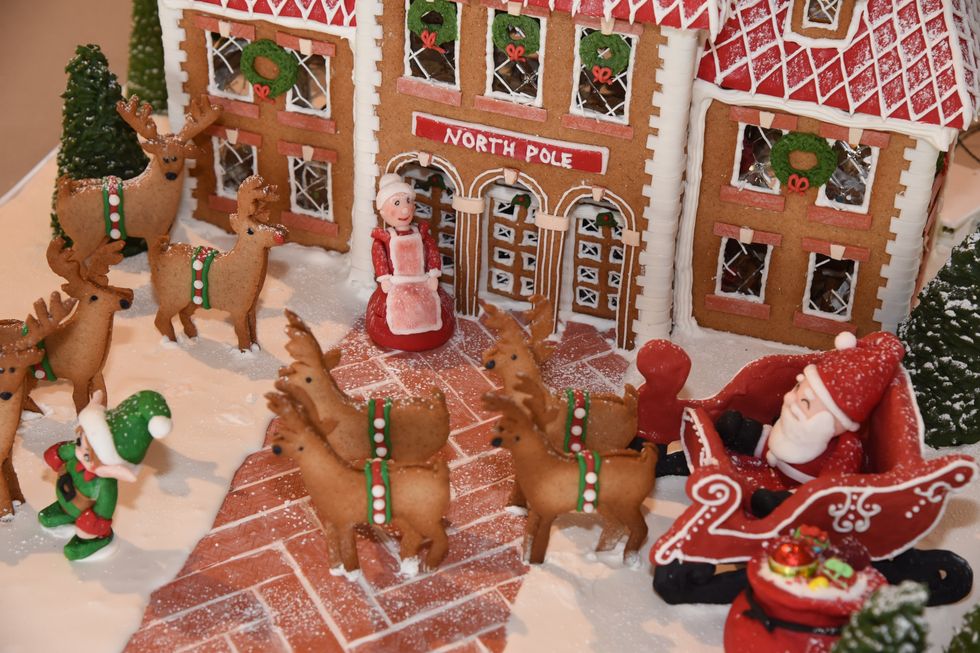
Gingerbread houses can be fun and simple or over-the-top elaborate; you can bake the cookies from your own dough and assemble them yourself or you can buy any of a dozen or so easy-to-find gingerbread kits.
No matter how you get there, it’s all fun — and what evokes childhood fantasy more than being able to eat a house?
Of course, the most eye-catching cookie houses are more in the look-but-don’t-lick category. This is largely the case with the elaborate constructions featured each year in the Kent, Conn., Chamber of Commerce Gingerbread Festival.
The Kent festival claims to be one of the biggest in Connecticut. It opens this week on Friday, Nov. 27, and will remain on display through the month of December. This year the cookie constructions are arrayed in a gallery space at the Kent Town Center at 25 N. Main St., perfect for socially distant viewing.
The “Ginger Girls” will as always create a simple puzzle that visitors can solve as they admire the cookie scenes.
Get more information and a “taste” of what was on display last year online at www.kentctgingerbreadfest.com. You can also go to www.facebook.com/kentgingerbread or call 860-592-0061.
The Kent houses are large-scale and pretty sophisticated. For those who are new to the gingerbread arts and just want to have a little creative fun, the Warner Theatre in Torrington, Conn., is sponsoring a contest for bakers between the ages of 8 and 17.
The rules say you need to design, build and decorate your own house, which implies that you also need to bake your own cookies. You then need to shoot and submit a brief video, one that is 45 seconds or shorter, with a little information on your inspirations and your process.
There isn’t a lot of time left to make plans; participants have to register by Tuesday, Dec. 1. Send an email to Isabel Carrington at icarrington@warnertheatre.org; include your name, age and town.
Completed video entries must be sent and received by email by Tuesday, Dec. 15. Prizes will be awarded for the most creative and unique design(s); the winners will be featured on the theater’s social media.
In this age of the instructive online video, you probably can figure out pretty quickly how to best build a cookie house. If you want a recipe that is as delicious as it is sturdy, try the one from children’s book author Cynthia Rylant, on this page. It is included in her book “The Cookie-Store Cat.”
The dough requires some effort, as is true with all gingerbread cookie dough. It must be refrigerated overnight, so don’t wait until the last minute.
To hold the cookie walls together requires some patience and finesse. The legendary baker Patsy Stroble of Kent, Conn., taught a gingerbread workshop many years ago in which she recommended “gluing” two walls together at a time with royal icing and leaning them against a soup can while the “glue” dries.
But again — this is why we have YouTube.
Gingerbread cookie dough
From Cynthia Rylant’s “The Cookie-Store Cat”
1/2 cup butter, soft
1/2 cup sugar
1 egg
1/2 cup molasses
1 Tbs. vinegar
2 1/2 cups all-purpose flour
1 1/2 tsp. ginger
3/4 tsp. baking soda
1/2 tsp. cinnamon
1/2 tsp. cloves
1/4 tsp. salt
Cream the butter and the sugar. Beat in the egg, molasses and vinegar. Sift the dry ingredients and blend them into the creamed mixture. Don’t overbeat the dough, not only so it remains tender but also so you don’t burn out the engine on your mixer.
Separate the dough into three parcels, wrap them in plastic wrap and refrigerate them for three hours or overnight.
When you’re ready to bake, you’ll want to be prepared not only to cut out your shapes but also to get them in the oven fairly soon. Preheat your oven to 375 degrees. If you can, have at least two cookie sheets ready. You can grease them but you’ll be much happier if you line them with parchment paper instead.
Gingerbread cookie dough is easiest to work with when it’s cold; that’s why you have three separate packets: Work on one at a time and leave the rest in the refrigerator.
There are two ways to cut your shapes: before you bake or after you bake. Cookie dough responds unexpectedly to heat, so if you cut your shapes first, they’ll puff up and distort slightly as they bake. This can be fine, depending on your design (it’s best if you know what your design is before you start to bake).
The other method is to roll the dough out in sheets and then cut your shapes the instant you take the cookies out of the oven. This will give you sharper edges but is fairly difficult to do.
I have historically made mini gingerbread houses, using playing cards as my shape guides. Each wall is one card. Cut one card in half lengthwise and use the halves as the guide for your two roof sheets. Cut another card in half the other way to make the front and back walls that hold the two larger walls together.
You are better off decorating the pieces before you try to glue the house together, in my experience.
Once you’ve figured out your walls, cut your cookies and bake them for about 5 or 6 minutes. If you roll them out and then cut them on the parchment paper it’s very easy to lift the parchment sheet from your worktable and put it on the cookie sheet.
To make the royal icing, combine one egg white with 2 cups of confectioners sugar and the juice of half a lemon. The easiest way to get the icing onto your cookie walls is to carefully scoop it into a sturdy plastic bag. Cut off a tiny bit of the tip of one bottom corner of the bag and gently squeeze the icing out, as you would with a pastry bag. Make sure the top of the bag is sealed shut so the icing doesn’t come up out of the top.