Thank you, Facebook. You have uncovered a secret that’s haunted us for some 35 years. What ever happened to Suwit?He was a little boy from Thailand who rounded up all the frogs in the creek that flows behind our old farmstead, smashed their heads against a rock, then cooked and ate their legs.I didn’t know any of the frogs personally, but I so much enjoyed listening to them sing “rib it, rib it, rib it,” the frog melody that lulled me to sleep.We didn’t admonish the Thai boy, Suwit Soothijirapan, because he was our guest, sent to live with us by AFS as part of their international student program to familiarize foreign students with the real, not the Hollywood, version of America.As best as we could determine, Suwit came from a town about 100 miles north of Bangkok and lived in a house on stilts with farm animals underneath. He arrived with a small suitcase with one change of clothes for the year.At first he got along famously with our eldest son, Jonathan, until Suwit discovered that he was older than Jon. Apparently he believed that you don’t hobnob with anyone younger than you. Then Suwit became mysterious with my wife. When she asked him a question he would spread his arms out, look upward and say: “The answer is written in the wind!” Alas, there’s just so much of that you can take. (Today when I turn on the GPS in my car, the answer really is written in the wind!)Sadly, we got the idea that Suwit was not the least bit interested in learning about any of our American ways. And he didn’t make much attempt to give us a true understanding of what it meant to live in a little village way far away from one of the world’s most interesting cities.So when it came time for Suwit to return home there was no jolly going-away party, no urging him to send us his address and keep in touch. He just vanished out of our lives like a gust of wind.Thus you can understand the absolute shriek of incredulity when awhile back our daughter Ann called to tell us that she had a message on Facebook from Suwit. He said he had been following our family all these years, knew about our son, Adam, who died at age 36 from skin cancer, everything.I must be a late bloomer because I have only just started messing with Facebook but I found Suwit’s picture and message. He is a handsome man in his early 50s and has been serving as a diplomat for his country. His latest assignment was in the tiny, relatively new country of Timor.You’ve all heard of Timor, right? Maybe not. Our 22-year-old grandson not only never heard of Timor but barely knew about the mutiny on the Bounty, the most storied mutiny in the history of the British Navy.You remember how Fletcher Christian, leader of a mutiny on the British ship Bounty, set Captain Bligh and 35 crewmen, who remained loyal to him, adrift in a long boat and wished them well?Christian returned to Tahiti to pick up a dozen or so Tahitian women and then vanished off the face of the earth when he sailed the Bounty to Pitcairn Island. The island was a perfect hideaway because it had been misplaced on everyone’s maps of the South Pacific.Bligh meanwhile was trying to find an island refuge where he could put in to await rescue by the British Navy. There were several islands not too far from Tahiti but Bligh claimed he heard the natives were cannibals.So he sailed on and on and on. When he and his men ran out of food and water they fished and caught birds. After an incredible voyage of 3,000 miles in the small open boat, Bligh and his desperate crew landed at, ha, you guessed it, the island of Timor!And so now the story comes full circle. I sent Suwit a Facebook message asking him if there was a plaque on a rock or building in Timor telling of Bligh’s record-breaking voyage. Suwit answered me, but in Thai script, which I am not able to translate.I guess I won’t really ever know. Mayhap I should look to the sky on a windy day. Freelance writer Barnett Laschever, the curmudgeon of Goshen, has taken to watching top chefs creating fancy dishes on the Cooking Channel. He’s waiting for Bobby Flay or Wolfgang Puck to prepare before his very eyes a gourmet dish of frog’s legs.
Latest News

The organic runway at HVSFW puts sustainable style among the apple trees at Stone Ridge Orchard.
Jay Ballesteros
That’s the question behind Hudson Valley Sustainable Fashion Week[end], a two-day celebration of sustainable style, local makers and the possibilities of keeping clothing in circulation. The weekend lands at Stone Ridge Orchard, a 200-year-old working farm, on Sept. 25 and 26, pairing an evening fashion show with a new all-ages Slow Fashion Fair.
“To me, slow fashion means intentional fashion. Careful, thoughtful, human,” said Joanne Louis-Paul, the event’s communications director. “Slow fashion is the speed at which one person can sew an intricately detailed dress. It’s taking the time to go to a thrift store or clothing swap and sifting through an unknown bounty of possibilities. It’s extending the life of a piece of clothing for as long as possible.”
In everyday terms, she said, “It’s stopping to think before purchasing anything or giving anything away.”
Friday’s fourth annual Organic Runway brings Hudson Valley designers to the farm for a sunset showcase of garments made from repurposed textiles and produced locally. Designers include Clare Bare, ennui, Kacy Coyle, KNUD, la vie après l’amour, Last Night on Earth, So Vicki and Touch Threads. The evening runs from 4 to 8 p.m., giving attendees time to pick apples and sip local cider before settling in for the runway.
“We’re all about the whimsy here at HVSFW,” Louis-Paul said. “The runway is so incredibly dreamy. Being outside makes for an unpredictable, one-of-a-kind backdrop every year, and there’s just nothing like that sunset glow.”
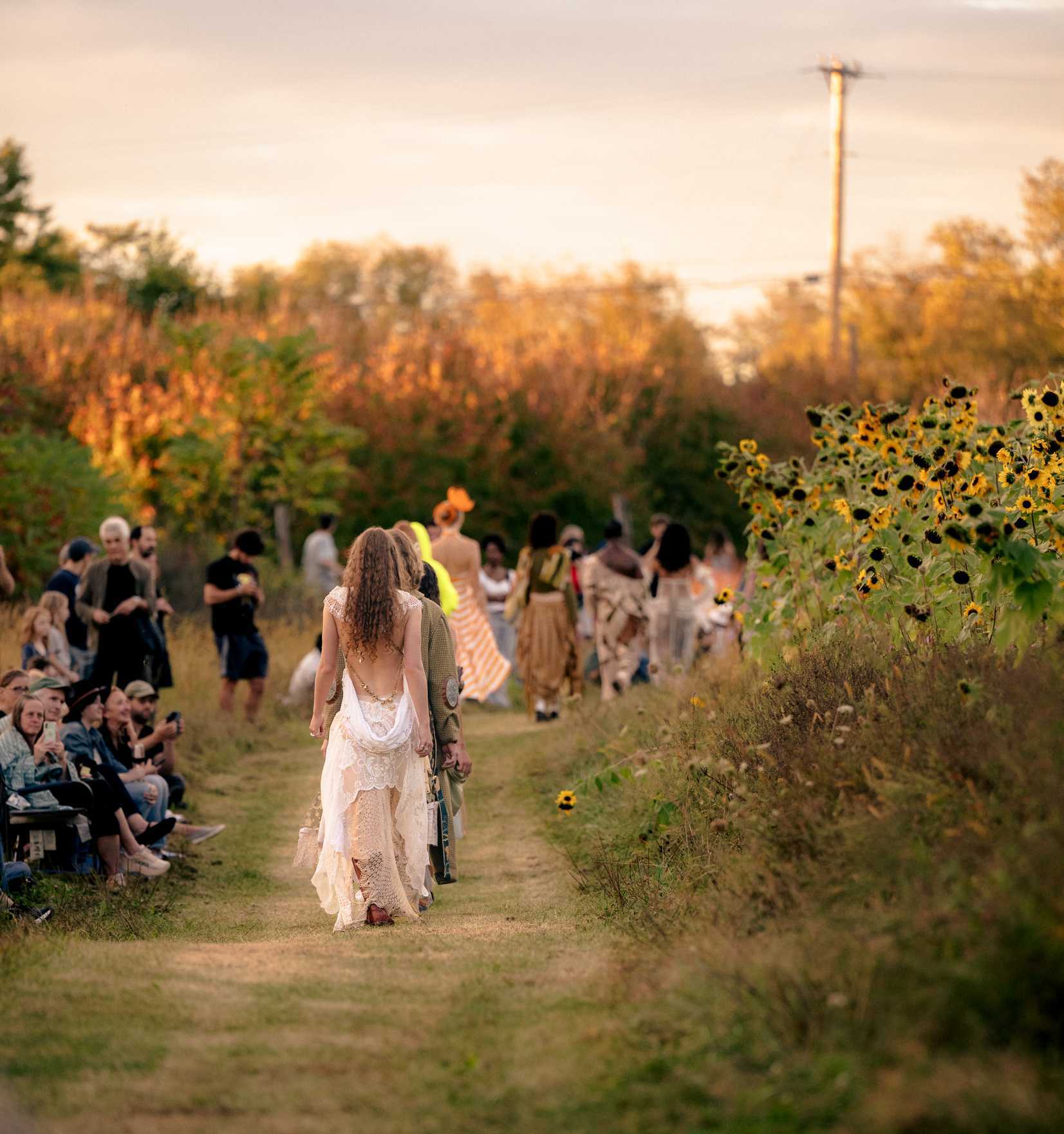 Models walk the organic runway at HVSFW. Ilan Harel
The unlikely pairing of fashion and farming is also part of the point.
“Once you’re sitting amongst the apple trees, you realize how much sense it makes to mend the relationship between fashion and nature,” she said.
Saturday introduces the inaugural Slow Fashion Fair, from 11 a.m. to 5 p.m., with workshops, mending, fiber art, vendors, music, eco-friendly kids’ crafts and a clothing swap. There will even be sheep.
“We wanted to have a fair so we could invite more people in the eco-friendly ecosystem into the fold,” Louis-Paul said. “We get to highlight not only designers, but makers and artisans of all kinds.”
The organizers hope the fair appeals not only to people already thinking about climate and sustainability but also to those encountering the ideas for the first time. With mending, a clothing swap and hands-on workshops, the emphasis is on showing visitors things they can actually do.
“There are so many things anyone can start doing today,” Louis-Paul said. “From something as simple as sewing a patch onto a stain or tear to hosting a mini clothing swap at your house with friends and family, there are tons of ways to engage with your wardrobe more thoughtfully.”
She speaks from experience. Before becoming involved with the event, she said, secondhand shopping held little appeal.
“As someone who never liked the idea of thrifting, I am now completely sold on circular fashion,” she said. “I recently sewed a broken strap on a dress I got at a clothing swap, and I felt so accomplished! Being in this world has shown me that conscious consumption is attainable and fun.”
But behind the fun is a serious concern about what happens to clothing once consumers decide they no longer want it.
“Just because you throw it away doesn’t mean it goes away,” she said, pointing to discarded clothing accumulating in other parts of the world and the microplastics shed by synthetic fabrics. “The planet and people are suffering because of this throwaway culture we’ve adopted. If an outfit is new but super cheap, believe there’s a high cost to someone else.”
For more information and tickets, visit hvsfw.org
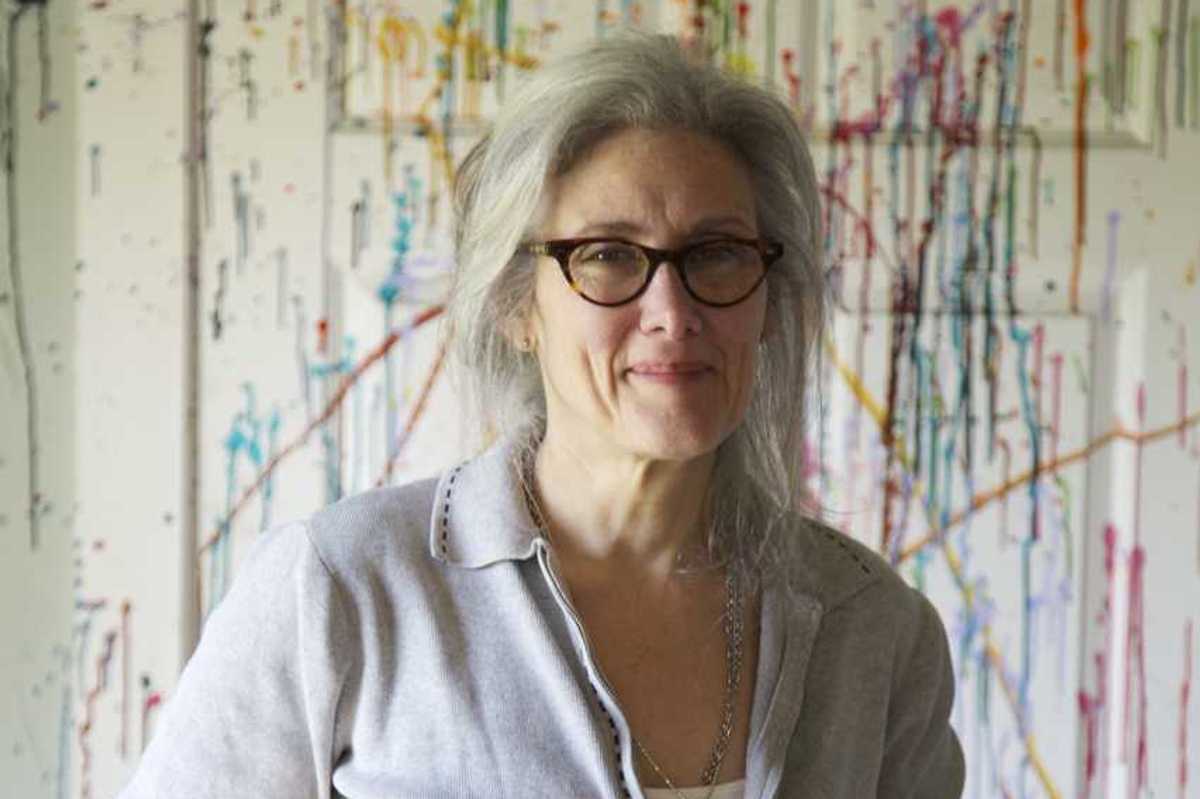
Susan Schneider, owner of Shandell’s in Ashley Falls, in her studio.
Susan Schneider, owner of Shandell’s in Ashley Falls, in her studio.
She has been creating lampshades for 25 years and has settled in Ashley Falls, where she is renovating a barn behind her house for a larger studio. Her mission: “Changing the view on plain white lampshades, one at a time!”
Besides using marbled paper, she uses papyrus, silk and hand-painted papers for the shades.
Shandell’s on Main Street, offers a large selection of marbled decorative home items on its website — trays, coasters and bookends, to name a few — as well as scarves and belts. Schneider will also customize items and creates custom wallpaper, gifts and favors for weddings and special events. She offers consultations by appointment.
Schneider explained how she began making lampshades.
“I was in business as an antiques and textile dealer, needing lampshades at the time (the early 1990s). I had a dealer who used to make lampshades. She was moving and sold me everything she had in her barn for making them. Arcs, templates for lampshades, and tools.”
Schneider used the marbled paper from the endpapers of old books to make small lampshades.
“I collected those voraciously.”
The papers were too small for the larger lampshades she wanted to make. To get paper in the size she needed, she decided to learn how to marble.
That was 10 years ago. She now has 20 tanks for marbling, including one 10-foot tank that allows her to make 3 yards of fabric at a time.
As she demonstrated the marbling process, making covers for journals, it was easy to see why she “got hooked.”
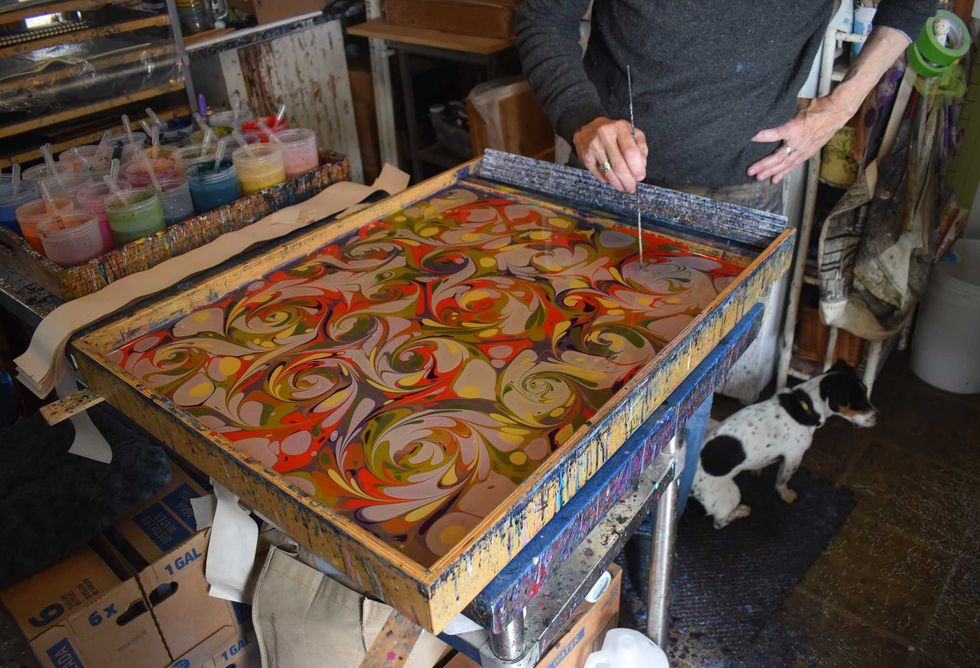 Susan Schneider, owner of Shandell’s, creates a variety of products with marbleized surfaces in her Ashley Falls studio.L. Tomaino
She explained that marbling takes a couple of days of preparation. She prepares water mixed with carrageenan the night before so that it thickens and becomes a viscous liquid onto which the acrylic paints can be dropped. Paper or fabric must also be prepared with alum, which “makes the paint stick,” she said, a day or two ahead of time.
When she was ready to start, Schneider first used a level to make sure the tank was even. Then she pulled a squeegee across the surface of the carrageenan mixture to break the surface tension, followed by strips of newsprint for the same purpose. She also dipped small pieces of newsprint into the mixture.
“The hardest thing to teach people is to break the surface tension first,” she noted.
Next, she used droppers to place rows of paint onto the mixture.
“It’s a joyful process,” she said as she chose more colors. “It’s totally the pleasure of the colors.”
She explained, “The colors are stopped from spreading by the surface tension.”
Then she added newsprint around the edges of the tank to break the tension again and added another layer of color. Next, she used a marbling comb, slowly dragging it back and forth across the width of the tank to create a feather-like design.
Combs come in many sizes, with teeth spaced at different intervals and in different patterns. She chose another comb to drag through the length of the tank, making the design more intricate before laying two pieces of paper on the surface. After a second or two, she lifted them, perfectly capturing the pattern, and carried them to the sink for a rinse with water.
Once she squeegeed away the paint left in the tank, she was ready to begin the process again.
Next, she created a different type of design, dripping colors in a less ordered array, then twirling them into curving lines and circles with a thin rod.
When the surface was ready, she laid a journal cover on top, then lifted it out, covered in a vibrant pattern of swirling colors.
For observers, the process can seem magical.
Schneider loves to share the delight of marbling by teaching classes at Dewey Hall in Sheffield. Upcoming classes will be held Nov. 20, 21 and 22. Beginning in November, she will also offer private classes in her home studio. Schneider had never pictured herself having a business like Shandell’s, but she discovered a passion for creating, as she says, “things that make you smile.”
For more information about her work and upcoming classes or to contact her for a consultation, visit shandells.com.

Want more of our stories on Google? Click here to make us a Preferred Source.

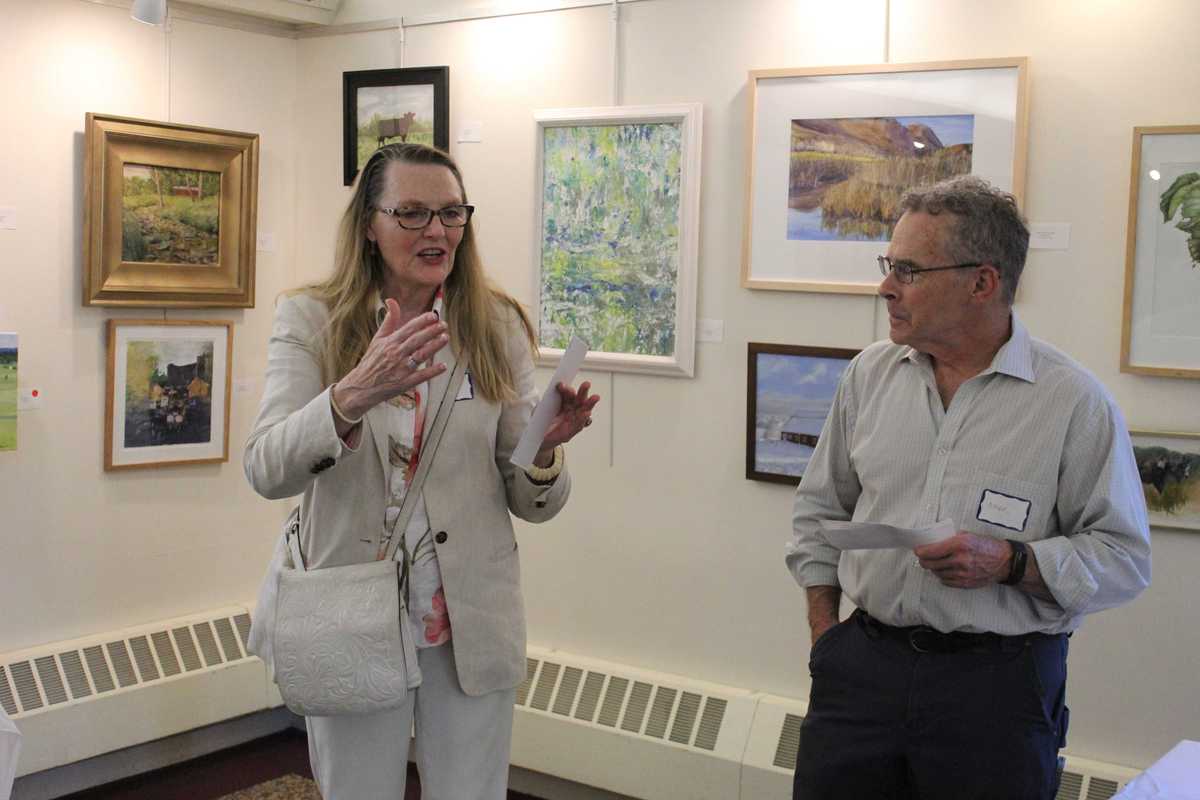
Muriel Stockdale, left, and judge Roger McKee during the awards announcement at the juried art show at Trinity Episcopal Church. Stockdale\u2019s \u201cKevin\u201d was the second place winner.
Patrick L. Sullivan
Organizer Theresa Kenny said the show attracted some 66 artists, 10 of whom were new to the show.
Judge Roger McKee, who recently retired as an art teacher at Salisbury School, said of the winning work, “The technical mastery here is overwhelming.”
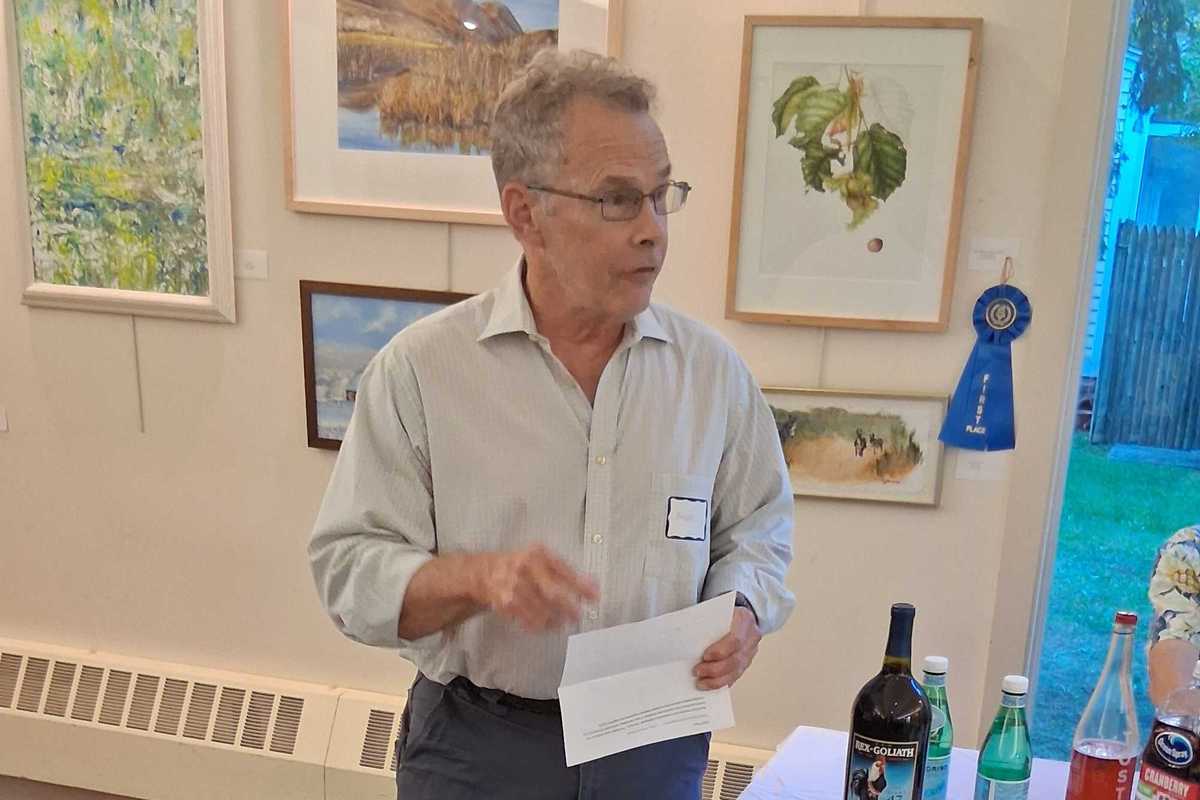 Roger McKee naming the winners with the first place entry over his left shoulder. Patrick L. Sullivan
Hwang was unable to attend the reception, but the second- and third-place finishers were on hand.
Second place went to Muriel Stockdale’s “Kevin.” McKee said the piece “has just enough to be compelling without getting too caught up in the details.”
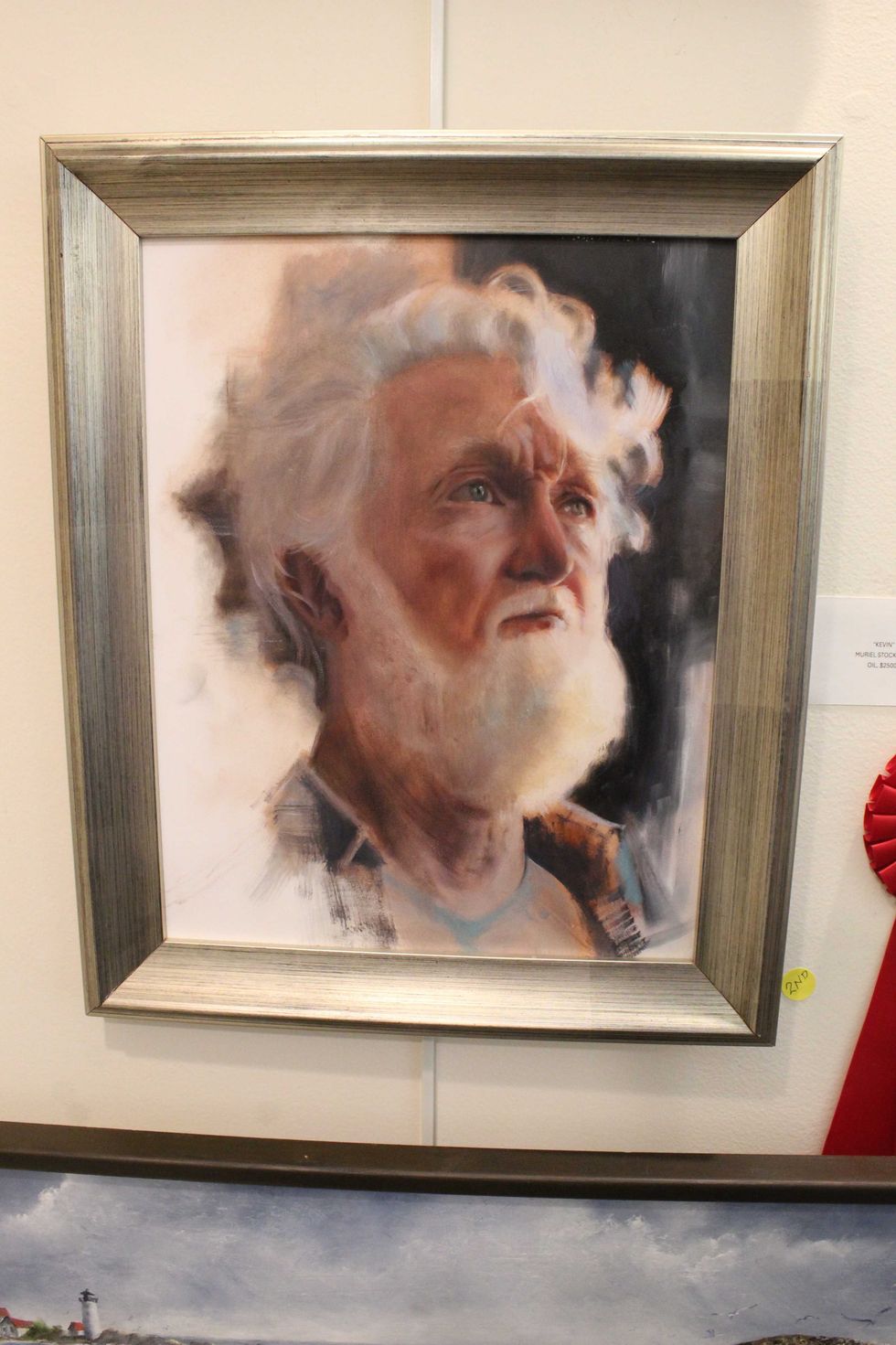 Muriel Stockdale’s “Kevin” took second place in the juried art show at Trinity Episcopal Church.Patrick L. Sullivan
Joan Macfarlane’s “Branching Out” was the third-place winner. McKee described the piece as “a compelling balance of realism and interpretation.”
McKee and Emily Cox served as judges. Cox could not attend the reception, but McKee said they began their work by looking at the entire show, then went through it a second time, taking photos with their phones of the standout pieces before comparing notes.
“There was a lot of overlap,” he said. “We argued a little bit and then came to an agreement.”
The show is open for viewing Saturday and Sunday, Sept. 26 and 27, from noon to 4 p.m.

Want more of our stories on Google? Click here to make us a Preferred Source.