

Electrathon Challenge brings purring race cars

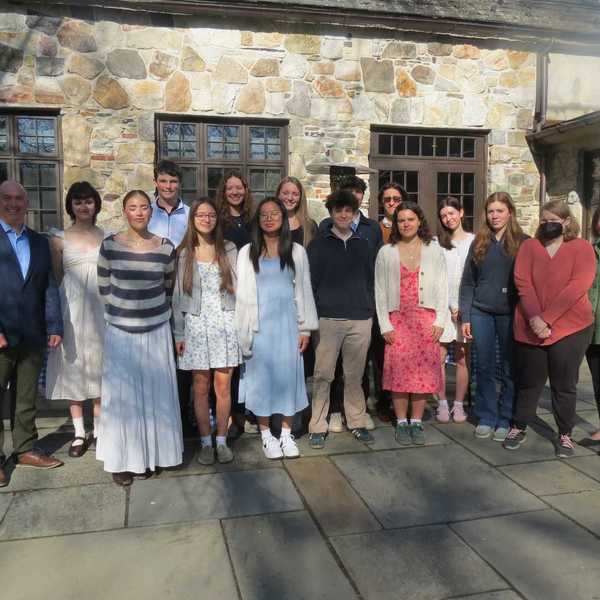
LIME ROCK — It was a pep rally, of sorts. Students from all over the state traveled to the race track at Lime Rock Park on Friday, Oct. 30, to take part in the autumn edition of the Connecticut Electrathon Challenge. Only 13 cars were entered this time; the big race is in spring, when about 35 of the peppy little electric cars whiz silently around the track.  Someone noted that, “If this is what the future is going to be like, it’s going to be awfully quiet.â€

The cars are powered by regular car batteries, usually two. The combined weight of the batteries can’t exceed 64 pounds, according to the national Electrathon rules. Weight is an important element in this contest.

There isn’t a weight requirement for the car but there is a rule that says the driver must weigh at least 180 pounds. All of the drivers are juniors or seniors in high school, and all must be small enough to fit in the tiny cockpits of their mean machines — all of the drivers in Friday’s competition had to carry metal ballast; and when they stopped to change drivers halfway around the course, each driver had to be weighed, with ballast, immediately by race officials.

A race of ratios

One would think that there would be fierce competition among the students to get a chance behind the wheel of the car. But in fact, most teams have trouble finding someone to pilot the team vehicle. All drivers must have a valid driver’s license, and many of the team members are just old enough to have a permit.

All the participants stressed, however, that this race doesn’t really glorify the driver. The cars aren’t moving at breakneck speed; 35 mph is pretty much the maximum. And while there is some passing on the curves and in the straightaways, it’s fairly quiet and contained. There are no squealing tires in the Electrathon Challenge.

There is a great deal of discussion on the sidelines about ratios, however. This race is in many ways as much of a contest for math-letes as it is for race cars. The winning car is not necessarily the one that stays ahead of the others in the pack; it’s the car that completes the most laps around the Park’s upper auto cross .2-mile track  in the one-hour time limit.

Often, there is only one car still standing at the end of the hour. Students have to figure out how all the different parts of the car will work together to bring them a victory. A car that goes too fast, for example, can eat up all its battery power.

Slow but steady

Students from Nonnewaug High School were taking a tortoise-and-hare approach to piloting their vehicle around the track on Friday morning. James Whyte, president of the Nonnewaug Electric Car Club and a high school junior, was sanguine as his club’s diminutive racer glided around the course.

“A few other cars have passed us but we’re OK with that,†he said. “Our car can go faster, we’re pacing ourselves.â€

Although Nonnewaug has not yet won an Electrathon, Whyte said his club is continually refining its vehicle, trying new motors and better body parts. In spring, the eight-year-old car lasted longer than it ever had before.

“But at 45 minutes one of the tires popped,†Whyte said. If not for that unexpected equipment failure, the car probably would have lasted 55 minutes, he said.

There were two heats, if such a word can be applied to cool little cars traveling silently along at low speed. The ultimate winner was Nathan Hale Ray High School in East Haddam. The school brought two cars; the winning vehicle went 119 laps (or 23.8 miles).

In addition to Nonnewaug, the other schools that raced were Lyme-Old Lyme High School, Somers High School, Farmington High School, Cheshire High School and Old Saybrook High School.

But in many ways, last week’s competition was really just a preliminary event, a warm-up to the big race in spring. Several schools came out on Friday just to watch, and learn. They will spend the comingmonths preparing cars of their own. No date has been set yet for the spring race, but it will be held at Lime Rock Park, which has hosted the Connecticut Electrathon since its beginning in 2001. At that race, there wil be entries from all over New England.

No local schools participate in the Electrathon, yet. Students at Housatonic Valley Regional High School are more involved in the national FIRST Robotics program and in the  environmentally oriented Envirothon.

Area private schools have come to watch the challenge, but none has brought a car.

Each student has a value

The Connecticut Electrathon is organized and managed by Mike Grella, a recently retired tech-ed teacher who taught at Terryville and lives in Litchfield. He now travels around the state, showing schools how to start an Electrathon team of their own (contact him at ths_solar_team@yahoo.com or 860-309-7954).

For Grella, the Electrathon is above all a teaching opportunity. It not only helps students understand the technology and logic of electric vehicles, which are likely to be the automotive future; it also teaches them about teamwork, respect and cooperation, he said.

Perhaps most important, it offers non-athletes an opportunity to take part in a team and take pride in their abilities, whether they are good with their hands or mathematically gifted.

“You see that each student has a value,†he said.

The cars themselves have a value, too, of course. Grella estimated that it costs about $2,000 to build a car. Part of the Electrathon challenge is that students have to raise funds for their cars; the same car can also be used year after year, although modifications are usually added by the students.

Many teams also have multiple vehicles. Of the seven schools that competed Friday, four had more than one car.

Some teams have sponsors. Nonnewaug is sponsored by EMS Pabst, a company that makes motors for industrial-sized fans. But fundraisers are still needed; most recently, the students hosted a successful videogame fundraiser.

Few of the teams come from large schools with fulsome budgets. The winning team, Nathan Hale Ray, has a population of only about 400 students.

A real electric racer

The teams at last Friday’s event got a glimpse of the future: Parked on one side of the field was a racey-looking maroon sports car, its hood and trunk open, its top down.

Lying on the grass behind the car were the electric cables used to charge up the cars batteries.

Mark Wilson of Farmington brought the vehicle so the students could see it, touch it and admire it. Wilson made his fortune in a variety of enterprises, including power plants and a chain of liquor stores. He now mainly does charitable work. Most of the time, he still drives a battered pickup truck. But on Friday, his pickup towed an electric Tesla sports car that he bought after his niece took part in the 2003 Electrathon, driving for the Farmington High School team.  

The car cost him $145,000, he said.

“But it only costs me about $4 to recharge the batteries,†Wilson said. The car can travel at speeds up to 130 miles per hour (“It pins you to the back of the seat as it accelerates,†he said) but it only travels about 180 miles before it needs to be recharged. Wilson said he can only travel about 60 miles at a time (“you have to save enough power so you can get back home againâ€) but he doesn’t mind. He’s already ordered a Tesla sedan.

The Connecticut Electrathon Challenge is sponsored by Lime Rock Park; the Wicks Group, PLLC; the Diebold Foundation; and Central Connecticut State University. To find out when the spring event will be scheduled, visit limerock.com or contact Grella at ths_solar_team@yahoo.com.

Latest News

Living art takes center stage in the Berkshires

Contemporary chamber musicians, HUB, performing at The Clark.

D.H. Callahan

Northwestern Massachusetts may sometimes feel remote, but last weekend it felt like the center of the contemporary art world.

Within 15 miles of each other, MASS MoCA in North Adams and the Clark Art Institute in Williamstown showcased not only their renowned historic collections, but an impressive range of living artists pushing boundaries in technology, identity and sound.

Keep ReadingShow less
Persistently amplifying women’s voices

Francesca Donner, founder and editor of The Persistent. Subscribe at thepersistent.com.

Aly Morrissey

Francesca Donner pours a cup of tea in the cozy library of Troutbeck’s Manor House in Amenia, likely a habit she picked up during her formative years in the United Kingdom. Flanked by old books and a roaring fire, Donner feels at home in the quiet room, where she spends much of her time working as founder, editor and CEO of The Persistent, a journalism platform created to amplify women’s voices.

Although her parents are American and she spent her earliest years in New York City and Litchfield County — even attending Washington Montessori School as a preschooler — Donner moved to England at around five years old and completed most of her education there. Her accent still bears the imprint of what she describes as a traditional English schooling.

Keep ReadingShow less
Jarrett Porter on the enduring power of Schubert’s ‘Winterreise’
Baritone Jarrett Porter to perform Schubert’s “Winterreise”
Tim Gersten

On March 7, Berkshire Opera Festival will bring “Winterreise” to Studio E at Tanglewood’s Linde Center for Music and Learning, with baritone Jarrett Porter and BOF Artistic Director and pianist Brian Garman performing Franz Schubert’s haunting 24-song setting of poems by Wilhelm Müller.

A rejected lover. A frozen landscape. A mind unraveling in real time. Nearly 200 years after its premiere, “Winterreise” remains unnervingly current in its psychological portrait of isolation, heartbreak and existential drift.

Keep ReadingShow less
google preferred source

Want more of our stories on Google? Click here to make us a Preferred Source.
A grand finale for Crescendo’s 22nd season

Christine Gevert, artistic director, brings together international and local musicians for a season of rare works.

Stephen Potter

Crescendo, the Lakeville-based nonprofit specializing in early and rarely performed classical music, will close its 22nd season with a slate of spring concerts featuring international performers, local musicians and works by pioneering composers from the Baroque era to the 20th century.

Christine Gevert, the organization’s artistic director, has gathered international vocal and instrumental talent, blending it with local voices to provide Berkshire audiences with rare musical treats.

Keep ReadingShow less

Leopold Week honors land and legacy

Leopold Week honors land and legacy

Aldo Leopold in 1942, seated at his desk examining a gray partridge specimen.

Robert C. Oetking

In his 1949 seminal work, “A Sand County Almanac,” Aldo Leopold, regarded by many conservationists as the father of wildlife ecology and modern conservation, wrote, “There are some who can live without wild things and some who cannot.” Leopold was a forester, philosopher, conservationist, educator, writer and outdoor enthusiast.

Originally published by Oxford University Press, “A Sand County Almanac” has sold 2 million copies and been translated into 15 languages. On Sunday, March 8, from 3 to 5 p.m. in the Great Hall of the Norfolk Library, the public is invited to a community reading of selections from the book followed by a moderated discussion with Steve Dunsky, director of “Green Fire,” an Emmy Award-winning documentary film exploring the origins of Leopold’s “land ethic.” Similar reading events take place each year across the country during “Leopold Week” in early March. Planning for this Litchfield County reading began when the Norfolk Library received a grant from the Aldo Leopold Foundation, which provided copies of “A Sand County Almanac” to distribute during the event.

Keep ReadingShow less

Erica Child Prud’homme

Erica Child Prud’homme

WEST CORNWALL — Erica Child Prud’homme died peacefully in her sleep on Jan. 9, 2026, at home in West Cornwall, Connecticut, at 93.

Erica was born on April 27, 1932, in Doylestown, Pennsylvania, the eldest of three children of Charles and Fredericka Child. With her siblings Rachel and Jonathan, Erica was raised in Lumberville, a town in the creative enclave of Bucks County where she began to sketch and paint as a child.

Keep ReadingShow less
google preferred source

Want more of our stories on Google? Click here to make us a Preferred Source.
google preferred source

Want more of our stories on Google? Click here to make us a Preferred Source.