Thank you!
Your support is sustaining the future of local news in our communities.

‘Fields of Snakes’ opens at Standard Space, exploring collaboration and transformation

‘Fields of Snakes’ opens at Standard Space, exploring collaboration and transformation

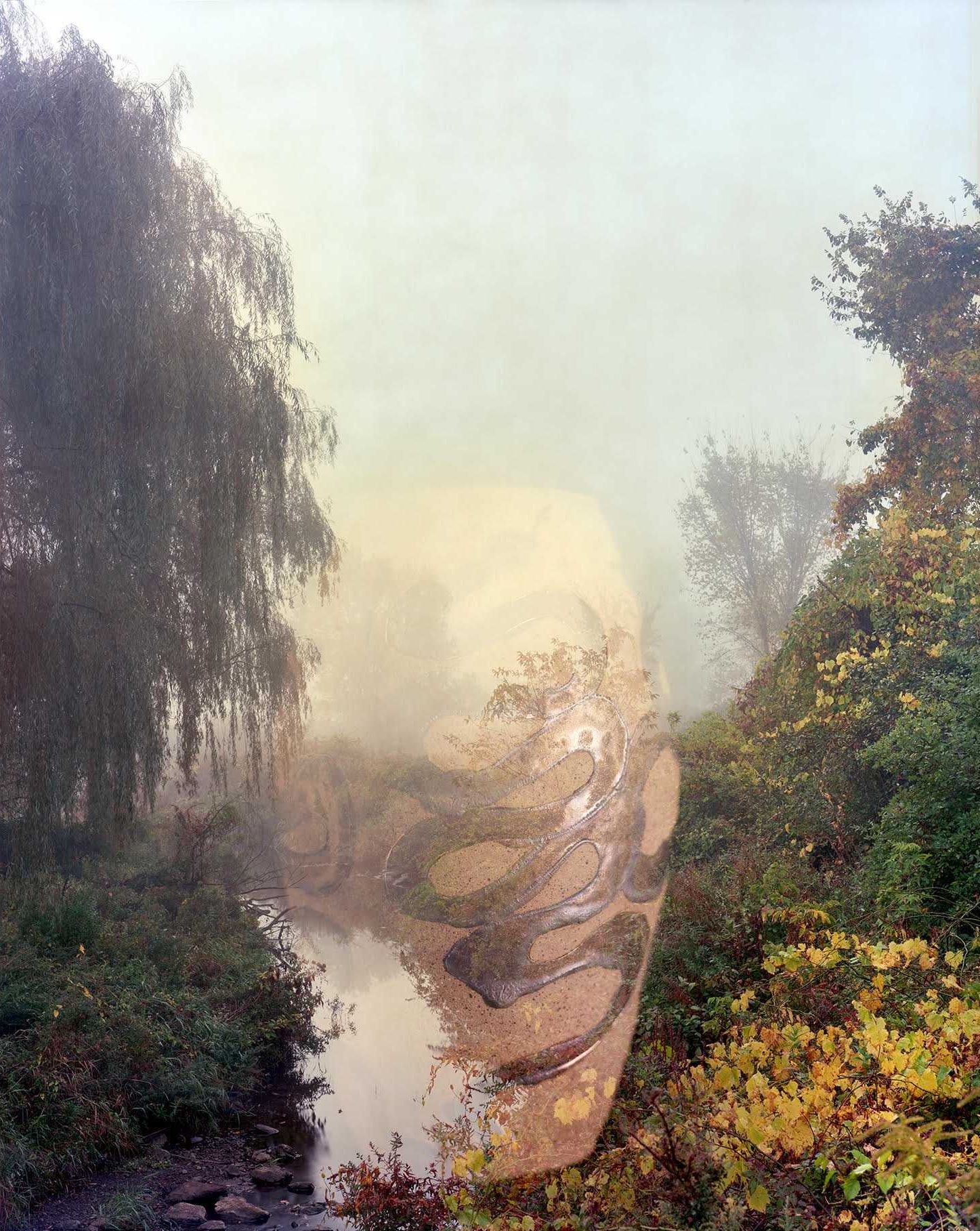
‘Snakes on Downey Rd, Millerton, NY, 2025,’ a pigment print by Theo Coulombe and Eve Biddle, from the series ‘Fields of Snakes.’ Printed from an 8×10-inch color negative on archival rag paper, 32 by 40 inches, 2024.

Provided

Artist and Standard Space founder Theo Coulombe and Eve Biddle, artist and co-executive director of The Wassaic Project, share a fascination with land, body and transformation. Their recent collaboration is culminating in “Fields of Snakes,” opening at Standard Space in Sharon on Nov. 8.

The exhibit features new large-format landscapes by Coulombe alongside a collaborative body of work: photographs of Biddle’s ceramic sculptures placed within the very landscapes Coulombe captures.

Collaboration is central to both artists’ creative lives. Coulombe opened Standard Space in 2017 after decades in Brooklyn’s photography scene and has built the gallery into a space known for its collaborative spirit and sharp curatorial eye. For Biddle, collaboration is practically a medium in itself.

“I love his work,” Biddle said of Coulombe. “It’s so fun to collaborate with someone who thinks about the same things — about land and our physical relationship with land, and our body and looking and appreciating our local beautiful landscape.”

For Coulombe, the process of working with his 8x10 Deardorff camera — a slow, meditative tool — shapes both the work and his relationship to his subjects.

“You become part of the camera,” he writes in his artist statement. “You use a dark cloth and look at the ground glass on the back of — not through — the camera. You become an interior of the eye. You’re upside down and backward… the composition and the groundlessness is the canvas.”

That attentiveness to the natural world complements Biddle’s sculptural practice, which often explores the body and transformation through form and myth.

“The snake is really a symbol of resiliency,” she explained, “our ability to let things go in our lives — to still be the same people but shed what we don’t need. It’s more a metaphor for death and our contemporary experience as humans in our landscape.”

To create the work in Fields of Snakes, Biddle handed her sculptures to Coulombe with complete trust.

“It was all Theo,” she said. “I lent him the pieces and was like, ‘go nuts.’ That’s one of the fun things about collaborating successfully — really leaning into the expertise and skill set of the people you’re collaborating with.”

This show marks Biddle’s first exhibition at Standard Space. “I’ve been a huge admirer of Theo’s program,” she says. “There’s been wonderful overlap between his program and the Wassaic Project. He’s been really open and kind about those connections.”

For both artists, collaboration is a natural extension of how they move through the art world. Biddle describes her practice — from co-founding the Wassaic Project to making ceramics, curating, and building community — as “a big radical collaboration.”

“I don’t love working alone,” she said. “It’s important as creatives to recognize what drains us and what feeds us.”

And because no opening at Standard Space is complete without a touch of community celebration, there will also be a dance party after the opening at Le Gamin.

“We’ll have some purchasable wares as well,” said Coulombe, “like t-shirts, ceramics, and jewelry.”

Coulombe was referring to Biddle’s new limited-edition merch release. T-shirts and sweatshirts will be available only at Standard Space on opening day. They will be available later at the Wassaic Project Winter Wonderland Market which takes place the first two weekends in December.

Fields of Snakes is the 58th exhibition at Standard Space, but in many ways it is a new chapter — a show about reciprocity, risk and the creative ecosystems that emerge when artists trust one another.

As Biddle put it: “I really believe in bringing my full self to whatever I’m doing… and this show feels like a natural extension of that.”


Latest News

Grand jury indicts Cole Bushnell on murder, evidence tampering charges

Cole Bushnell appears in Berkshire Superior Court on Thursday after a grand jury indicted him on charges of murder and evidence tampering.

Madi Long

An Ashley Falls man whose arrest drew attention on both sides of the Massachusetts-Connecticut border has been indicted on charges of murder and evidence tampering in connection with the June 1 killing of Michael A. Moore, a former Falls Village resident.

A Berkshire County grand jury has indicted Cole Bushnell, 41, on charges of murder and evidence tampering in the death of Moore, 40, of Winsted. The evidence tampering count is a new felony charge, with prosecutors alleging that Bushnell attempted to destroy his cellphone following the killing to conceal evidence.

Keep ReadingShow less

Angry bees close Mudge Pond Beach

Angry bees close Mudge Pond Beach

Officials closed the Sharon town beach at Mudge Pond on Wednesday, July 15, after a fallen tree limb exposed a large beehive. The beach is expected to reopen Thursday.

Alec Linden

SHARON – The town beach on Mudge Pond closed on Wednesday, July 15, but the cause wasn’t the smoky haze drifting in from Canadian wildfires – it was angry bees.

According to Sharon’s Parks and Recreation Director Bryan Failla, a large limb fell from an old tree near the lifeguard stand overnight, exposing a hole that houses a large beehive. He said the town made the decision to close the beach Wednesday morning “out of an abundance of caution.”

Keep ReadingShow less
Millerton dressmaker forged path as early businesswoman
Mary Kisselbrack, left, and her husband, George.
Provided

If you’ve driven down Main Street in Millerton, you’ve passed the former home and shop of one of the village’s earliest female entrepreneurs. At a time when most businesses were owned by men, Mary Kisselbrack made a name for herself in the late 1800s as a well-respected milliner and dressmaker.

On April 11, 1891, train conductor George Kisselbrack purchased a 124-by-232-foot vacant lot at 54 Main St. and hired locally renowned builders Beers and Trafford to design what would become their home and Mary’s business.

Keep ReadingShow less
google preferred source

Want more of our stories on Google? Click here to make us a Preferred Source.

Wastewater project coming to fruition after decades of debate

Millerton’s business community will soon see the completion of a public wastewater system, addressing what local officials and business owners have called a major constraint on commercial development in the community for decades.

The $13.8 million project, which is expected to serve the core of the Village of Millerton and a commercial stretch of the Town of North East along U.S. Route 44, represents one of the largest infrastructure investments in the community in decades, and brings an end to calls for a sewer system that stretch back to World War II. Officials say the system will safeguard local waterways while creating a foundation for long-term economic stability.

Keep ReadingShow less
Millerton Moviehouse marks 120 years with structural upgrades

Wooden beams made from tree trunks comprise the load-bearing structure under Millerton’s Moviehouse.

Graham Corrigan

There are a handful of buildings that have stood the test of time over Millerton’s 175-year history. But if there’s one that stands out as a singular representation of the town, it’s the Millerton Moviehouse and its iconic clock tower.

Built in 1903 as a grange hall, it was soon converted into a movie theater with a second-floor ballroom. It was one of a handful of buildings that came to define the town in the following decades, standing tall across the street from the Episcopal Church and Millerton Inn, next to Terni’s, and up the hill from Millerton’s train station.

Keep ReadingShow less
Irondale Schoolhouse: a piece of living history

Ralph Fedele sits at a desk in the historic Irondale Schoolhouse, which he led the effort to relocate to downtown Millerton.

Aly Morrissey
“It was in dire straits. Right on the road, but beautiful. I remember thinking, ‘Wouldn’t that be a great building to move into the village?’” —Ralph Fedele

A one-room schoolhouse sits on Main Street along the Harlem Valley Rail Trail, offering an opportunity for locals and visitors to step inside a piece of living history.

The Irondale Schoolhouse that now sits in downtown Millerton was not originally located on Main Street. The building was first constructed in 1858 along what is now Route 22 in the Irondale section of town, defined by Irondale road and the Old Mill that still sits along Webatuck Creek. At the time, the schoolhouse was one of 14 that served the Town of North East’s children.

Keep ReadingShow less
google preferred source

Want more of our stories on Google? Click here to make us a Preferred Source.

google preferred source

Want more of our stories on Google? Click here to make us a Preferred Source.