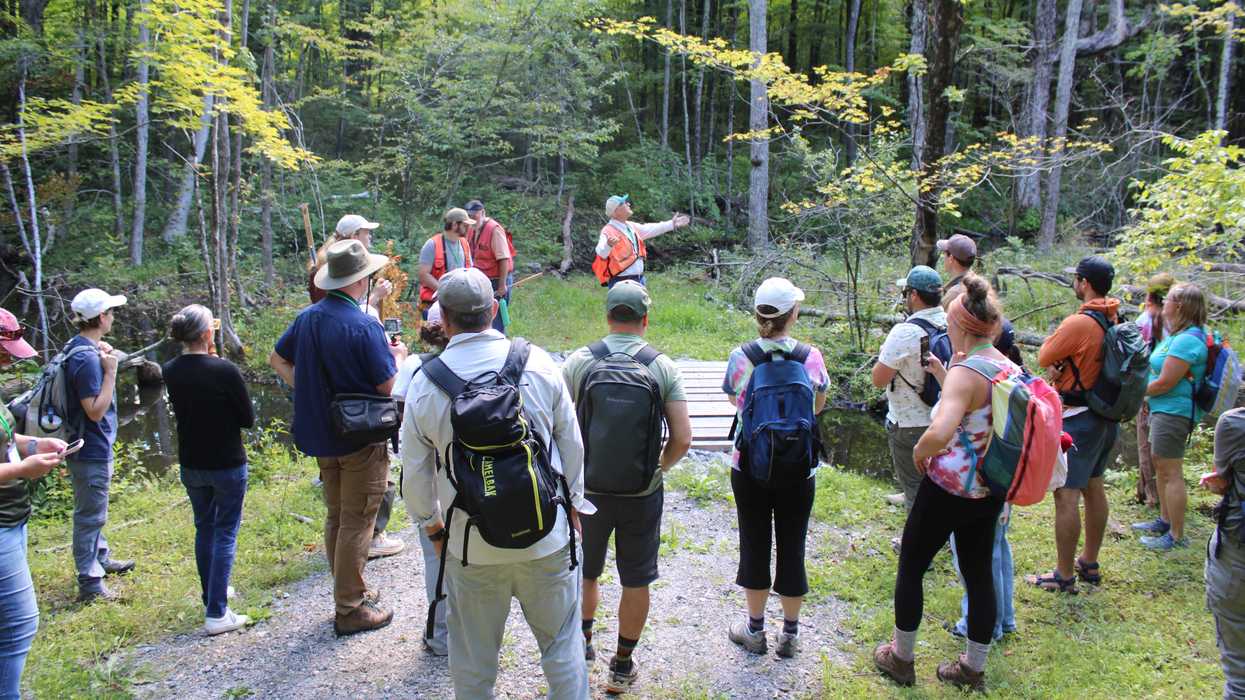
NORFOLK – Deep in the Norfolk woods over the weekend of Aug. 14 to 16, teachers gathered to take lessons of their own.
The three-day Teach the Teachers Forestry Educators Retreat brought 20 educators to Great Mountain Forest for hands-on training in outdoor education and forestry. The participants teach students ranging from kindergartners to adults.
The retreat was organized by Great Mountain Forest, UConn 4-H and the Northwest Conservation District. Great Mountain Forest is a sustainable forestry nonprofit based on more than 6,000 acres of highland forest in Norfolk. UConn 4-H is a youth development organization, while the Northwest Conservation District is a regional nonprofit organization created by state statute to protect agricultural and natural resources. The retreat was meant to bridge the gap between Connecticut’s educators and experts in the environmental field.
The weekend retreat grew out of 10 years of discussions between veteran outdoor educators Audra Leach and Emily Picard, who realized that many of their colleagues needed additional training and professional connections to teach forestry concepts.
“A lot of the teachers that we’ve been working with over the past few years are new to the natural resource career pathway and weren’t comfortable teaching the concepts that we are comfortable teaching,” said Picard during a rare moment of downtime while the group was out in the woods taking a crash course in forestry education from Great Mountain Forest staff.
“Now that we’re in professions outside of the classroom,” she added, “looking back, we wanted to be able to share the network that we’ve established over the years.”
“It’s about closing that gap between education and industry,” said Leach, who was also enjoying a brief rest from the packed weekend schedule, which included seminars, workshops and plenty of networking opportunities with fellow educators and experts.
Leach, who once served as Housatonic Valley Regional High School’s agricultural education teacher, is now program administrator at the Northwest Conservation District. Picard also has an extensive background in agricultural education and is now the Fairfield County educator for UConn 4-H.
“We’re a bridge,” Leach said, “and so everybody that’s running a workshop is an industry professional that has that knowledge to help people bridge that gap and make connections.”
“You don’t get this training in any formal education,” she added later. “It all has to be, I think, passed down from somebody.”
Both organizers said that it’s not only the people but also the place that makes a true retreat.
“It’s kind of a hidden gem in the middle of nowhere,” said Picard of the venue, based at the historic Yale Camp, a rustic, timber-built compound located several miles into the forest off a forestry road usually closed to public access. The camp, which was deeded to Yale University in the 1940s and is regularly used by the Yale School of the Environment, has a history of bringing natural resource educators together, including Leach and Picard themselves.
“We didn’t know we were at the same event,” Leach said as both laughed, “but 20 years ago we were both here for a forestry education event.”
She said the feeling of inspiration she experienced then has stuck with her throughout her career. The two hoped to impart that same inspiration to the teachers attending the retreat and, ultimately, to their students.
“Every kid needs to be inspired by somebody, and that’s what these folks are doing,” said Picard of the attendees.
Both said the remote location, cut off from cell service, allowed the participants to dine, work and learn together while cultivating a true retreat environment.
Leach spoke of an impromptu constellation-naming lesson that sprang up organically around the campfire the previous night. “That type of experience really exemplifies the word retreat,” she said, “and that’s why we called it that—hoping for those types of experiences.”
The effect on the group was noticeable. By Saturday morning, the second day of programming, the participants chatted easily with one another as they sipped coffee and ate breakfast on one of Yale Camp’s sunny porches before heading out on the trail for their forestry workshop.
Shannon Koberl, an agricultural educator at Lyman Hall High School in Wallingford, said, “I came for the forestry—that’s what got me to sign up—but the connections have been amazing.”
“And it’s at Great Mountain Forest, which is awesome,” she added between lessons from Great Mountain Forest foresters Larry Rousseau, Jody Bronson and Kate Regan-Loomis.
The lessons themselves, which included subjects such as soil science, watershed studies, curriculum-building and others in addition to forestry, also proved valuable to the attendees.
Central Connecticut State University rising junior and Northwest Conservation District summer outreach education intern Hannah Foster was animated by a lesson on forest inventory, during which Rousseau, Bronson, Regan-Loomis and forester’s assistant Will Watkins demonstrated several methods used to estimate the amount of timber in a forest stand.
“I just feel so refreshed with all this new knowledge,” she said.
Caitlin Anderson is a kindergarten teacher at the Community Nursery School in Guilford, an alternative early learning institution based on outdoor experiences. She said she was interested in incorporating an angle gauge, a simple metal tool foresters use to measure tree inventory, into her students’ curriculum.
“They’re so capable,” she said of the students, who make maple syrup and press apple cider and practice other outdoor skills as part of their education. “They’d be so pumped to add these to the rotation,” she said.
In addition to the hands-on workshops, the retreat offered seminars on softer skills such as goal-setting and incorporating environmental topics into classrooms across many disciplines.
An afternoon keynote talk by forester, author and popular social media personality Ethan Tapper was the only public event of the retreat, bringing a crowd of 200 into the halls of Norfolk’s Church of Christ, Congregational. The well-attended talk, which told the enthusiastic crowd that in order to love a forest, you have to learn about it, received major support from the Norfolk's Doolittle Lake Company in addition to the three core organizers.
Leach and Picard thanked the sponsors. “We can do our work because of the sponsors and funding that people that care about these things provide,” Leach said. “Truly, that is how we function.”

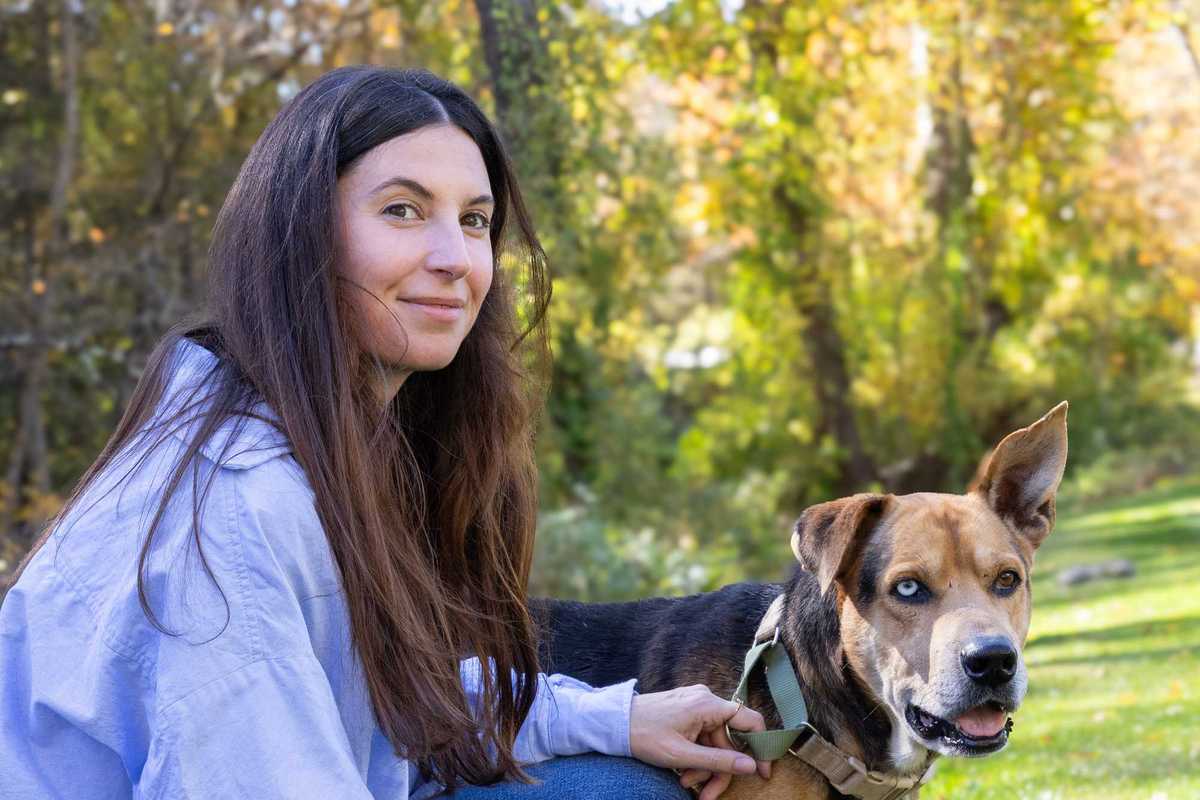
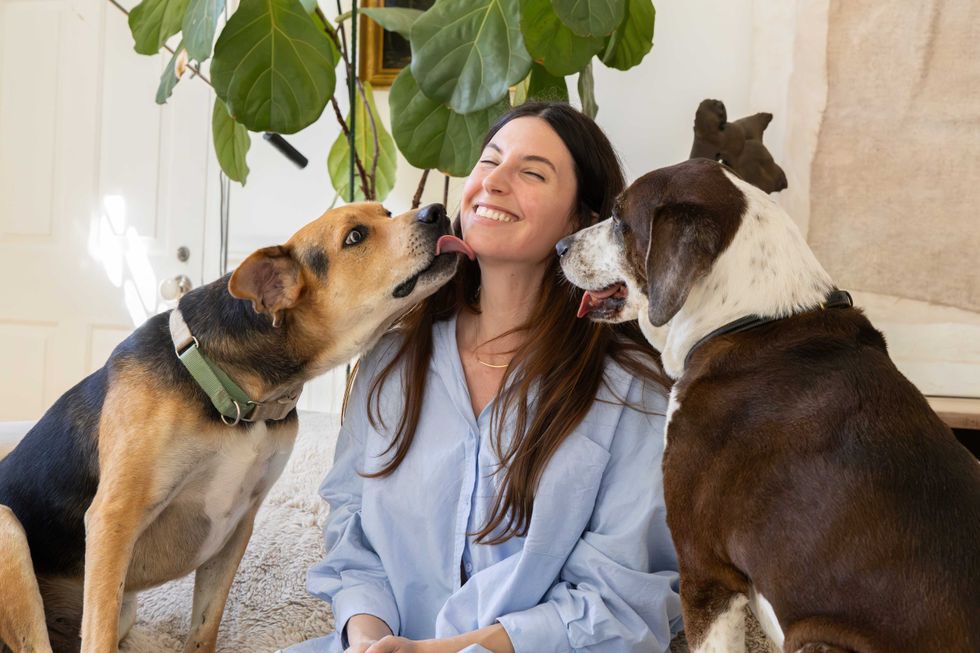 Stephanie Saetta,with her rescue dog George and Blue (left), a shepherd mix awaiting his forever home.Madi Long
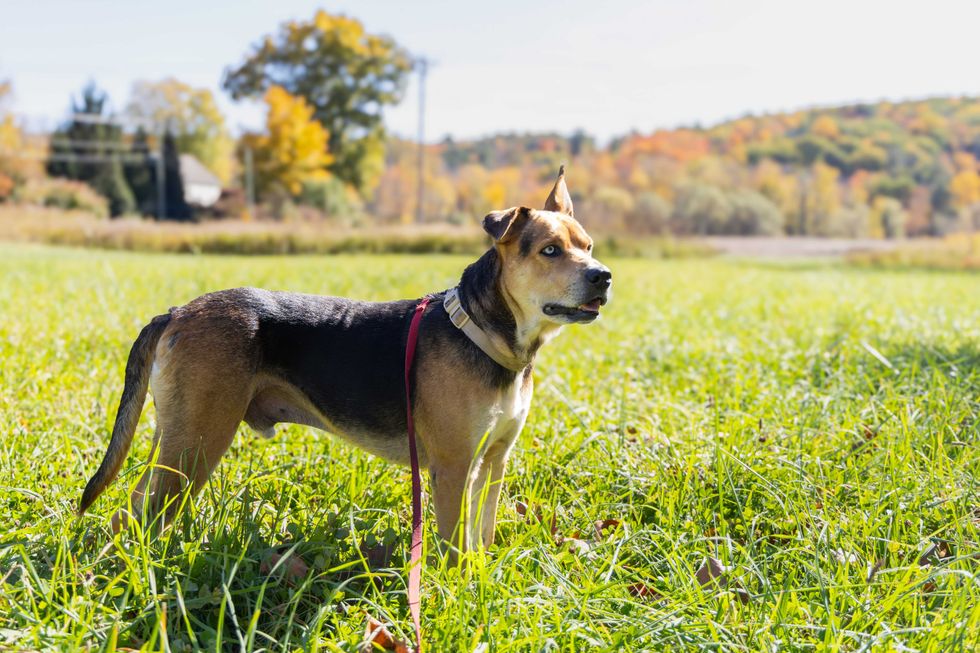 Blue, a 7 year-old Shepard mix, is waiting for his forever home. Madi Long