‘Guys and Dolls’ premieres at Housy March 19
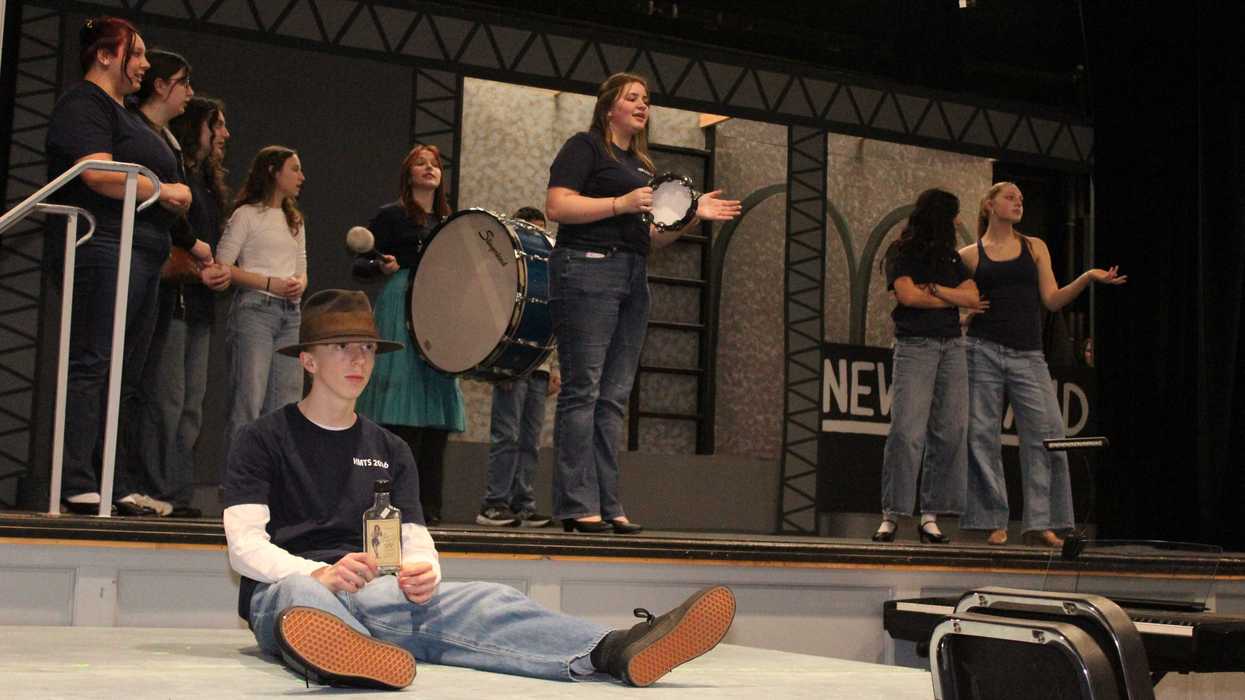
The cast of ‘Guys and Dolls’ rehearses March 12.
Patrick L. Sullivan


The cast of ‘Guys and Dolls’ rehearses March 12.
FALLS VILLAGE — The cast of “Guys and Dolls” ran through the entire show for the first time during rehearsal Thursday, March 12, ahead of the production’s March 19 opening.
The performers were not yet in costume — aside from a few hats.
Choreographer Amber Cameron, however, sent most of them back to retrieve their “show shoes.”
Cameron, Director Christiane Olson, Music Director Tom Krupa and Assistant Production Manager Micah Conway watched closely during the opening scenes, occasionally offering prompts or conferring over stage directions.
The Housatonic Musical Theatre Society production opens at Housatonic Valley Regional High School on Thursday, March 19, at 7 p.m., with additional performances Friday, March 20, at 7 p.m., and Saturday, March 21, at 2 p.m. and 7 p.m.
Tickets will be available at the door.
Patrick L. Sullivan
SALISBURY — The Board of Finance received preliminary budget proposals for 2026-27 from the Board of Selectmen, Salisbury Central School and Region One during an online meeting Thursday, March 12.
The current draft budget for town spending totals $9,618,325, an increase of $413,223, or 4.4%. First Selectman Curtis Rand said there will be a third draft and possibly a fourth before the finance board’s next meeting Thursday, March 26.
Rand said salaries for unionized employees at Town Hall and the town garage are up 4%. Some employees are getting additional pay for extra work, such as reviewing the town’s ordinances, many of which are outdated, and providing additional tech support.
Rand added that the lines for the registrar’s office are up in anticipation of primary elections this year, as well as the cost of early voting.
The legal line is up “because we never know where that ends up,” Rand said.
Health insurance for town employees is down $195,200 (18%) because the town switched to a state insurance plan.
Salisbury Central School (SCS) Principal Stephanie Magyar presented the town’s education budget proposal.
The spending plan calls for a total of $7,236,676, an increase of $339,528, or 4.92%.
Magyar said 81% of the increase is from existing contracts with teachers and staff. She said there are “no new things” in the spending plan.
Region One Business Manager Sam Herrick also presented the current Region One budget proposal. He said the plan is very much a work in progress, with the regional school board’s budget committee scheduled to meet two more times before the public hearing Thursday, April 9.
The current Region One budget draft is up 6.2%, or $1,146,478, for a total of $19,631,686. Herrick said this is the biggest increase he has seen in his 26 years at Region One.
The Region One budget has three components: Housatonic Valley Regional High School (HVRHS), Pupil Services (which includes special education), and the Regional Schools Services Center (aka the Central Office).
The six Region One towns pay a percentage of the total based on how many students they send to HVRHS, except for the superintendent’s salary, which is shared equally by the towns.
Herrick said the biggest increase is in Pupil Services. Specifically, out of district placements for qualifying students and the transportation costs associated with them are up significantly. The Pupil Services line is currently at $8,205,920, an increase of $683,364, or 9.08%.
Herrick’s numbers show Salisbury’s share of Region One at $4,825,659, an increase of $44,566, or 1.07%. The SCS budget draft has that figure slightly lower, at $4,813,638 (plus $32,545, or 0.68%).
The Board of Finance will meet again Thursday, March 26 to receive final budget proposals and vote on sending them to a public hearing.
Alec Linden
KENT — The Kent Planning and Zoning Commission resolved two long-pending applications at its regular meeting Thursday, March 12 — approving a scaled-back request from High Watch Recovery Center to amend its special permit and granting approval for a housing conversion on Lane Street.
After months of deliberations and heated public hearings, the commission approved just two changes to High Watch Recovery Center’s 2019 special permit, far fewer than the seven modifications the treatment facility initially requested.
P&Z Chair Karen Casey said Thursday evening that High Watch emailed the town in late February withdrawing two proposed changes — the controversial installation of a new lecture hall and a condition that would have allowed the facility to accept patients after hours.
Other previously withdrawn elements of the original application included an expansion of two beds in the detox center, a proposal to allow the facility to admit patients who are in custody or court-mandated to treatment, and a request to remove a condition limiting use of the facility’s PA system.
Two changes were ultimately approved unanimously by the commission.
First, the commission added a note acknowledging that while the facility is expected to notify authorities if a patient leaves unexpectedly, federal privacy laws may prevent it from doing so in some cases.
Second, the commission removed a requirement that the center sign a contract with a private emergency response company for situations that do not require a 911 call.
The Kent Volunteer Fire Department has said it does not expect the facility to place an undue burden on its ambulance service. The commission also reserved the right to reimpose the private emergency response requirement in the future if needed.
“Those are the two things,” Casey said after outlining what remained of the application. “Very simple, very straightforward — no big deal, in my opinion.”
High Watch, a substance use disorder treatment facility on Carter Road, approached the commission last fall seeking to modify several conditions attached to its special permit. CEO Andrew Roberts argued the requirements were unnecessary, cumbersome or in some cases conflicted with the law.
The proposal drew pushback from neighbors. A small group of residents spoke out at public hearings, on the town’s Facebook page and in circulated fliers, arguing the changes would represent an expansion of an already disruptive institution.
Throughout the hearing process, Roberts said he believed the organization had been misrepresented by members of the public. In a February letter, he claimed that High Watch had been treated unfairly by the commission.
Lane Street housing conversion approved
A decades-old zoning issue that had prevented John and Diane Degnan from converting an old industrial building on their property into their primary residence was also resolved at the March 12 Planning and Zoning Commission meeting.
An application initially presented to the commission late last year was simplified through the joint efforts of Jay Klein, attorney for the Degnans, and Michael Ziska, the commission’s attorney. The two identified a zoning regulation that allows one nonconforming use of a property to be changed to another nonconforming use, as long as the change is not detrimental to the neighborhood.
“The regulation is tailor made for this situation,” Klein said Thursday evening. “We think this is a move in the right direction — it’s something that is endorsed by the community.”
During several rounds of public hearings on the proposal, neighbors voiced strong support for the Degnans’ plan, saying they preferred to see the building used as a residence rather than return to commercial use.
Over the years, the structure has housed an auto body shop, an aquarium store and a sign production facility, among other businesses.
The commission voted unanimously to approve the Degnans’ proposal.
Ruth Epstein
Heidi Whitney moves bins of items into the Bargain Barn temporary headquarters at the Sharon American Legion Post 126.
SHARON — The Bargain Barn is on the move.
The popular thrift shop has been housed in a building off Low Road for decades. The property was purchased by Low Road Foundation, which has plans to raze the structures. The Bargain Barn will be moving to a site now under construction just north of the shopping center owned by Brian Murtagh. But until those premises are complete, the operation will be housed temporarily at the American Legion Hall Post 126 behind the Sharon Volunteer Fire Department’s firehouse on West Main Street.
The origins of the operation go back to when it was the Nightingale Shop run by auxiliary volunteers out of the Sharon Historical Society building. Eventually it became the Bargain Box and Barn and when it was about to close 10 years ago, Marshall Miles and Jill Goodman of Tri-State Public Communications took it over.
Offering a wide variety of items, including clothing, shoes, jewelry, housewares, DVDs and books at reasonable prices, the Bargain Barn provides an important resource for people. “It’s a new cool thing to be thrifty,” said manager Heidi Haskell, and the barn fits that bill. “The prices are right and there’s something for everyone. We see people furnishing their first house, kids going off to college or mothers outfitting their children.”
But it’s more than just a shop. Haskell said, calling it “a cool community place.” Regulars come to check out the inventory as well as meet up with friends.
Plans called for opening at the American Legion Hall on March 17, with hours Tuesday through Saturday from 10 a.m. to 3 p.m. Donations of two bags or two boxes will be accepted from 9:30 a.m. to 12:30 p.m. She said the selection may be smaller while in the temporary spot because of the smaller space. “I want to give a big thanks to all those who helped us move, and for everyone’s patience and support,” said Haskell.

Want more of our stories on Google? Click here to make us a Preferred Source.

Lakeville Journal
Save our National Lands
We have seen the government gutted of personnel, but we can rebuild it.
The universities have been attacked and public money for research withheld, butwe will be able to restore health research.
Law firms who defended the law against government corruption have been attacked, but those firms can be restored to favor.
Money to the states for SNAP, which gives food help to the needy, has been cut, but we can restore that.
They have started a war in the Middle East, but hopefully we can soon withdraw from that.
Attacks to the environment and our public lands, however, can never be restored. Selling off public lands, which belong to the American people, can never be repurchased.Permitting oil companies to drill in our National Parks in the Arctic creates terrible pollution which cannot be cleaned up. Creating miles of roads at our expense through our National Forests opens the wilderness to exploitation, such as removing timber, but it will take a lifetime to restore those forests.Letting mining companies drill in our National Parks leaves huge open pits in the ground, which can never be restored. Compromising the Endangered Species Act could eliminate the existence of many species of animals, birds and plants forever.
We must stop the destruction.We must stop the attacks on our public lands.Our National Forests and our National Parks belong to us -the people -and we want it left to our children and for all the generations to come.
Lizbeth Piel
Sharon
Harlem Valley Rail Trail accident is horrifying
I was horrified to read about the bicycle accident on the Rail Trail, resulting in a fractured vertebra and a long healing process for someone who was enjoying a ride on a path specifically built for that purpose.
I am an active cyclist who rides 150+ miles per week in warm weather. I occasionally ride parts of the Rail Trail, almost always during the week when there is little activity, and only to connect to a road.
The Rail Trail is NOT for serious cyclists. Whenever I approach walkers I call out well in advance and coast my bike past them at a slow speed. If they don’t turn around, I stop. I would never pass another cyclist, especially a casual rider, on any of the elevated wooden walkways. It is infuriating that an accident like this is completely foreseeable, yet happened anyway.
I don’t walk the Rail Trail but if I did I would be very vocal (but friendly) in telling cyclists to slow down and, if on a walkway, to dismount. It is for their safety as well. The woman who was injured could have just as easily turned into the cyclist, which could have put them both in the hospital.
I was strongly tempted to suggest litigation here, but I am sure friends long ago offered that advice. As warm weather approaches you might consider an article about local bike safety, perhaps focused on the Rail Trail. The tiny silver lining here is that the article is not about a small child being hit by cyclist.
Terry Vance
Sharon
‘Able-bodied’ does not mean ‘able-minded’
I am writing in response to Ruth Epstein’s article about the League of Women Voters’ breakfast with six local CT representatives. Representative John Piscopo (R-76) made an unfortunate statement about wanting “able-bodied” people to go to work.
He thereby embodied an all-too-common misperception about the poor/folks receiving state assistance who appear to be “able-bodied”. He has apparently never noticed the distinction between “able-bodied” and “able-minded”.
He has undoubtedly never spoken to a person who is receiving welfare benefits. I spoke to many during my decades as a Family Physician in both rural and inner city Medicaid clinics. They include the people who are still illiterate because their dyslexia was never discovered during their school years, people who fall well below the average IQ on the classic normal distribution curve of such things, people with mental health disorders of multiple types, many inheritable and others caused by stress.
There are people whose childhoods were so marred by physical, psychological and sexual abuse that they will never be able-minded, and far too many of them are substance abusers as a result.
They all belong to our society, we have failed to prevent what happened to them, and, in my opinion, we owe them at least a square meal on their tables.
Representative Piscopo needs to rediscover his potential for empathy, something all humans possess but some never bother to use.
Anna Timell, MD
Cornwall
Carol Ascher
President Trump’s second term has been a coming out party for cruelty, whether in casual pronouncements or formal policies. Amidst a cascade of international aggressions, and what looks like an expanding War in Iran, I fear for Cuba, which has been receiving U.S. threats that its centralized economy structured to ensure fairness and equality, values that many Americans also hold dear, must be give way to the excesses of free enterprise.
It may seem too long ago to remember that for decades USAID was a key component of America’s soft power. Early in his second term, the Trump Ad-ministration peremptorily ended USAID funding, partly to help balance a budget constrained by GOP tax breaks to corporations and billionaires, but also to clarify the Administration’s contempt for international decency, generosity and caring. Without Congressional discussion or approval, the U.S. summarily eliminated maternal and child healthcare for 95 million people, and created food insecurity and malnutrition, which threatened to increase forced migration even as hundreds of thousands have already died. The end of USAID also meant the cancellation of 390 education projects effecting 23 million children, with vulnerable children and girls especially effected. And, in a final Trumpian twist, the end of USAID left millions of dollars of unused food grown by U.S. farmers spoiling in warehouses.
In fact, President Trump’s attitude toward ordinary Americans has also been uncaring, if not cruel. The Administration has threatened to cut as much as $900 million in transportation funding within the U.S. and withhold over $1.3 billion in disaster relief funding to four Democratic-led states. It has also attempted to punish states whose policies it disagrees with by stripping funding, including to those states that refuse to support the President’s inhumane mass deportation agenda.
Although many Americans voted for Trump because of his promise to end the disasters of war, within the first year of his second term, his administration has authorized military strikes and bombing operations in Iraq, Somalia, Syria, and Yemen. The U.S. also bombed nuclear facilities in Iran in June 2025, and a facility in Venezuela in late 2025. Early in 2026, it also collaborated with Israel in a widening war with Iran.
Pete Hegseth, our Secretary of the renamed Department of War, has epitomized the Administration’s cruelty and disdain. Aiming to sound bellicose, tough and vengeful, Hegseth has said that, “We fight to win. We unleash over-whelming and punishing violence on the enemy.” We also don’t fight with “politically correct” or “stupid rules of engagement.” That is presumably why no effort was made to rescue the 180 Persian sailors left in the water when their warship was torpedoed by a U.S. submarine in the Indian Ocean, 2,000 miles from Iran.And why there has been no apology or even acknowledgment for the 175, mostly children, killed when a U.S. bomb mistakenly hit the Shajarah Tayyebeh elementary school building in Teheran.
Finally, in our own hemisphere, more than 157 people have been killed in 46 separate bombings of small boats in the Caribbean that were supposedly delivering drugs. Moreover, since Secretary Hegseth had directly ordered to that everyone on board should be “killed,” this tally includes two men who had survived the bombing of their boat and were clinging to its destroyed pieces when they were directly targeted, a war crime by international rules of engagement. And the dramatic seizure of President Nicolas Maduro and his wife in Caracas included the murder of 47 Venezuelan soldiers, along with 32 Cuban security personnel acting as bodyguards, for which there has been no formal expression of condolence.
Unfortunately, this refusal by Trump and Hegseth to give the deaths of Americans the dignity of an apology or acknowledgment extends to both soldiers and people killed by government agents on U.S. soil. As President Trump made clear in his State of the Union address, he considers it unpatriotic to worry about immigrants seeking asylum, Green-card holders, or even American citizens either violently rounded up by ICE, or held in one of the new mega-detention centers, without access to families or an attorney. And this morning Donald Trump used a photo of himself in a “dignified return” of a soldier killed in the Middle east to sell his private security briefings.
All of which make me especially worried about the Administration’s bellicose attitude toward Cuba, whose people have lived under a U.S. embargo throughout its 67 years of socialism. In January, 2026, President Trump urged Cuba to “make a deal, before it is too late.” At the same time, the Administration cut off all oil that Cuba had been receiving from Venezuela, its major sup-plier. Moreover, Trump’s threat to impose tariffs on any country that provides oil to Cuba resulted in Mexico closing off its shipments, leaving Cubans with dwindling available oil. And Trump has made clear that Cuba needs to open its economy to capitalism if its people want to survive.
As of March 2026, Secretary of State, Marco Rubio, whose parents left for the United States soon after the Revolution, is said to be in contact with the Cuban leadership, including Raul Castro’s grandson. While supposedly “squeezing” the regime, he is offering to roll back sanctions if Cuba implements the privatization sought by the Trump Administration. However, given the paucity of private companies currently in Cuba, this process is likely to be slow. And since American philanthropic organizations like USAID no longer exist to offer food, medicine and electricity in the meantime, there will be more suffering for Cubans, including longer blackouts, more scarcity and ongoing migration.
A March 13, 2026 article in the New York Times by Frances Robles, a seasoned reporter on the Caribbean, notes that experts say, “Any meaningful deal with the Cuban government” would also have to include such important changes as “an end to the criminalization of dissent,” and “a restoration of basic civil liberties including freedom of speech and the press”—important re-forms, if we want Cuba to become a democracy. However, these are exactly the freedoms that Trump and his supporters find threatening in the United States and are working to remove. Perhaps the experts hope that our island neighbor, 90 miles south of Florida, will be there as a beacon of democracy in years hence to remind us of all we carelessly gave away.
Carol Ascher, who lives in Sharon, has published seven books of fiction and nonfiction, as well as many essays and stories.She is trained as a spiritual director.

Want more of our stories on Google? Click here to make us a Preferred Source.
Want more of our stories on Google? Click here to make us a Preferred Source.