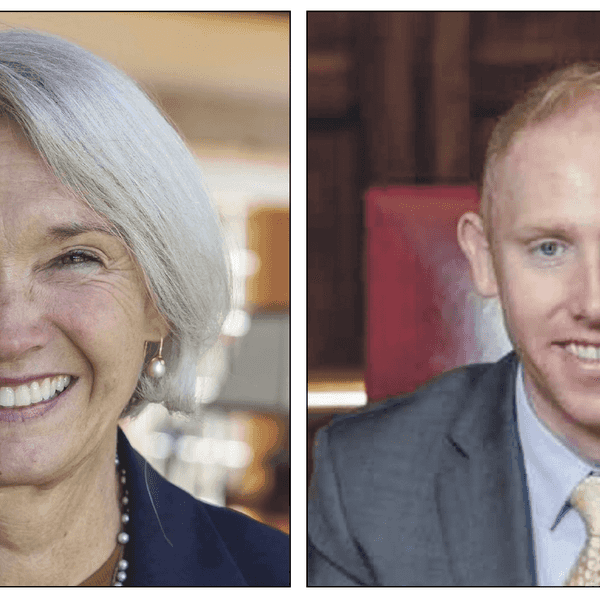
SALISBURY — If you’re nearing age 65 and wondering what to do about enrolling for Medicare, whatever you do, don’t procrastinate.
That message came through loud and clear from Margaret Foran Ackley, who helps people with their Medicare options as an “independent agent advisor.”
That means it’s free to consult her, or one of the roughly 3,000 others in the state of Connecticut.
She said she added Medicare to her portfolio after years of observing her aunt’s annual ritual of spending two weeks trying to puzzle out what changes, if any, to make in her Medicare plan.
“Medicare is not one-size-fits-all,” Ackley said.
She ran through the basics. Medicare part A is hospital insurance. Part B is medical insurance (out of the hospital). Both cost the patient some money.
In Part A, a person currently pays $1,364 out of pocket until the Medicare benefits kick in. In Part B, the average monthly premium currently is $135.50, based on income for a rolling two year period — less than $85,000 if single, less than $170,000 if married.
Part B has an annual deductible of $185. After that, the patient pays 20% of all Medicare charges.
Medicare does not have a maximum out-of-pocket limit.
“That’s why you want secondary insurance,” said Ackley.
Once a person is enrolled in Parts A and B, it is mandatory to buy a prescription plan — or else pay a hefty penalty.
Secondary insurance plans come in several varieties. A Medicare supplement plan covers the gaps in Parts A and B. These are private plans. The more you pay, the more they cover.
This is where an agent comes in handy. Ackley said that in Connecticut, the private plans are identical, even though the companies charge different rates. She can help guide clients to the companies that are the best fit in terms of price and customer service.
These plans are portable. They can be used anywhere in the country.
When buying a Medicare supplement plan it is still necessary to buy a stand-alone prescription plan.
Medicare Advantage plans are also private insurance. Ackley said these plans are set up similarly to health insurance plans from employers. In Litchfield County, the average monthly premium is $130 to $140 per month, with a maximum out-of-pocket limit of $6,700.
These plans require patients to stay in provider networks, unlike the Medicare supplement plans.
So the first option is good if someone is planning to move out of state, or wants to use out-of-state doctors or hospitals.
Then there is Part D prescription drug coverage. It is important to get this right, to avoid going to the pharmacy expecting to pay the usual co-pay and finding out that the limit has been reached and the co-pay is now considerably higher.
When should people enroll? Ackley said people become eligible on the first day of the month of their birthday, and have three months before and after to enroll.
Do not wait around until the last minute, she urged the audience. People who miss the deadline incur a monthly penalty for the rest of their lives.
If planning to retire, get the Medicare stuff squared away well ahead of time.
“Don’t go into work and say ‘I’m not coming back tomorrow’ without planning ahead.”
Ackley said the employer has forms to fill out as well as the retiring employee. These forms have to go to the Social Security Administration.
In theory the paperwork can be mailed. In practice, Ackley said, the paperwork has to be taken to the nearest Social Security office and handed in. She said 99% of her clients who mail the paperwork report it gets lost.
Once enrolled, changes to plans can be made during the annual enrollment period of Oct. 15 to Dec. 7.
She said it is unwise to treat Medicare like car insurance, which usually doesn’t change much from year to year.
“Something is going to change.”


 Justine and Victor Valla in their studio with a painting of Victor’s,”Jonah and the Whale.” Robin Roraback



 A ceramic vase by Kathleen Heidemann.Provided
 Joy Brown’s delightful ceramic sculptures.Provided


 Hundreds of items at Stateline Auctions, including a candy-apple-red Crosley pickup truck.D.H. Callahan