KENT — The Planning and Zoning Commission voted to approve a special permit enabling a long-standing but unpermitted home pottery studio to continue commercial operations. The permit included limitations, however, that the applicant described as unfeasible.
“We’re not satisfied at all,” said applicant Steve Katz following the vote at the Feb. 13 P&Z meeting. Katz has represented the Alison Palmer Studio alongside his wife Alison Palmer during their appearances at the previous two P&Z meetings.
Palmer, who has run the studio with Katz from their home at 48 Stone Fences Ln. for 16 years, said that she is grateful to P&Z for granting permission for the studio to operate, but that the conditions of the resolution indicate a lack of understanding amongst the commissioners about making a livelihood from pottery. “Nobody on [the Commission] had any understanding of what it is to be an artist,” she said.
Katz concurred: “We’re happy that we were approved, but [the Commission] doesn’t understand what it takes to run pottery workshops.”
The resolution granted the studio a special permit, but restricted the total number of days workshops could be hosted at the residence to 12 per year, with no session lasting more than three consecutive days. The resolution also shortened the operating hours of the workshops from 10 a.m. to 5 p.m. and 10 a.m. to 4 p.m.
“I believe P&Z misunderstood our business,” said Palmer. “That just isn’t going to happen –I mean, it can’t happen.”
She emphasized that a workshop must run for multiple days to account for instruction, firing the pieces, glazing and finalizing. She and Katz said that they intend, if possible, to reapply to P&Z for a permit that allows their proposed schedule of 12 to 14 annual workshops, each lasting between two and four days.
While discussing the resolution at the Feb. 13 meeting, P&Z member Darren Cherniske said that the “conditions and restrictions we put in our resolution are sufficient” to account for the zoning concerns voiced by the commission and neighbors.
Those concerns primarily revolved around workshop and pottery event attendants increasing traffic on Stone Fences Lane, which is a short private road. The Alison Palmer Studio sits at the end of the street – “up in the woods,” as Palmer put it.
The issue was first brought before P&Z as a last minute addition to the Dec. 12, 2024, meeting agenda as Palmer and Katz applied for a permit to run a holiday open-house style event that was planned to last a week.
At that meeting, David and Denyse Stoneback of 11 Stone Fences Lane spoke out against allowing the permit to go forward and announced that the studio had been operating without proper zoning permission for years.
The Stonebacks had moved to Stone Fences Lane earlier in the year and were surprised by the traffic on the road. Many of the vehicles on the roadway were speeding, they said, which they attributed to pottery studio visitors.
At the Jan. 9 public hearing for the general Major Home Occupation permit, several other neighbors also voiced concerns about traffic on the road. The Stone Fences Association, a neighborhood board, spoke out against the precedent set by allowing a business to operate in a neighborhood that is explicitly zoned as residential.
P&Z member Sarah Chase pointed out that the application was for a special permit, and thus by definition does not set precedent but rather is reviewed on a “case by case basis” as all other special permits are.
At the Feb. 13 meeting, P&Z Vice Chair Karen Casey emphasized that there had been no specific traffic study conducted on the street, and thus the Commission couldn’t levy decisions based on unsubstantiated data.
Palmer and Katz have claimed that the street, like many in present day Kent, is busy due to residential density, and that the studio’s contributions are negligible.
Katz explained that he and Palmer have strategized new plans to ameliorate the neighbors’ concerns while maintaining their business, including a car-pooling plan that he said will cut down vehicle traffic to the studio even further. “We want to apply again so we can put in these new factors that would straighten out the misunderstandings,” he said.
Palmer said that while the issue may be a just question of traffic to neighbors, it is existential to her and Katz’ life in Kent. “If they close down our workshop,” she claimed, “We will lose our house – it’ll go into foreclosure.”
“I mean to displace us old people, you know, for such a trivial matter is like – I just can’t believe my neighbors would do that to me.”


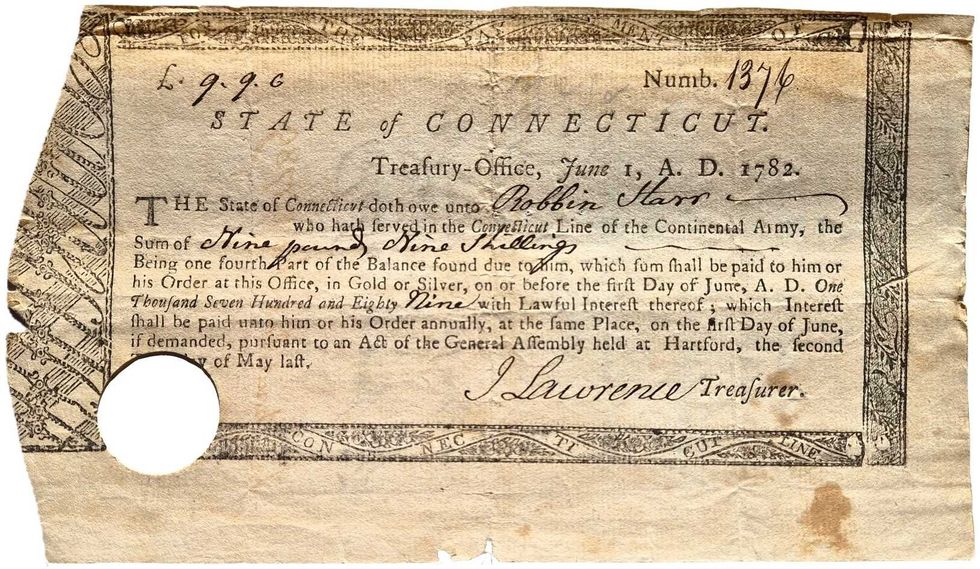 Pay Bill for Robin Starr’s service in the Continental Army.Courtesy the Alex Breanne Corporation
 John Mills speaking at Quinnipiac University.Courtesy the Alex Breanne Corporation
 Stephanie Saetta,with her rescue dog George and Blue (left), a shepherd mix awaiting his forever home.Madi Long
 Blue, a 7 year-old Shepard mix, is waiting for his forever home. Madi Long