In the USA today, a young man who runs up and down a basketball court in shorts for a living can earn an amount in cash equal to the combined salaries of 10 or more highly qualified science, math, history or language teachers. Nothing against professional sports, but what does this say about cultural values in America? Does level of income reward and reflect utility, or something else?
• • •
Take this example in the field of human health: The director-general of the World Health Organization, who oversees billions of dollars worth of international health and disease control programs, and supervises thousands of technical and medical staff, with offices and programs in over 200 countries worldwide, earns a transparent and reasonable $213,000 a year.
By comparison, here in the United States, the CEOs of many smaller hospitals earn multiples of that, and the highest paid hospital CEO in New York City earns $4.3 million a year. (For that price, we could hire 20 directors-general of WHO.) Why the disparity? Where is the value for money? What does this mean for the cost of health care in the United States?
The president of the United States earns “only” $400,000 a year. How does that compare with the remuneration of our elite captains of finance and industry? The CEO of Citigroup, for example, earns $17.6 million a year (or the price of about 44 U.S. presidents, for whatever that’s worth).
Not bad, but not really up there with the biggest boys. The CEO of Oracle corporation, which makes computer software, earns $78.4 million a year. (That’s well over four times Citigroup’s CEO, or nearly 200 U.S. presidents.) But if you seek ultimate pay for imagined utility, try Cheniere Energy. Who are they? Cheniere is the largest “fracking” corporation in the USA and Canada.
Last year, their CEO was rewarded with a remuneration package of $141.9 million (or the equal of more than 350 U.S. presidents, or 1,400 science teachers.) For what utility? For “fracking”? Does America receive that much utility benefit from “fracking”? Or are U.S. presidents and teachers of so little utilitarian value?
It doesn’t take long for these levels of income to add up to real money. This allows the corporate CEO to enter the billionaire class, become a pure investor in or exploiter of the U.S. economy, and pass these advantages on to friends and progeny, thus creating a virtual aristocracy of wealth in America, threatening to exceed even that of the “Gilded Age,” the inequity of which brought about the Crash of 1929 and the Great Depression of the 1930s.
Although accumulated wealth is difficult to track, it is reliably estimated by several sources that the top 0.2 percent today own more than one-half the total financial wealth of the nation, while, adding insult to injury, the 0.1 percent, that is, those above 99.9 percent, own nearly the 10 times that of the 99.2 percent (i.e. astounding inequity within inequity). Difficult to believe, but inequitable tax policy and practice is unquestionably a big part of the problem, and therefore should be an important part of the solution.
It is often observed that the self-styled elites of unregulated “laissez faire” capitalism have stacked the deck and the tax laws in their own favor. Recent studies show that, of the income and capital gains that billionaires of the 0.1 percent variety actually admit to (i.e., declare to the IRS), they pay on average only between one-fifth and one-half the effective tax rate paid by middle class professionals and blue-collar workers (the ones who don’t just play the market, and who shower after work). Some billionaires go year after year paying no taxes at all.
Consequently, wealth in today’s America is accumulated, maximized, off-shored, under-taxed and largely inherited. You can inherit several millions, become a pure investor, hedge-funder or corporate raider, become a billionaire yourself, and stash hundreds of millions in foreign tax havens (for tax avoidance or evasion purposes), and still run for governor of Connecticut or president of the United States, with hardly anyone noticing. If you don’t want to run for political office, you can, thanks to Citizens United, simply make unlimited, anonymous PAC campaign contributions, and buy the election. Ordinary citizens can’t do this. Why should the American public meekly accept this situation?
Is there a way of correcting the underlying tax inequity in this country? To rewrite the entire U.S. Tax Code is the ultimate solution, but it’s a long, drawn-out, controversial process. For starters, in the shorter term, we could first add one overriding provision in the Tax Code: Every taxpayer (above the poverty line) must pay at least a defined minimum effective tax rate — no exceptions — on all income and capital gains regardless of otherwise legitimate deductions, allowances, deferrals, etc. Second, we could adopt a federal law clearly and unequivocally criminalizing use of tax havens to delay or evade payment of taxes. Third, we could get serious, really serious, about tax collection and law enforcement.
• • •
The effect of these three reforms would be (1) to make budget deficits, budget cuts and so-called “sequesters” a thing of the past, and (2) to gradually re-establish a more equitable and consistent balance of income, wealth and taxation, returning our American republic from today’s plutocracy and oligarchy back to its founding principles of democracy, equal opportunity, and social justice.
Sharon resident Anthony Piel is a former director and general legal counsel of the World Health Organization.
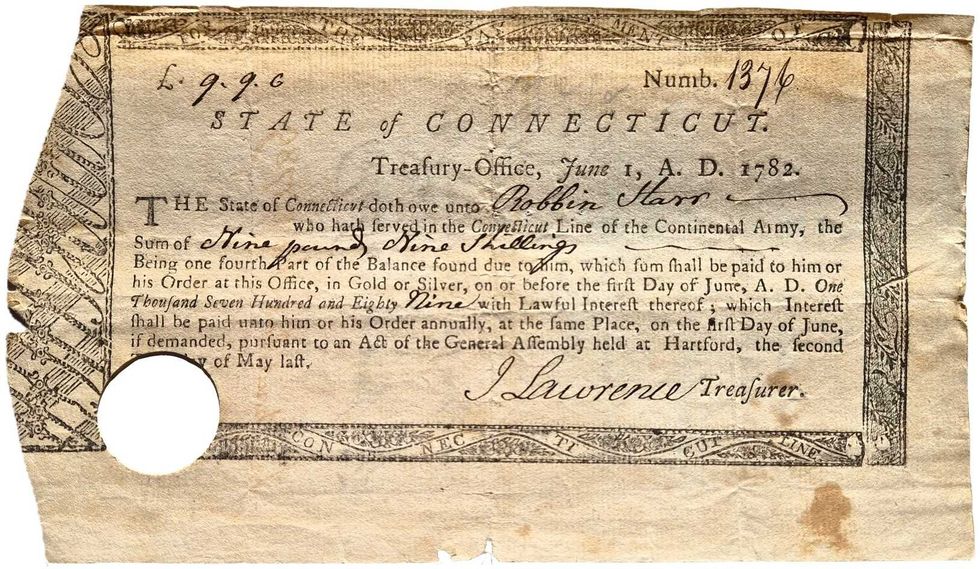 Pay Bill for Robin Starr’s service in the Continental Army.Courtesy the Alex Breanne Corporation
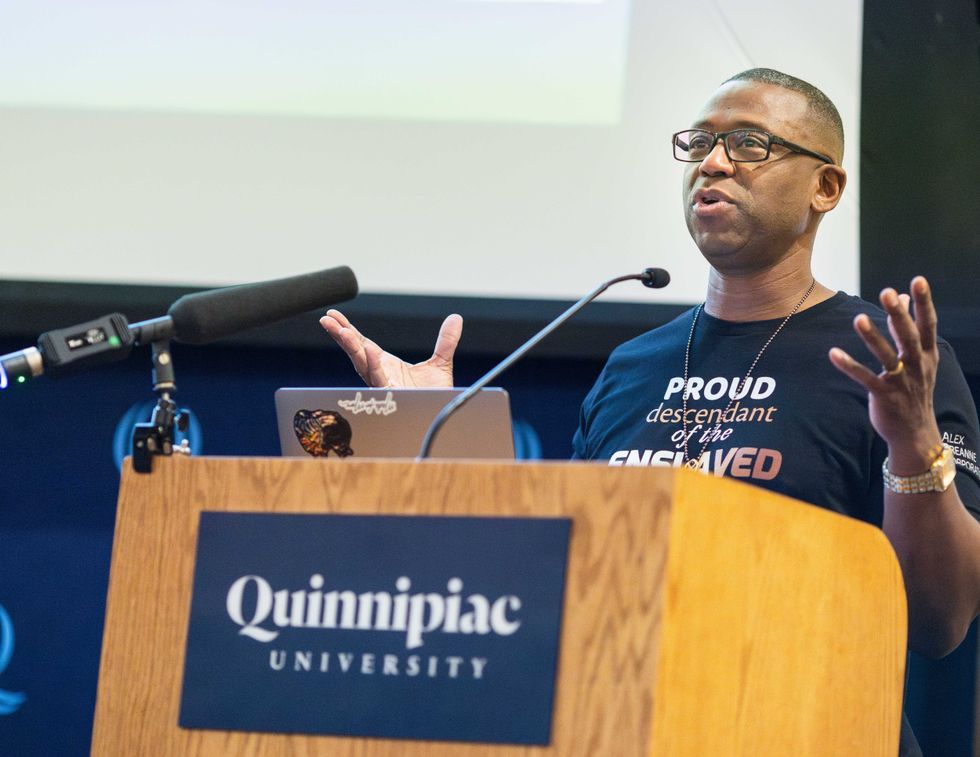 John Mills speaking at Quinnipiac University.Courtesy the Alex Breanne Corporation

 Stephanie Saetta,with her rescue dog George and Blue (left), a shepherd mix awaiting his forever home.Madi Long
 Blue, a 7 year-old Shepard mix, is waiting for his forever home. Madi Long