SALISBURY — Researchers are warning that Lake Wononscopomuc is at a “critical time” as concerns grow over declining water clarity, nutrient pollution and the long-term condition of Connecticut’s deepest natural lake.
The announcement came during a 90-minute Zoom meeting of the Lake Wononscopomuc Association on May 26, attended by several dozen residents, lakefront property owners and association members.
Discussion centered around a newly released lake management report, prepared by Northeast Aquatic Research (NEAR) and posted on the lake association’s website. Researchers noted that while overall water quality remains relatively strong, several indicators warrant continued monitoring and proactive management.
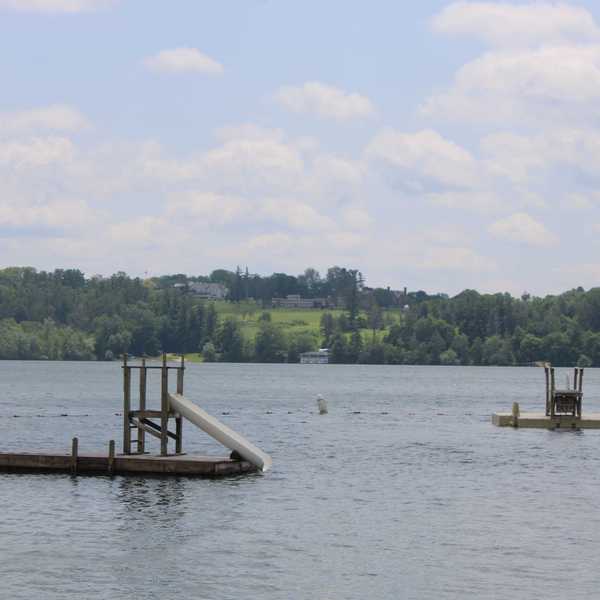
For area residents and weekenders who visit The Grove during the summer, this means the water is currently safe for recreational use, although scientists and researchers are closely monitoring the water quality.
“We’re very concerned,” said NEAR representative Kendra Kilson. “The lake, from my perspective, isn’t doing great. This is a very critical time and we need to keep an eye on it.”
Overall, water clarity in Lake Wononscopomuc remained “fair to good” during 2025, according to the report. But researchers also documented substantial oxygen loss in deep waters and elevated nutrient levels in some tributaries, findings likely to renew discussion of septic-system impacts, watershed management and other measures aimed at protecting the lake.
Oxygen loss ‘substantial,’ depletion a concern
The lake, which reaches a depth of approximately 100 feet, is monitored closely for even subtle changes in water quality, like oxygen levels and water clarity.
Last year, researchers observed significant oxygen depletion in deeper parts of the lake, particularly by late season. When oxygen levels deplete – a state known as anoxia – nutrient levels can tend to become more concentrated, which can contribute to algae growth and declining water clarity over time.
George Knoecklein, founder and principal scientist at NEAR, said water clarity remains one of the most important indicators of lake condition.
“I like to use water clarity as part of a general overarching description of the condition of the lake,” he said.
The lake’s clarity measurements in 2025 generally ranged between three and four meters. When it dips below two meters, the lake doesn’t support recreational use, Knoecklein said, adding that two meters or less can lead to cyanobacteria blooms, which may produce toxins harmful to people, pets and wildlife. Five meters of clarity are desirable.
“All in all, it’s not great, but it’s not terrible,” he said.
The findings prompted discussion among attendees about the potential sources of nutrients entering the lake and what measures might be taken to address them.
“I’d like to get some idea of where the pollutants are coming from and which are the more serious sources that we can do something about,” said association treasurer Arthur Strang. Others echoed that sentiment, identifying it as a priority before any large-scale mitigation efforts are considered.
Knoecklein cited stormwater runoff, agricultural runoff, fertilizers and aging septic systems as potential contributors.
Multi-million dollar mitigation strategy revisited
The long-debated question of sewer expansion around the lake was discussed, an issue periodically raised as a possible way to reduce nutrient inputs from shoreline properties.
“I remember it was very hard to get homeowners to spend money for the sewers,” said Susan Strang, recalling prior discussions.
Tino Galluzzo, association vice president, noted that any future sewer project would likely require widespread participation among property owners to be financially feasible.
Bill Littauer, who is serving his 25th year as president of the lake association, said past attempts failed due to costs. “It was determined to be far too expensive, millions of dollars.”
Knoecklein said sewer infrastructure could help reduce nutrient inputs over time but noted that some of the lake’s challenges have become increasingly self-sustaining.
He described the lake’s anoxia as “its own monster.”
“The thing about a sewer system is once you hook up, your rates go up,” he said. “But I also see milfoil doing poorly in lakes that are sewered,” citing Highland Lake in Winsted as an example.
As an alternative, he suggested that aeration systems, which introduce oxygen into deeper water, may deserve consideration as a future management tool.
Knoecklein requested historical information on past lake studies so it can be determined whether recent conditions represent a long-term or annual trend. He also said, “It would be good to know where the sewers around the lake end and where the septic systems start.”
The good news: still no evidence of hydrilla
While the discussion focused on water quality, the report also contained encouraging news regarding invasive species.
Despite the spread of hydrilla elsewhere in Connecticut, researchers found no evidence of the invasive aquatic plant in Lake Wononscopomuc during the 2025 monitoring season, and periodic monitoring will continue this year.
Since hydrilla was discovered in nearby East Twin Lake four years ago, town and lake officials have taken extensive precautions to prevent its introduction into Lakeville Lake, including closing the boat launch to reduce the risk of accidental introduction.
Researchers also recommended conducting future end-of-season monitoring later in the fall, possibly in November or even December, to better capture seasonal turnover patterns that appear to be shifting.


 Pay Bill for Robin Starr’s service in the Continental Army.Courtesy the Alex Breanne Corporation
 John Mills speaking at Quinnipiac University.Courtesy the Alex Breanne Corporation
 Stephanie Saetta,with her rescue dog George and Blue (left), a shepherd mix awaiting his forever home.Madi Long
 Blue, a 7 year-old Shepard mix, is waiting for his forever home. Madi Long