Here is an open letter that Barack Obama should write to Mitt Romney – pronto!Dear Mr. Romney:Not a day goes by without you blaming me for every slumping or stagnant economic indicator. Unemployment, increases in the number of food stamp recipients, government borrowing, and spending, home foreclosures, economic uncertainty for businesses, trade deficits — you name it. Only for droughts and hurricanes have you absolved me from responsibility.I won’t go into what was inherited from your Republican party’s years in office. Deregulation, nonenforcement, nondisclosure by the financial industry, and subsidies and bailouts were that period’s hallmarks. But if I were to be held responsible for the state of the American economy, there would have to be a “command and control” economy enforced by the White House. You know full well that is not the case for several reasons.First, our economy is dominated by corporations that make their own investment and hiring decisions. Two-thirds of the tens of millions of low-wage workers are employed by 50 large corporations, such as Walmart and McDonald’s. Thirty million American workers are laboring between the federal minimum wage of $7.25 per hour and what the minimum wage, adjusted for inflation from 1968, should be now — about $10 per hour. These companies are successfully opposing in Congress any increase in the minimum wage to catch up with 1968. By the way, you favored an inflation-adjusted minimum wage for years. During the Republican primaries earlier this year, you changed your long-standing position and now oppose raising the minimum wage.Moreover, many companies are sitting on more than $2 trillion in inactive cash reserves. I have no power to get more of that capital invested, other than to appeal to their U.S. corporate patriotism. I could also use that patriotic appeal to urge them to increase their dividends to shareholders which would pump tens of billions of dollars into our consumer economy to encourage much-needed spending. Some of these successful companies like Google, EMC and others offer no dividends at all to their owners. Those exhortations are just exhortations. CEOs can do what they want.Second, I am not the Federal Reserve. The Fed has kept interest rates very low which has limited the return on savings. Tens of millions of middle and lower income people could spend those interest payments on the necessities of life. But the Fed is its own ruler, and its catering to the capital investment community doesn’t seem to be boosting the economy.Third, there is the Congress and the oppositional unanimity by Republicans to block any economic, job-producing measures due to their priority of using a recessionary economy to help you defeat me in November. Remember Senate Republican leader, Senator Mitch McConnell’s oft-repeated words about that being their number-one priority?I tried to promote a major public works construction and repair program in Congress. The Republicans in the House blocked it under the aegis of Representatives John Boehner and Eric Cantor. This program would have produced well-paying jobs, with multiplier effects, that could not be exported to China. Our communities have trillions of dollars in deferred maintenance afflicting schools, clinics, public transit systems, highways, bridges, dams and water and sewage systems. I cannot make this happen without the Republicans in Congress. You and your running mate, Paul Ryan, have not exactly urged them to take up this jobs initiative.You have declared that “Washington has become an impediment to economic growth.” Why then don’t you be specific, name and support an end to the vast array of corporate subsidies, handouts, bailouts and inflated government contracts, especially from the defense industry? Imagine what your friends on Wall Street and in Houston would think of you after that burst of candor.See how many jobs disappear with the end of what conservatives call crony capitalism, the end of the huge, historic outpourings of government research and development monies that substantially built and help maintain innovations in the aerospace, biotech, pharmaceutical, computer, telecommunications and containerization industries — to name a few. And if you think taxpayer investment in public works all over the country is an “impediment to economic growth,” say so forthrightly, as you campaign in battleground states.I look forward to our first debate on Oct. 3 in Denver and shall observe your struggle with consistency. While you’re at it, kindly bring your pre-2010 tax returns, so we can learn more about what you mean when you talk about your policy of tax cuts.In solidarity for America. Consumer advocate and former presidential candidate Ralph Nader grew up in Winsted and is a graduate of The Gilbert School.
Latest News
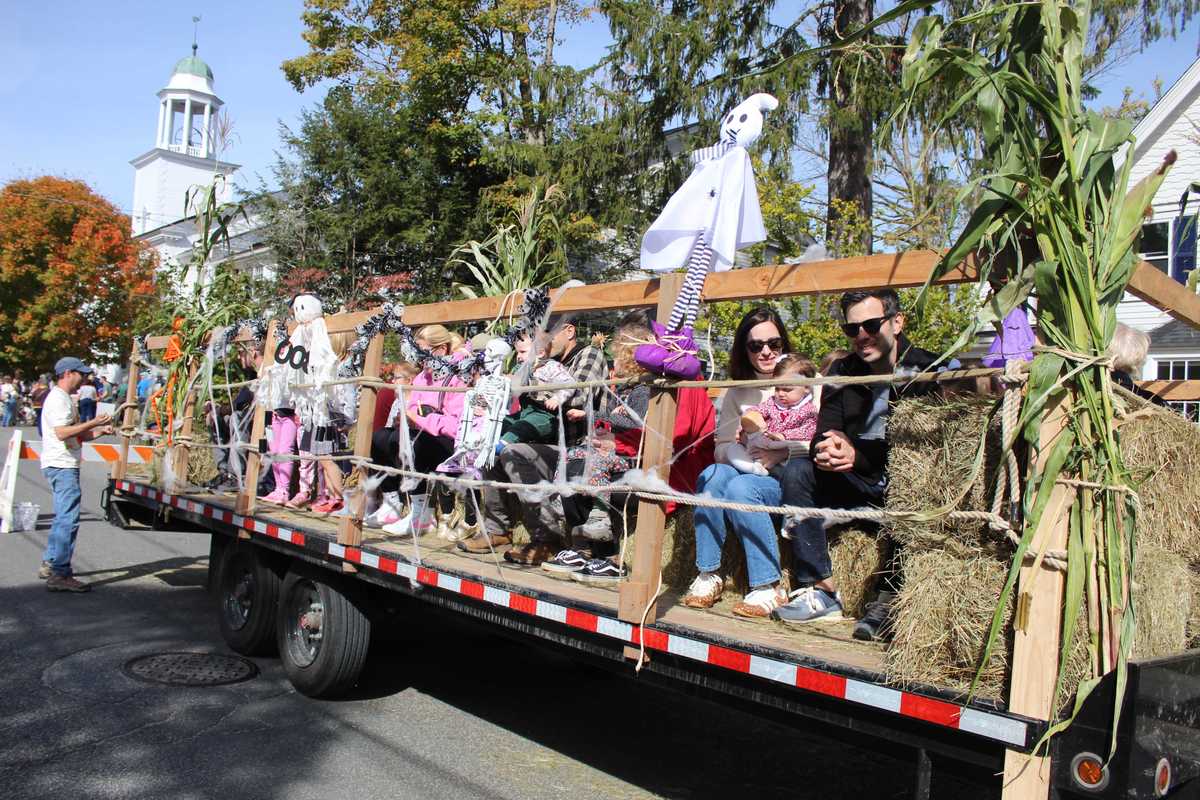
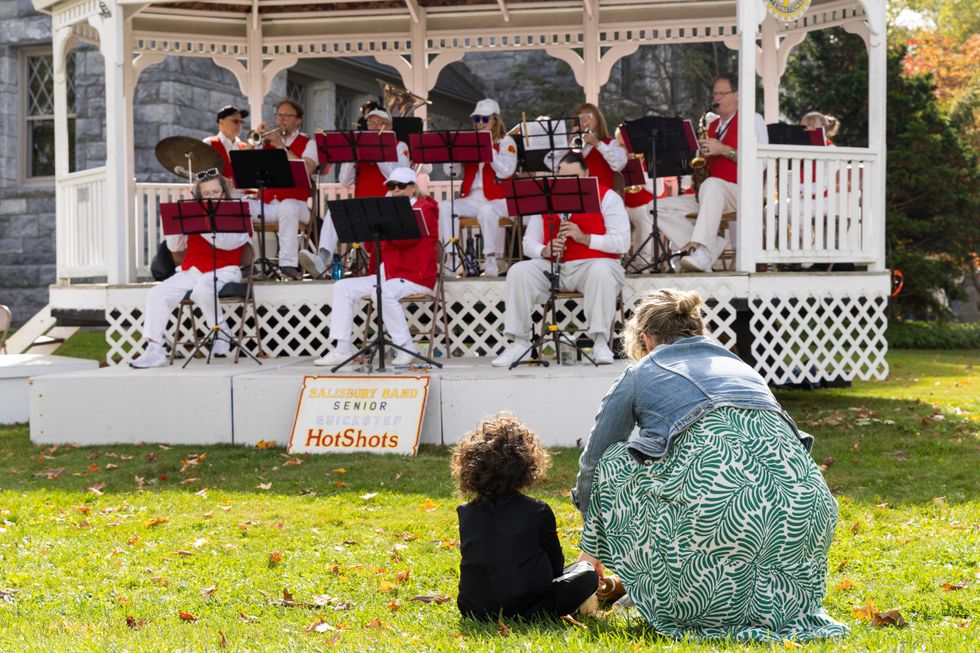
Children enjoy a hayride during Salisbury’s 69th Fall Festival Saturday, Oct. 10, as beautiful weather drew crowds downtown for activities, book sales and live entertainment.
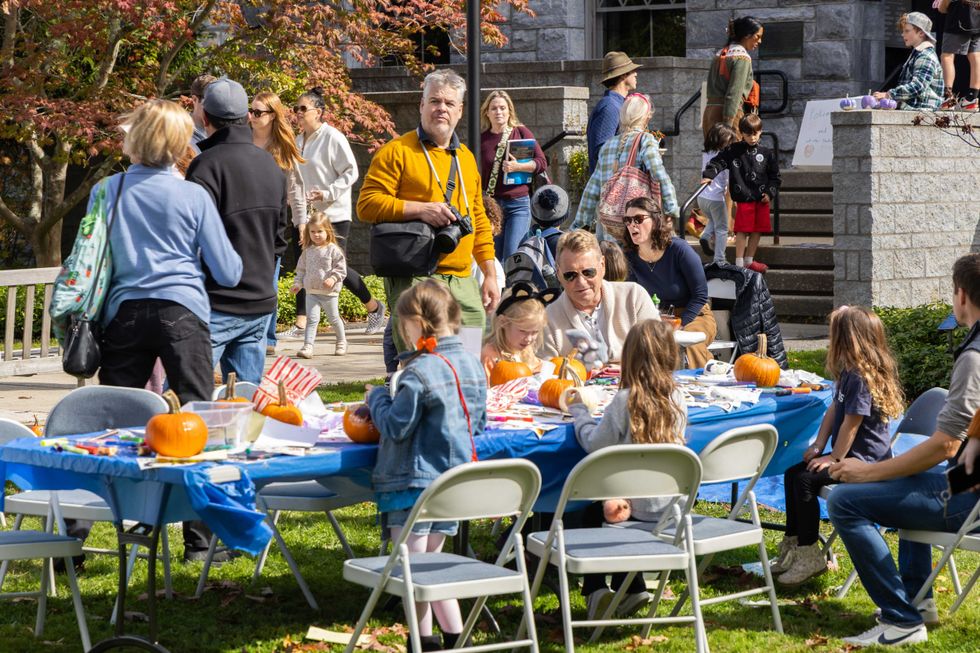
The library lawn was crowded with children decorating pumpkins and receiving temporary henna tattoos.
Inside and behind the library, book lovers browsed the Friends of the Scoville Library book sale. This year, the Friends added a tent behind the library for more display space.
Across Library Street, by the Congregational Church, magician Peter James wowed the crowd with illusions, including the “Chop-A-Lot,” which magically sliced carrots but not fingers.
Inside the church was the annual quilt show in the worship space and a massive tag sale in the community room at the rear.
A highly arbitrary sample of items for sale: a fondue pot, an air purifier, assorted fabrics, baked goods of every description and a set of wooden salad bowls.
The quilts had also provided a backdrop Friday at noon for the church’s regular monthly musical performance. Solo cellist Jakob Nordlinger played an all-Bach program, surrounded by quilts hanging over the pews and from the railings.
Moving along Main Street, the church’s hot dog tent was doing brisk business, enlivened by stalwart parishioner Barbara Wiggins in a hot dog costume.
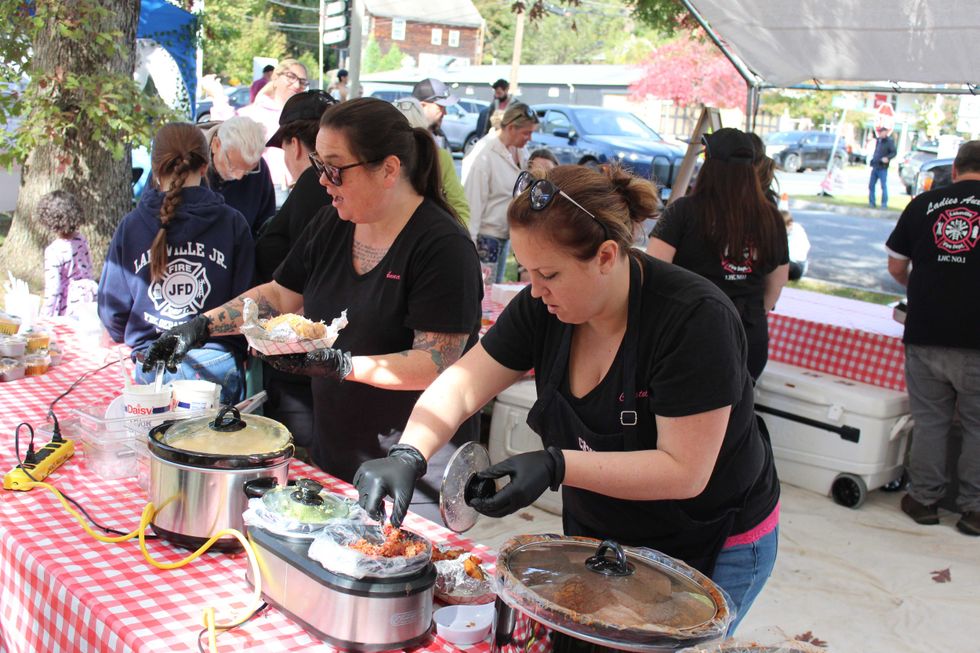
Next door, the Lakeville Hose Company Ladies Auxiliary tent was equally busy dishing out “comfort food,” mainly variations on chili and macaroni and cheese.
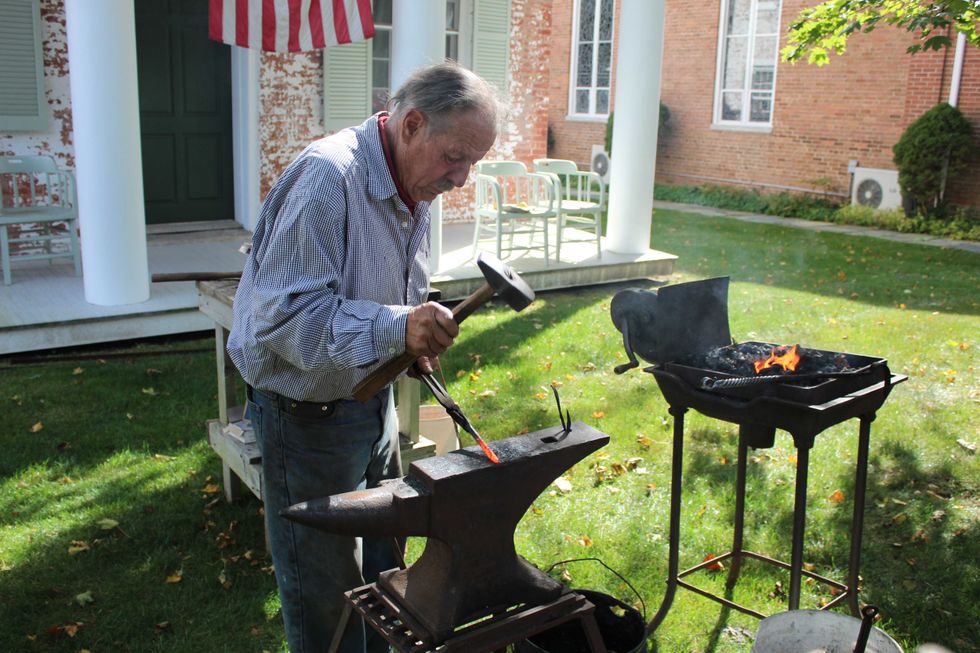
Next to St. John’s Episcopal Church, Will Trowbridge of Sharon provided visitors with an ongoing blacksmithing demonstration.
Someone asked if he was using coal.
“Yes, that’s coal,” said Trowbridge. “And you see where it’s fluffy? That’s coke.”
Coke, a fuel formed as coal heats, burns hot enough to heat iron for shaping.
The visitor asked whether the coke could be used to fuel the forge.
“Oh my yes,” replied Trowbridge, lifting a red-hot piece of iron out of the fire.
At the town green at the intersection of Undermountain Road and Main Street, protesters were holding a “No Kings” demonstration.
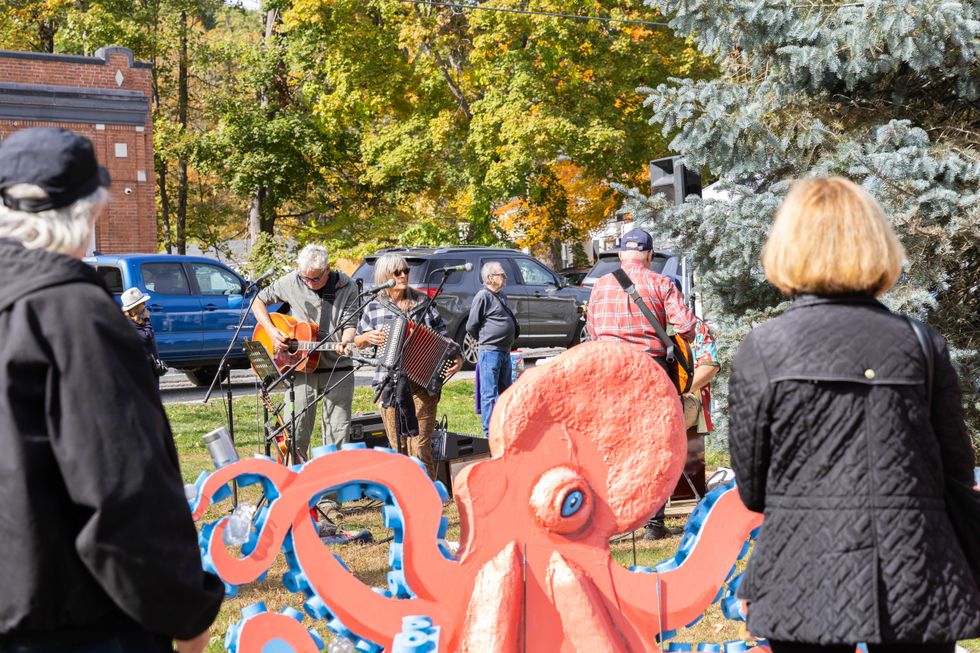
Nearby, the musical group The Joint Chiefs was setting up.
On the White Hart lawn, Salisbury Handmade artisans offered goods ranging from woolen shawls to ceramics and leather goods.
People sat at tables on the lawn enjoying lunch and the fine weather.
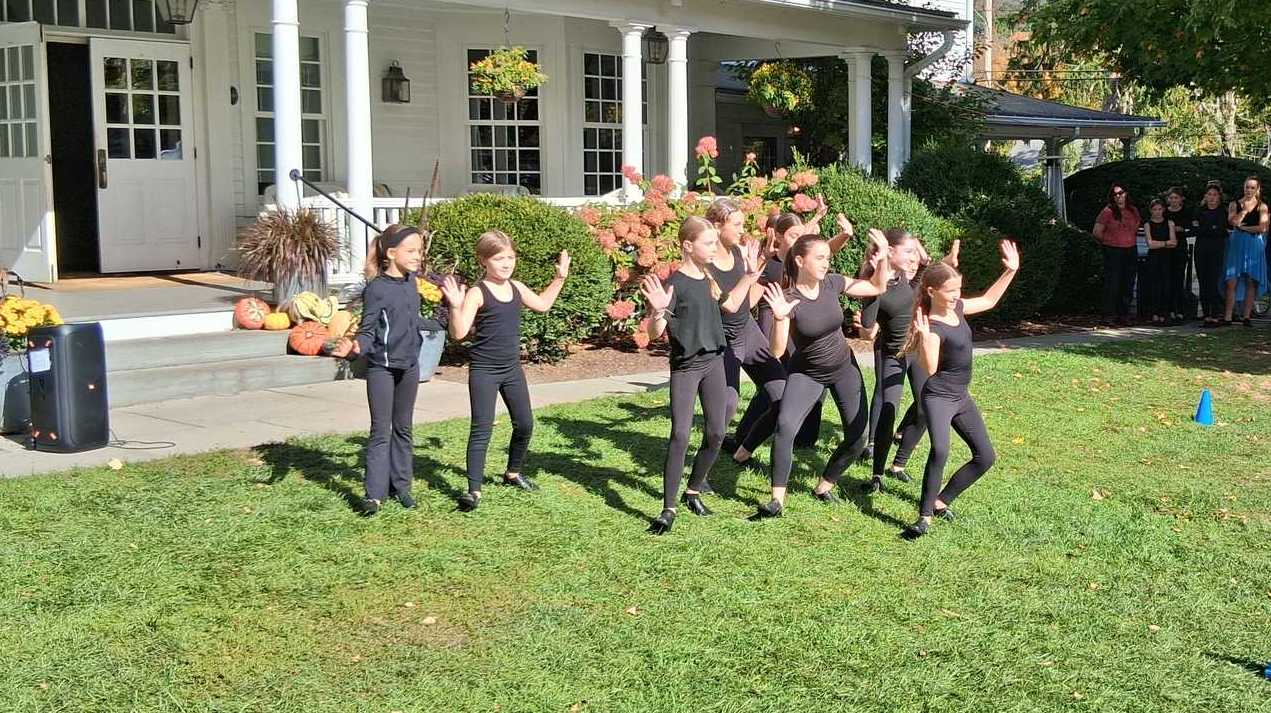
As the clock approached 2 p.m., Darcy Boynton and Amber Cameron of Blue Studio Dance politely asked diners to move their tables back a bit from the White Hart porch so a dance program could begin.
Everybody was agreeable, and most stuck around for the show.
Sunday dawned chilly and wet, forcing the cancellation of the Pet Parade in Lakeville.
But the Salisbury Winter Sports Association’s Brew Ski event at Satre Hill went ahead.
Attendees sampled beers and ales, including “Roadsmary’s Baby,” described by the brewer, Two Roads of Stratford, as a “rum barrel-aged pumpkin ale.”
Ethan Gee of Salisbury shook his head when told about the pumpkin ale.
“No. Pumpkin pie at Thanksgiving. That’s it.”
With the unpleasant weather, Main Street was largely deserted Sunday afternoon, but the Friends of the Scoville Library book sale was still going strong.
Lisa White of the Friends said sales were on track to beat the previous record set in 2024. The proceeds support library programming.
All weekend, everywhere one looked in Salisbury and Lakeville, there were scarecrows.
Some elaborate, some simple, some bearing messages, some just for fun. The winners of the scarecrow contest were announced on Monday.
Madi Long
Children enjoy pumpkin decorating on the lawn of the Scoville Memorial Library during the Salisbury Fall Festival Saturday, Oct. 10.




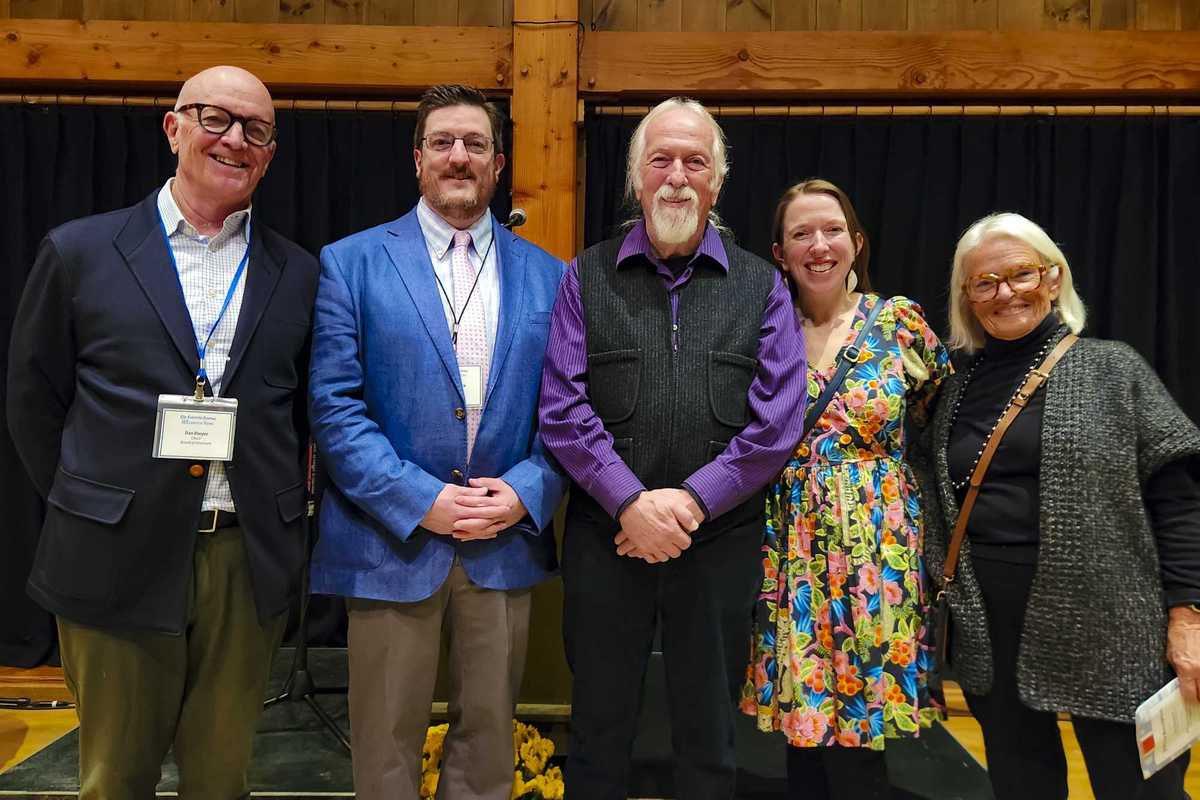
From left, Board Chair Dan Dwyer, Publisher and CEO James Clark, Estabrook Community Leadership Award recipient Dick Hermans, his daughter Suzanna Hermans and Jubilee co-chair Joan Osofsky at the annual gala Oct. 11.
In an address to supporters, Publisher and CEO James Clark said the papers’ survival had been uncertain five years ago, before the transition to nonprofit ownership. Clark thanked attendees, board members and others in the community whose grassroots support enabled that transition.
“You demonstrated that The Lakeville Journal and The Millerton News are essential community assets worth supporting. That support has allowed us to do much more than sustain two newspapers,” Clark said. “We’ve strengthened our newsroom, expanded our reporting, and invested in the people and resources needed to cover our communities more thoroughly.”
Brian Ross, the board vice chair, also addressed the gathering.
The Estabrook award, named for the publications’ former owners, Mary Lou and Robert Estabrook, recognizes outstanding work in the community. Clark praised Hermans’ “longstanding commitment to this region,” saying he “made a lasting difference” as the owner of Oblong Books and as a community activist.
Dan Dwyer, board chairman, connected that commitment to the support of those in attendance, crediting them with helping keep the newspapers going despite widespread closures across the industry.
“Newspapers across the country, thousands of them, have closed in the last 30 years. Similarly, bookstores around the country have too,” Dwyer said.
He pointed to Hermans and the Estabrooks as examples of the community commitment that helps such institutions endure.
“It’s because the Estabrooks established the pivotal role of the newspaper in this community. And Dick Hermans, through his business and his public service, has identified community service as the role that a citizen needs to play.”
For Dwyer, Hermans’ work embodied the practice of good citizenship.
“A bookshop is not just a place where you sell books.It’s where people come… it’s a place where ideas are exchanged,” Dwyer said. “If you want to talk about good old-fashioned civics… this is the guy who’s practiced it for his whole life.”Hermans’ daughter, Suzanna Hermans, and Dwyer presented him with the award. In his remarks, he reflected on his business, his work establishing the Harlem Valley Rail Trail and his upbringing in the area.
“The store has succeeded beyond my wildest dreams and the Rail Trail is more beautiful than anybody could expect from an old railroad line,” said Hermans, who was “instrumental” in its establishment.
Hermans also reflected on his own experience in journalism, starting as a college radio host for the now NPR-affiliated WJHU in Baltimore. Hermans also co-founded the New Pine Plains Herald, a non-profit community newspaper.
“Accurate information and good news about things our neighbors are doing is a key to maintaining a cohesive community,” he said. “By being here, you’re part of The Lakeville Journal/Millerton News community. It is so important that we keep our communities sane.”
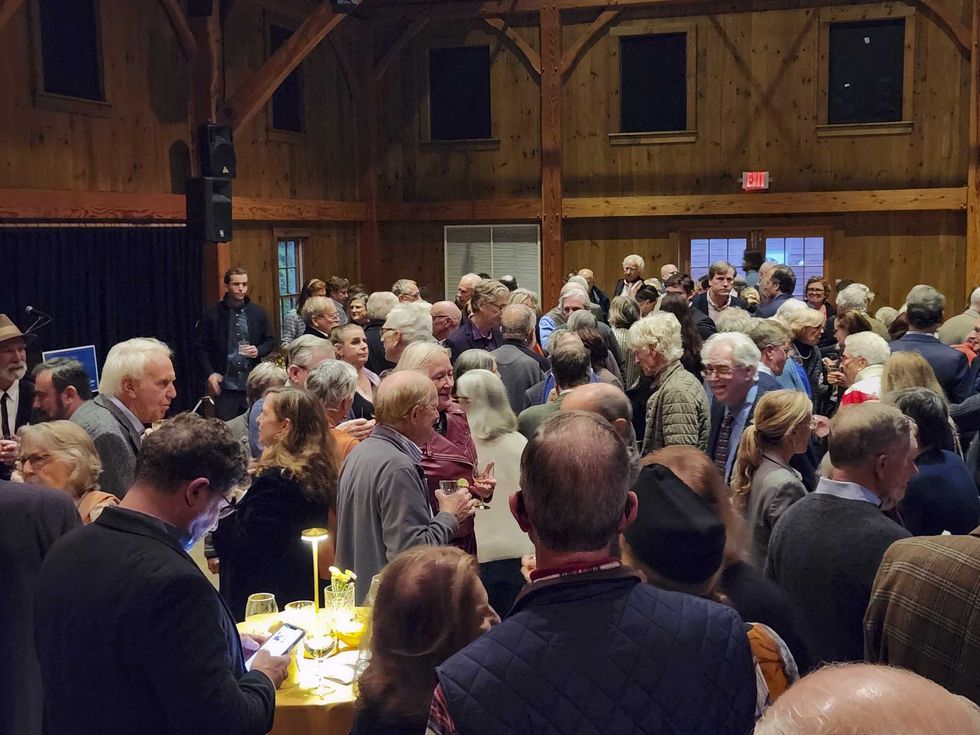 Attendees gather at the Sharon Playhouse Sunday, Oct. 11, for the annual Jubilee gala, celebrating five years of nonprofit ownership of The Lakeville Journal and The Millerton News.Patrick Stachniak

Want more of our stories on Google? Click here to make us a Preferred Source.
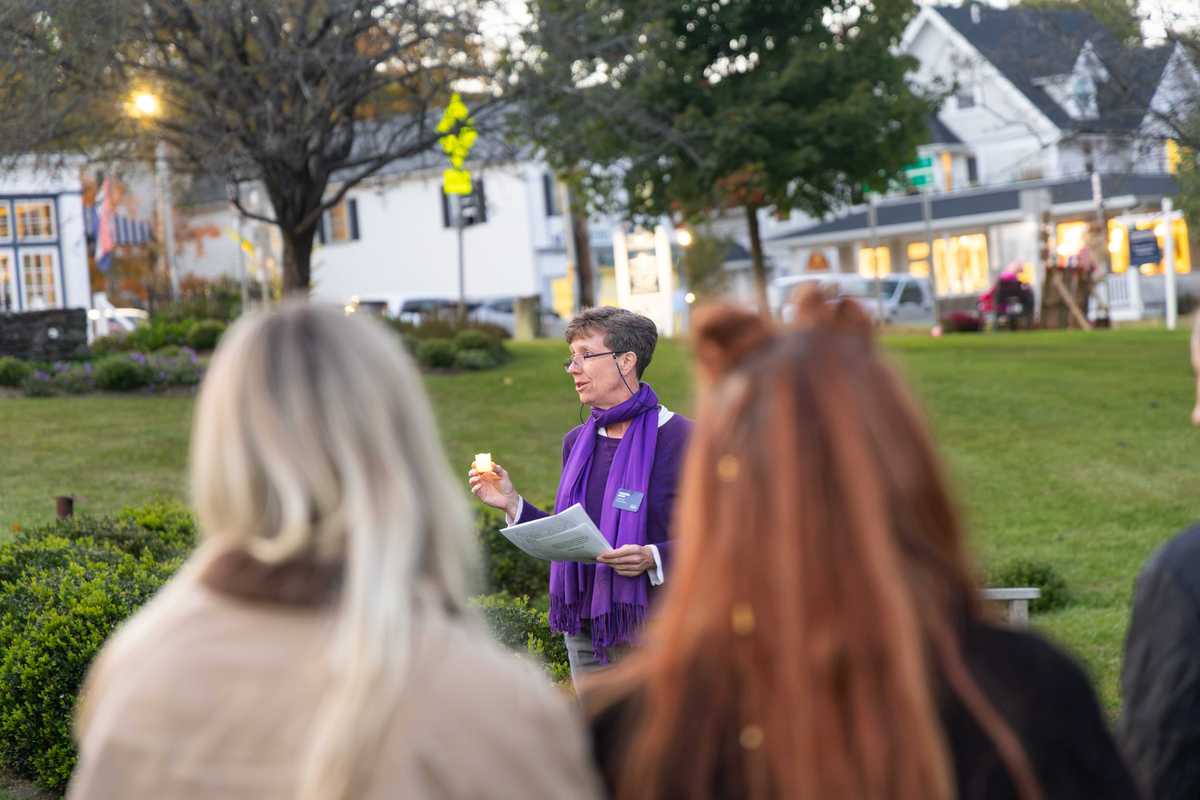
Virginia Gold of Project SAGE speaks at the Oct. 8 vigil.
About 60 people gathered for the vigil, which honored those killed in the past year and called for change in the attitudes and behaviors that enable abuse.
Virginia Gold, Project SAGE’s director of client services, spoke about Carrie Stetson, who was killed in Winsted in June by her estranged husband. Stetson ran the Railroad Cafe at Geer Village in North Canaan and in Winsted.
“Carrie did everything right,” Gold said. “It wasn’t enough.”
Stetson’s husband, Leon Stetson, was arrested and charged with murder, home invasion and violation of a protective order. He remains in jail, with his next court date scheduled for Oct. 27.
“No single action is enough,” Gold told the gathering. “Change doesn’t work that way.”
While organizations such as Project SAGE provide practical help to victims of relationship violence, Gold said, their broader mission is to change conventional attitudes about power and control. Events such as the vigil contribute to that work incrementally.
 Lindsay Dombrovsky and Janay Gregory attend the vigil to raise awareness and show support for survivors. Madi Long
The evening began at Cannon Park, at the intersection of Main Street and Sharon Road, where participants received small packets of red sand.
Artist Kristen Pratt of the Red Sand Project explained that the participatory art project raises awareness of people who fall through the cracks, including those affected by relationship violence and human trafficking.
She led participants in pouring the bright red sand into cracks in the sidewalk.
“It illuminates something we often overlook,” Pratt said.
She reinforced the message by writing “No One Should Fall Between the Cracks” in chalk on the sidewalk.
Participants then walked to Project SAGE’s headquarters at 13A Porter St. The Lakeville nonprofit supports victims and survivors and works to end interpersonal relationship violence.
Executive Director Kristen Van Ginhoven said Project SAGE holds the vigil each October alongside similar organizations nationwide. She described the emotional demands of the work as holding “joy and grief, side by side.”
Gold thanked attendees for being “a witness to the power of community and hope.”
Project SAGE board chair Tom Connell closed with a message about the importance of their participation.
“Your presence here is the sound of hope,” he said. “It’s a reminder of what it means to show up and work for change.”
REAL ESTATE FOR SALE
PUBLISHER'S NOTICE: Equal Housing Opportunity. All real estate advertised in this newspaper is subject to the Federal Fair Housing Act of 1966 revised March 12, 1989 which makes it illegal to advertise any preference, limitation, or discrimination based on race, color religion, sex, handicap or familial status or national origin or intention to make any such preference, limitation or discrimination. All residential property advertised in the State of Connecticut General Statutes 46a-64c which prohibit the making, printing or publishing or causing to be made, printed or published any notice, statement or advertisement with respect to the sale or:rental of a dwelling that indicates any preference, limitation or discrimination based on race, creed, color, national origin, ancestry, sex, marital status, age, lawful source of income, familial status, physical or mental disability or an intention to make any such preference, limitation or discrimination
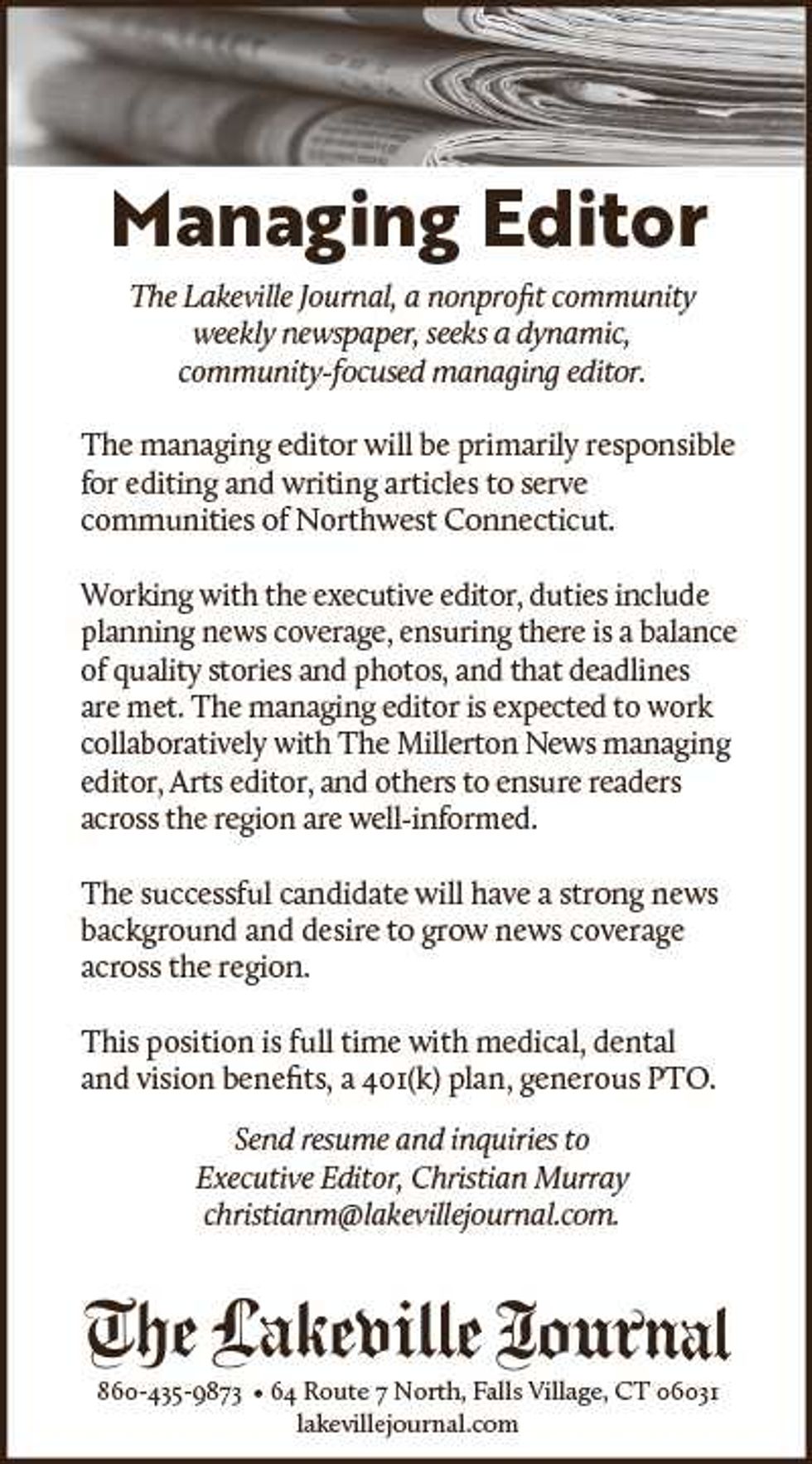
HELP WANTED
Carpenters Wanted:Local established company looking for qualified carpenters. Segalla's TurnKey Housing, LLC is looking for a few carpenters with varying levels of expertise to join an established team. Must be able to work well with others performing a varied list of tasks from siding and framing to finish trim. Competitive wages, 401K, paid holidays, vacation and health insurance offered. Please contact us at 860-824-0019.
Wanted: a mechanic to service my small Husqvarna Z254F zero-turn lawn mower. I'm in Lakeville. 860-435-2660.
Full-time Warehouse and Office positions available in Sharon, CT. We're looking for dependable, self-motivated individuals who are ready to work and take pride in doing a good job. Pay is $22 to $30 an hour, depending on experience. Applicants must have reliable transportation, be dependable and on time every day, be self-motivated and able to work independently, have a positive attitude and good work ethic. Interested? Call Mike or Greg at 800-245-8222 for more information.
HOUSE FOR RENT
2 Bedroom House. Millerton, NY. Quiet. 4 miles from town. No Dogs. $2400 monthly, plus utilities. 518-567-8277.
TAG SALES NORTH CANAAN, CT
TAG SALE. October 16, 17, 18 from 11 a.m. to 5 p.m. 119 Granite Avenue Ext. North Canaan, CT 06018 (corner of Granite Ave. Ext. and Orchard St., off Railroad St). Furniture, jewelry, indoor plants, dried hydrangeas, woman's white ice skates (size 8), women's tan Birkenstock sandles (size 38 narrow), holiday decor, decorative housewares, miscellaneous.
APARTMENTS FOR RENT
3 room apartment in Sharon, utilities included. $1800 per month. 860-248-0056.



Want more of our stories on Google? Click here to make us a Preferred Source.