Northwest towns to take control of Torrington Transfer Station July 1

The entrance to Torrington Transfer Station.
Photo by Jennifer Almquist


A newly formed regional waste authority will take control of the Torrington transfer station on July 1, capping a year-long effort by Northwest Connecticut towns to keep the facility in public hands.
The Northwest Regional Refuse Authority (NRRA), representing several Northwest Corner towns, will assume ownership of the transfer station following legislation signed by Gov. Ned Lamont in May transferring the property to the consortium.
The authority was created in 2025 after a proposed $3.25 million sale of the Torrington Transfer Station to a private waste company alarmed local officials, who feared the loss of a public disposal option could eventually lead to higher costs and a monopoly on waste services in the region.
Municipal leaders argued that private ownership could result in higher tipping fees — the per-ton charges municipalities pay to dispose of household trash — a major expense that directly affects local budgets and taxpayers. The state ultimately blocked the sale, prompting municipalities to organize a regional authority to take over the facility instead.
The NRRA includes Salisbury, Sharon, Cornwall, Falls Village, North Canaan, Norfolk, Goshen, Colebrook and Torrington. Kent is not participating because it already belongs to the Housatonic Resources Recovery Authority, a separate regional waste authority that NRRA plans to emulate.
The Torrington Transfer Station has served as a key disposal hub for Northwest Connecticut communities for decades. Its future became uncertain after the state announced plans to end its operation of the facility more than a year ahead of schedule.
Officials across the Northwest Corner quickly embraced the NRRA proposal. Voters in member towns approved ordinances to join, creating a coalition aimed at maintaining local control over waste disposal.
“The concern that a lot of people have is that if the site were sold to a private hauler, there could potentially be a monopoly in the Northwest Corner when it comes to garbage,” Sharon First Selectman Casey Flanagan said when the town approved the ordinance. “That might not be an issue today, but five or 10 years from now it could be a major problem for communities like ours.”
Cornwall First Selectman Gordon Ridgway said the authority will allow towns to work together on disposal contracts, recycling initiatives and grant opportunities while maintaining local oversight.
“We will hopefully get the lowest price possible,” Ridgway said. “We’re not in it to make money. We’re in it to manage costs.”
The NRRA is still in its infancy and has yet to finalize tipping fees, though officials expect them to remain largely unchanged.
Falls Village First Selectman Dave Barger said preserving local control was a key reason his town joined the authority.
“It provides us with an opportunity to stabilize tipping fees,” Barger said. “It provides us with local control. We can also set our own recycling policies.”
Barger said the authority’s broader goal is to preserve a public option for waste disposal rather than relying entirely on private contractors.
The governing board, made up of the first selectman from each member town, will oversee future decisions regarding disposal contracts, recycling programs and operations at the Torrington facility.
For residents, little is expected to change immediately. Local transfer stations will continue operating as they do today, and existing collection systems will remain in place.
The difference, local officials say, is that decisions about the region’s waste disposal system will now be made by the municipalities that use it rather than by the state or a private operator.
Ruth Epstein
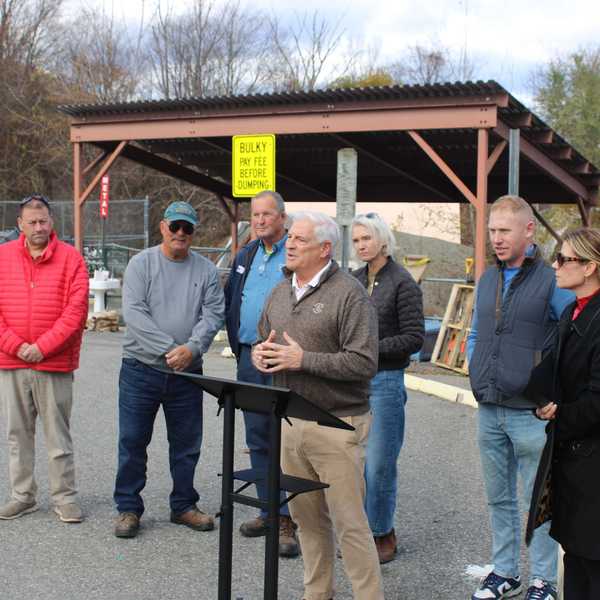
A large crowd gathered at the home of Jamie Delaney and Michael Cullen for the annual CHORE Service Garden Party.
Community members gathered at the hillside home of Jamie Delany and Michael Cullen on Saturday, June 20, to help ensure that their senior and disabled neighbors are able to remain independent.
The event was the annual CHORE Service garden party. The organization provides a variety of everyday support services people rely on, such as help with errands and light housekeeping, while also providing employment opportunities for local residents.
As guests strolled through the expansive gardens and enjoyed hors d’oeuvres, cocktails and one another’s company, they were thanked by staff and board members for their support.
“Because of your support, this past year has been one of meaningful growth and impact,” Jane MacLaren, CHORE Service director, told the audience. “Together we provided nearly 10,000 hours of essential services — an 18% increase over last year — and served 254 residents in our community. We also provided part-time employment to more than 50 caregivers.”
She shared the story of one couple in which the husband is slowing down. While he is largely independent, his wife does not feel comfortable leaving him alone for long periods. Her life had become centered on caregiving, and she felt the need for some time for herself.
She called CHORE, and now, once a week, a caregiver takes her husband out to run errands, giving him an opportunity to stay active and connected while providing her with a break from constant responsibility.
“That’s the difference a few hours can make,” MacLaren said.
She announced that CHORE is expanding its services to include nonmedical respite care for unpaid caregivers like this wife. The organization also plans to expand its transportation program in response to growing demand for rides to medical appointments and social events.
“We look forward to sharing more about these new and expanded initiatives with you in the coming weeks and to demonstrating how your support continues to shape our neighbors’ lives.”
Board Vice Chairman David Becker spoke about the Fund the Cause initiative, which has a goal of $30,000. The funds will be earmarked for transportation to medical appointments.
He noted the beauty of the Northwest Corner but said its lack of transportation options can create significant challenges for many residents.
“Uber doesn’t exist in this part of the state,” he quipped, adding, “No one should miss medical appointments because they don’t have a ride.”
Among the attendees was Darcey Markelon of Litchfield, a CHORE caregiver. She signed up four years ago after retiring as a special education teacher in New Milford. She currently has two clients, and her enthusiasm for the work quickly became apparent.
“I’ve always enjoyed working with the elderly; it’s so rewarding,” Markelon said. “My clients and I have developed close relationships. I look forward to seeing them every week, and they look forward to seeing me.”
For more information, visit choreservice.org
Lakeville Journal
The documentary Bar None: Cannabis Redemption will screen at Stissing Center in Pine Plains Saturday, June 27 at 7:30 p.m. Although cannabis is now legal in much of the U.S., hundreds of thousands still carry the weight of past convictions — and tens of thousands remain behind bars. The film follows 13 people caught in the justice system who’ve turned their lives around by entering the legal cannabis industry. The screening will be followed by a Q&A with the film’s creator. Tickets are available at thestissingcenter.org

Want more of our stories on Google? Click here to make us a Preferred Source.
Lakeville Journal
This Week
Summer is here, bringing long days, local events, gardens, lake time, family visits and, for some, a chance to slow down.
What are you looking forward to this summer? Is there a place you plan to visit, a restaurant you want to try, a show or concert you hope to see, a trail you want to explore or a summer tradition you never miss?
Send your responses to social@lakevillejournal.com by Monday, June 29 at 10 a.m. or comment on Facebook or Instagram.
We’ll publish a selection in next week’s paper.
Last Week’s Question
Should communities hold on to fireworks, embrace drone shows or find room for both?
“Ask the dogs …”
— Heron Hill
“This is a tough question. Drone shows are much more expensive and mostly unaffordable to small towns who have yearly traditions of fireworks. However, fireworks really aren’t good for multiple reasons, including the environment, wildlife and our Veterans. Wish there was a happy-medium like a silent firework!”
— Jessie Lawrence, Canaan
“Perhaps instead of each individual town igniting fireworks we could combine resources for a regional drone show. It’s way past time we should take climate action & consider air quality & effects on animals & humans with PTSD.”
— Lisa Palmer
“Prefer drone shows. Safer and quieter. Drought conditions, wildlife, vets and first responders with PTS and anxious pets.”
— Chloe Keyzn
Lakeville Journal
Thanks to community and volunteers for Fix-it
The organizers of the second annual Salisbury Fix-it Pop-Up would like to thank the community and the volunteers for making this year’s event a wonderful community building event. On May 23, over seventy people attended with over 100 items in need of repair. Our skilled volunteers - Paul Bascik, Rob Buccino, Arthur Fort, Angela Lomanto, Shepherd Myers, Pastor John Nelson, Karin Noyes, Bob Palmer, Pat Palmer, Barbara Reeves and Steven Wolf - worked diligently to repair as many items as possible. A shout out to Karen Vrotsos for promotional emails and scheduling through the library and Sarah Curtis for assisting with registrations. Thank you to Barbara Bettigole and the Salisbury/Sharon Transfer Station for supporting the signage around town. Thank you to the Congregational Church of Salisbury for the use of the parish hall. Thank you to the Lakeville Journal for putting our event in your events calendar and for printing Patrick Sullivan’s photo and article that appeared in the May 28 issue of The Lakeville Journal.
Thank you,
From the Organizers:
Angela Lomanto and Pat Palmer, the Congregational Church of Salisbury
Karen Vrotsos, Scoville Memorial Library
Barbara Bettigole, TRAC (Transfer Station Recycling Advisory Committee)

Want more of our stories on Google? Click here to make us a Preferred Source.

Want more of our stories on Google? Click here to make us a Preferred Source.
America’s 250th anniversary
Jeff Joyce
I have a small but real connection to America’s 250th birthday.
My six-times-removed great-grandfather, Elijah Joyce (1752-1804, b. Charlotte County, Virginia, d. Guilford County, North Carolina) fought the British as a Private in the Guilford County North Carolina Militia under Captain Alexander Hunter. He was at the Battle at Moore’s Creek Bridge, February 27, 1776, the first of the Revolutionary War in North Carolina. I do not know how much combat action he saw there. This brief but important battle effectively ended Royal rule in North Carolina (“First in Freedom” is the slogan on NC license plates). Elijah’s Continental Army pension stubs are in the State Archives in Raleigh.
I don’t take inordinate personal pride in this knowledge, but it is interesting. I can’t really know how Elijah viewed his service. It may be unfair to judge an ancestor’s actions through our knowledge of subsequent history. I suspect he knew Patrick Henry, as they were neighboring landowners in Virginia. I imagine Elijah scorned the British, given the bad treatment they had given his ancestors in the lowlands of Scotland and later in Ireland. Perhaps he wanted ‘the English’ just to get out of his immigrant father’s new home land. Elijah did not die in the fight for Independence, but probably of natural causes years later. He is likely buried somewhere on the land his father purchased along the Mayo River in North Carolina, but the exact location of his grave is not known. I do not know if he was wounded in battle. I will note and remember the man named Crispus Attucks (of both African and Wampanoag descent), the first person killed in confrontation at the Boston Massacre, and many Patriots after.
Branches of my family tree in America reach back to the 1640s in Virginia. Some people would call me a ‘Heritage American,’ a term I have no use for. There were already people from West Africa in the same colony who had arrived as early as 1619, in chains. And of course, there were the Powhatan, who had lived on that same land for perhaps 12,000 years.
Part of Elijah’s military service under Captain Hunter, perhaps the major part, involved attacks on the Cherokee (Tsalagi) people of western North Carolina. In response to colonist uprisings the British encouraged Native tribes to attack white settlements in western North Carolina, and then abandoned the tribes. Patriot militia retaliated against the tribes in the summer of 1776. In the 18th century, the Tsalagi Nation was huge, stretching across what is now western North Carolina, South Carolina, Tennessee, and Georgia. The Tsalagi were a highly developed society with a complex knowledge of their own history, language (Kituwah), and spiritual practice. The near complete extermination of this civilization by European settlers was a crime against humanity, a stain on our culture. Much as we might wish, we cannot change that history, but we should not forget it happened.
Now, here we are, Americans. Descendants of the Tsalagi, Mohican. Bantu, Igbo, Ashanti. Scots. Irish. Jews. Maya. Spanish. French Huguenots. Filipinos. Vietnamese. And many more.
The battle for independence we still must fight is the one against any notion that we not one people. Now, perhaps more than ever before in our history we need to act in solidarity.
Jeff Joyce is an artist who lives in Sharon.