Latest News

Gardeners needed for native plant design business: March 15-December 1st. Must be physically fit and dependable. Call for interview 347-496-5168. Resume and references needed.
Weatogue Stables in Salisbury, CT: has an opening for experienced barn help for Mondays and Tuesdays. More hours available if desired. Reliable and experienced please! All daily aspects of farm care- feeding, grooming, turnout/in, stall/barn/pasture cleaning. Possible housing available for a full-time applicant. Lovely facility, great staff and horses! Contact Bobbi at 860-307-8531. Text best for prompt reply.
Services Offered
Hector Pacay Landscaping and Construction LLC: Fully insured. Renovation, decking, painting; interior exterior, mowing lawn, garden, stone wall, patio, tree work, clean gutters, mowing fields. 845-636-3212.
PROFESSIONAL HOUSEKEEPING & HOUSE SITTING: Experienced, dependable, and respectful of your home. Excellent references. Reasonable prices. Flexible scheduling available. Residential/ commercial. Call/Text: 860-318-5385. Ana Mazo.
Pets
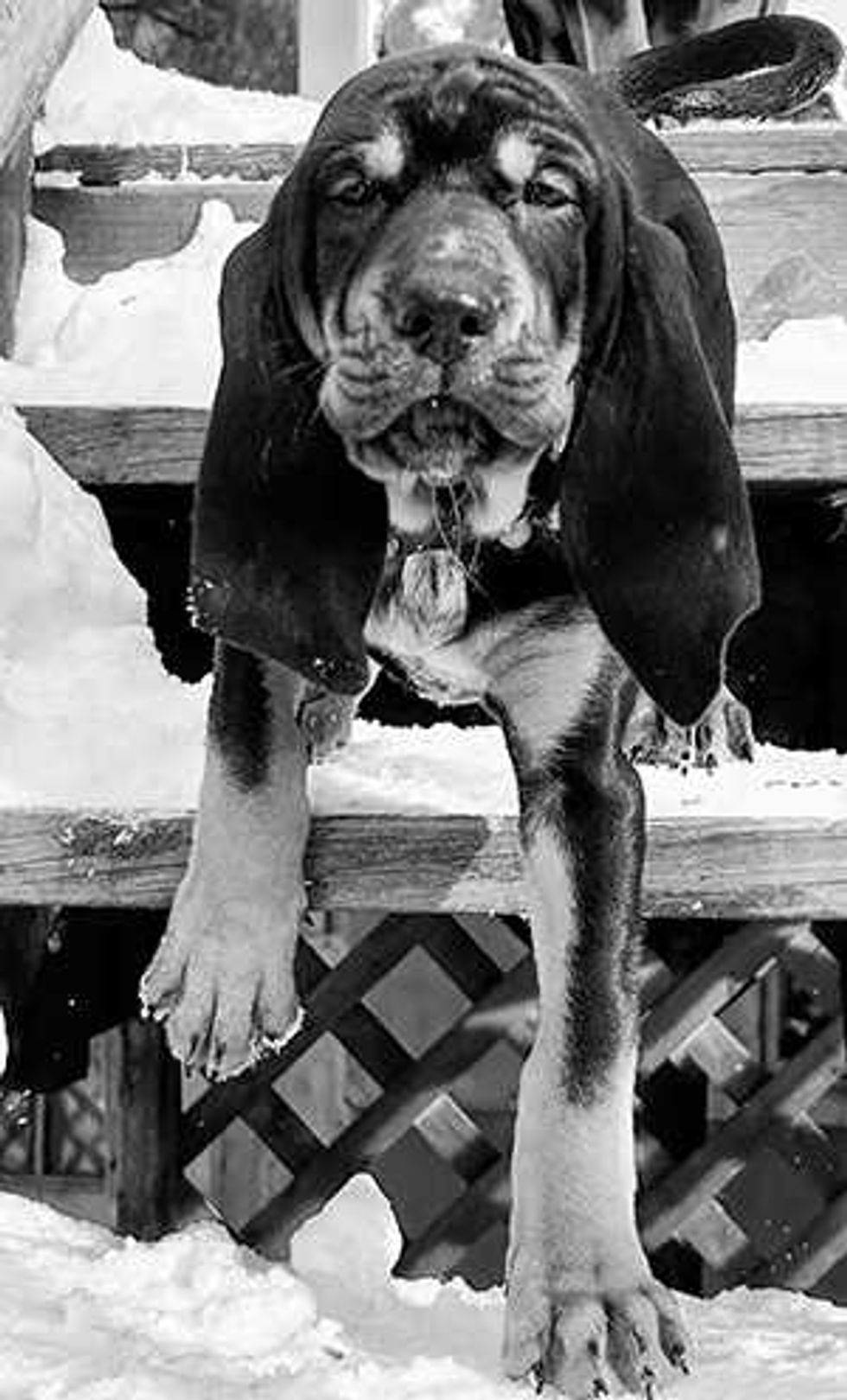
12 week old black and tan/blue tick coonhound: mix for sale. First set of puppy shots done at 8 weeks. Call 860-248-9947 for more info. and price.
Real Estate
PUBLISHER’S NOTICE: Equal Housing Opportunity. All real estate advertised in this newspaper is subject to the Federal Fair Housing Act of 1966 revised March 12, 1989 which makes it illegal to advertise any preference, limitation, or discrimination based on race, color religion, sex, handicap or familial status or national origin or intention to make any such preference, limitation or discrimination. All residential property advertised in the State of Connecticut General Statutes 46a-64c which prohibit the making, printing or publishing or causing to be made, printed or published any notice, statement or advertisement with respect to the sale or:rental of a dwelling that indicates any preference, limitation or discrimination based on race, creed, color, national origin, ancestry, sex, marital status, age, lawful source of income, familial status, physical or mental disability or an intention to make any such preference, limitation or discrimination.
Real Estate For Sale
 lakevillejournal.com
FOR SALE: 39 Hospital Hill Road, Sharon. 1680 sq.ft. Two family, rare side-by-side units. 4 bed; 2 full bath, 2 half. Great investment, or live in one and rent other side. $485,000. Call/text Sava, 914 -227-4127.
Business Opportunities
FOR RENT COMMERCIAL KITCHEN IN FALLS VILLAGE: Located in the heart of Falls Village. 425 sf space fully equipped for catering business, wholesale food prep or bakery. Several successful local businesses got their start here! Event space in building could be available. Contact anita@100mainst.com.





Want more of our stories on Google? Click here to make us a Preferred Source.

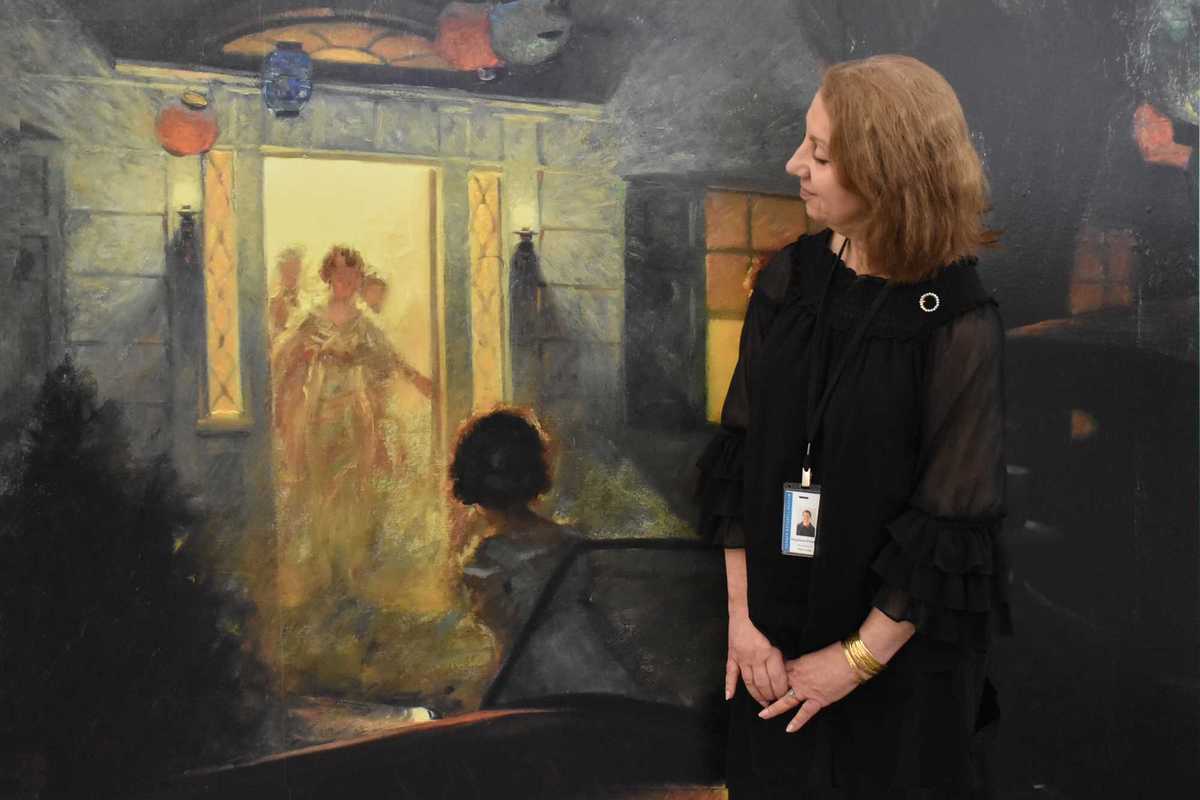
Stephanie Haboush Plunkett
L. Tomaino
“The field of illustration is very close to my heart,” she said. Inspired by that example, she studied illustration at Pratt Institute and began her career as an illustrator before shifting toward museum work. An internship at the Brooklyn Museum proved pivotal. “It was inspiring to see the children come alive in front of art,” she recalled.
In addition to her curatorial work, Plunkett is the author of two children’s books, “Kongi and Potgi: A Cinderella Story from China” and “Sir Whong and the Golden Pig,” and has written or co-authored numerous books on illustration, including “Drawing Lessons from the Famous Artists School” and “Leo Lionni: Storyteller, Illustrator, Designer.” She earned an MFA from the School of Visual Arts and built a museum career that included positions at the Brooklyn Museum, the Brooklyn Children’s Museum and the Heckscher Museum of Art before joining the Norman Rockwell Museum, where she has worked for 31 years.
But elevating illustration has meant challenging decades of critical skepticism.
“The goal has been to shine a light on this important American art form and to elevate public awareness of its artistic and cultural importance,”Plunkett said.
As a popular and widely circulated art, illustration is sometimes thought of as inferior to fine art, such as painting and sculpture. Plunkett considered why. She theorized that the 1913 New York Armory Show, the International Exhibition of Modern Art, with works by artists such as Picasso, Matisse and Duchamp, initially contributed to this evaluation. In the 1930s and ’40s, abstract expressionism became the art of the nation, and the rift widened further.
“Norman Rockwell became the antihero for many art critics of the time,” said Plunkett. “Illustration was viewed as too commercial and sentimental because of its emphasis on visual storytelling.”
Plunkett calls illustration “art with a job to do.” She explained, “Illustrators are adept at solving visual problems for their clients while expressing their own aesthetic and artistic vision.”
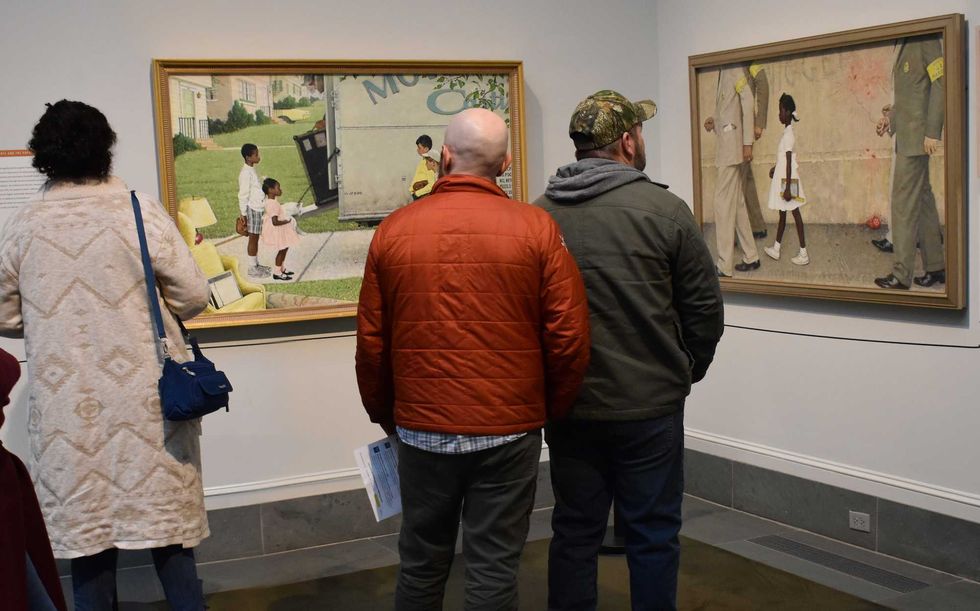 Visitors consider Norman Rockwell’s paintings on Civil Rights for Look Magazine, “New Kids in the Neighborhood” (1967) and “The Problem We All Live With” (1963.) L. Tomaino
She noted that the line between the fine and applied arts “is much more porous now, with many artists working across platforms and styles.” She cited late-20th-century illustrators like Marshall Arisman, Barbara Nessim, Robert Cunningham, Bernie Fuchs and Mark English as illustrators who forged unique approaches to working and seeing.
Plunkett commented that people want to see the original illustrations. “Generally, Rockwell exhibitions bring high attendance. Currently, our traveling exhibition, ‘Norman Rockwell: From Camera to Canvas,’ is at the New Britain Museum of American Art, but we’ve traveled Rockwell and illustration to 45 states and several countries, including Japan, France, Italy and Germany.”
Nowadays, illustrators take on subjects that are important to them. “The children’s book industry is committed to sharing the richness and diversity of people and cultures with young readers.” Plunkett cited the late illustrator Jerry Pinkney’s commitment to this goal. As a boy, Pinkney found no books portraying children like him, and “his life’s mission as an artist was to present inspiring, positive images of children of color.”
The Norman Rockwell Museum and Rockwell Center seeds were sown when “Rockwell placed the first 199 artworks in the care and collection of the Norman Rockwell Museum upon its founding in 1969, some of which he personally acquired for the fledgling collection,” said Plunkett. “The museum’s current Rockwell holdings include 865 original artworks, the artist’s Stockbridge studio and an archive of 400,000 photographs, letters, props and first uses of the artist’s work. We also hold about 25,000 illustrations by other artists, from the historical to the contemporary.”
“We call ourselves the home for American illustration. We have a real commitment to illustrators and what they’ve accomplished,” said Plunkett.
The Norman Rockwell Museum is located at 9 Glendale Road, Stockbridge. For more information and to purchase tickets, visit
nrm.org

Want more of our stories on Google? Click here to make us a Preferred Source.