Paws and flair at yearly Pet Parade

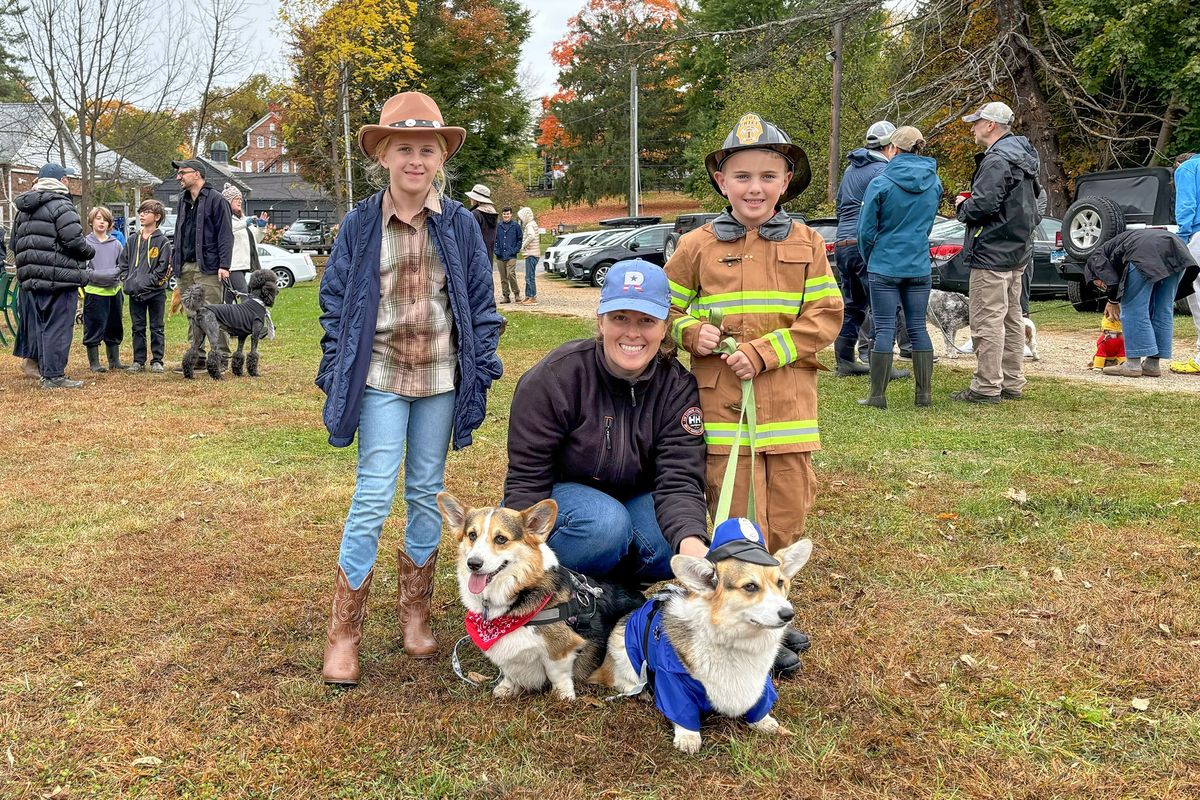
Maggie and Goldie pose with their humans Jaclyn, Lillian and Tillman.
Alec Linden

Maggie and Goldie pose with their humans Jaclyn, Lillian and Tillman.
SALISBURY — The drizzle and chill kept the crowd smaller than usual at this year’s pet parade, which went forward despite the weather on Sunday. The hardy dogs — and their human counterparts — were well rewarded for braving the elements, since the lower numbers meant that every participating pooch went away with an award.
Meeting at the Lakeville Community Field at noon, owners wrangled their dressed-up dogs into a sort of managed chaos so the whole entourage could set off across the field, left onto Pettee Street, and then back down Main Street to complete the loop. Upon regrouping at the field, a few dogs performed tricks, after which awards, treats and toys were doled out to a chorus of clapping and woofs.
Maggie and Goldie of the Perusse family won best costumes for their getups as a police officer and a cowgirl, respectively. Lillian and Tillman Perusse complemented their pets’ looks with another cowgirl costume and a firefighter suit.
Ziggy, whose eight-pound stature was made even more menacing by a spiky coyote vest, was awarded most talented trick for her flawless performance of “both paws, down, and twirl.” Ziggy’s owner Zosia Baroody had come from Brooklyn to visit her dad and his dog, Falafel, who matched Ziggy’s accomplishment with the award for cutest trick.
Other dogs didn’t have to perform for recognition, but got it just by being themselves. Tucker, of the Brutting family, is 14 and didn’t have to lift a paw as his family pushed him in a stroller. He was awarded oldest dog for his efforts, and looked great while doing it in an L.L. Bean vest.
Some pets were just too cool to dress up. Two of the Muzaurieta family’s three Cavalier King Charles Spaniels were dutifully adorned in Winnie-the-Pooh getups. Lola, however, sported a stylish Halloween sweater — “too sophisticated for a costume,” her mom Annie explained.
SHARON — Thomas was born in London, England, May 1, 1945.His parents had left Germany in 1938 and arrived in England by way of Prague.Thomas grew up in London and followed his father into the Brod Gallery, specializing in Dutch 17th century paintings and drawings.When he was eighteen, his father sent him to the United States for the first time.His assignment was to travel the country visiting collectors and museums.This would be his first trip, but many would follow.
Thomas loved art, music, travel, skiing, woodworking, and everything that went up in the air (he was a private pilot and also enjoyed flying radio control model airplanes).But there was nothing he loved more than his family.His four children, Alex, Jonathan, Julian and Amelia, their spouses, and his grandchildren.Thomas had Parkinson’s disease for 36 years, which progressively hindered many of his usual activities.But time spent with his family, children, grandchildren and his wife, Brenda, always brought him joy and increased energy.He always had a wry and surprising sense of humor, and laugh lines at the corners of his eyes, or a raised eyebrow, when someone made a joke.
Thomas, Brenda and family lived in Sharon for part of each year, beginning in 1983.In 2018, Thomas and Brenda moved permanently to Sharon.Thomas felt a strong kinship to this area from his first visit.It is where he, and his family, spent many of the happiest moments of their lives.We are glad that his last years were spent here.
Thomas died at home in the early hours of New Year’s day after enjoying a New Year’s dinner with his family.
SHARON — Theodore Ned Drumm passed away peacefully on Jan. 1, 2026 after a long battle with heart failure.
Ted Drumm was born Nov. 26, 1932 in Sharon to the late Julia and Ned Drumm. He lived all his life in Sharon.
Ted was a loving father and husband. He was a member of the First Church of Christ Congregational and the Taghhannuck Grange No. 100 for more than 50 years. He served on the board of Deacons and was the first moderator of the church. He also served on the Sharon Board of Finance. He ran a paint contracting business for more than 35 years.
He is predeceased by his wife and son. There are no survivors.
A celebration of life will be held on Saturday, Jan. 17 at 11:00 a.m. at The First Church of Christ Congregational in Sharon.
Burial is private.
In lieu of flowers, contributions may be made to the Sharon Ambulance Squad on The Teddy Lee Memorial Scholarship Fund, 271 Main Street, Suite 3, Great Barrington, MA 01230.
The Kenny Funeral Home has care of arrangements.
SALISBURY — Jill Scott passed away peacefully on Jan. 2, after 93 years of a wide-ranging and well-travelled life.
She was born in Essex, England in 1932. She attended a girls’ boarding school, then went on to complete a year of college. Unfortunately, the need to educate two younger brothers and the Second World War (during which she was evacuated to Oxford) interrupted her studies.
She briefly worked assorted jobs in the London area and attended her brother’s sporting events at the King’s School, Canterbury. It was at King’s that she met and married her husband Neil, a teacher. She was soon hired by King’s as a “house matron,” essentially taking on the household management and “mothering duties” for a large dormitory of teenage boys.
Prior to starting a family, she and Neil went on a motorcycle camping trip to Scotland. Later, summers were spent camping with her growing family in nearby European countries.
Jill and Neil needed new horizons, so they moved with their three children to Quebec, Canada for a year, then down to the Hotchkiss School in Connecticut in 1970. Jill immediately became engaged in supporting all the activities of her family, and, once the children were old enough to be home alone, she started working part-time for the Lakeville Journal as a copy editor. Always a supporter of Hotchkiss, Jill frequently worked in the Hotchkiss School store.
A teaching exchange year in New Zealand provided additional adventure in 1986-1987, and Jill thoroughly enjoyed traveling throughout those islands with Neil and with visiting friends.
Upon Neil’s retirement in 1993 Jill continued her family support work, taking special joy in spending any time possible with each of her four grandchildren as they grew. Jill and Neil also traveled overseas and around the globe, visiting family and friends, and just enjoying new people and experiences.
Besides being family-centered, Jill was a lifelong learner. She read voraciously and thoroughly enjoyed discussing world events with anyone and everyone. She took a multitude of classes, from ceramics to world history, and always enjoyed learning something new. She also believed in community service and was a long-time member of the Salisbury Garden club. Indeed, she was a passionate gardener and, as one friend put it, she could plant a broomstick in the ground and make it grow. She thoroughly enjoyed her time reading to younger students at Salisbury Central School and working with the Noble Horizons Auxiliary. She thrived being outdoors, whether camping, canoeing, skiing, sailing, playing golf, just going for walks, or, in her last years, riding the pathways at Noble Horizons in her electric chair.
Jill was very practical, and in a file designated for after her passing she left us all a note written long before:
“No pain, no senility. I am just in the next room. Laugh and enjoy every day”.
Jill is survived by her son David (Kari), daughter Carol, grandchildren Harry (Samantha), Alexandra, Philip, Spencer, and son-in-law Paul. She is predeceased by her husband Neil, daughter Kathryn, and brothers Jack and Robert. We all miss her greatly.
A celebration of life will be held in the dining room at Noble Horizons at 2:00 p.m. on Saturday, May 2, 2026.
In lieu of flowers, donations can be made in Jill’s name to Noble Horizons Auxiliary, 17 Cobble Road, Salisbury, CT 06068.
The Kenny Funeral Home has care arrangements.
“I’m not a great activist,” said filmmaker Oren Rudavsky, humbly. “I do my work in my own quiet way, and I hope that it speaks to people.”
Rudavsky’s film “Elie Wiesel: Soul on Fire,” screens at The Moviehouse in Millerton on Saturday, Jan. 18, followed by a post-film conversation with Rudavsky and moderator Ileene Smith.
Rudavsky, who lives in New York City and has a home in Lakeville, has been screening films at The Moviehouse for nearly three decades. “I was the first independent filmmaker to show a film there back in 1997 or ’98,” he recalled, with “A Life Apart: Hasidism in America.” “I think I’ve shown four or five films there over the years.”
Best known for his searing 1958 memoir, “Night,” Elie Wiesel forever altered how the Holocaust would be written about and remembered. A teenage survivor of Auschwitz and Buchenwald, the Romanian-born author became an international spokesperson for memory, conscience and moral responsibility. Yet Rudavsky’s documentary looks beyond Wiesel’s public role, revealing a man who was, in the director’s words, “intensely private and profoundly public.”
Rudavsky’s connection to Wiesel is also personal. “I grew up in Boston,” he said, “and Elie started teaching there in ’77 or ’78, and my mother took a class with him.” His father was a Reform rabbi, and the family’s shelves were filled with Jewish books, including Wiesel’s, such as “Night,” “Jews of Silence,” and the volume that would later lend its name to the film: “Souls on Fire.”
“His mystical storytelling is where he’s at his best,” Rudavsky said of the book. “So eloquent and beautiful — you could pick up any page and be transported into this other world, this other realm. ‘Night’ does that too, in a horrifying way, but it achieves that same sort of consciousness change.”
Wiesel, who died in 2016 at the age of 87, would go on to establish what is now the Elie Wiesel Center for Jewish Studies at Boston University, an institution devoted to ethical inquiry, dialogue and human rights, principles that shaped both his teaching and his writing.
“One of the things that is most striking to me in living with Elie Wiesel’s work for the past four years,” said Rudavsky, “is how civilized, cultured, eloquent, soft-spoken and gentle a person he was, how loving in general a person he was.” That gentleness and quiet insistence on civility becomes one of the film’s most moving revelations.
The documentary does not present Wiesel as a saint or a monument. It lingers instead on the human questions. “How do you overcome trauma?” Rudavsky asked. “How do you live with it? Do you ever overcome it? I don’t think Elie did overcome it, but I think he learned to live with it and learned to enjoy life — sleeplessly perhaps — but he enjoyed the world.”
To evoke the inner life of memory, the film incorporates hand-painted animation by Joel Orloff, inspired in part by the illustrator Mark Podwal, who collaborated with Wiesel on several projects. “A few of the animations are inspired by his brilliant work,” Rudavsky said. “Everything else is from Joel Orloff’s imagination.”

The technique they employed in the film was influenced by South African artist William Kentridge, whose charcoal drawings evolve through erasure and reworking. “We wanted to evoke memory through the animation,” Rudavsky explained. “Joel painted on glass, smudged it, poured water onto it.” The result is a haunting, fluid visual language, neither literal nor ornamental.
“At first, I wasn’t sure I was going to use animation,” Rudavsky explained. “But when I read portions of Elie’s autobiography, he intersperses these dreams about his family, his father, and I thought, ‘This just cries out for animation.’” The effect is striking: a fusion of conscious and subconscious, past and present.
Marion Wiesel, Elie’s wife, translator, and closest collaborator, passed away in February of last year. She was able to see the film at a screening at Lincoln Center. “She said to me, ‘I love the film, but it caused me pain because it made me fall in love with Elie all over again,’” Rudavsky recalled. “Which was heartbreaking — but for a filmmaker, what more can you really ask for?”
Marion, he added, was a remarkable figure in her own right, deeply involved in civil rights activism. A member of the NAACP in the 1950s, she encouraged Elie to look beyond the Jewish world he mostly traveled in and toward a broader global perspective.
That outward gaze was central to Wiesel’s public life. The film revisits moments when he spoke directly to political power, including his famous confrontation with President Ronald Reagan over a planned visit to a cemetery in Bitburg, Germany, where SS members were buried. “Elie lost the battle but won the war,” Rudavsky said. “Because how he spoke up was much more lasting than whatever Reagan did.” He adds that what mattered most was the tone: “It was a civil dialogue. A gentle dialogue.”
Moderating the post-screening discussion will be Ileene Smith, editor at large for Farrar, Straus and Giroux and editorial director of Jewish Lives, the prizewinning biography series published by Yale University Press. Smith worked closely with both Elie and Marion Wiesel on many books, including the new translation of “Night.” In 1986, she accompanied the Wiesels to Oslo when Elie received the Nobel Peace Prize. Her husband, Howard Sobel, served for many years on the board of the Elie Wiesel Foundation for Humanity.
Wiesel believed that memory was not passive; it was a moral act. Asked about the moral obligation to bear witness, Rudavsky said, “It’s an endless moral obligation. And we all take on what we can, which is always too little.”
And what would Rudavsky ask Wiesel now if he were still here to bear witness?
“People ask, post–Oct. 7, what would Elie have said? And I can’t speak for him but I know he would have spoken up from where he comes from. Some would have disagreed with him. But in the U.S. today, when immigrants are being shipped off to places unknown, when people trying to defend them are facing violence, even death, we all need to try to do whatever little bit there is to do.”
Even within disagreement, Wiesel believed in dialogue. Rudavsky, speaking about his relationship with Wiesel’s son, Elisha, said: “We have different political perspectives, but we’re united in saying we’ll keep talking, we’ll keep working together. It’s such a divisive time where people don’t talk to each other — they yell at each other and kill each other. That’s something Elie Wiesel certainly would have spoken up about.”
Because for Wiesel, bearing witness was not only about preserving the past. It was about refusing indifference in the present.
For tickets, visit: themoviehouse.net