Thank you!
Your support is sustaining the future of local news in our communities.

A ring cycle with a happy ending

FALLS VILLAGE — Though it doesn’t have the drama of Wagner’s Ring  Cycle, this ring story is intriguing in its own special way.

And it has a happy ending.

The alumni Web site post seeking the owner of a Housatonic Valley Regional High School class ring was not particularly enticing at first. But what caught this reporter’s interest was the suggestion that there was a tale. The ring had only a date, 1963, and the initials “KRC.� But Dan Seichter, the Wallingford man who had recently taken possession of the ring, had written online, “from the story that I understand from the ring, it belonged to a Ken or Kenneth.�

The story Seichter knew of was that the ring, made in the style of that era — a flat onyx stone bearing a gold crest — had been stored with his aunt’s belongings. Marilyn Seichter died of Huntington’s disease in 2002.

Her sister was unpacking from a move earlier this year when she found a box of Seichter’s jewelry. She gave the ring to her son, Dan, telling him she believed his aunt had been engaged to its original owner. She wasn’t sure but thought his name was Ken.

Finding her former sweetheart

The search for a full name began with Bunny McGuire, now retired but a long-time secretary at Housatonic and a graduate of the school herself. From an old yearbook, she came up with the name of Kenneth Robert Cavanaugh, who lived in Cornwall when he attended Housy. He graduated in 1963.

His brother, Gordon, still lives in Cornwall. He couldn’t recall much about Marilyn or any engagement, but was himself intrigued by the story, and passed along his brother’s phone number in Pottstown, Pa., where he lives with his wife, Dolores.

Ring, ring on the telephone

While dialing the number, it occurred to this reporter that Dolores might not know about Marilyn. Thus, the message left on the answering machine had to be somewhat veiled, referring only to the discovery of “a ring.�

As it turned out, it was Dolores Cavanaugh who heard the message first.

“She wondered right away if Marilyn had had the ring,� Ken Cavanaugh said, once this reporter had a chance to speak with him. “A few times over the years we wondered what happened to my high school ring. Dolores knew about Marilyn, and I thought I might have given it to her, but I honestly cannot remember that I did.�

Cavanaugh and Marilyn Seichter met while students at the University of Connecticut. He started at the Torrington branch, then moved to the main campus in September 1964. The couple met the following spring. He recalls their getting “pinned,� the college version of going steady. He remembers giving her his fraternity pin. But not his high school ring.

They talked about marriage but, in the fall of 1966, decided they needed to step back and focus on education and careers.

“The breakup was amicable,� Cavanaugh said. “My grades were taking a beating. It wasn’t easy to be a chemical engineering major and be in a serious relationship. Marilyn was a political science major and planning to go on to UConn law school.

“She was pretty ambitious. I followed her career. She was one of the first women to get a law degree from UConn and went on to be the first woman president of the Connecticut Bar Association.�

Cavanaugh left graduate school in the fall of 1967 for a job in Waterbury. Marilyn was still in law school a little over a year later when Cavanaugh asked her to dinner.

“Part of me was wondering if there was still something there. We caught up, but we were on our own paths, and that was the last time we saw each other.�

Not long after that, he took an engineering job in Pottstown, met Dolores,  a receptionist at the company, and they married. Cavanaugh had no reason not to tell her about his past relationship.

Coming full circle

Cavanaugh was put in touch with Dan Seichter. At last report, they had a great phone conversation, and the ring was on its way to Pottstown.

Seichter also donated some of his aunt’s personal effects to the Connecticut State Library archives, where she is included for her impressive career as a law partner, in politics and for her work on landmark cases, especially those concerning women’s rights.
Latest News

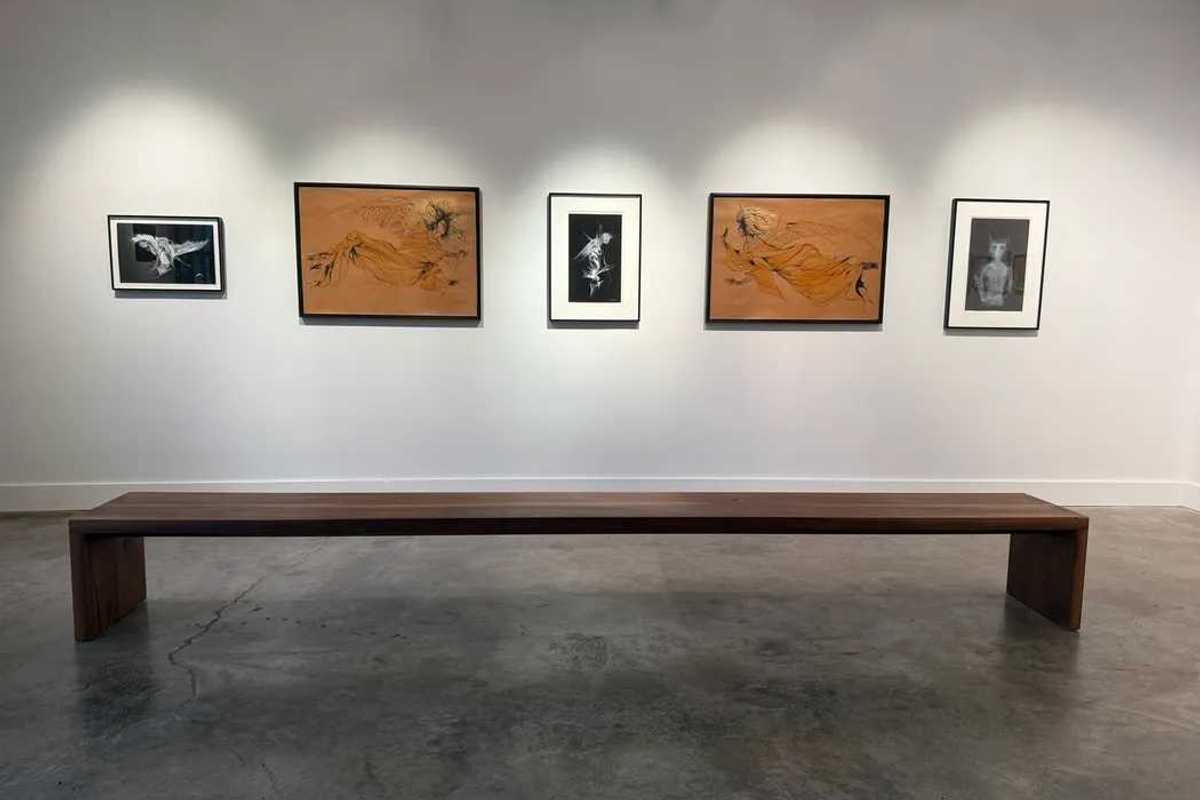
‘So Little to Do,’ so much to discover at James Barron Art

Curator Deborah Goodman Davis reads the Emily Dickinson poem “The Grass So Little Has to Do.” Spencer Finch’s “Following Three Bees (Zinnias)” buzzes in the background.

Photo by Natalia Zukerman

“The Grass Has So Little to Do,” on view at James Barron Art in Kent, takes its title from Emily Dickinson’s poem “The Grass So Little Has to Do,” written in 1862:

“The Grass so little has to do—
A Sphere of simple Green—
With only Butterflies to brood
And Bees to entertain—”

Keep ReadingShow less

Marina Kotchoubey is not a woodworker

Marina Kotchoubey is not a woodworker

Marina Kotchoubey at the Ian Ingersoll Cabinetmakers showroom in West Cornwall.

Photo by D.H. Callahan

After 40-something years navigating the world of custom fine furniture, Ian Ingersoll was getting ready to retire. Starting off with a little dovetail stool that he sold at a shop in West Cornwall in the 1970s, he’d grown his skill and his business into something he — and the whole town — could be proud of. Shutting down that business was not an option.

Ingersoll built Ian Ingersoll Cabinetmakers, which produced mainly classical Shaker furniture, on passion: the passion he had to make a living through creative challenges and the passion of his employees, who all seem deeply in love with their craft.

Keep ReadingShow less
A legacy of giving at Norfolk Chamber Music Festival

One hundred and twenty years ago, Carl and Ellen Stoeckel commissioned New York architect E.K. Rossiter to design The Music Shed in Norfolk, Connecticut. After nearly a decade of entertaining their friends and neighbors with the finest music of the day, they built a permanent home for their beloved Litchfield County Choral Union.

The commission and full funding of the construction was not unheard of in an era when great fortunes led to public enrichment. Railroad tycoon John D. Rockefeller was instrumental in funding institutes of higher education. Steel baron Andrew Carnegie was building libraries all over the country, and famously said that a man who dies rich is a disgrace, challenging his peers to give their fortunes back to the people.

Keep ReadingShow less
google preferred source

Want more of our stories on Google? Click here to make us a Preferred Source.

Two unique exhibitions at Geary Gallery

Henry Klimowicz with his sculpture, “Partial Pillar 1”

Photo by D.H. Callahan

On Saturday, Aug. 1, Geary Gallery opened its doors in Salisbury for two unique shows in its first- and second-floor gallery spaces. Art lovers flooded both floors over the course of the afternoon, giving the events a vibrant feeling that enhanced the importance of the art.

On the first floor is a show by Chicago-born, Colorado-based photographer Summers Moore, titled “Lobitos: Pueblo Fantasma,” or “Lobitos: Ghost Town.” The work centers around her daughter’s current hometown in Peru. Moore herself found a home away from home in Colorado in the mid-1980s and encouraged her children to seek out new places outside of their comfort zones.

Keep ReadingShow less

Writer’s retreat in the woods

Writer’s retreat in the woods

Participants in a 2024 Great Mountain Forest Woodland Academy workshop at Yale Camp.

Photo by Mike Zarfos

Great Mountain Forest (GMF) will host its first Nature Writing Retreat at the historic Yale Camp in Falls Village from Aug. 7-9, 2026. Writers of all levels are invited to draw inspiration from one of New England’s most notable forest landscapes. GMF envisions the retreat becoming an annual event celebrating writing, conservation and the relationship between people and forests.

This immersive three-day retreat reflects on the legacy of Hal Borland, the American writer and New York Times nature columnist whose work was deeply connected to this landscape. The retreat explores how wilderness shapes language, strengthens close observation and fosters environmental consciousness.

Keep ReadingShow less
From Cornwall to Rome, Adam Van Doren at Berkshire Botanical Garden

Artist Adam Van Doren and curator Donna Hassler talk to a group of visitors at the Berkshire Botanical Garden. A Stephen Proctor vessel sits to their left.

Photo by Natalia Zukerman

This summer, the Berkshire Botanical Garden in Stockbridge has hosted “Grounded in Nature: Paintings by Adam Van Doren,” an exhibition exploring the intimate relationship between architecture and the natural world.

On view for only a few more weeks in the Leonhardt Galleries, the exhibition features more than 35 watercolor and oil paintings by the New York-based artist, architect, author and Yale professor, curated by art historian Donna Hassler, director emerita of Chesterwood. The works span three distinct places that have shaped Van Doren’s artistic practice: New York City, Cornwall, Connecticut, and his travels throughout Europe.

Keep ReadingShow less
google preferred source

Want more of our stories on Google? Click here to make us a Preferred Source.

google preferred source

Want more of our stories on Google? Click here to make us a Preferred Source.