By ERICA TAYLOR
NEW HARTFORD — State Rep. Bill Simanski (R-62), and state Sen. Kevin Witkos (R-8) held a public meeting on Thursday, June 9, at the Senior Center in Town Hall.
The meeting covered the state budgets and the issues that defined the fiscal 2016-2017 legislative budget.
Looking back at a legislative session
Simanski and Witkos discussed a range of measures that were implemented and others that failed to be adopted in 2016.
“The important thing is not just what their budget does include, but what it does not include,” Simanski said. “It does not include any significant long-term changes, it does not include any structural changes.”
Simanski emphasized the importance of strengthening state bond caps and implementing a spending cap.
“When the income tax went in, in 1971, the state promised the people in this state that we would have a constitutional spending cap so that we would be limited in the amount of money that the state could increase spending,” Simanski said. “It never happened. Every year, we keep bring up proposals, and it never happens. Since 1971, when the income tax went in, our spending has increased by more than 250 percent.”
Simanski said the ever-growing budget deficit was “the worst thing that has happened this year.”
“What happens in Connecticut, we have a massive deficit, followed by a huge tax increase, and that’s just the cycle we’ve been going through for the past six years,” Witkos said. “We’ve got to break the cycle.”
Simanski also covered the importance of taking measures to protect the Special Transportation Fund. “Gov. Dannel Malloy wanted a constitutional amendment to protect the Special Transportation Fund, so that your gas taxes, department of motor vehicle fees, gross receipts tax on petroleum, all of those things go into the special transportation fund,” Simanski said. “The fund is supposed to pay for roads and bridges, to take care of paving roads, fixing your bridges, and railroad and transportation issues, too.”
Successful measures
Among the major legislative measures that were successfully adopted in 2016 was a proposal requiring people who have been notified of a temporary restraining order to surrender firearms and ammunition within 24 hours of the order, along with a state-administered retirement savings program.
Simanski spoke to the audience in regard to the state-administered retirement savings program.
“Here the state is mandating that the employer take money out of your paycheck and put it into a state-administered retirement program, where you have the option to opt out,” Simanski said. “But by law, you have to opt out, otherwise you are automatically enrolled in the state retirement program, unless your employer already offers a retirement program or a 401K.”
The palliative use of medical marijuana for minors was passed in 2016 and considered a positive by the audience at the meeting, as it can provide relief to minors struggling with ailments due to conditions such as cystic fibrosis and cerebral palsy.
“From the testimonies we’ve had, it does bring relief to those people who are suffering from those conditions,” Simanski said. “It’s not legalizing marijuana, and it’s not smoke form. It’s liquid.”
Failed measures
Among legislative measures that failed in 2016 were the taxing of Yale’s endowment, a proposal requiring permit holders for pistols or revolvers to present their permits to law enforcers upon request and a $15 an hour minimum wage bill.
Under the $15 an hour minimum wage bill, required employers would have to pay the state a tax, ranging from 10 cents to $1 an hour for each hour worked by an employee receiving less than $15 an hour. “It’s kind of an incorrect way of trying to get people to move up to a $15 an hour minimum wage,” Simanski said. “If you’re going to impose laws like this, it sends a message to the entire business community that you’re not welcome here in this state.”
Among legislative issues mentioned with bipartisan support were cancer relief funds for firefighters, and measures to curb heroin and opioid overdoses, including putting a seven day cap on opioid prescriptions and ensuring that first responders have access to Narcan.
“Some of these school athletes, 14- to 15 years-old, suffer an injury playing sports and are given an opioid prescription for two weeks,” Simanski said. “When you get addicted to opioids, it’s cheaper to buy heroin than it is to buy opioids, and that’s why people are going from opioid addiction to heroin. We did put a limit, seven days for the initial prescription. If you need more than that you have to go to the doctor, and prove why you need a second prescription.”
At the conclusion of the meeting, Senator Witkos said that during the next legislative session he will be working on an unemployment compensation reform for 2017 and funding for special education.


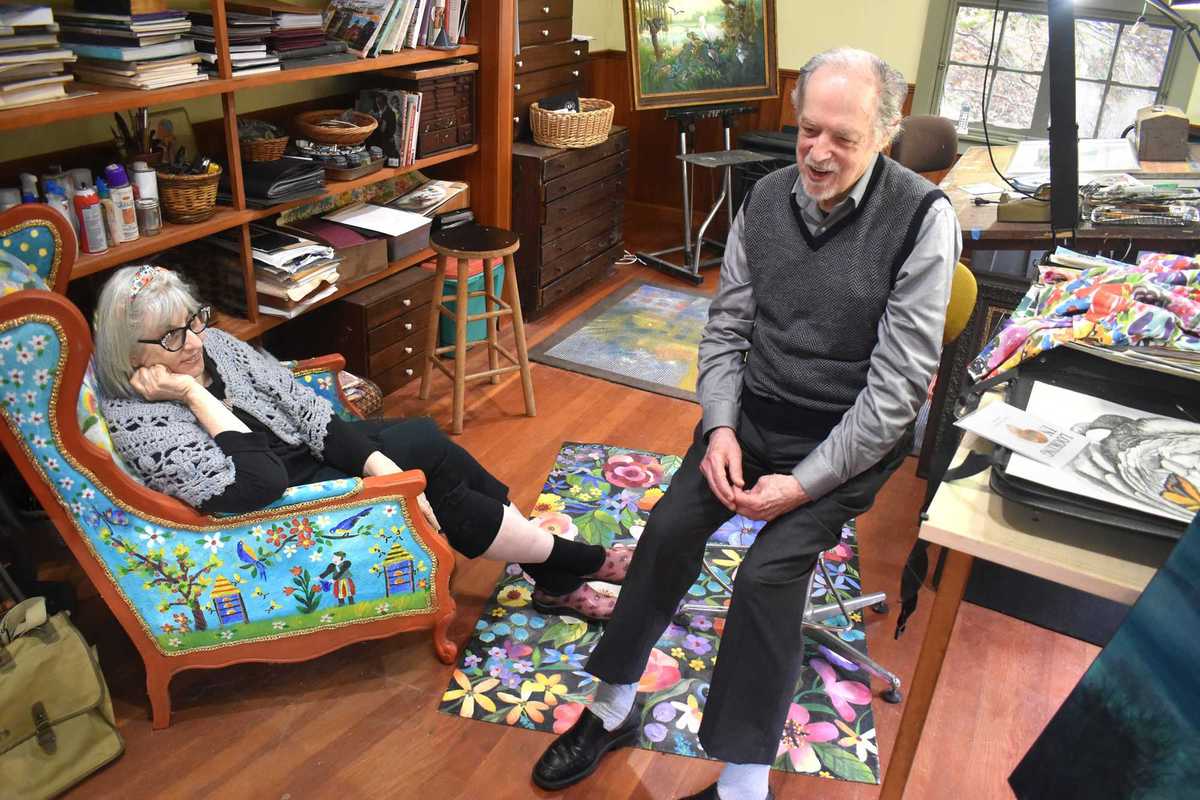
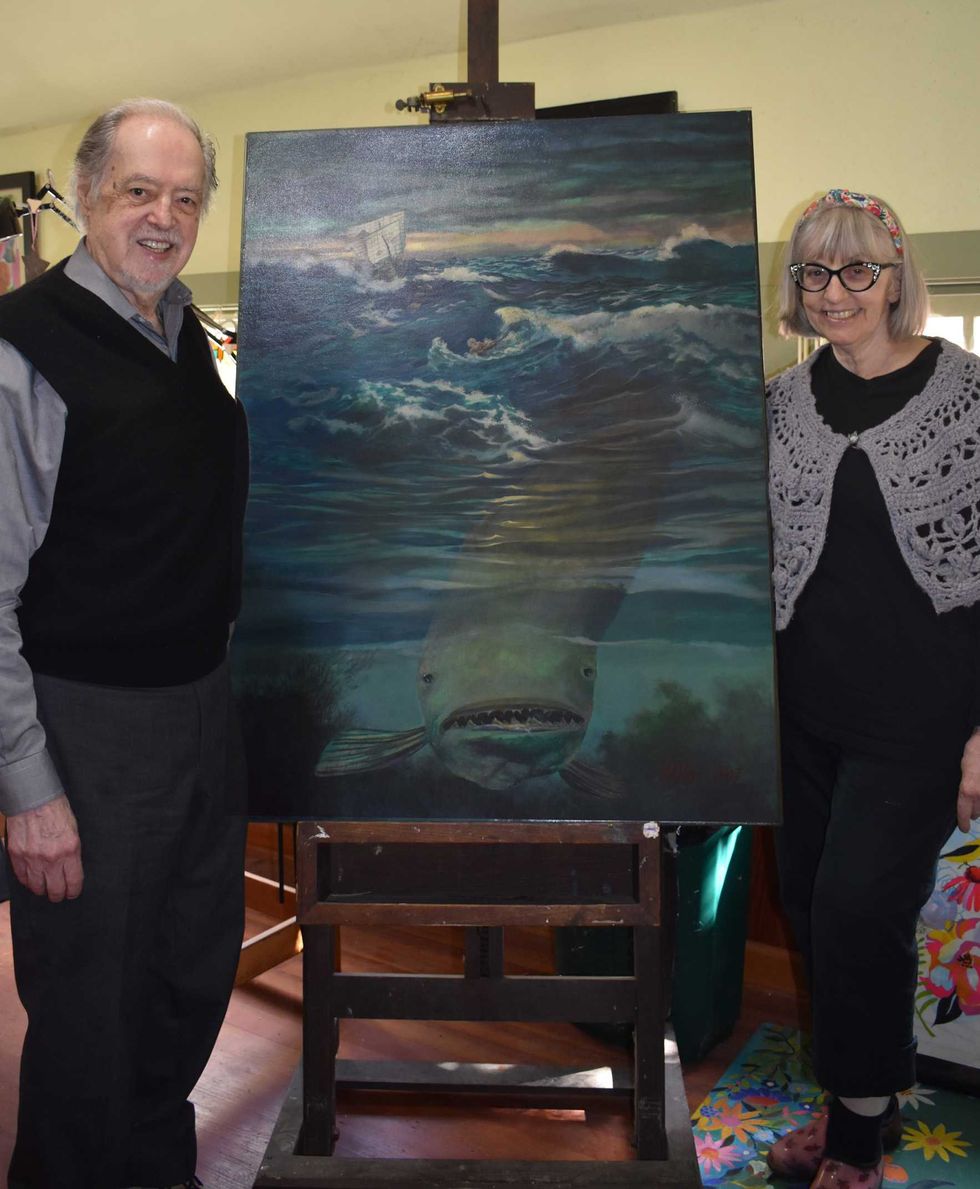 Justine and Victor Valla in their studio with a painting of Victor’s,”Jonah and the Whale.” Robin Roraback


 A ceramic vase by Kathleen Heidemann.Provided
  Joy Brown’s delightful ceramic sculptures.Provided