These old buildings can tell tales

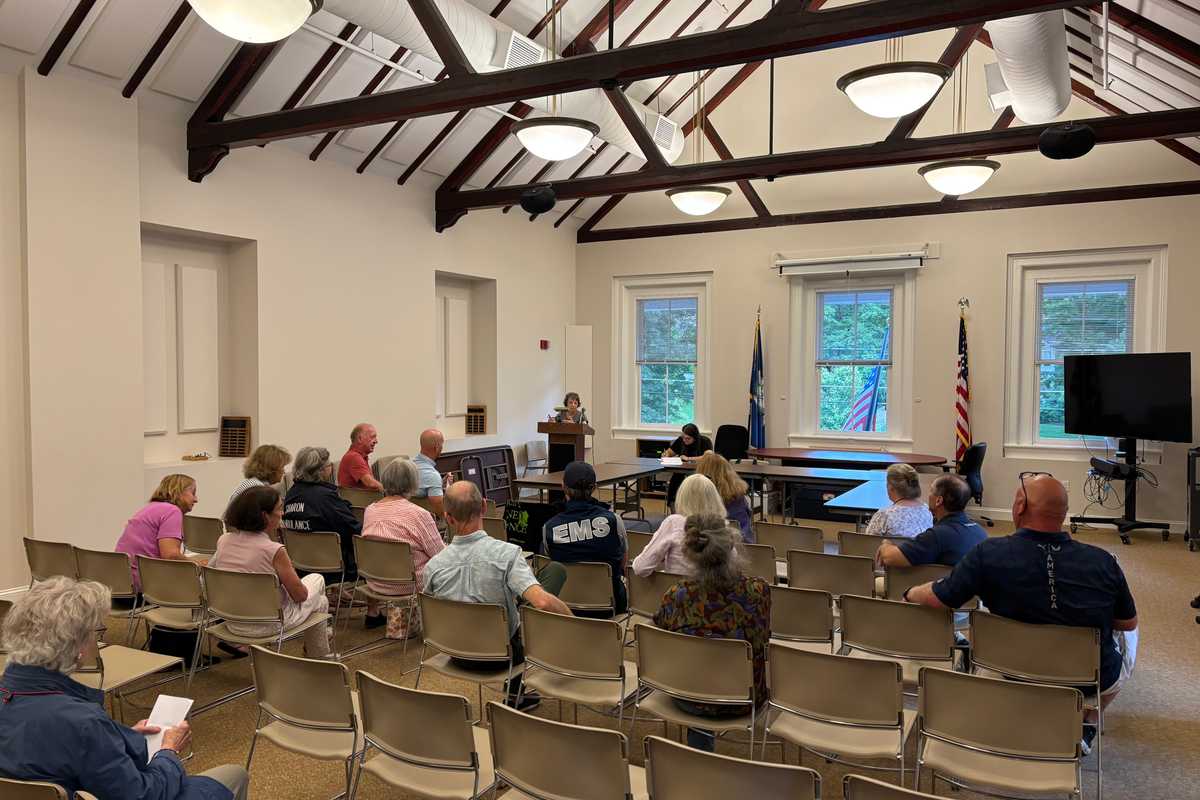
SHARON — Walking the centuries-old paths where now-silent generations strolled and considered their town’s present and hopeful future proved to be a provocative experience for the 20 or so residents and visitors who joined in a walk around the Sharon Green on Saturday, Sept. 28.

The weather could not have been better for the event billed as The Sharon Green Then and Now, an apt description.  Sharon Historical Society Director Jennifer Owens narrated the walk, armed with old photographs to show each property as it was when photography first became possible. 

As for further back in time, Owens narrated how the buildings were purposed in the 18th and 19th centuries.

“Our records go back to the founding of the town, in 1739,” Owens reported. 

“I was surprised to see how many general stores there were,” she added.

Part of the Housatonic Heritage Walks program being offered throughout the region this month, the walk began at the Gay-Hoyt House, home to the historical society, and moved on to the Hotchkiss Library of Sharon, built in 1893.

Before there was the Methodist church, services were held at what is now The Taylor House in 1788, when it was a tavern.

Down on Main Street, there were several general stores over the years. Notice was taken of the varied histories of the properties, including a casino that offered cultural events and perhaps dances — not a casino in the modern sense of casino gambling, necessarily.

The Green itself, temporarily brown due to re-seeding after completion of a massive rebuild, but expected to become green within a month, was a public space and continues to be so. 

Over the summer, a drainage system and new sidewalk curbs were added on the upper side of the Green. The work was just completed, a month ahead of schedule. 

Long ago, horses were watered and rested on the Green, Owens said. Militia met there during the Revolutionary War. Newly formed churches would hold services; revivals would be a regular occurrence. Owners of distant Sharon properties would bring their animals there during important town center events such as the annual town meeting.

Ken and Elizabeth Frydman spoke to the group briefly about their home, its history and their stewardship of that heritage. The Abner and Elizabeth Burnham House, built between 1811 and 181, was a tavern for a while, then a girls’ school, then a millinery shop and then a pharmacy. 

One home held the roots of the Sharon Playhouse which began with dramatic readings being performed there between the 1920s and World War II.

A grand old hotel with porches that went on forever stood across from the Clock Tower. Vacationers from New York would take the train north to Sharon Station in the late 1800s and early 1900s to breathe the fresh Sharon air. 

The tour concluded at the iconic 1884 Clock Tower.

For anyone who missed the tour, a video and more information about each house is at the historical society’s website at www.sharonhist.org. Click on A Guide to the Homes and Buildings of the Sharon Green.

To find out about other Housatonic Heritage outings, go to www. housatonicheritage.org/events.
Latest News

Living art takes center stage in the Berkshires

Contemporary chamber musicians, HUB, performing at The Clark.

D.H. Callahan

Northwestern Massachusetts may sometimes feel remote, but last weekend it felt like the center of the contemporary art world.

Within 15 miles of each other, MASS MoCA in North Adams and the Clark Art Institute in Williamstown showcased not only their renowned historic collections, but an impressive range of living artists pushing boundaries in technology, identity and sound.

Keep ReadingShow less
Persistently amplifying women’s voices

Francesca Donner, founder and editor of The Persistent. Subscribe at thepersistent.com.

Aly Morrissey

Francesca Donner pours a cup of tea in the cozy library of Troutbeck’s Manor House in Amenia, likely a habit she picked up during her formative years in the United Kingdom. Flanked by old books and a roaring fire, Donner feels at home in the quiet room, where she spends much of her time working as founder, editor and CEO of The Persistent, a journalism platform created to amplify women’s voices.

Although her parents are American and she spent her earliest years in New York City and Litchfield County — even attending Washington Montessori School as a preschooler — Donner moved to England at around five years old and completed most of her education there. Her accent still bears the imprint of what she describes as a traditional English schooling.

Keep ReadingShow less
Jarrett Porter on the enduring power of Schubert’s ‘Winterreise’
Baritone Jarrett Porter to perform Schubert’s “Winterreise”
Tim Gersten

On March 7, Berkshire Opera Festival will bring “Winterreise” to Studio E at Tanglewood’s Linde Center for Music and Learning, with baritone Jarrett Porter and BOF Artistic Director and pianist Brian Garman performing Franz Schubert’s haunting 24-song setting of poems by Wilhelm Müller.

A rejected lover. A frozen landscape. A mind unraveling in real time. Nearly 200 years after its premiere, “Winterreise” remains unnervingly current in its psychological portrait of isolation, heartbreak and existential drift.

Keep ReadingShow less
google preferred source

Want more of our stories on Google? Click here to make us a Preferred Source.

A grand finale for Crescendo’s 22nd season

Christine Gevert, artistic director, brings together international and local musicians for a season of rare works.

Stephen Potter

Crescendo, the Lakeville-based nonprofit specializing in early and rarely performed classical music, will close its 22nd season with a slate of spring concerts featuring international performers, local musicians and works by pioneering composers from the Baroque era to the 20th century.

Christine Gevert, the organization’s artistic director, has gathered international vocal and instrumental talent, blending it with local voices to provide Berkshire audiences with rare musical treats.

Keep ReadingShow less

Leopold Week honors land and legacy

Leopold Week honors land and legacy

Aldo Leopold in 1942, seated at his desk examining a gray partridge specimen.

Robert C. Oetking

In his 1949 seminal work, “A Sand County Almanac,” Aldo Leopold, regarded by many conservationists as the father of wildlife ecology and modern conservation, wrote, “There are some who can live without wild things and some who cannot.” Leopold was a forester, philosopher, conservationist, educator, writer and outdoor enthusiast.

Originally published by Oxford University Press, “A Sand County Almanac” has sold 2 million copies and been translated into 15 languages. On Sunday, March 8, from 3 to 5 p.m. in the Great Hall of the Norfolk Library, the public is invited to a community reading of selections from the book followed by a moderated discussion with Steve Dunsky, director of “Green Fire,” an Emmy Award-winning documentary film exploring the origins of Leopold’s “land ethic.” Similar reading events take place each year across the country during “Leopold Week” in early March. Planning for this Litchfield County reading began when the Norfolk Library received a grant from the Aldo Leopold Foundation, which provided copies of “A Sand County Almanac” to distribute during the event.

Keep ReadingShow less

Erica Child Prud’homme

Erica Child Prud’homme

WEST CORNWALL — Erica Child Prud’homme died peacefully in her sleep on Jan. 9, 2026, at home in West Cornwall, Connecticut, at 93.

Erica was born on April 27, 1932, in Doylestown, Pennsylvania, the eldest of three children of Charles and Fredericka Child. With her siblings Rachel and Jonathan, Erica was raised in Lumberville, a town in the creative enclave of Bucks County where she began to sketch and paint as a child.

Keep ReadingShow less
google preferred source

Want more of our stories on Google? Click here to make us a Preferred Source.

google preferred source

Want more of our stories on Google? Click here to make us a Preferred Source.