MILLBROOK — Emotional, sometimes contentious, the meeting held at the Millbrook firehouse on Monday, April 7, was a long time coming — the wide array of questions, answers and raw emotions was not unexpected. In fact, for more than a year, it has come up at numerous Town and Village Board meetings. The question to be answered: Do town of Washington and Millbrook residents need 24/7 paid ambulance service? Roughly 60 people attended.
An incident in December of 2018 involved a man falling near his home. Neighbors saw it happen and called for an ambulance, and the injured party waited an estimated 30 minutes for a response.
What has been raised since, and is a major part of the discussion at the firehouse, is the fear of needing an ambulance in an emergency that takes too long to arrive. There is a shortage of not only volunteer emergency medical technicians (EMTs) but of paid emergency workers as well. Low wages, strenuous work and odd hours are not conducive to attracting or keeping good workers, said those at last week’s meeting, so even with paid full time services, one is not always guaranteed a quick response time.
In this area there are mutual services, so if there are two calls already out and a third call comes in, one must wait. There will be a response — so the question is not if, but when?
For more than 70 years, Millbrook has relied on volunteers and it seemed to work well. However, at this time there are only about a half dozen volunteers, some of whom are no longer young, with few younger volunteers to take their place. The population is decreasing, as the schools have long noted; younger residents tend to go to college and then eventually leave the area.
At the present time, there is paid service from 5 a.m. to 5 p.m., then volunteers take over during those weekdays. On weekends, the service is volunteer unless there needs to be extra coverage, then paid services are available. When paid services are on duty, there is a paramedic, an ambulance and a driver stationed at the firehouse. However, if that unit is sent on a call and another need arises, residents may still have to rely on volunteers or on mutual aid from another area.
Lori Olson, head of the volunteer rescue squad, was at last week’s meeting. She was emotional as she spoke about the length of time the volunteer service has been functioning, and the time, energy and support volunteers have given to the community. There were many people at the meeting, with members of the squad and the public participating. Residents praised the rescue squad and all that it does.
Millbrook Mayor Rodney Brown, Washington town Supervisor Gary Ciferri and many audience members, including firemen who work with the rescue squad, were quick to state that in no way do they want the rescue squad to be dissolved. But Olson strongly believes that if paid services are brought in, the squad will stop functioning.
Much of the discussion was of course about how much taxes would go up if full time services are contracted with outside providers. Another part of the discussion was how to bring in new volunteers. There were many ideas thrown out, such as giving out incentives or possibly paying college tuition for young volunteers. One suggestion, which brought many chuckles, was to “…not hire a paid service, but to pay the volunteers more.”
Some also asked why more hadn’t been done to attract attention to the fact that volunteers are needed. It was pointed out that the call for volunteers is in all town and village newsletters; it has been mentioned several times in The Millerton News and it is often mentioned at various meetings. The ambulance is also stationed at many local events, where Olson or other members of the squad interact with the public in hopes of recruiting volunteers.
As village Trustee Mike Herzog said, volunteerism is down all over, not just in the Millbrook area. People today work more jobs and longer hours; there is an aging population; and fewer residents have the same long-term bonds and responsibilities as their predecessors. However, there are incentives in place, such as the Length of Service Awards Program (LOSAP) which is similar to a pension program, but is intended to assist emergency service organizations. An increase to LOSAP was recently voted on so volunteers can accrue hours that will be evaluated and converted into retirement funds.
Those organizing the meeting tried to convey that the real incentive is that the volunteers are dedicated, they know the population, they live nearby and they have a personal interest in the safety and wellbeing of their friends and neighbors.
At the same time, a number of residents voiced their concerns about response times, staffing paramedics versus EMTs and raising taxes in order to feel more secure in emergency situations.
At this point, the pendulum is swinging toward full 24/7 paid services, with high hopes that the volunteer squad will remain intact and still be an integral part of the community. No firm decision has been made so the debate will continue for now, with good and honest discussion from both sides of the aisle.

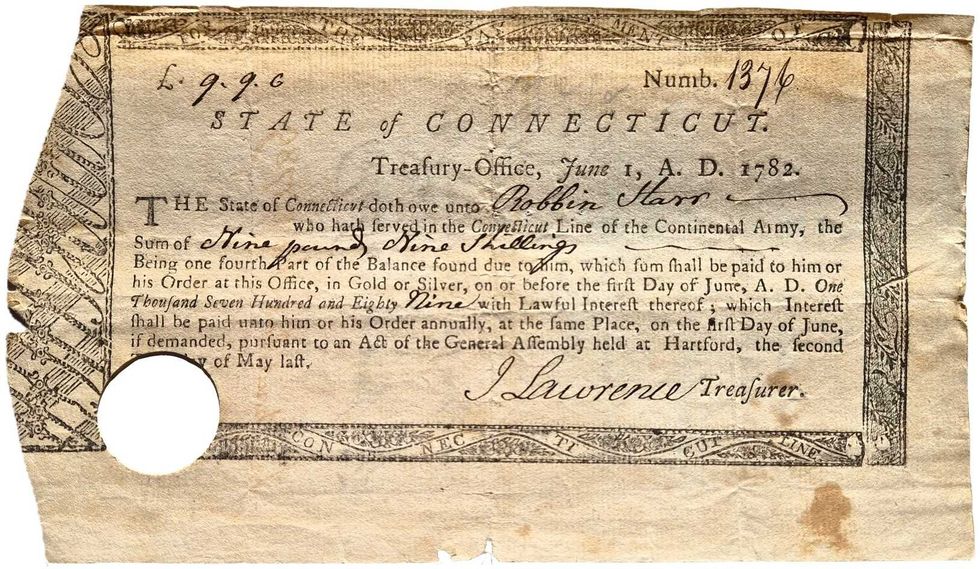 Pay Bill for Robin Starr’s service in the Continental Army.Courtesy the Alex Breanne Corporation
 John Mills speaking at Quinnipiac University.Courtesy the Alex Breanne Corporation

 Stephanie Saetta,with her rescue dog George and Blue (left), a shepherd mix awaiting his forever home.Madi Long
 Blue, a 7 year-old Shepard mix, is waiting for his forever home. Madi Long