Adults and teens in the area have expressed some confusion about the police response to a party held in Cornwall on May 9, following the Housatonic Valley Regional High School junior prom.
Ralph Dzenutis, parent of a student in the junior class, invited his son’s friends to their Cornwall residence for an after-prom party. Reports differ on how many youths were invited; Dzenutis claims he expected about 30 students. (See companion story, this page.)
Students have said that in fact there were as many as 200 young people, including several high school alumni and an unwelcome group of teens from nearby New York state. A fight broke out with the out-of-state teens; some witnesses claim that a knife was involved.
The state police were called by a neighbor at around 1:30 a.m. When the first trooper arrived, according to police reports, he found between 80 and 100 young people. Several were in an extreme state of intoxication; three were taken to Sharon Hospital, including a 15-year-old boy who reportedly drank an entire bottle of vodka by himself.
Many of the party-goers ran into the woods surrounding the house when the police arrived.
Two additional troopers were called in, including one who blocked off the street to keep partygoers from driving off before being interviewed by police. The police took the names and ages of all the students and made sure everyone had a sober ride home.
A police K-9 and a thermal imaging camera owned by the town of Cornwall were used to find young people hiding in the woods, bring them out and ensure that they had a safe ride home.
None of the partygoers was arrested, even though many were underage and intoxicated. Students at the party said that some of the young people also had illegal drugs with them.
“That was a secondary concern,†said State Police Spokesman Lt. J. Paul Vance, when asked why the students were interviewed but not arrested. “Our main concern was managing their safe return to their parents.â€
Of the search in the forest, Cornwall First Selectman Gordon Ridgway said that the imaging camera was used only to get the young people out of the dark woods before someone got hurt.
“Three young people had already been taken to the hospital and there were more kids in various states of disrepair,†Ridgway said. “It was a health and safety concern.â€
Social host liability law
The only person who was arrested that night was the host of the party. The charge against the 48-year-old Dzenutis was risk of injury to minors/impairing the morals of a minor and permitting minors to illegally possess liquor on private property.
The last charge is part of a law enacted in 2006 that is known as a social host liability law. Similar laws have been passed in many states as part of an effort to combat what some experts see as a rise in teen drinking.
The Connecticut Act Concerning Underage Drinking says, “No person having possession of, or exercising dominion and control over, any dwelling unit or private property shall knowingly permit any minor to possess alcoholic liquor... or knowing that any minor possesses alcoholic liquor ... in such dwelling unit or on such private property, fail to make reasonable efforts to halt such possession.â€
The first time someone is convicted under this law, it is considered an infraction. The second offense is punishable with a fine of up to $500 and a year in prison.
Dzenutis will appear in court on May 26. He said he plans to act as his own attorney.
Rise in underage drinking
There was a great deal of debate in the year before this bill was passed. Cynthia Bianchi, executive director of the Housatonic Youth Service Bureau, which serves the six towns of the Region One school district, visited boards of selectmen in the area towns to explain the intent behind the bill, and try to gain support for it.
At that time, a comment made by many town officials and community members was that some parents feel they are doing the right thing by allowing their children and their children’s peers to drink, as long as they are doing it in a safe place under the supervision of an adult.
“Hosting parties where underage drinking is allowed — despite best intentions — often backfires,†Bianchi said in an interview this week. “Parties quickly get out of hand; inordinate amounts of alcohol are consumed, often resulting in physical violence, injuries and medical emergencies.â€
The host liability law “was meant to be one more tool that parents and the community could use as a means to deter underage drinking,†she said. “Although there has recently been an increased concern about other illegal drug use, alcohol continues to be the ‘drug of choice’ for teens — not only in our area, but nationwide.â€
State Rep. Roberta Willis (D-64) was a member of the Youth Service board during the period when efforts were underway to make what was already an ordinance in about 50 towns into a state law.
“This has been a major cause for the YSB and it’s a very difficult issue,†Willis said. “In Connecticut, the average age at which a child begins drinking is between 11 and 13. This is hardly a new problem but we had seen a rise in underage drinking in our towns. And parties hosted by parents, where they facilitated underage drinking, were also on the rise. We tried several local initiatives but they had limited success.â€
“The social host ordinance was put into state law primarily as a way to close the loophole regarding underage drinking,†Bianchi explained. “Prior to that time, it was not illegal for minors to consume alcohol on private property. Prior to the law, about a third of Connecticut towns had passed the ordinance. Locally, Kent was the only town to have passed the ordinance, in March 2005; other towns preferred to wait until the state passed it as a law.â€
For parties, not families
When the law was being discussed, some adults had also said they felt they should be allowed to have a glass of wine with their children at dinner, and teach them to drink alcohol responsibly.
Some said that the law would create problems for parents with children who were attending college (or were in the armed forces) in places where drinking was allowed at age 18.
“If a soldier is back on leave from Iraq and he comes to visit me at my house, I’d like to be able to offer him a beer,†one town official said.
In its final form, the law allows parents to consume alcohol at home with their own children, even if they are underage. And, in reality, according to police, it is unlikely that an adult would be arrested for serving a beer to a visiting 18-year-old.
Lt. Vance noted that the law is designed for situations when numerous young people are believed to be drinking large quantities of alcohol.
“In the past, when we couldn’t enter a property where we suspected there was underage drinking, we had the fear, as law enforcement officers, that someome might get behind the wheel of a car and kill themselves, a passenger or another driver. It sounds melodramatic but it does happen.
“Also, young people, because of their lack of experience, can drink so much they go into respiratory arrest.â€
He was clear that, “You can have a drink with your own child. You can give a drink for example to a college student who is back from a state where the legal age is 18. That’s manageable. But when the underage friends of that 18-year-old want to come and crack open a keg, that’s a problem.â€
This week, the office of Gov. M. Jodi Rell sent out a news release announcing a Web site with information on the host liability law, as well as the dangers of teen drinking. The site is at SetTheRulesCt.org and is part of a federally funded campaign that, the governor said, “delivers two important messages: hosting underage drinking parties is against the law; and alcohol consumption before the age of 21 can cause permanent brain damage.â€

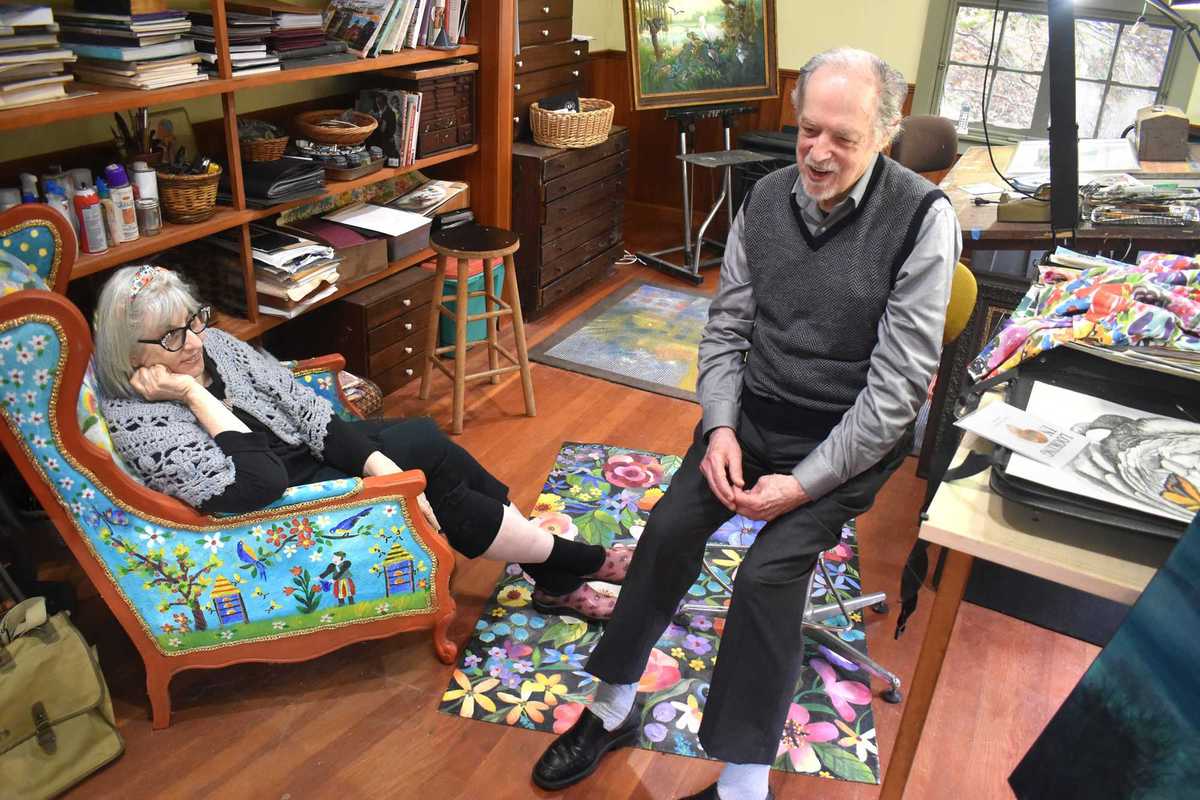
 Justine and Victor Valla in their studio with a painting of Victor’s,”Jonah and the Whale.” Robin Roraback


 A ceramic vase by Kathleen Heidemann.Provided
  Joy Brown’s delightful ceramic sculptures.Provided