Most of us tend to take food supply for granted.Our grocery stores and supermarkets are full of most everything we might wish to eat except for the occasional out-of-season fruit or vegetable---and even these have become more available. But there are someincreasing signs that our food complacency may be short-sighted, that there may be trouble down the road.
Over the past eighty years, the world’s human population has quadrupled and still continues to grow. Just providing food for people in the less affluent regions is more and more difficult. All over the world forests are being torn down to make way for economically viable but strictly for export crops like palm oil trees. In many parts of the U.S., clean, fresh water, a basic requirement for agriculture is becoming scarcer thereby making agriculture considerably more expensive and food scarce.Drought caused by climate change is making more land around the world unsuitable for growing crops. Over-harvesting can devastate land; 2,000 years ago most of North Africa was forested and fertile but largely through poor management it became over the centuries nearly desert.
President Trump’s war in Iran has disrupted global commerce beyond expectations. The predictable closing of the Strait of Hormuz has limited trade of most everything coming to or going from the Middle East, the most obvious commodities being oil and gas which run most industrial (and agricultural)operations worldwide. The Middle East also supplies a major portion of the world’s fertilizer, both the finished product and the raw materials and that is for most of the world not just Europe and America. A significant reduction in world food supply is expected.
Currently before the U.S. SupremeCourt is a case regarding the legal liability ofMonsanto, now a subsidiary of Bayer, for its herbicide, Roundup, the country’s most popular weed killer. The suit concerns whether product liability warnings issued by a state agency are overruled by a differing federal ruling. While the state has a warning label on the container saying that the contents are “probably carcinogenic” to humans, the federal Environmental Protection Agency has said Roundup is not carcinogenic.Countless lawsuits and billions of dollars of possible settlements await the Court’s verdict.
To help diminish future lawsuits, a homegardening version without glyphosate, the key ingredient, has recently come on the market. Should standard Roundup actually be banished, the effect on conventional industrial agriculture would be huge. Health Secretary Robert F. Kennedy, Jr., who has campaigned repeatedly for organic farming, has backtracked, speaking out forcefully against a ban on glyphosate saying that such a move would be “tooabrupt” (thereby infuriating most of his “MAHA” supporters). But a banning of Roundup’s glyphosate with no proven successor and a swift return from industrial agriculture to basic organic farming techniques would raise food prices enormously and probably cause a lot of political dissent.
Another looming problem comes from PFAS, often referred to as “forever chemicals” because of their inability to break down. In 1946, DuPont introduced nonstick cookware coated with Teflon. Today the family of fluorinated chemicals that sprang from Teflon includes thousands of non-stick, stain-repellent and waterproof compounds called PFAS, short for per- and poly-fluoroalkyl substances.
Back in the 1970s I was involved in the creation of several community parks and gardens on vacant lots in New York City. To cover the crushed rubble ground surfaces, we located a large supply of special compost soil from a drug company’s corporate campus in the suburbs---free but for the trucking.Composed of company dining hall food waste, sewage sludge, mycelium from drug manufacturing, and other organic waste. The compost proved to be fertile, humusy soil, an excellent growing medium, a good prototype for rich planting soil (without chemical fertilizers).
Over the decades more and more farm fields have drastically cut back on their use of expensive chemical fertilizers and, at the same time and are providing disposal for municipal sewage and other composted waste. But a few years ago, a New York Times environmental reporter discovered that compost from many sewage treatment plants across the country were contaminated with high levels of PFAS and other dangerous contaminants. Subsequently, this widespread use of sewage sludge fertilizer is being restricted in many instances and will continue to be discouraged until the federal Environmental Protection Agency follows through on its earlier promises to mandate cleaning up public water facilities of PFAS and other contaminants.
In 1935, the Dupont Corporation came up with one of the most famous advertising slogans of the era:“Better Living Through Chemistry”.But the naive optimism of the original slogan now carries a more sardonic tone. Modern science has made great strides in agriculture as in so many fields but our problems feeding ourselves and keeping healthy are not behind us.The Green Revolution that came into being after WW2 doubled world food production but also left us with perhaps insolvable medical problems.
Architect G. Mackenzie Gordon, AIA lives in Lakeville.




 Tiffany Lemelin, shelter manager, brushing Marsala upon arrival.Provided
 Michael DeBarba, certified dog trainer working with Marsala.Jennifer Almquist
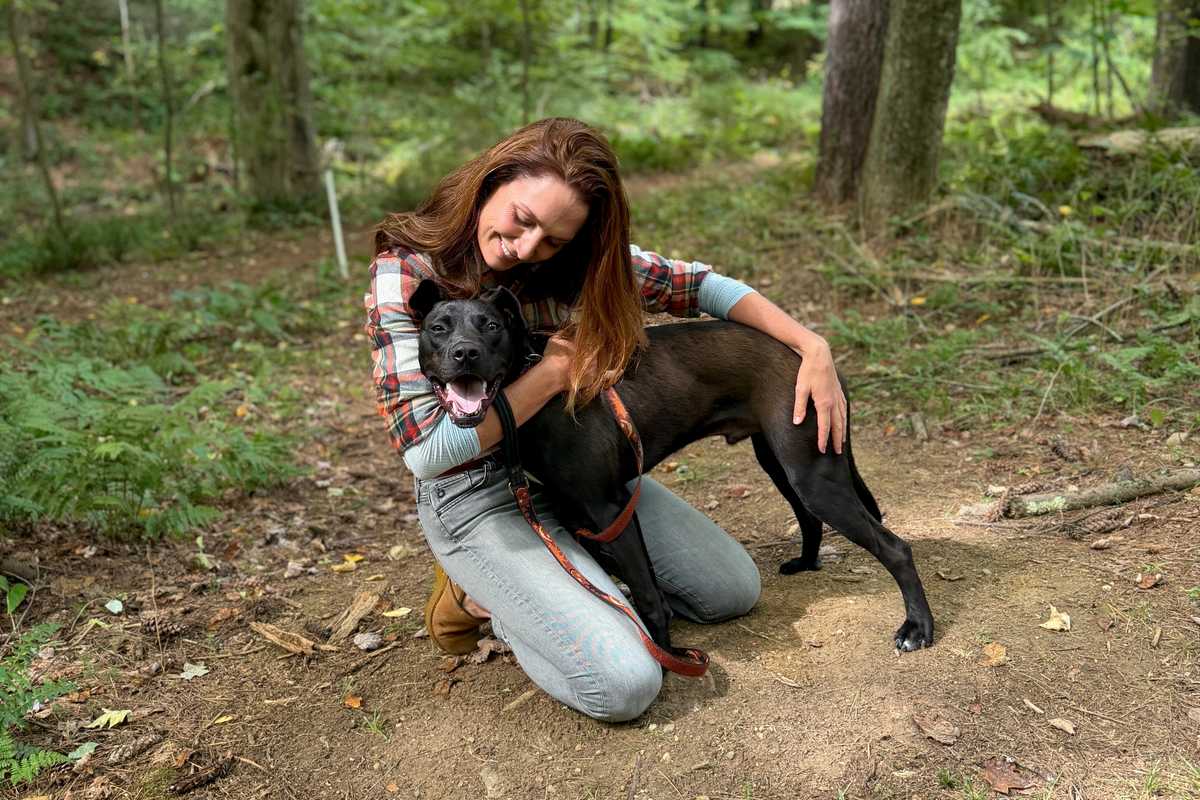 Marsala wins a heart.Jennifer Almquist

 Sadie, center, a Carolina dog, plays with her friend Negra, a terrier mix. Bella Linda, the small poodle, has since been adopted.L. Tomaino
 Wesley, a young, exuberant mix, is looking for an active home.L. Tomaino
 Bonnie and Clyde, an affectionate terrier pair.L. Tomaino

 Provided