AMENIA — The Town Board meeting on Thursday, Jan. 24, yielded heated discussion in regard to a $5,000 payment defined by the state as “final compensation” for Town Bookkeeper Sherry Johnson that was approved in a resolution on Dec. 13, 2012.
The board awarded the payment for accruing “time in excess of 20 hours per week for Jan. 1 through Nov. 23, 2012, [which] is 194.75 hours or $5,628.27,” for which she accepted $5,000, according to the resolution. Johnson’s regular part-time salary is $30,357 annually, according to the salary list read at the town’s annual organizational meeting.
Dutchess County Human Resources Personnel Technician Karl Menuau sent a letter addressed to town Supervisor Bill Flood dated Jan. 7 to address several issues with the resolution.
The letter states that, “when an incumbent in the position of bookkeeper works more than part-time hours the position is classified in the competitive class, an examination is required, and you would be required to canvas and appoint from the eligible list.”
Johnson’s position is currently approved in the non-competitive class as long as the position meets the definition of part-time hours.
Amenia resident Cheryl Morse spoke up during public comment at the board’s meeting on Jan. 24 to address the letter and Menuau’s explanation.
“As a part-time employee she shouldn’t work more than 20 hours or receive compensation since the record sent to the county and verified didn’t show the additional hours,” Morse said.
Flood lashed out defensively to Morse’s comments, saying, “Obviously you don’t know what you’re talking about.”
Morse raised her voice, saying, “Excuse me, Mr. Flood.”
The two went back and forth as Morse asked direct questions about payroll certification. Flood answered with repetitive responses.
“One week of payroll per year is certified [by the county],” he said, indicating that’s what he believes is standard protocol.
“I don’t believe that’s so,” she said.
Flood then cut off Morse, reminding her she had three minutes to talk during public comment.
“How is the board going to address this? This is taxpayer money. Is it going to be paid back?” she asked.
“No. The board is allowed to give a merit raise and that’s what we did,” said Flood.
Flood is the only one on the board calling the payment a “merit raise.” The rest of the board and the state have referred to it as “final compensation for additional time worked.”
“I think you’re giving me a load of crap,” said Morse.
Morse and another audience member chimed in to say they have each spoken to Menuau and didn’t believe Flood to be accurate.
“Oh, I know you have. You’ve all made complaints,” he said.
“With all due respect,” Morse said, “there has been more than one occasion where I have come before the board and made public comment. I’ve even read legislation to you, after the fact, when you’ve told me something wasn’t legal or wasn’t possible. I don’t think that you were entirely factual. I want to know the disposition of what’s going to happen.”
Flood responded that nothing would be done.
“I just told you the board gave a $5,000 merit raise,” he said.
Morse was not content with the answer.
“That is not legal according to this [Menuau’s] document. I urge the other board members who vote with you without doing their homework to seek out information and the truth,” she said.
The initial resolution was approved by each board member except Councilwoman Victoria Perotti, who voted against it.
As Morse finished speaking, Flood said to her, “Fine. Thank you. Do your homework.”
As Morse left the podium the two continued to banter back and forth, claiming each had been misinformed.
Flood lost his temper and stood up for Johnson.
“I’ll tell you what, Sherry Johnson is probably the most important employee in this building. She’s earned every penny of it,” he said.
Morse countered that his statement was “a slap in the face to the other employees.”
“It’s not a slap in the face to anyone. I’m not being rude at all. You’re being rude,” said Flood.
The conversation ended, and the next speaker during public comment stepped forth.
Before that speaker began, however, Flood turned to his fellow board members and said in a hushed tone, “Consider the source,” speaking of Morse, which was picked up clearly by the microphones used by each board member.
Menuau was out of the office and unavailable for comment in time for publication.
More information on the town of Amenia, including meeting information, can be found at www.ameniany.gov.
The meeting can also be viewed in its entirety online at www.youtube.com/ameniatv.

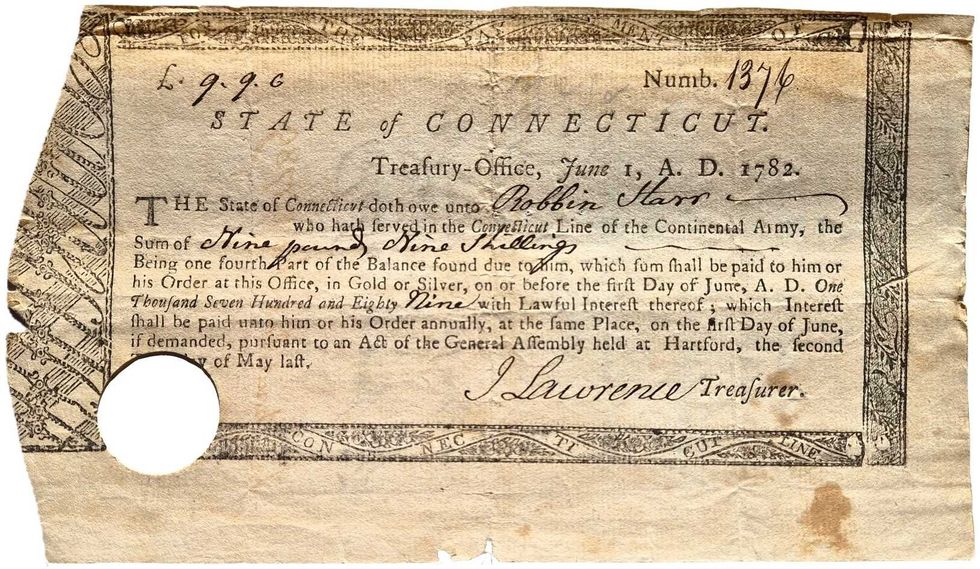 Pay Bill for Robin Starr’s service in the Continental Army.Courtesy the Alex Breanne Corporation
 John Mills speaking at Quinnipiac University.Courtesy the Alex Breanne Corporation
 Stephanie Saetta,with her rescue dog George and Blue (left), a shepherd mix awaiting his forever home.Madi Long
 Blue, a 7 year-old Shepard mix, is waiting for his forever home. Madi Long