Thank you!
Your support is sustaining the future of local news in our communities.

Back in the state-stocked stomping ground

Back in the state-stocked stomping ground

The scene of innumerable frustrations over the years.

Patrick L. Sullivan

SOMEWHERE IN NORTHWEST CONNECTICUT — As I type Thursday morning, April 18 it is raining again. Thank God for that. I was worried about the crops.

Q: What crops?

A: Any crops. I just like saying “crops.”

In what seems to be an increasing rarity, we had two days without hardly any rain, on Tuesday and Wednesday, April 16-17. (It did start raining Wednesday evening.)

I ventured into a brook in the lower reaches, where the descendants of state-stocked browns have taken firm hold.

The state stopped stocking the stream about 20 years ago, so these fish are — what, the fifth or sixth generation?

There are more of them in this small stream than you might think from a casual glance. And they are incredibly difficult to catch.

On Wednesday I used a little eight-foot Japanese Tenkara rod I forgot about. Not the greatest rod but it got the job done. I also carried the Dragontail Talon, which at a foot long when collapsed fits in the hand warmer pocket of my waders. It’s 10 feet and change in action. And it’s just a better rod.

(So have I gone all Zen weirdness? No, I use my regular rods all the time. I operate on 100% whim.)

In these new spots, I plucked not one but two wild browns from deeper plunge pools, and both were well over 10 inches. This doesn’t sound like much perhaps, but the typical fish in here is four to six inches and could easily fit in a little rectangular can labeled “sardines.”

Fish were coming up for big dries, Stimulators (size 10) and Parachute Adams (size 10), but the big winner was Joe’s Weenie. Unlike the ho-hum standard Green Weenie, Joe’s Weenie is a darker green, tied on a jig hook and has a very heavy head. It sinks like a stone.
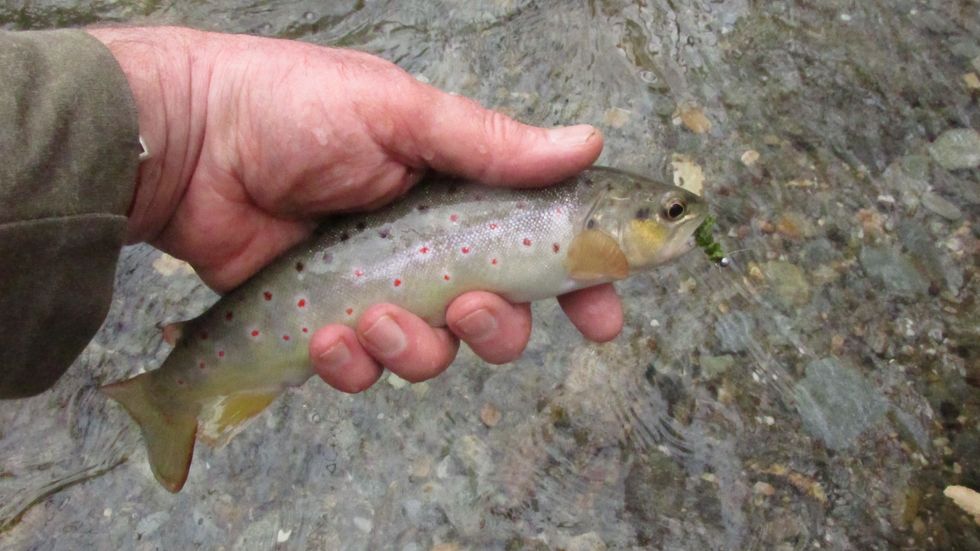
Joe's Weenie is the superior Green Weenie.Patrick L. Sullivan

With regard to the photo of the large pool with the tree across it: This pool, which looks incredibly inviting, is the scene of innumerable frustrations over the years.

The problem has always been the approach. The tailout is shallow, and the spooky fish could see me coming a mile away.

And while visible booted feet are bad enough, many is the time I have watched dark shapes scurrying away after being alerted to my looming presence by a) the looming and b) the waving of the rod.

But this tree fell just right. It minimizes the looming aspect and seems to help with the waving rod bit as well. I can stand a few feet behind it and cast over it without mishap.

Upstream a 20-year old logjam finally blew out and completely changed the configuration of about 40 yards of stream.

This reminds me that rivers are not static systems. When one door closes, another one opens.

And he who laughs last gathers no moss.
Latest News

‘So Little to Do,’ so much to discover at James Barron Art

Curator Deborah Goodman Davis reads the Emily Dickinson poem “The Grass So Little Has to Do.” Spencer Finch’s “Following Three Bees (Zinnias)” buzzes in the background.

Photo by Natalia Zukerman

“The Grass Has So Little to Do,” on view at James Barron Art in Kent, takes its title from Emily Dickinson’s poem “The Grass So Little Has to Do,” written in 1862:

“The Grass so little has to do—
A Sphere of simple Green—
With only Butterflies to brood
And Bees to entertain—”

Keep ReadingShow less
Marina Kotchoubey is taking care of business

Marina Kotchoubey at the Ian Ingersoll Cabinetmakers showroom in West Cornwall.

Photo by D.H. Callahan

After 40-something years navigating the world of custom fine furniture, Ian Ingersoll was getting ready to retire. Starting off with a little dovetail stool that he sold at a shop in West Cornwall in the 1970s, he’d grown his skill and his business into something he — and the whole town — could be proud of. Shutting down that business was not an option.

Ingersoll built Ian Ingersoll Cabinetmakers, which produced mainly classical Shaker furniture, on passion: the passion he had to make a living through creative challenges and the passion of his employees, who all seem deeply in love with their craft.

Keep ReadingShow less
A legacy of giving at Norfolk Chamber Music Festival

One hundred and twenty years ago, Carl and Ellen Stoeckel commissioned New York architect E.K. Rossiter to design The Music Shed in Norfolk, Connecticut. After nearly a decade of entertaining their friends and neighbors with the finest music of the day, they built a permanent home for their beloved Litchfield County Choral Union.

The commission and full funding of the construction was not unheard of in an era when great fortunes led to public enrichment. Railroad tycoon John D. Rockefeller was instrumental in funding institutes of higher education. Steel baron Andrew Carnegie was building libraries all over the country, and famously said that a man who dies rich is a disgrace, challenging his peers to give their fortunes back to the people.

Keep ReadingShow less
google preferred source

Want more of our stories on Google? Click here to make us a Preferred Source.

Two unique exhibitions at Geary Gallery

Henry Klimowicz with his sculpture, “Partial Pillar 1”

Photo by D.H. Callahan

On Saturday, Aug. 1, Geary Gallery opened its doors in Salisbury for two unique shows in its first- and second-floor gallery spaces. Art lovers flooded both floors over the course of the afternoon, giving the events a vibrant feeling that enhanced the importance of the art.

On the first floor is a show by Chicago-born, Colorado-based photographer Summers Moore, titled “Lobitos: Pueblo Fantasma,” or “Lobitos: Ghost Town.” The work centers around her daughter’s current hometown in Peru. Moore herself found a home away from home in Colorado in the mid-1980s and encouraged her children to seek out new places outside of their comfort zones.

Keep ReadingShow less

Writer’s retreat in the woods

Writer’s retreat in the woods

Participants in a 2024 Great Mountain Forest Woodland Academy workshop at Yale Camp.

Photo by Mike Zarfos

Great Mountain Forest (GMF) will host its first Nature Writing Retreat at the historic Yale Camp in Falls Village from Aug. 7-9, 2026. Writers of all levels are invited to draw inspiration from one of New England’s most notable forest landscapes. GMF envisions the retreat becoming an annual event celebrating writing, conservation and the relationship between people and forests.

This immersive three-day retreat reflects on the legacy of Hal Borland, the American writer and New York Times nature columnist whose work was deeply connected to this landscape. The retreat explores how wilderness shapes language, strengthens close observation and fosters environmental consciousness.

Keep ReadingShow less
From Cornwall to Rome, Adam Van Doren at Berkshire Botanical Garden

Artist Adam Van Doren and curator Donna Hassler talk to a group of visitors at the Berkshire Botanical Garden. A Stephen Proctor vessel sits to their left.

Photo by Natalia Zukerman

This summer, the Berkshire Botanical Garden in Stockbridge has hosted “Grounded in Nature: Paintings by Adam Van Doren,” an exhibition exploring the intimate relationship between architecture and the natural world.

On view for only a few more weeks in the Leonhardt Galleries, the exhibition features more than 35 watercolor and oil paintings by the New York-based artist, architect, author and Yale professor, curated by art historian Donna Hassler, director emerita of Chesterwood. The works span three distinct places that have shaped Van Doren’s artistic practice: New York City, Cornwall, Connecticut, and his travels throughout Europe.

Keep ReadingShow less
google preferred source

Want more of our stories on Google? Click here to make us a Preferred Source.

google preferred source

Want more of our stories on Google? Click here to make us a Preferred Source.