Before the electoral year of 2012 slinks into history, it is worth a comparative glance back to the electoral year of 1912 to give us some jolting perspective on how degraded our contemporary elections, voter performance and election expectations have become. One hundred years ago, workers were marching, picketing and forming unions. Eugene Debs, the great labor leader and presidential candidate that year, spoke to outdoor labor rallies of 100,000 to 200,000 workers and their families gathered to protest low wages and working conditions. Farmers were flexing their muscle with vibrant political activity in progressive parties and organizing farm cooperatives, through their granges, and pushing for proper regulation of the banks and railroads. On the presidential ballot were Republican incumbent William Howard Taft, Democrat Woodrow Wilson and the Progressive “Bull Moose” Party’s choice, former president Theodore Roosevelt. Taft would be repudiated for being far too populist and too critical of corporations by today’s Republican Party. He favored national, not state, charters for “national corporations.”The Democrats were committed to their platform of 1908 which asked “Shall the people rule is the overshadowing issue which manifests itself in all the questions now under discussion.” The context was shaped by the giant corporations (“called the trusts”) and their lobbies in Washington, which had to be curbed. The Supreme Court in 1911 had just ruled to break up the giant Standard Oil trust. Women’s suffrage, abolition of child labor, workers’ compensation; states adopting the initiative, referendum, and recall; the eight-hour work day, minimum wage laws (Massachusetts was the first in 1912), taxing corporate profits and the “inheritance of fortunes,” were some of the many hot issues of 1912. Taft, Wilson and Roosevelt fought over who was the most progressive. Theodore Roosevelt in an August 1912 speech declared that “Behind the ostensible government sits enthroned an invisible government owing no allegiance and acknowledging no responsibility to the people. To destroy this invisible government, to befoul the unholy alliance between corrupt business and corrupt politics is the first task of the statesmanship of the day.” While Wilson repeatedly said that the country’s “salvation required the dissolution of the evil partnership between the government and the trusts.” Apart from how deeply these candidates believed in what they said, they repeated their campaign pledges again and again because the people were rising and breathing down their necks with demands.Fast forward to 2012 to the far greater grip of big business on government and elections. So much so that both major parties offer no solution to the “too big to fail” perch of the giant banks and additional corporate behemoths, other than to continue bailing them out with taxpayer dollars and under-regulating them to boot.Entrepreneur, lawyer, shareholder advocate, and author, Robert A. Monks wrote recently that “American corporations today enjoy an absolute reign. They and they alone have the power to control the rules under which they function. Corporations, and the most powerful CEOs acting through them, have effectively seized authority over the United States without assuming any of the responsibilities of dominion.”Was corporate domination the theme of the recent Republican and Democratic conventions? Only to the extent to which hospitality parties put on by the drug, banking, insurance, energy and other industries had the best booze, food and other allurements.The conventions, and their scripted speeches off the PAC-greased election trails, were congealed b.s.The leader of the AFL-CIO, Richard Trumka, was trotted out for a few minutes before a nationwide television audience to ignore mentioning both his own priority of legislating “the card check” for union organizing and the needs of 30 million American workers making less than workers made in 1968, inflation-adjusted, due to a frozen minimum wage. Eugene Debs, one of Trumka’s heroes, not only made establishing the minimum wage one of his clarion calls, but he indefatigably ran for president in 1912 on the Socialist Party ticket garnering 900,000 votes (equal to about 5 million votes today) and pushing the major candidates and parties from the grass roots. In 2012, third-party candidates were blocked from the debates, given virtually no media, obstructed from access to the ballots and otherwise harassed by officialdom.The two major parties were like corporate lapdogs fed daily with corporate cash to shut up about corporate crime, corporate tax evasion, corporate control of government, corporate abuses of consumers, toxic chemicals and fossil fuels jeopardizing air, water, soil and the climate, corporate abandonment of American labor to fascist and communist regimes abroad, facilitated by the global trade agreements, drafted by their corporate lawyers, corporate corruption of electoral campaigns integrity, corporate fine-print contract servitude, corporate closing of courtroom doors to individuals wrongfully harmed, and the draining corporate-bred military-industrial complex that President Eisenhower warned about in his farewell address. The Democrats from Obama to the Congressional leadership and candidates took corporate oaths, they wouldn’t even raise the minimum wage issue to “catch up to 1968” for 30 million Americans and their impoverished families laboring for Walmart, McDonald’s and other low-wage companies.Meanwhile, the clenched teeth Republicans with their vacuumed brains nominated Mitt Romney who, for years, led the Bain Consulting Group to, in Monk’s words, “reap untold millions in profits by using borrowed capital to buy companies, then sucking them dry, leaving the remains for bankruptcy referees to sort through, and stashing vast profits in off-shore tax havens.” In 1912, such an aspiring oligarch would have been laughed away.Let’s face it, our country is in crisis and wallowing in disgust, discouragement and despair won’t turn it around. Nor will apathy, accepted powerlessness or preoccupation with those weapons of mass distraction we hold in our hands or watch on our screens just about everywhere.Only together can we make the difference, with far better modes of communication and transportation than our poor forebears, who still managed to rise up and show up more than 100 years ago to make their country better for them and us. (See www.seventeensolutions.com for my take on this patriotic mission of immediate renewal as well as respect for future generations.)Consumer advocate and former presidential candidate Ralph Nader grew up in Winsted and is a graduate of The Gilbert School.
Latest News
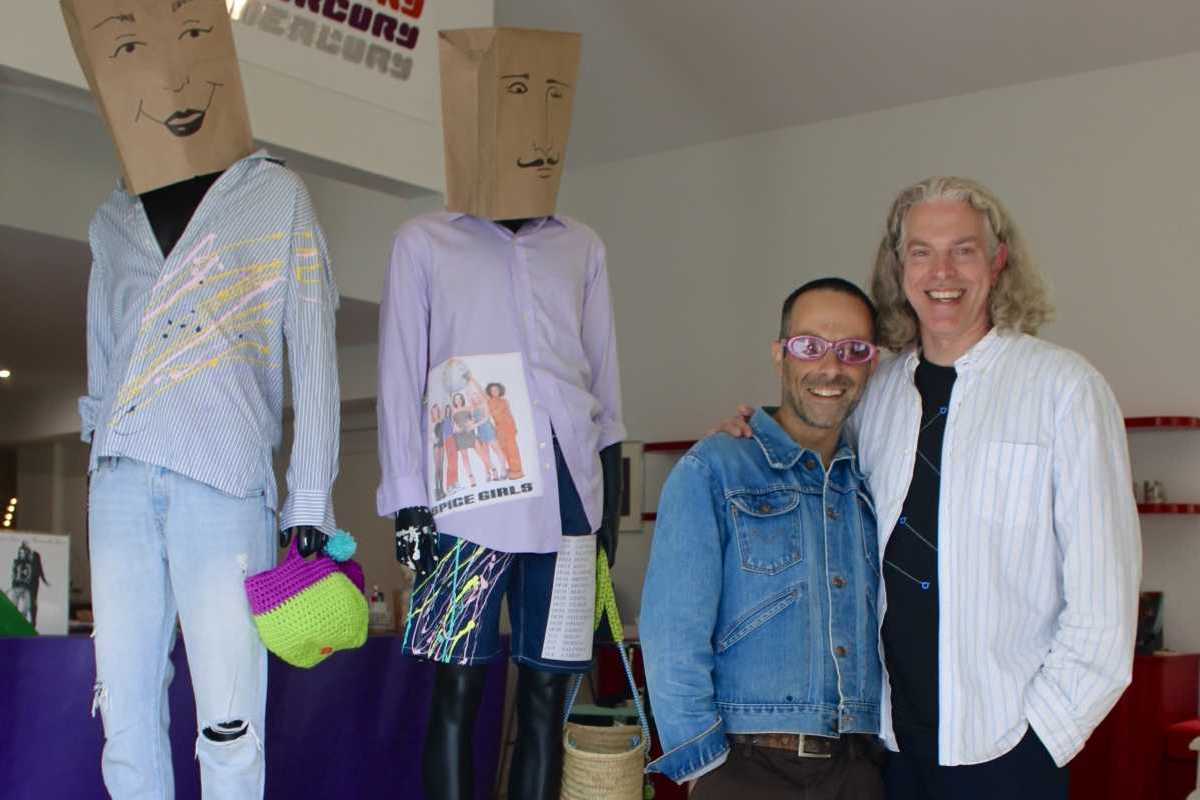
Greg Fricke and James Boehmer, co-owners of Peggy Mercury in Kent, recently launched their first fashion line, “Imaginary Concerts.”
Provided
Fricke and Boehmer are not there to stock their shelves with the same products customers find at standard makeup retailers. They’re there to help customers find what works for them. That usually means asking customers about themselves and learning about their beauty habits, skin, style and the way they like to present themselves. Fricke and Boehmer believe it’s their job to help customers bring out the qualities that suit them and determine what works best for their look.
So much of the Peggy Mercury world is about emboldening people to become more creative, and possibly bolder, versions of themselves. Some of this comes through the store’s creative collaborations with artists, designers and stylists.
It’s part of an ethos that encourages them and their friends to use the shop as a kind of laboratory, trying out new creative experiments without knowing how they might turn out. Whether in fashion, painting, fiber arts or photography, the projects almost always turn out marvelously.
A line of sterling silver charms they sell started as a small project by their friend Nolan Percival. In the beginning, the pieces were for close friends and loved ones. But Boehmer and Fricke encouraged Percival to get a little more serious about the project and create a whole line for the store. Today, it’s one of their top-selling collections.
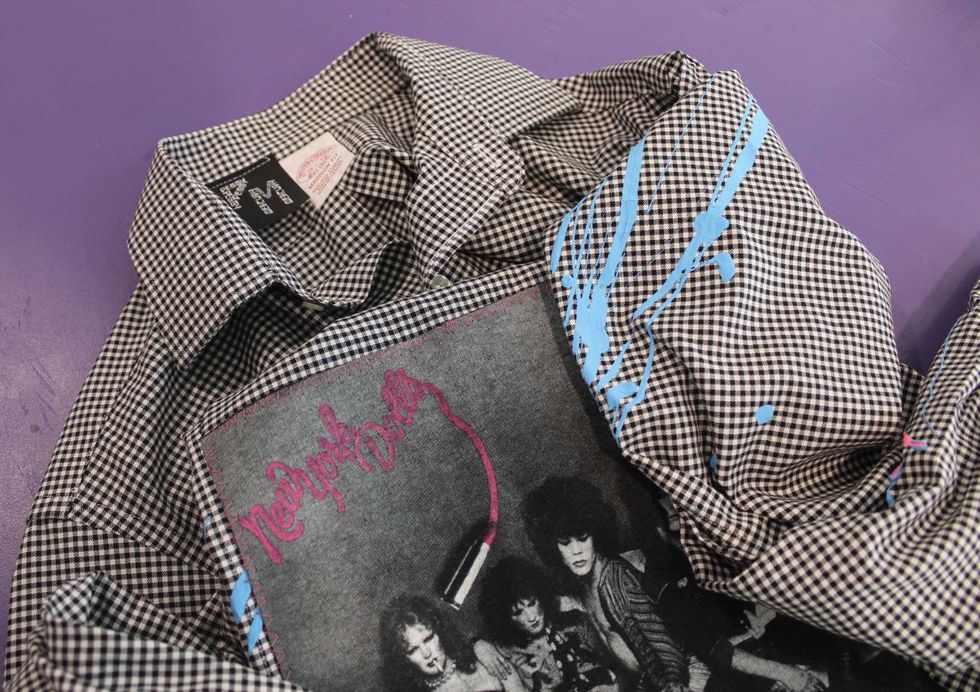 Classic styles, bold colors, and creative concerts make up the “Imaginary Concerts” line at Peggy Mercury.Provided
“Imaginary Concerts” has the duo taking their own advice.
The project started as a way for Boehmer to connect with his mother, who had been diagnosed with Alzheimer’s disease. Taking old concert shirts from his own collection, Boehmer and his mother began cutting out the graphics with the idea that they would make a quilt together. Unfortunately, she died before they could complete the project in 2025. The pieces, which were ready for production, were put on the back burner as Boehmer and Fricke dealt with their loss and the whirlwind of projects that never seemed to cease at Peggy Mercury.
But the harsh winter of 2026 presented an opportunity to take some time and focus on themselves. Part of that meant revisiting and redefining the concert T-shirt project. This time, instead of looking to the warmth and comfort of a quilt, they turned to another passion — fashion.
Taking a page from their own book, they wanted to create something that felt comfortable to them. They took two disparate loves — one rooted in simple preppy style, with clean lines and classic silhouettes, and the other in the nitty gritty worlds of punk rock and pop — and blended them together to create something entirely new. Pulling from the staples of vintage Brooks Brothers and Charvet collections, they applied the graphic elements with bold stitching reminiscent of punk jackets of the ‘70s and ‘80s, but with a much more sophisticated air.
But the remixing isn’t just the pairing of prep and punk. The pieces are not canon. They take liberties with the realities of concert tours, combining one band’s dates with another band’s logos, mixing them all up until the reality is lost and imagination is the only truth.
 Shirts from Peggy Mercury’s first fashion line, “Imaginary Concerts,” hang on display.Provided
Adding to the mix is an element of perpetual creativity. Art can be messy, both figuratively and literally, and many of Fricke and Boehmer’s artist friends carry evidence of their work on them at all times. As a nod to these tireless creatives, the duo added haphazard splashes of bright color, giving the line an even more distinctive feel.
For them, “Imaginary Concerts” passes the “Peggy Test.” The mythical Peggy Mercury is a fictional figurehead for the company, a character who thrives on creativity and change. The name, much like the clothing line, is a mixture of interests: Mercury is a planet, a deity and an elusive, transformative element, while Peggy is the wonderfully stylish and boundary-pushing Peggy Guggenheim.
Everything Fricke and Boehmer put in their store has to pass this test: Would Peggy Mercury approve? For their first collection, the answer is a resounding yes.
Peggy Mercury is at 9 Maple St., Unit 2, Kent.


Want more of our stories on Google? Click here to make us a Preferred Source.