Part 2 of 2
As mentioned in the last column, I was asked by members of the Northwestern Connecticut Community College’s 50th Anniversary Committee what I knew about the buildings that the college owned at Park Place East. Although I realized that I knew far more about a few of the residential buildings at Park Place West due to articles called “Winchester Architectural Treasures” printed in The Winsted Voice back in 1996, I felt I could find enough information from the East End Historic District application of 1977, census and city records and those iconic histories, Frank DeMars’, Winsted and the Town of Winchester and John Boyd’s, Annals of Winchester, Conn. to research the neighborhood. I also stopped at the assessor’s office at Town Hall since some of the information is either missing or conflicts with other sources. I had ten days in which to accomplish this mission in order to disseminate the information to the staff in time for the opening reception for the celebration on May 15. This week I will discuss Park Place West.
On the west side of the street, according to Frank DeMars, there was a small store located on the corner of Main Street. North of that building, the wooden First Congregational Church, which stood on the green for more than 40 years, had been moved to the west side where the entrance to the Northwest Community Bank is now located.
After the stone church was built on the Holabird property, the former wooden church would be used as a tenement housing many French-Canadians who worked at the Winsted Hosiery.
Next came the Orson W. Jopp residence, which was built in 1816, probably by Ebenezer Rowley who had the farm and dwelling prior to Jopp, according to John Boyd. It is unclear to me whether this building is still in use, perhaps as the Nationwide Insurance building. If so, it probably dates back to the early to mid-19th century.
u u u
53 Park Place West: This residence was built in 1848 by Charles Alvord and sold to William H. Phelps in 1852. Phelps, the son of Colebrook resident, Dr. Lancelot Phelps a prestigious doctor and U.S. Congressman, would take his knowledge of the dry goods business learned from his grandfather, Alpha Sage, and from the dry good emporium of Normand Adams where he served as clerk. In the 1840s he left for Chicago where he formed a partnership in a mercantile firm. Nevertheless, he returned to Winsted in 1852 and purchased the magnificent Victorian fantasy that would be called Park Cottage, complete with gargoyles (now missing).
He became President of the Hurlbut Bank, a position he retained while also serving as the first warden (similar to the position of mayor) when Winsted became a borough in 1858. One of his first orders of business was to build sidewalks, improve streets and renovate the town green. This lasting legacy was instituted, not through taxes, but by fundraising. He eliminated the road dividing the green and built parallel roads. He then enclosed the park with the stone and iron railing familiar to us today. Under his guidance, the park was graded, planted with grass and trees (prior to this the green was not very “green”, covered in gravel) and the entire area became known as Park Place.
James Alvord owned the next house which was torn down to form the entrance to the Old Burying Ground.
u u u
75 Park Place West: Next is the Lorenzo Blake house, on the south side of Grove Street. The house was probably built in 1860 according to Susan McGoey’s article about the “architectural treasures” in the town of Winchester. Blake was the son of Charles Blake, who owned the house on the opposite side of Grove Street. He was the president of the First National Bank and treasurer of Winsted Savings Bank until 1875. He sold the home in 1894. Years later, it was sold to a two-term member of the state’s General Assembly, William A. Blodgett. He and his wife lived there the rest of their lives.
79 Park Place West: The Charles Blake house, possibly built in 1848, was situated on the north corner of Grove Street, located next to the William Holabird mansion. Charles Blake was the son-in-law of James C. Cleveland. Later his widowed sister, Mary A. Blake Mitchell, would move in with him. Mitchell would bequeath funds for a fountain in the park- the oldest structure on the green. Members of the Blake family would live in this house until at least 1946, according to DeMars.
North of the Blake house was the grandest house at that time in Winsted, the William S. Holabird estate. Holabird was the losing U.S. prosecutor in the Amistad case and would become lieutenant governor of Connecticut from 1842 to 1844. Regretfully, the members of the Holabird clan were not long-lived and the mansion was torn down at the end of the century to build the stone First Congregational Church.
I encourage all to take a walk around the East End Historic District, which is partially described here. It is an oasis of beauty and much of the east side has been restored by Northwestern Connecticut Community College. Congratulations to the college on its 50th anniversary and thank you, not only for providing quality education, but for being such a good neighbor!
Virginia Shultz-Charette is a former adjunct college U.S. History instructor, vice-chair of Soldiers’ Monument and co-author of the Arcadia Publication “Winsted and Winchester.”

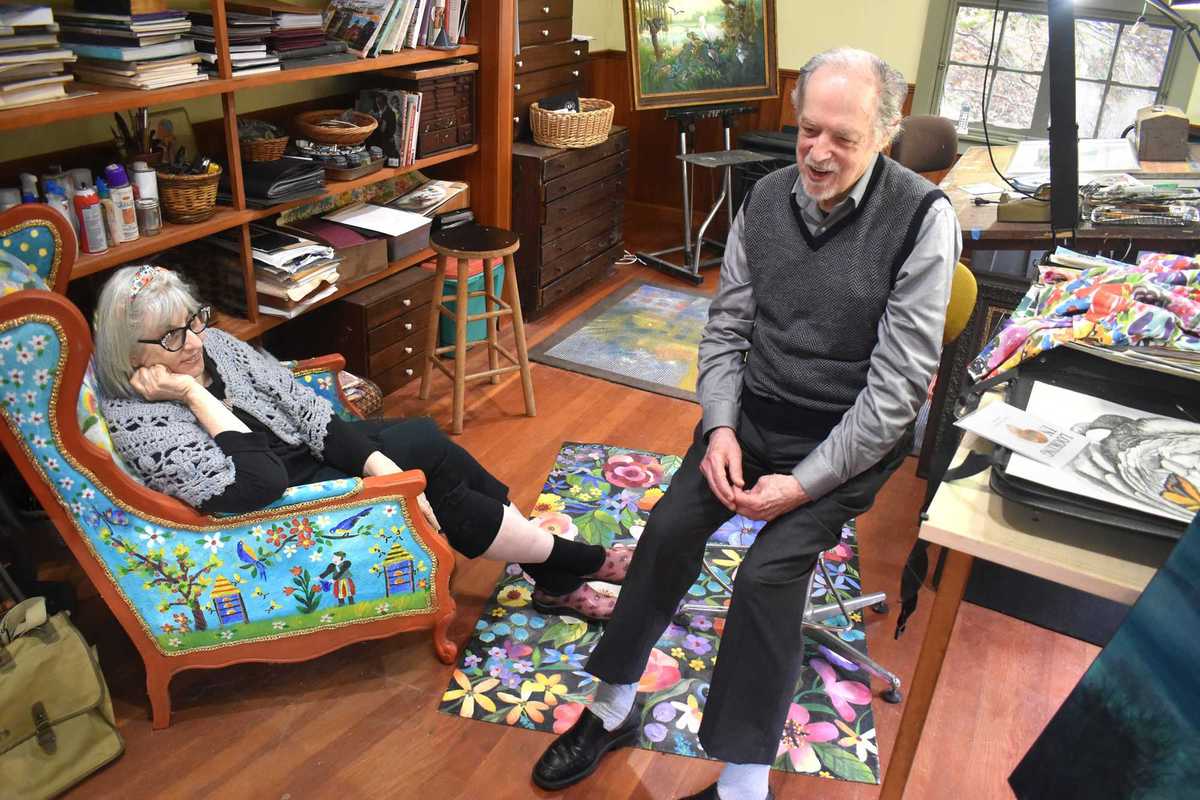
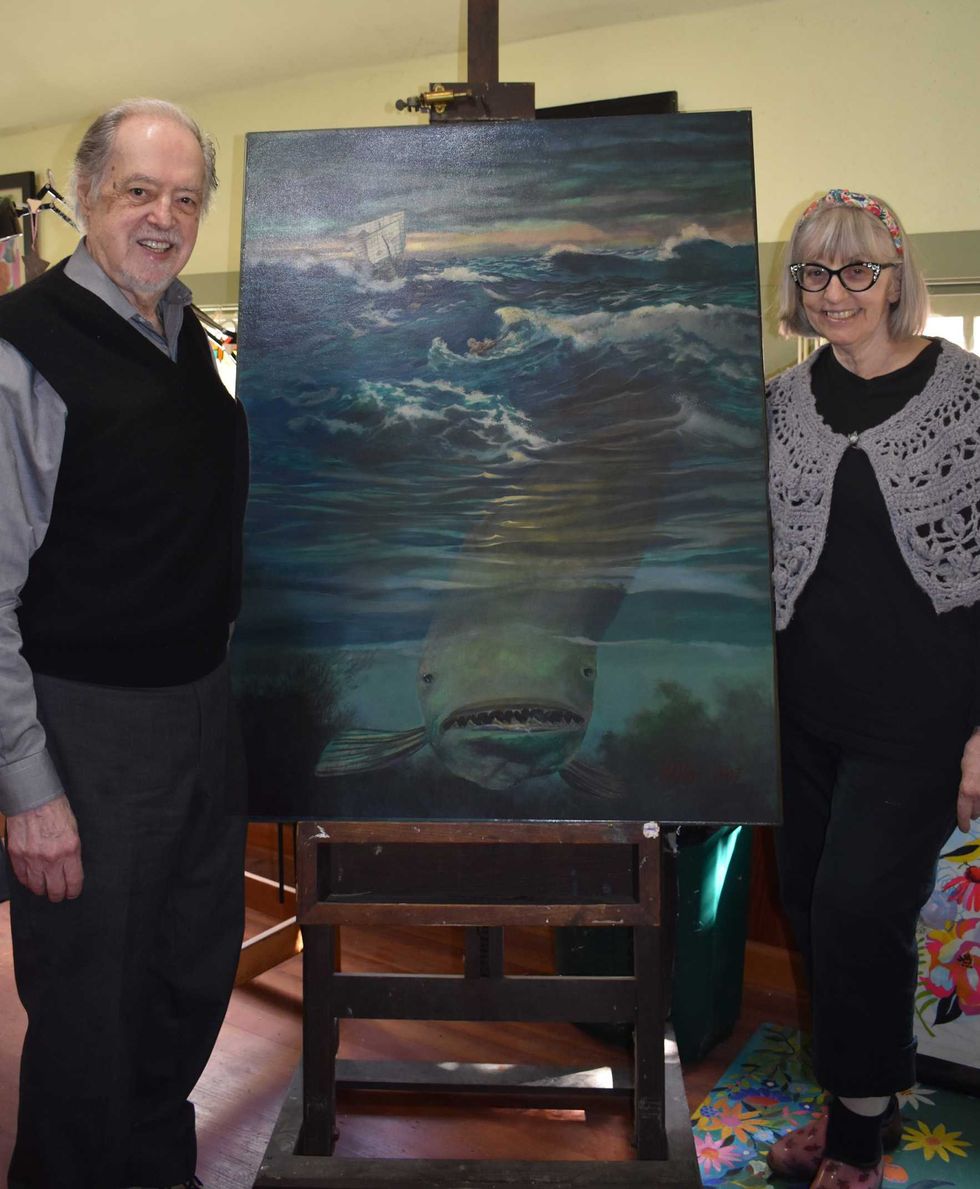 Justine and Victor Valla in their studio with a painting of Victor’s,”Jonah and the Whale.” Robin Roraback



 A ceramic vase by Kathleen Heidemann.Provided
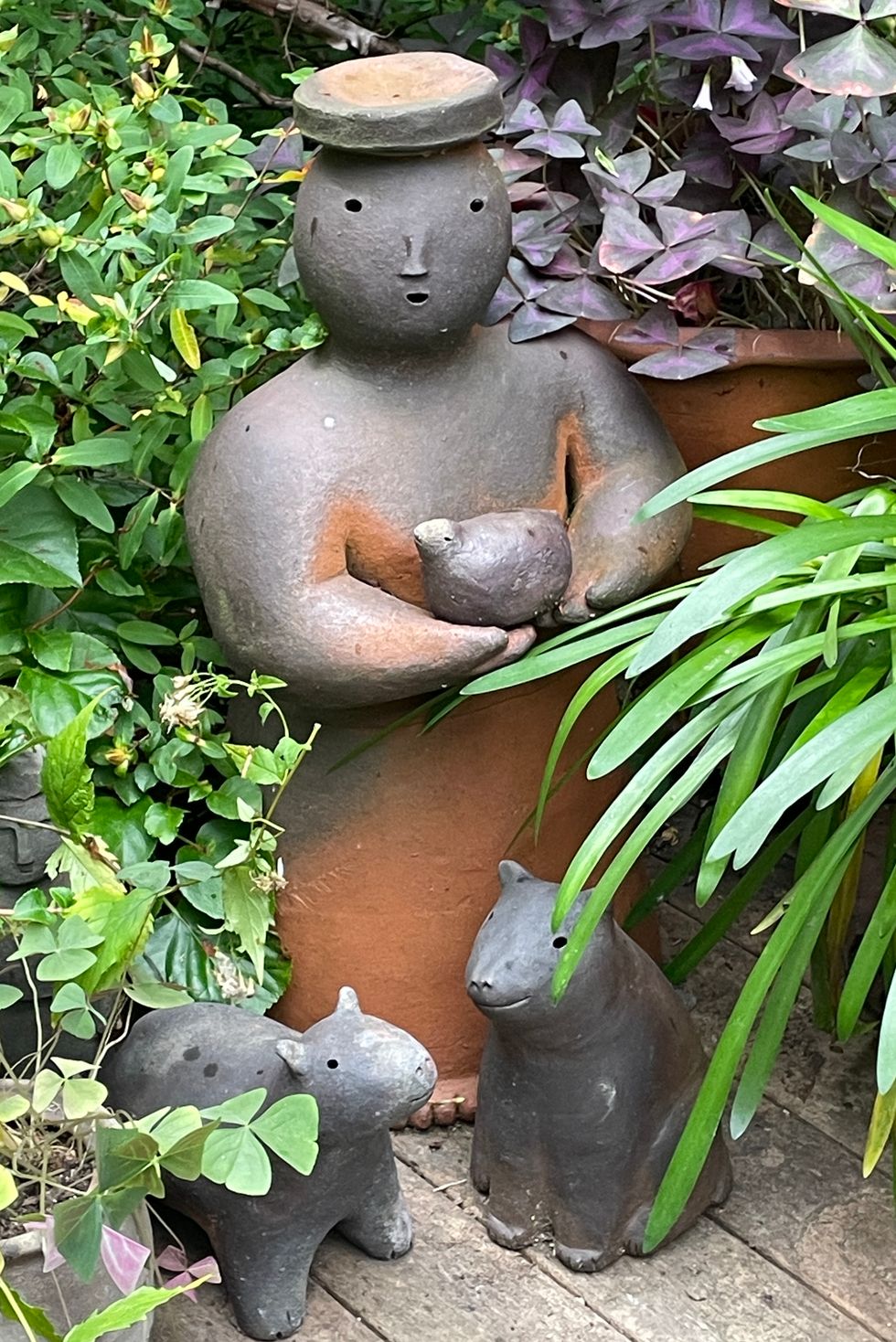 Joy Brown’s delightful ceramic sculptures.Provided