Think globally, act locally.
This is a great principle unless it hoodwinks a specific region into ignoring its own safety for hypothetical gains to nonspecific others. Such is the case with the greenwashing of the Cricket Valley Energy Center (CVEC) natural gas-fired energy plant under construction in Dover, on the Wingdale/Litchfield County line. Litchfield County is being asked to fall on its well-honed green sword for the theoretical common good of cleaner air from Iowa to Vermont. But proximity is everything when it comes to pollution, as are local microclimates. Amazingly, no one has looked at impacts here — yet.
There are clear environmental and economic benefits for Dover regarding old brown fields remediation and jobs creation but that town’s good fortune if an industrial behemoth like CVEC can be called that — likely comes at the expense of Litchfield County’s air, water and soil. Effects could reach well beyond the Northwest Corner into the Berkshires and beyond. Several Hudson Valley towns as far west as Poughkeepsie are unhappy with this already-approved project that plans to go online in 2020. And Connecticut’s prime protector of the environment, the Department of Energy and Environmental Protection (DEEP) was, at best, I believe, asleep at the switch.
Backstory
CVEC’s wending through the long New York approval process from 2009 to 2012 overlapped with a Connecticut cost-saving effort when our former Department of Energy was combined with the former Department of Environmental Protection and the two morphed into DEEP. The consolidation was the brainchild of former (from 2011 to 2014) DEEP Commissioner Dan Esty, a dual faculty member at Yale in economics and environment who had so many conflicts of interest as a consultant to various industries that he had to recuse himself from hearing applications from over 23 former clients with potential business before DEEP. Protecting the environment in Connecticut has never regained its stature compared to energy promotion at that agency. Bills have regularly been introduced in the state Legislature to separate those regulatory functions again but none have gone the distance to enactment.
CVEC is the poster child for why energy and environment — with fundamentally different and often conflicting assignments — should never have been combined. Central to Esty’s cornerstone energy policy was the promotion of new natural gas plants and pipelines in Connecticut, with matching taxpayer funding from the also Esty-inspired Connecticut Green Bank. DEEP was all-in on natural gas. We live with the reverberations of that policy today, to wit the fact that DEEP never involved itself with CVEC beyond CVEC asking them for information on current state air pollution. They simply trusted New York’s Department of Environmental Conservation (DEC) to do a good job, according to one DEEP insider.
This, even as a mega-polluter was proposed smack on our border with immediate air quality impacts to the state’s most iconic areas — the Appalachian Trail, the multi-state Highlands Project, the Housatonic River (recently federally designated as Wild & Scenic), and Lake Waramaug, designated as the state’s only Heritage Lake bordering three potential impact towns. Then there are the numerous state forests, campgrounds, intrepid land trusts and popular hiking trails. The quality of Litchfield County’s environment is surely its strongest calling card — now directly jeopardized for nothing in return.
uuu
Under DEEP, we have completely failed our stewardship. It is hard to imagine the former enviro-loving DEP commissioner Gina McCarthy (from 2004 to 2009) when that agency was still focused strictly on environment, or Richard Blumenthal when he served as state attorney general (from 1990 to 2009) giving something this consequential a pass. In fact, in 1999 the Connecticut Siting Council turned down the 500 MW Sempra natural gas-fired plant — less than half the size of CVEC — in New Milford based on this area’s complex microclimates and potential adverse effects to future economic growth.
While CVEC’s approval process was strictly a New York affair, neighboring Connecticut deserves much closer scrutiny by DEEP, conservation/environmental groups, town governments and citizens. Even this late in the game, much can be done. We also need to hear from our state Department of Health. Small particulate matter like that to be emitted from CVEC in hundreds of metric tons per year, lodges deep in lung tissue with effects particularly to children and the elderly and many other effects.
DEEP’ Commissioner Rob Klee has graciously agreed to speak to the conservation commissions and public on Sept. 26 at the Kent Town Hall at 7 p.m. He has some explaining to do to help the public understand the approach the DEEP has taken.
uuu
Here’s what Litchfield County needs from DEEP:
1. Immediate ambient air quality pre-testing to establish baselines in main impact areas of New Milford, Sherman and Kent with expanded monitoring in Cornwall, Warren, and Lake Waramaug. Some states have mobile air monitoring units. Monitoring should cover the entire range of pollutants generated by CVEC.
2. Installation of new state-of-the-art permanent monitoring equipment to cover the entire Housatonic Valley from New Milford through Cornwall and Sharon with particular attention to microclimates in valleys where smog will accumulate. Measurements should be for peak real-time exposures, not averaged, and available to the public.
3. Establish with New York state automatic shutdown of CVEC if/when monitors exceed thresholds in Connecticut.
4. Establish separate air quality standards in Connecticut if necessary, particular to microclimates, not just adherence to federal EPA standards which are regional, time-averaged, and are becoming more lenient under the current administration.
5. Include Litchfield County in air advisories.
6. Connecticut needs to conduct detailed air modeling pertinent to CVEC with data from Bradley Airport using Siting Council criteria. Air modeling should focus on unique microclimates of Housatonic Valley like the 1999 Siting Council’s review of the Sempra/NME proposal that was denied. We also need visual analysis from many sensitive Connecticut areas and economic analysis for northwest Connecticut towns.
uuu
And what DEEP needs from us is a guarantee that this will be funded. Litchfield County’s long-term goals are to establish accurate, detailed air monitoring infrastructure; cooperative agreements between Connecticut and New York for automatic shutdowns when pollution levels register high; determine what emissions will be measured, how recorded and how made public; establish better public transparency between DEEP’s air quality division and the Connecticut Dept. of Health regarding new air quality studies particular to children and vulnerable populations; establish permanent DEEP funding for expanded air monitoring/testing in northwest Connecticut, including funding to upgrade test equipment or purchase mobile units if needed, and lastly, harmonize Connecticut air standards with those of other New England states if ours are more lenient.
It took the CVEC wolf-at-the-door to get our attention regarding the huge regulatory holes in air quality monitoring and protection here. Air is the first requirement of life. We can live days without water and weeks without food, but only minutes without air. This one counts.
B. Blake Levitt is a former New York Times contributor, author and communications director at the Berkshire-Litchfield Environmental Council. She writes about how technology affects biology. Go online to the Town of Dover, N.Y., website, and look for the Cricket Valley Energy DEIS, www.townofdoverny.us/CricketValleyEnergyDEIS0511.cfm.
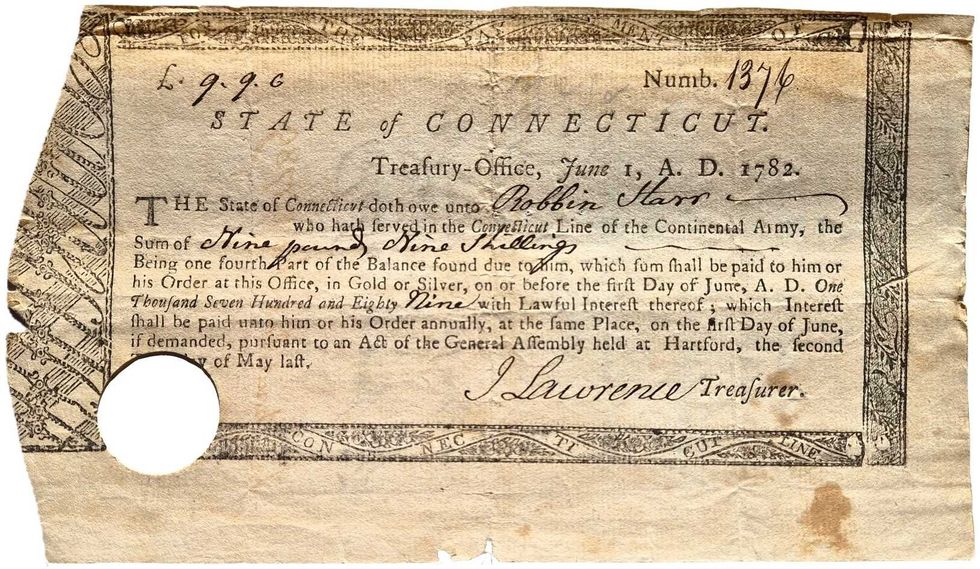 Pay Bill for Robin Starr’s service in the Continental Army.Courtesy the Alex Breanne Corporation
 John Mills speaking at Quinnipiac University.Courtesy the Alex Breanne Corporation
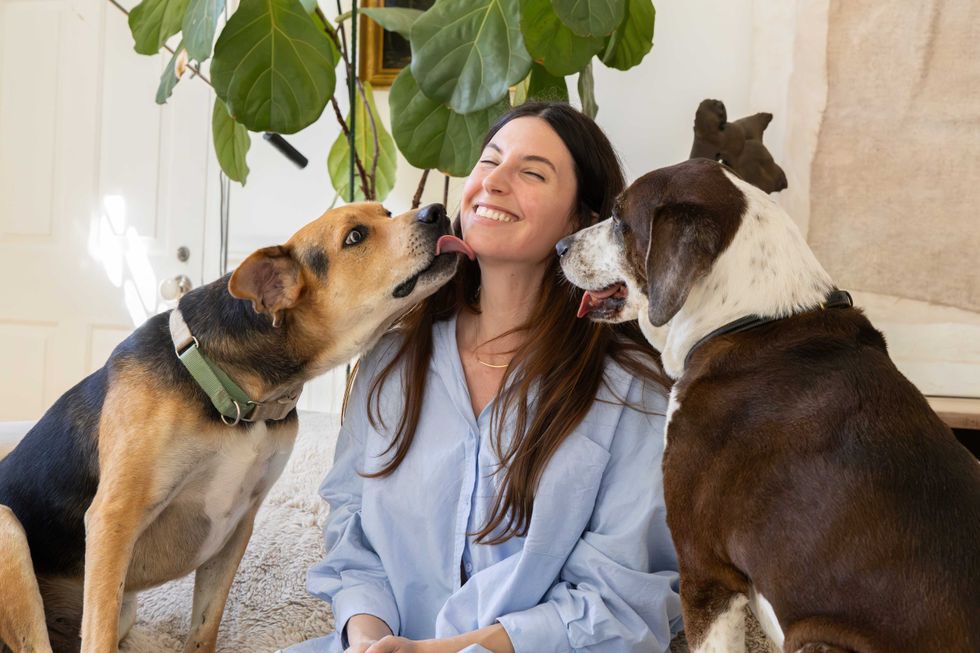 Stephanie Saetta,with her rescue dog George and Blue (left), a shepherd mix awaiting his forever home.Madi Long
 Blue, a 7 year-old Shepard mix, is waiting for his forever home. Madi Long