DeMay steps down from role as director of Douglas Library

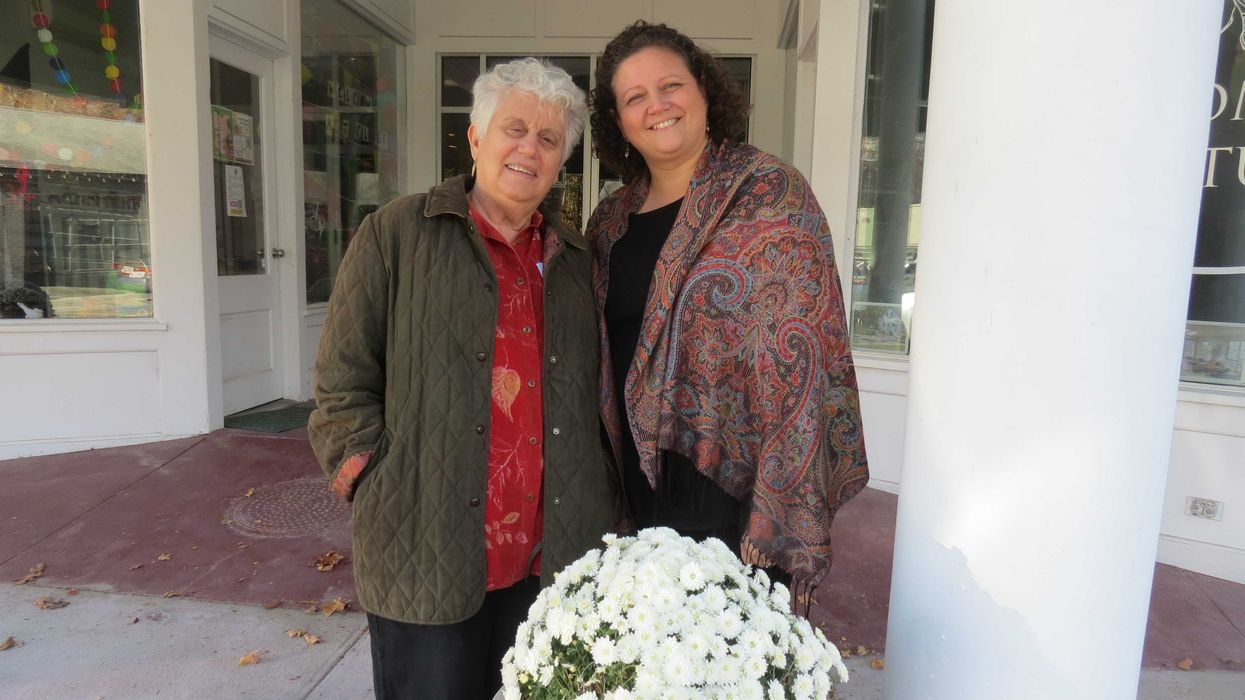
Norma DeMay, left, has retired as library director of the Douglas Library in North Canaan. She is with her successor, Laura Moran.
Ruth Epstein

Norma DeMay, left, has retired as library director of the Douglas Library in North Canaan. She is with her successor, Laura Moran.
NORTH CANAAN — The Douglas Library exudes a warm, cozy feeling — thanks in large part to Director Norma DeMay, who for 28 years has welcomed visitors to the Main Street building. DeMay recently retired and was succeeded by Laura Moran, another familiar face who plans to continue that tradition.
DeMay recently reflected on the many changes during her tenure, particularly in technology. She recalls when the library had just one computer with dial-up internet. Since then, high-speed access and other innovations have arrived, allowing patrons to enjoy the same resources offered at larger libraries.
The library’s inviting atmosphere, — with its armchairs found among the nooks and crannies, and its extensive collection of books, magazines and audio materials, numbering about 20,000 volumes— is a focal point of the town.
While smaller than many of its counterparts in the Northwest Corner, the Douglas Library operates on a tight budget. It receives $100,000 annually from the town, which is supplemented with grants and revenues from fundraising. DeMay said understanding that North Canaan is not a wealthy town, and the mill rate is high, there were years she didn’t ask for an increase.
“I like to be frugal,” she said.
But that doesn’t preclude the library’s ability to have many of the offerings of a modern-day media center. It has Bibliomation, which is a non-profit consortium in Connecticut that provides a wide range of technical and automated services to its member libraries, such as shared online cataloging for searching and borrowing materials, IT support and a unified computer network for libraries across the state. The Canaan Foundation helps to fund this service.
It has the use of the interlibrary loan system, which enables readers to get books from other libraries. There are children’s programs, events for adults, Scrabble evenings and a book group. There’s a plan to add mah jong to the offerings. The upstairs houses the Charlie H. Pease Museum of Natural History featuring examples of taxidermied birds and animals.
Asked about what types of books circulate well, DeMay said prolific author James Patterson’s are always a favorite. Mysteries, literary fiction, works by foreign authors, especially British, and graphic novels for the young are all popular.
DeMay was raised in Wethersfield and graduated from the University of Connecticut as an art and English major. She’s taken some online library courses over the years. She plans to stay on to do the book ordering.
“I’ve loved my job,” she said, full of praise for her staff and board members. “I love chatting with the people who come in. And you can’t beat a 9-minute commute.” The mother of three, with three grandchildren, plans to spend time with her family, read, garden and hopefully do some traveling.
The beginnings of a North Canaan library can be traced back to William Douglas, a bookworm of sorts, who, when he died in 1821, bequeathed $800 to the town to establish a library. According to Kathryn Boughton, town historian, he split the money, with $400 going for the purchase of books and $400 for an endowment to build a future collection. At that time, the books were housed in the old town hall, a building close to the Douglas home, near the entrance to Geer today. The Douglas Library became a true library in 1895, when books circulated free.
There is much history involving the library when Falls Village and North Canaan split in 1858. In 1890, Mrs. Edmund Lawrence erected a small brick building on Railroad Street. When that space became too small, Samuel Eddy negotiated the purchase of Hattie Peet’s house on Main Street which was given to the town with the provision that the municipality maintain it. Since 1927, Douglas Library has stood at that site.
Runners line up at the starting line alongside Santa before the start of the 5th Annual North Canaan Santa Chase 5K on Saturday, Dec. 13.
NORTH CANAAN — Forty-eight runners braved frigid temperatures to participate in the 5th Annual North Canaan Santa Chase 5K Road Race on Saturday, Dec. 13.
Michael Mills, 45, of Goshen, led the pack with a time of 19 minutes, 15-seconds, averaging a 6:12-per-mile pace. Mills won the race for the third time and said he stays in shape by running with his daughter, a freshman at Lakeview High School in Litchfield.

Don Green, 64, of Red Hook, New York, was second among male runners with a time of 21:17 and a 6:52-per-mile pace. Becky Wilkinson, 47, of Southfield, Massachusetts, was the first woman to cross the finish line with a time of 22:16, averaging a 7:11-per-mile pace. Wilkinson finished fourth overall.
Margaret Banker, 52, of Lakeville, finished second among women runners with a time of 23:59 and a 7:44-per-mile pace.
Runners came from all over Connecticut, Massachusetts and New York. One runner listed home as London, England. Many were members of the Run 169 Towns Society, a group that is dedicated to completing races in every one of Connecticut’s 169 towns. Elizabeth Smith, 32, of Manchester, a member of Run 169, said this was her 162nd town.
“I started 10 years ago,” Smith said. Her husband, Daniel, 33, has run races in 73 Connecticut towns, now including North Canaan. He was eager to know where to get a good cup of coffee after the race.
Santa, who got a head start on the group of runners but finished next to last with a time of 44:14, has been a feature in the North Canaan race since it started five years ago.
The 5K proceeds from a start in front of the North Canaan Elementary School on Pease Street to course around the Town Hall parking lot, up West Main Street past the transfer station to the state line and back. Cheryl Ambrosi, 45, of Danbury, was the last to cross the finish line with her dog Benji. “It was so much fun,” she said as she ended, even though she didn’t catch Santa.

The Torrington Transfer Station, where the Northwest Resource Recovery Authority plans to expand operations using a $350,000 state grant.
TORRINGTON — The Northwest Resource Recovery Authority, a public entity formed this year to preserve municipal control over trash and recycling services in northwest Connecticut, has been awarded $350,000 in grant funds to develop and expand its operations.
The funding comes from the Department of Energy and Environmental Protection via its Sustainable Materials Management grant program. It is intended to help the NRRA establish operations at the Torrington Transfer Station as well as support regional education, transportation, hauler registration and partnerships with other authorities.
Founded by the City of Torrington in May 2025, the NRRA was established to oversee regional municipal solid waste management. Its creation followed a $3.25 million offer by USA Waste & Recycling to purchase the Torrington Transfer Station — a sale that would have privatized trash services in the region.
The proposed sale was initially approved by the MIRA Dissolution Authority, the entity responsible for dissolving the state’s former Materials Innovation and Recycling Authority, which owned the Transfer Station at the time. Before the transaction could close, the state intervened and directed that the facility’s operating permit be assigned to the NRRA to preserve a publicly controlled alternative.
MIRA has since dissolved, and the Transfer Station is currently operated by the state Department of Administrative Services. Many towns in northwest Connecticut have expressed interest in joining the NRRA. As of December, Torrington and Goshen were the only two municipalities in the authority.
At the Dec. 11 meeting of the Northwest Hills Council of Governments (COG) — a regional planning body representing 21 municipalities in northwest Connecticut — Director of Community and Economic Development Rista Malanca encouraged more towns to sign on.
“We need towns to join the Northwest Resource Recovery Authority to show your support, show this is what you want to do,” Malanca said.
Salisbury First Selectman Curtis Rand said his municipality is planning a town meeting in January to vote on a resolution to join the NRRA. Cornwall’s Board of Selectmen recently discussed scheduling a town meeting in the winter for the same purpose. Sharon, Falls Village and North Canaan have also expressed continued interest in pursuing a public option.
Kent is the northernmost member of the Housatonic Resource Recovery Authority, a regional solid waste authority representing 14 municipalities stretching south to Ridgefield. COG towns expressed interest in joining HRRA in 2024, but they were denied and set out to develop the NRRA.
“We also have been having conversations with the Capital Region Council of Governments and the Naugatuck Valley Council of Governments to think about how we can use existing resources, maybe some of these grant funds, to bring in shared resources or shared staffing that will help with some of the recycling coordinating efforts,” Malanca said.
With grant funds secured, NRRA aims to grow to a point that it can take over operations at Torrington Transfer Station to serve as a regional hauling hub. What happens to the trash after that has yet to be determined. Currently, it is being shipped to a landfill out of state. The existing municipal refuse hauling contracts that were established with the state expire in 2027.
The Salisbury Winter Sports Association (SWSA) will host its annual Junior Jump Camp, a two-day introduction to ski jumping, on Saturday and Sunday, Dec. 27 and 28, from 9 a.m. to 2 p.m. at Satre Hill in Salisbury.
The camp is open to children ages 7 and up and focuses on teaching the basics of ski jumping, with an emphasis on safety, balance and control, using SWSA’s smallest hill. No prior experience is required.
The cost is $50 per child and includes instruction and lunch on both days. For more information or to register, visit www.skireg.com/swsa-camp or email info@jumpfest.org
Jesse Bunce, first selectman of North Canaan.
LITCHFIELD — The Northwest Hills Council of Governments welcomed six newly elected municipal leaders Thursday, Dec. 11, at its first meeting following the 2025 municipal elections.
The council — a regional planning body representing 21 towns in northwest Connecticut — coordinates transportation, emergency planning, housing, economic development and other shared municipal services.
Barkhamsted First Selectman Meaghan Cook, Goshen First Selectman Seth Breakell, Kent First Selectman Eric Epstein, Norfolk First Selectman Henry Tirrell, North Canaan First Selectman Jesse Bunce and Torrington Mayor Molly Spino were each elected to their post in November.
They filled the seats of their predecessors on the COG, who were each given a toast of appreciation: Nick Lukiwsky (Barkhamsted), Todd Carusillo (Goshen), Marty Lindenmeyer (Kent), Matt Riiska (Norfolk), Brian Ohler (North Canaan) and Elinor Carbone (Torrington).
COG Executive Director Rob Phillips said the outgoing members were given a going away mug that read “You’re living the dream still.” Members voted to appoint Warren First Selectman Greg LaCava to fill a vacancy on the Council’s Executive Committee. COG members voted by paper ballot, and LaCava defeated Burlington First Selectman Doug Thompson for the vacant seat.