SALISBURY — Salisbury’s watershed was the topic of a presentation at Town Hall on Saturday, April 5, at an event sponsored by the Salisbury Association and the Scoville Memorial Library.Elaine Hecht opened the meeting, observing that while Salisbury is rich in water resources, it is easy to forget that the health of the watershed “affects everything we see and don’t see.”Tim Abbott from the Housatonic Valley Association (and a Lakeville Journal Nature’s Notebook columnist) talked about the Housatonic watershed as a whole, and the interconnectivity of its component parts.Salamander season is now“Last night was the night the salamanders came out,” he said. Unfortunately, human and salamander activity coincide when the amphibians take to the highways in search of vernal pools. “A couple of roads are really bad,” he said. “But it’s hard to shut down Route 41 the first time it rains” in the spring.While regulations might protect vernal pools, Abbott said “it’s worth knowing” which roads or structures are in the salamanders’ path.Harry White, an ecologist and the Salisbury Land Trust’s conservation director, talked about headwaters. He said that topographical maps generally only show 20 percent of headwaters, the definition of which he said is “somewhat amorphous.”“They could be vernal pools, springs or small streams, but they compose 80 percent of the watershed so they have an enormous influence on the water,” he said. White said the purest water comes from a dense, clean forest — preferably from hemlock woods with steep cold-water streams.“It’s a complex microtopography that slows water down or contains silt and protects streams and rivers below,” he said.Mary Silks of the Lake Wononscopomuc Association discussed the human impact on the watershed and on the lake.She said visibility in the lake, recently at 12 feet in the summer, was 30 feet prior to 1940. In a series of aerial and satellite photos, Silk showed that, while there was almost no sediment buildup around the lake in the late 1930s, photos from 1991 and 2011 show brooks draining into the lake with deltas of sediment.Silk said at least 46 culverts drain highways into the lake, bringing silt, oil, road salt and nutrients with the water. Create a rain gardenWhat homeowners do on their property has a big effect on the lake. Silk said that 1 inch of rain on 1 acre of land produces 27,000 gallons of water — and an inch of rain on a 1,500-square-foot roof produces 1,000 gallons. How that water is controlled determines the health of the lake. So rather than hold to past practices — “Pave it, pipe it, pollute it” — Silk advised homeowners to, at a minimum, direct their downspouts into vegetated areas rather than impervious surfaces such as driveways. Going further, she urged property owners to create “rain gardens” or shallow depressions with plantings to absorb rain water. Trout in the Salmon Kill Tracy Brown from Trout Unlimited underlined the importance of the watersheds as she discussed a restoration project now underway on the Salmon Kill. She pointed out that brook trout are a native species found in the headwaters on Mount Riga, but their population has greatly diminished over time. While brown trout and rainbow trout can be found downstream, there are almost no brook trout. She said one result of the restoration of the Salmon Kill could be creating a downstream destination for native brook trout.The restoration project involves riparian plantings to restore vegetative canopies over the stream to cool the water, creating logjams to slow the flow and create deep thermal pools for the fish to spawn, eat and hide and repairing stream banks that have been scoured out by fast-moving water.First Selectman Curtis Rand said the town’s involvement with watershed protection takes three forms: regulatory, educational and budgetary.He said the town spends $100,000 on water protection (not including what Planning and Zoning or the Conservation Commission might spend).He said both Planning and Zoning and the Conservation Commission have developed regulations that are designed specifically to protect the watershed, and he pointed to the Natural Resources Inventory and the Plan of Conservation and Development as two tools that address watershed issues.
Latest News
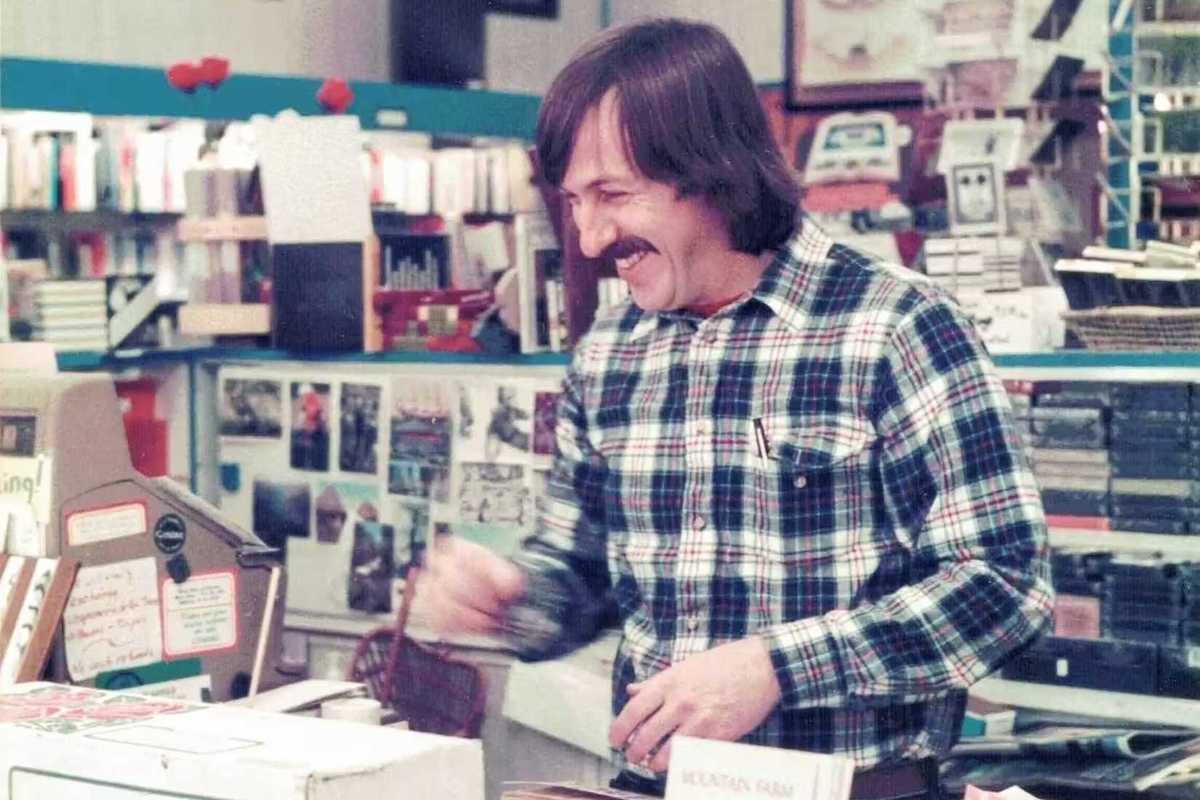
Dick Hermans in the Oblong Bookstore on Millerton\u2019s Main Street in 1985.
Provided
For Hermans, the award has prompted some reflection about why he has spent so much of his life involved in community projects.
“I was thinking about it this morning: Why do I do what I do?” he said. “And I think no matter what I’ve done, whether it’s been school board or rail trail, I’m trying to be useful to the communities I’m associated with.”
Hermans is perhaps best known as the longtime co-founder and steward of Oblong Books in Millerton, a business that began almost by accident. He and his former partner, Holly Nelson, were living in Millerton and looking for something to do during the winter. They had been painting houses, including the Grange Hall in Millerton, a job Hermans got through his aunt, who belonged to the Grange.
At the time, Hermans was also working in insurance for his father, doing collections.
“It was fine except I was doing collections, and it really kind of left me cold,” he said.
He and Nelson began thinking about what they might do together. Nelson was an avid reader, while Hermans had studied journalism and had worked in a record store. They noticed a chain of book and record stores operating elsewhere in the Hudson Valley and decided to follow that model.
And so Oblong was born.
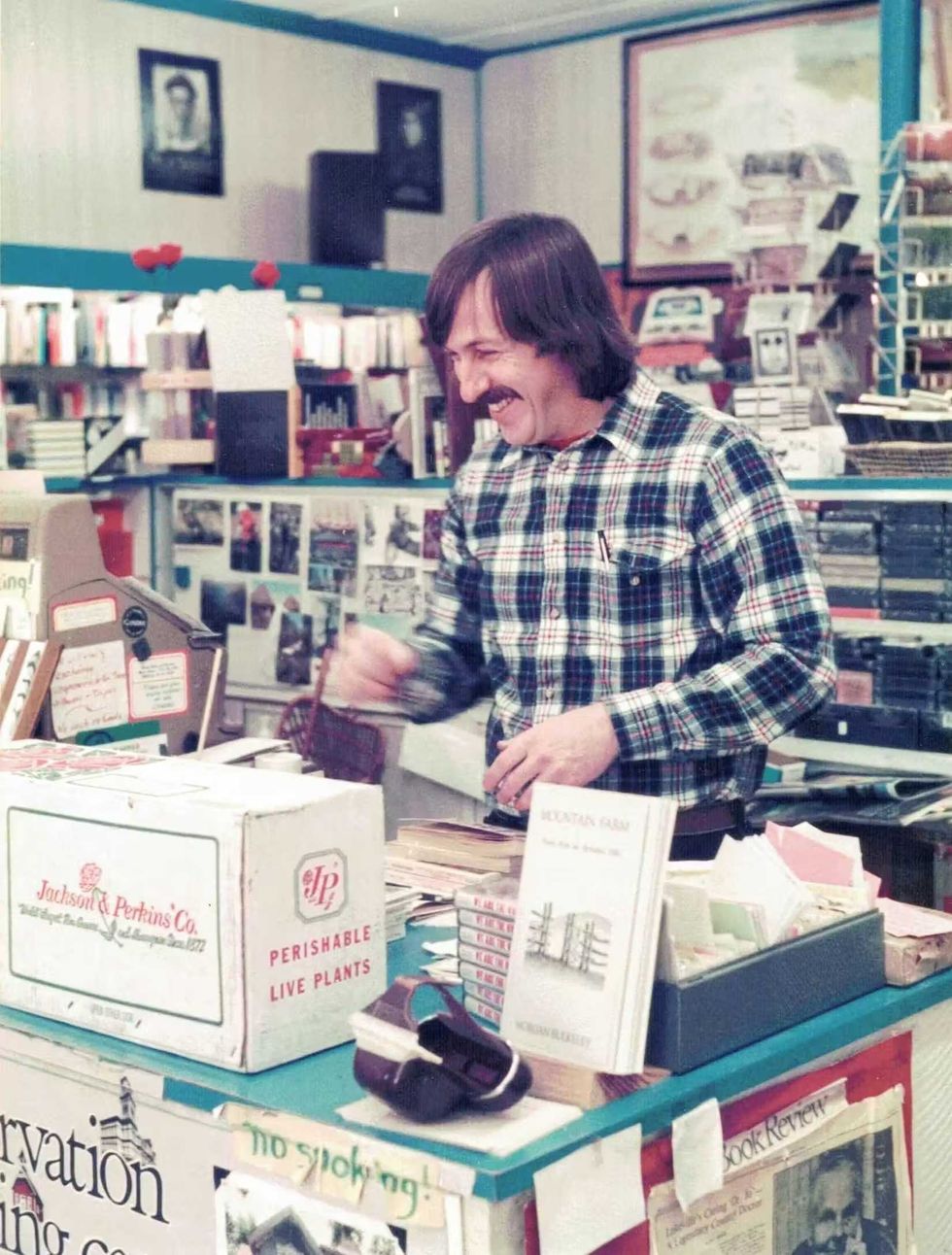 Dick Hermans in the Oblong Bookstore on Millerton’s Main Street in 1985.Provided
“We really learned it by the seat of our pants,” Hermans said.
The business would eventually become a beloved and integral part of Millerton’s commercial life. But although Hermans may have learned the book business as he went, his affinity for retail — and for the connections that happen across a counter — had begun much earlier.
As a child, his second-grade teacher operated a little cardboard pencil shop in the classroom, and Hermans still remembers the satisfaction of selling a pencil for a nickel.
“I really liked selling somebody a pencil for a nickel,” he recalled. “I can remember that experience, and it was so pleasant.”
Later, while living in Arizona, he helped establish a food co-op and worked at the counter.
“I kind of knew that I liked doing that kind of thing,” he said. “It’s a nice way to be pleasant with people, but without making too much commitment to them.”
His relationship with Millerton also predates Oblong. His grandparents lived in the village, and he first came to Millerton as a baby. Over the years, he has watched the town change through several generations.
He remembers a Millerton with a much broader array of businesses, when stores such as Delson’s, the Main Street department store that stood for nearly 40 years in what is now Millerton’s Antiques Center, seemed to carry almost everything a resident might need.
“You could find everything from a set of dishes to a shotgun,” he recalled.
The rise of shopping malls changed that kind of downtown retail, he said, but Millerton has remained a lively commercial village.
“For us, it’s been a great place to have business,” Hermans said. “It’s a busy village.”
For Hermans, running a store was never simply about selling books and records. It was a way of being part of a place.
Music has remained another constant. Hermans continues to sell music at Oblong and hosts the radio program “New Harmony” on WKZE. The business of selling music has changed dramatically over the years, particularly with the rise of streaming, but Hermans has adapted.
He was initially reluctant to bring vinyl records back into the store because of their expense. But about four or five years ago, he began stocking LPs again, and they have become the main form of music the store sells.
He finds that many of the customers buying them are reconnecting with music they loved years ago.
“I do best with classic albums that people may have had when they were young,” he said. “And now that they’re retired, they want to hear it again.”
Hermans still reviews between 700 and 1,200 new music releases each week through the store’s distributor, Alliance Entertainment, carefully deciding what belongs on Oblong’s shelves.
That same commitment to place has led Hermans into a wide range of community projects. His work with the Harlem Valley Rail Trail is among the efforts he mentions when reflecting on his years of civic involvement. He has also served on the school board and has been involved with the Millerton Business Alliance and the Irondale Schoolhouse. He is now involved with The New Pine Plains Herald, which he sees as complementary to the work of The Millerton News and The Lakeville Journal.
“I really think that the important thing about this award is that people understand what a newspaper does to connect them to their community,” he said. “And if that means anything to their lives, they gotta support it.”
Hermans knew Mary Lou and Robert Estabrook and remembers them as people who were deeply conscious of their responsibilities to the community.
“They were really nice folks,” he said. “They were very conscious of what their role in the community was.”
There is, in fact, still plenty on his plate. Hermans admits he needs to scale back because he has taken on more than his current abilities can comfortably accommodate.
“To be given this award is very special,” he added. “But I don’t feel like I’m done.”
This article has been changed to reflect that Hermans and Nelson were partners. A prior version states that they were married.


Want more of our stories on Google? Click here to make us a Preferred Source.

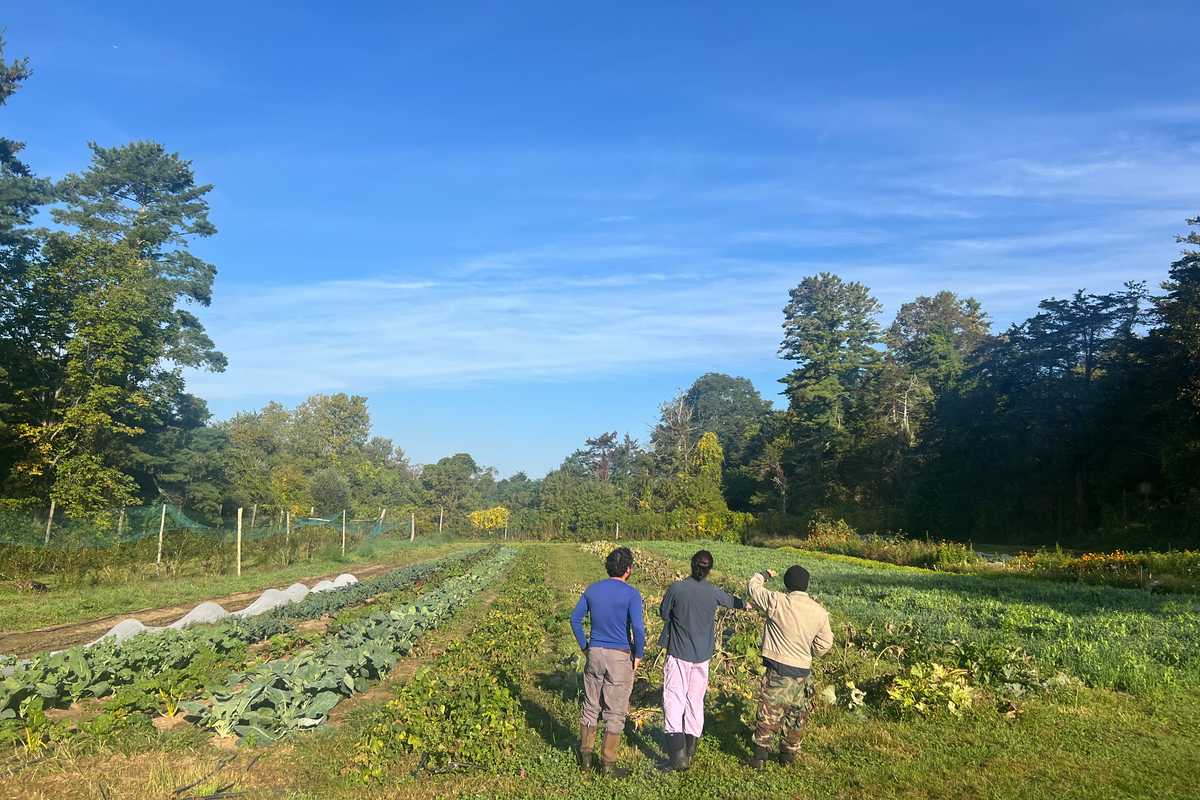
Adamah Farm crew members planning out the day’s tasks on a late September day.
Janna Siller
Over my 15 years of growing vegetables in Falls Village, I’ve exerted my will over all kinds of conditions, from drought to humidity to crows with a taste for cantaloupe. That’s what farming is all about. You zip around the field, hopping on and off tractors, moving hoses and chasing weeds, all in an effort to arrange conditions in favor of your crops. It is the crops’ job to gulp up sunlight and move water through their stems, to transform solar energy into your next pesto or ratatouille or butternut squash soup. It is the job of the farmer to irrigate just enough but not too much, to slice dandelion leaves without damaging delicate cabbage roots, to pander and pamper and stay in tune with what plants need to thrive.
The easy part of farming is trusting plants’ resilience. I have seen bright green shoots barrel ahead out of a plant torn to shreds by hail. I’ve watched wilty, heat-stressed seedlings turn rigid overnight and greet the next morning with vigor. The hard part is letting go of what you can’t control. As our crops lapped up Friday’s gentle sunshine and I considered the weekend forecast, I imagined roots holding tight to wet earth and branches supporting each other in sideways, pelting rain. I made sure all of our storage crops were already harvested and tucked away. I battened down the sides of our greenhouses and wished the remaining field crops good luck.
The nor’easter didn’t materialize too dramatically in our corner of New England. A few broken branches and debris blown about, nothing like the July Fourth storm that sent half a tree crashing onto the deer fence and left crates of fresh veggies in coolers without power.
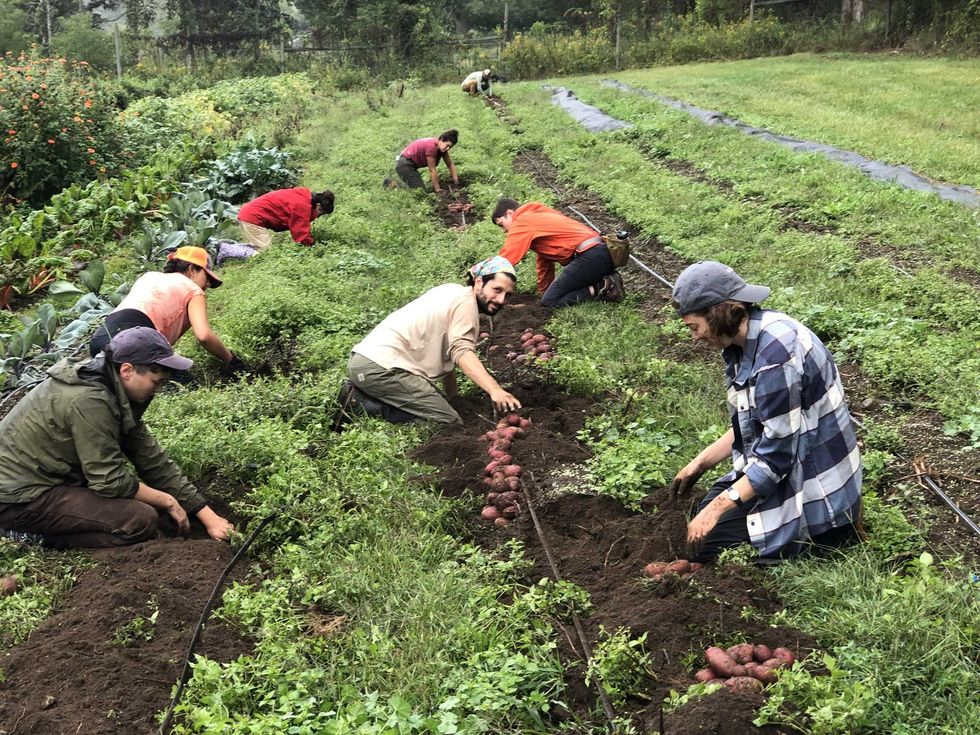 Fall storage crop harvests amid soil building cover crops at Adamah Farm in Falls Village. Janna Siller
Farming is an exercise in acceptance. To do it well and return year after year, you have to balance hubris and humility. The prize can often be a certain equanimity, a training in the art of moving into the next day even when the last one scrambled all your plans.
Epic change is not always about the unexpected. It also comes like clockwork on the seasonal calendar. As I type, the last of summer’s watermelons wait naively on the vine for a few hot days to finish ripening. Broccoli are holding their leaves wide as they did in June and July, only to find that the hours of sunlight decrease with each earlier sunset. Plants can’t pick up and go south or call the manager to order a bonus round of sunshine. Their growth slows and they get a resigned look to the hue of their leaves, so different from the frenzied growth of summer.
The release of fall is not tragic or gloomy. It is not an ending because so many fall tasks are about setting up for the new beginnings in spring.
We turn the vines that yielded thousands of pounds of fruit into the soil, where healthy microbes feast on their rotting stems. Then we plant cover crops — a mix of cereal grains like rye and oats and legumes like peas, vetch and clover. Cover crops hold the soil and its nutrients in place over winter, feeding the soil food web and adding organic matter that next season’s crops will need to grow.
We sort sprinklers and repair hoses. We inventory tarps. We take notes about which plants did well where and how we might try a new approach for this or that. We stack crates of cured garlic and onions and winter squash in a cool, dark room.
We save seeds from tomatoes and beans and lettuce, carefully labeling each variety for next season’s long, sunny days.
Janna Siller is the farm director at Adamah, a community farm in Falls Village offering CSA shares, educational programs and a food access program.

Want more of our stories on Google? Click here to make us a Preferred Source.