Fern Apfel: ‘Letters Home’ at Troutbeck

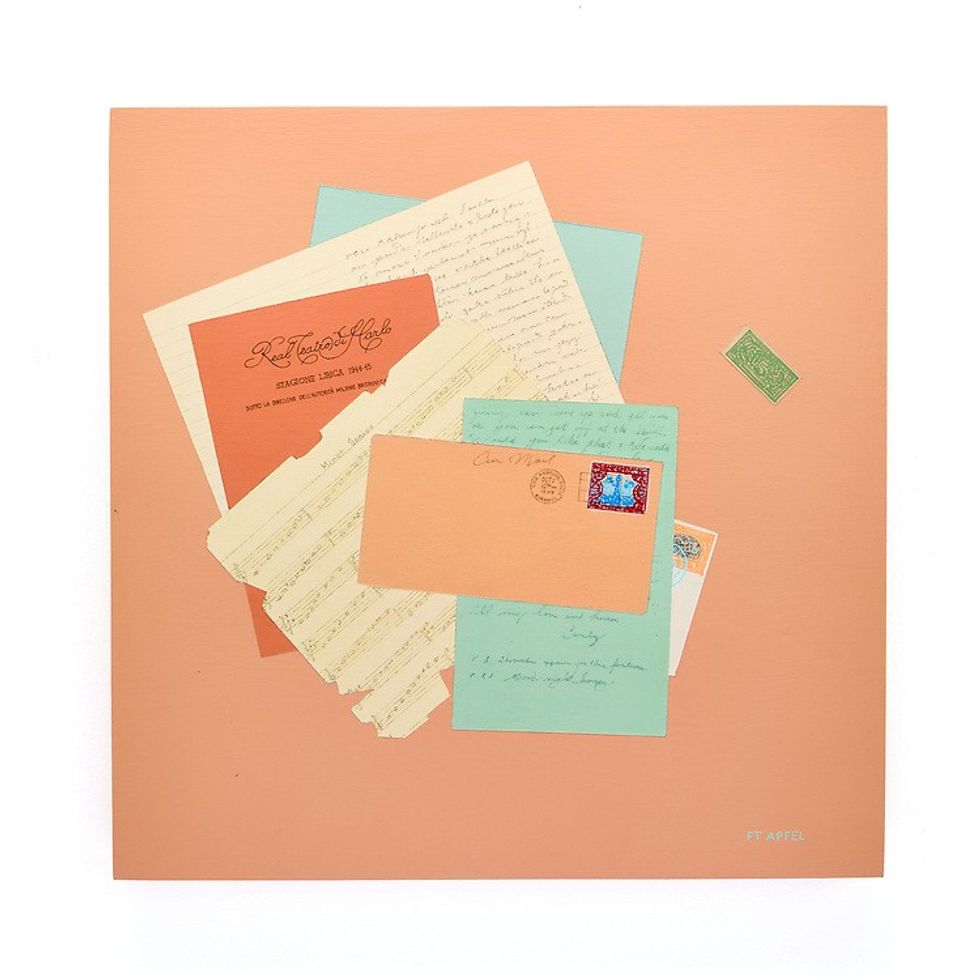
“A Magician Tells His Secrets” by Fern Apfel.
Photo by Jeff Barnett-Winsby

“A Magician Tells His Secrets” by Fern Apfel.
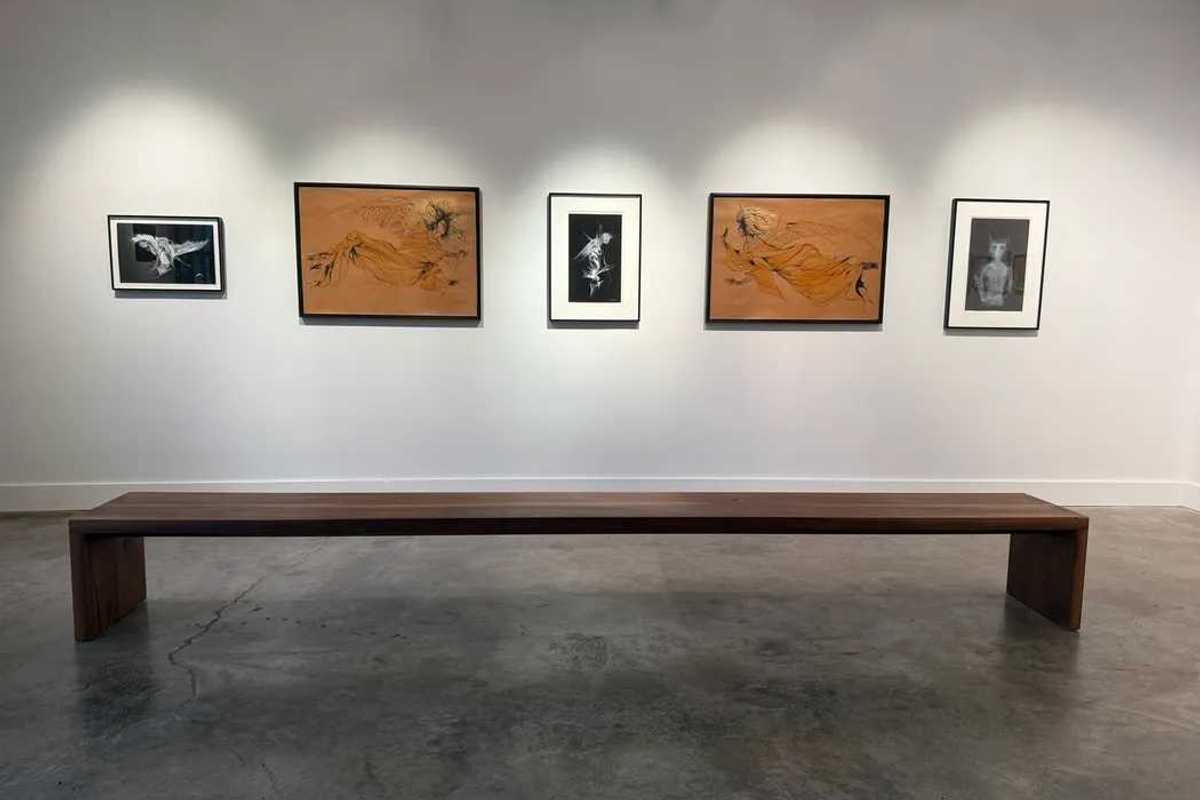
Opening on Friday, Feb. 21, “Letters Home” is the latest exhibition in Troutbeck’s ongoing collaboration with the Wassaic Project, a partnership that brings contemporary artists to the historic site in Amenia. This season features Fern Apfel, a Hudson Valley artist known for transforming handwritten letters, diaries, and ephemera into meticulously painted still lifes.
Apfel’s work explores the intersection of text, memory and abstraction, preserving the beauty of handwritten correspondence while reflecting on the passage of time. Though they appear to be collages, her paintings are carefully rendered in acrylic and archival pen, capturing the worn textures of aged paper, faded ink, and personal histories.
A two-time recipient of the New York Foundation for the Arts Individual Artists Grant, Apfel has exhibited widely, with works in the permanent collections of The Hyde Collection, The Albany Institute of History & Art, and the Tang Teaching Museum. In 2022, she received the Yasuo Kuniyoshi Award from the Woodstock Art Association & Museum, recognizing outstanding artistic achievement.
The opening reception will take place on Feb. 21 from 5 to 7 p.m., continuing Troutbeck’s commitment to showcasing artists whose work engages with history, language and place.
The Wassaic Project first began curating exhibitions at Troutbeck in 2022 with solo exhibitions by Wassaic alumni Polly Shindler and Taha Clayton. Most recently, Wassaic has curated a solo presentation of paintings by Dana Robinson, who also currently has work on view at the Wassaic Project in “A Space Between Worlds.” Additionally, they have presented a solo show of photographs from Wassaic Project co-director Jeff Barnett-Winsby. The two entities have also worked together numerous times over the past few years for programming events, including collaborating with the Wassaic Project’s education department to produce Troutbeck’s Symposium series. Most recently, Troutbeck hosted the Project’s winter benefit.
“Because of the small community that we share, it felt like a natural development to expand the Wassaic Project’s artists and art outside of Maxon Mills. We are excited to continue this partnership with Troutbeck,” said Will Hutnick, Wassaic Project’s director of artistic programming.
Riley Klein
Cornwall Town Hall
WEST CORNWALL — The future site of the wastewater plant in West Cornwall was officially determined by the Board of Selectmen Tuesday, Feb. 17.
The site is located on Route 128 between the post office and the design studio. The town has long planned to use this grassy plot for the sewer facility, and a signed option to lease the land from property owner Eric Tietz made it official.
The land was assessed at $94,000, which will be paid to Tietz out of the Housing and Urban Development grant that is funding most of the wastewater project. Moving forward, the town will pay $800 per month for the life of the 50-year lease.
With the land secured, Cornwall can move forward with the permitting approval process, which could take more than a year. A firm is already under contract to build the facility once the permits are finalized.
Patrick L. Sullivan
KENT — The Kent Board of Selectmen has formally joined opposition to a renewed effort by the Schaghticoke Tribal Nation (STN) to gain federal recognition.
The selectmen discussed the topic in executive session Tuesday, Feb. 17. In the regular meeting that followed, First Selectman Eric Epstein made a motion to approve a “common interest agreement” with the State of Connecticut and the Kent School to oppose federal recognition of STN. The motion passed unanimously.
STN is distinct from the Schaghticoke Indian Tribe (SIT), which recently received a positive review from the Office of Federal Acknowledgment. The tribe split into two factions — SIT and STN — roughly 40 years ago. STN is currently in the re-petition process for federal acknowledgment as well.
STN sued the state in 2016 seeking $610 million in damages for selling tribal land. The case was dismissed in 2019. Originally, STN aimed to leverage its land claims in Kent to build a casino in Bridgeport.
In other business, the board voted unanimously to recommend to the Board of Finance an alternative paving bid connected to Kent Center School. The town school board, working through Region One, has already gone out to bid for a repaving project at Kent Center School, for $494,477.
Attached to the bid package was the option of repaving Judd Avenue and Elizabeth Street south of the intersection of the two roads and adjacent to KCS, for an additional $97,010.
The selectmen heard from Kent resident Gregoire Pye, owner of the Crepe Royale food truck, who would like to operate in Kent.
The status quo is that food trucks are not allowed on public property in the town, but are allowed on private property. Gregoire noted the presence of a hot dog vendor in the summer, and wondered why he couldn’t get a similar exemption. The selectmen said the hot dog vendor was grandfathered in. Epstein said the Planning and Zoning Commission does not have a regulation about food trucks. The matter was tabled and will be addressed next month.
The board tinkered with a resolution governing the recording of public meetings. The change would allow a board or commission to close a meeting if audio recording fails and 30 minutes of troubleshooting is unsuccessful.
The selectmen accepted Matt Frasher’s resignation as chair of the USA 250 subcommittee and appointed Sarah Chase as a replacement.
Epstein reported that work is ongoing on a request for proposals for work at Emery Park pool. He said the town has $100,000 in federal COVID relief funds that need to be spent by the end of the year.
Patrick L. Sullivan
Natalia Zukerman explains the art of cartooning to a group at Scoville Memorial Library Sunday, Feb. 22.
SALISBURY — Cartoonist Natalia Zukerman gave practical advice on her craft at the Scoville Memorial Library Sunday morning, Feb. 22.
Zukerman has been the regular cartoonist for The Millerton News for about three years. She said her approach is to use a single panel rendered in black and white.
She gave several practical tips. “I don’t use a pencil sharpener. I use an Xacto knife.”
She held up the blade.
“It’s nerdy but you get the best point.”
She doesn’t use an eraser either. “I like to keep the history” of the cartoon in place, she said.
Besides, thanks to the wonders of Photoshop, blemishes and goofs can be fixed later in the process.
Among her tips was a stern instruction to use no more than 20 lines in trying to adapt one of three faces shown on the big screen in the library’s Wardell Room.
Face number one was a shocked face, with raised eyebrows and a round, open mouth.
Face number two was an angry face with furrowed brows and bared teeth.
Face number three belonged to a cat looking very pleased with itself.
As far as subject matter, she gave some examples of cartoons that literally illustrate common expressions, such as “silly goose” or “burning the candle at both ends.”
Karen Vrotsos of the library opened the proceedings with a quick overview of the history of political and/or satirical cartooning, starting with William Hogarth’s 1721 (published in 1724) “Emblematical Print on the South Sea Scheme,” which deals with the fallout from the failure of the British South Sea Company, which caused a serious financial disruption.
The first American political or satirical cartoon published widely is probably Benjamin Franklin’s “Join or Die,” depicting the then American colonies as sections of a rattlesnake. Because the cartoon dates from 1754, it refers to the colonies uniting with the British to fight the French and Indian War.

Want more of our stories on Google? Click here to make us a Preferred Source.
Ruth Epstein
Kathy Keane, head of North Canaan’s 250th celebration of the United States, left, Kathryn Boughton, the town’s historian, and First Selectman Jesse Bunce welcome guests to the Washington’s Day Ball Saturday.
NORTH CANAAN — Visitors from centuries past mingled with present-day residents Saturday evening as the town celebrated George Washington’s birthday and officially launched its 250th anniversary of the nation’s founding.
The Washington Birthday Ball, held at the aptly named Colonial Theatre, brought colonial history to life through reenactors portraying figures with deep ties to Canaan.
Captain Gershom Hewitt — a member of the expedition that captured Fort Ticonderoga — was dressed in full regalia, happy to speak about his service. Portrayed by Tim Abbott, executive director of the Housatonic Valley Association and a well-known reenactor, Hewitt hoisted a cup of rum punch declaring, “Confusion to our enemies.”

Hewitt is buried in the town’s Mountain View Cemetery.
Also in attendance was Colonel Charles Burrall (played by Peter Bickford), a war officer who in his early life was destitute, but went on to become one of the wealthiest of Canaan’s early land speculators. He held important government positions during his life, serving as a long-time representative to the General Assembly and as one of the delegates in 1788 who ratified the Constitution of the United States.
And of course, George and Martha Washington (Falls Village First Selectman David Barger and his wife, Carmela Barger) circulated among the guests.
Town historian Kathryn Boughton, one of the event’s organizers, said she was especially pleased that descendants of early settlers attended in costume.
Dan Adam’s ninth great-grandfather was Squire Samuel Forbes, who started a blacksmith shop in Canaan and eventually amassed a large amount of land. “Our family has been farming here for over 200 years,” he said, a tradition that continues to this day.
Samuel and Lucy Forbes’ daughter Abigail married John Adam, and Forbes and Adam went into business together. They created a farm called “Land of Nod” which provided food for the workers at nearby Beckley Furnace. That farm still exists, and while not as large as it once was, the Adam family still sells homemade syrups and jams, as well as wool from their sheep.
Adam came dressed as Samuel Forbes, and his wife, Melissa Adam, as Lucy Peirce Forbes. Their daughter Abigail Adam came as her namesake.
Ellen and Charlie Goodyear traveled from Virginia to attend the ball. He came as his ancestor Isaac Lawrence and she as his wife, Lydia. Lawrence is reputed to be Canaan’s second settler, arriving in 1739. He purchased land on the banks of the Blackberry River and by the time he died in 1793 had accumulated 192 acres. The stately house, built in 1751 on Route 7, is still owned by his descendants. In 1756, he opened a tavern on the southern side of the house.

The theatre was filled with ball goers who got into the spirit of the evening wearing elaborate costumes. Many of the men sported white wigs, while women primped in long colorful dresses.
Guests sampled period food and drink and followed a caller’s instructions through square dances and the Virginia Reel. Music was provided by Relatively Sound.
Theresa Freund of Freund’s Farm Market researched the food she prepared for the evening’s menu. “There is no recipe I found in Martha Washington’s cookbook that would be edible in modern day,” she said, noting how she was able to tweak items to keep them as authentic as possible.
She explained that when the settlers came to New England, they found chestnuts, so chestnut soup was among the offerings, along with turkey soup, mini meat pies, chicken fricassee, ham and mustard pastries and biscuits. “They seemed to use a lot of sauces and mustard,” said Freund, “maybe to cover up the meat that probably was rancid. Everything appeared to be simmered over a fire. I promise no one will come down with dysentery tonight,” she joked.
Desserts included walnut pie, since Washington loved nuts, hermits and apple crisp, among other treats.
Among the libations was George Washington small beer, which was inspired by the president’s 1757 recipe. A description stated that “at 3% ABV (alcohol by volume), it reflects the practical, sessionable beer people drank throughout the day during that period. In the 18th century, beer was often considered safer than water, since colonists didn’t yet understand the germ theory, but they did understand fermentation.” The beer was provided by Norbrook Farm Brewery.
Martha Washington’s rum punch recipe appeared in her handwritten cookbook. In that era, punch was more common than straight spirits and was meant to be shared in a communal bowl. The wine came from Land of Nod Winery.
As Kathy Keane, leader of the town’s 250th celebration and an organizer of the event, looked over the crowd, she declared the evening “a smashing success. I’m so glad so many came in costume. It’s been a joy to have this in Canaan. We’ve combined history and silliness.”
Patrick L. Sullivan
Peter Vermilyea at Scoville Memorial Library Feb. 19.
SALISBURY — Historian Peter Vermilyea took a group at the Scoville Memorial Library on a tour of the American Revolution that included a soldier who fought in the Continental Army and lived to see the end of the Civil War.
Vermilyea, who is the author of several books and the head of the Social Studies department at Housatonic Valley Regional High School, also touched on a serial killer and the role of Black soldiers in the conflict.
The Feb. 19 event was part of the library’s ongoing discussion of the American Revolution and Russell Shorto’s book “Revolution Song.”
Vermilyea engaged with the audience of about 25 people throughout the presentation.
He started with the strange case of Barnett Davenport, Litchfield County’s first mass murderer.
Prior to the Revolution, Davenport lived in what is now Washington, Connecticut, and decided to kill his family, set fire to their home, and fake his own death.
He wasn’t clever enough, however, and was eventually found hiding in a cave in Cornwall.
“This complicated the Revolution,” Vermilyea said.
Because of the notoriety of the Davenport case, in Litchfield County, soldiers in the Continental Army were not allowed to pass through unless they were with their units.
“This is at odds with our perception of the patriots who won the Revolution,” he said. “In their time they were not allowed to walk through the towns alone.”
Asked about Black soldiers in the Revolution, Vermilyea said unlike the Civil War, when Blacks fought in segregated units, the Blacks who fought on the colonists’ side were mixed in with everyone else, at least at first.
He said about 30,000 New England men responded to the events in Lexington and Concord, Massachusetts in April 1775.
“Immediately this starts to slide,” said Vermilyea. The volunteers were not a professional force, and when it was time to go home and bring in the fall crops, they left.
He said about 10% of those 30,000 men were Black.
When George Washington arrived on the scene as commander of the Continental Army, he ended the mixed-race units for fear of losing support from the southern colonies.
Asked about Litchfield County men fighting in the French and Indian War, Vermilyea said the war, which lasted from 1754 to 1760, started when an obscure colonial officer of the British army named George Washington “stumbled into a French camp.”
“Remember Litchfield County towns were essentially brand new,” with many founded in the 1730s.
“This was the frontier.”
Many of the men who fought under the British flag during the French and Indian War turned out to be Loyalists once the Revolution started.
“And consider this —in 1763 Americans were the healthiest, wealthiest people in the world. They attributed that status to their place within the British Empire and specifically to their being subjects of the British king.”
“And 12 years later they were shooting at British soldiers,” he said.
During the Civil War, Rev. Elias Brewster Hillard interviewed surviving Revolutionary War veterans, including Lemuel Cook.
Born in Plymouth, Connecticut, in 1759, Cook’s father, a farmer with a 100-acre spread, died young, causing hardship for the family.
When the Revolution started, Lemuel and his two brothers signed on with the Continentals, in part to support themselves and their families.
In 1776, Cook enlisted in Captain Moses Seymour’s troop of the 2nd Continental Light Dragoons and fought in major battles, including White Plains and Brandywine.
Cook was wounded several times and was there on Oct. 19, 1781, when the British surrendered at Yorktown.
Cook remained in the army for two and a half years after that, and his honorable discharge papers were signed by George Washington.
He returned to Plymouth and the family farm and subsequently moved several times through New York state.
During the Civil War, one Rev. Elias Brewster Hillard, in search of surviving Revolutionary War veterans, tracked down Cook, who was living in Clarendon, N.Y. near Lake Ontario.
Hillard interviewed and photographed Cook.
When the minister asked the centenarian veteran about the Civil War, Cook said it was “terrible but necessary” to put down the rebellion.
Cook died in 1865, age 106, having fought in the Revolution and lived through the War of 1812, the Mexican-American War, and the Civil War.
Vermilyea marveled at the changes that occurred during Cook’s life.
When Cook was born, “transportation had not changed from Caesar to Washington.”
“Communication had seen little progress since Gutenberg,” he said. “And he was born a subject of the English king, not a citizen.”
Cook witnessed revolutions in communications (the telegraph), transportation (steam engines for ships and trains).
He saw new political parties and institutions form, large-scale migration west and the conflict over slavery.
Vermilyea said Cook’s funeral had to be held outside to accommodate the crowd.
The 44th Psalm was read, including:
“We have heard with our ears, our fathers have told us.”
“That’s a fitting quote,” Vermilyea said. “Fitting for him, and for us looking back.”
Lakeville Journal
The following information was provided by the Connecticut State Police at Troop B. All suspects are considered innocent until proven guilty in a court of law.
Head-on near Haut Boy Hill
On Wednesday, Feb. 18, Christopher Franzi, 54, of Torrington, was traveling southbound on Route 63 in Cornwall near Haut Boy Hill in a 2008 Acura when his vehicle collided head-on with a northbound 2000 Mercedes Benz. The Mercedes was driven by George Cafiero, 56, of Wassaic, New York. Both vehicles sustained disabling damage and were towed from the scene. Cafiero was transported to Sharon Hospital with minor injuries. Franzi was transported to Waterbury Hospital with an ankle injury, and was issued an infraction for failure to maintain lane and operating too fast for conditions.
Subaru rollover in Sharon
Laura Bushey, 57, of Lakeville, was northbound on Route 7 River Road in Sharon on Friday, Feb. 20 in a 2020 Subaru Outback when the vehicle lost control, crossed the centerline into the southbound lane and struck an embankment, rolling over and coming to rest on the driver side in the southbound lane. The vehicle was towed from the scene. Bushey was issued a written warning for traveling too fast for conditions.
The Lakeville Journal will publish the outcome of police charges. Send mail to P.O. Box 1688, Lakeville, CT 06039, Attn: Police Blotter, or send to editor@lakevillejournal.com

Want more of our stories on Google? Click here to make us a Preferred Source.

Want more of our stories on Google? Click here to make us a Preferred Source.