

Latest News
Does declining immigration mean growing employment?
Bill Schmick
Jun 24, 2026

The immigration policies of the Trump administration may have some unexpected consequences in an era when Baby Boomers are leaving the workforce. Couple that with the AI boom, and we may be in for decades of lower productivity and a declining workforce.
Illegal immigration has already fallen by over 80% since Trump took office, while legal asylum seekers entering the U.S. has dropped by 99.9%, according to the Cato Institute. The reduction in legal immigrant entry have also been effective and are 2.5 times lower than illegal entries.
Last week the Republican House passed an additional $70 billion in spending for an immigration crackdown bill. They passed their bill by 2 votes. Now the legislation moved on to the Senate. The money will fund immigration enforcement. Clearly, the war on immigration continues.
In retrospect, today’s anti-immigration policies collides with one of the enduring American myths; that of the ‘melting pot.’ It was a cornerstone of American identity for decades. Without immigrants, so the story goes, there would be no United States. In one sense that is true, since the only inhabitants of North America in the time of the colonies were native Americans.
Although America’s population makes up about 4% of the world’s total, it accounts for 17% of all international migrants. As of 2023, more than 47.8 million immigrants lived in the U.S. That was the largest absolute number in the nation’s history. This foreign-born population accounted for 14.3% of the total population, almost as high as its 1890 peak of 14.8%. Historically, when immigration numbers have reached this level, there has been a backlash in attitudes towards immigrants.
In past columns, I have delved into America’s love/hate relationship with immigrants. As early as 1751, Benjamin Franklin worried about the number of Germans “swarming” into the colony of Pennsylvania. Suffice it to say that in the most recent presidential election, the majority of voters approved of Donald Trump’s anti-immigration rhetoric.
One result of these efforts has been a steep decline in U.S. population growth. One of the steepest in many years. Why does that matter? For one thing, lower population growth equates to a smaller workforce over time. The Congressional Budget Office had projected that higher-than-expected immigration levels between 2024 and 2034 would have increased U.S. GDP by an estimated $7 to $8.9 trillion.
Their analysis, along with that of many economists, argues that immigration was vital to economic growth. It does so by expanding the labor force and boosting consumer demand. Today, as the number of new immigrants decline precipitously that rosy view of economic growth and productivity is no longer a sure thing.
The analysts at the Federal Reserve Bank closely monitor employment, since full employment is one of its most important objectives. This year, they found that the monthly job gains required to keep unemployment steady (the breakeven rate) have now dwindled to near zero. Few economists expected to see the results of this drop off crop up so soon in the monthly employment figures. The immigration slowdown seems to be having an outsized impact on labor force growth.
Normally, a decline in job growth would signal an economic slowdown, but not this time. Employment growth has been anemic, and yet GDP growth has forged ahead. The combination of lower immigration, retiring Baby Boomers, and the advent of labor-saving AI is impacting job growth but not GDP growth, or at least not yet.
As for the labor market overall and its impact on the economy, both the retiring Baby Boomer workforce and declining immigration do not bode well for productivity growth. There is a hope that artificial intelligence will reverse the hit to productivity, but others argue that it will only do so at the expense of labor.
In my next column, I will expand on the benefits of immigration and exactly how the lack of it can hurt U.S. productivity.
Bill Schmick is a founding partner of Onota Partners, Inc., in the Berkshires.Bill’s forecasts and opinions are purely his own and do not necessarily represent the views of Onota Partners Inc.None of his commentary is or should be considered investment advice.Direct your inquiries to his website at www.schmicksretiredinvestor.com. Investments in securities are not insured, protected or guaranteed and may result in loss of income and/or principal.
Keep ReadingShow less
Turning Back the Pages - June 25, 2026
Norma Bosworth
Jun 24, 2026
125 years ago — June 1901
LIME ROCK — A building burned down here Tuesday afternoon that was built when Lime Rock was young. It was the old structure standing near the north end of the wheel foundry. Years ago it was used as a dwelling, but of late it has served as a store house. A spark from the foundry ignited it on the roof. A large crowd gathered and the new fire hose was brought out for the first time. James McCusker played an inch stream upon the flames and pretty much everything else in the vicinity, including himself, for an hour. The old time buildings with oak frames do not burn as rapidly as the modern balloon and this fire was kept under control from the start.
With the approach of the Fourth comes the danger of frightening nervous horses. It is all right for the boys to burn their powder on that day of days but they should not get premature and set off their fire crackers in the streets, before hand. On the Fourth horsemen are on the lookout for such things but at present they are not expected and a little patience and forbearance may prevent serious runaways. Any right minded person will not indulge in premature celebrating and all others should be made to refrain from it.
The Twin Lakes depot was burned to the ground on Tuesday morning between 11 and 12 o’clock. It is thought a spark from a locomotive started the blaze.
We understand that Judge Jerome and Dr. G.L. Hurd expect their automobiles here in the near future. Judge Jerome’s machine is operated by steam and Dr. Hurd’s by the gas explosive system.
Charles Molesphini of New York has been spending a short time in this village with his parents, Mr. and Mrs. Paul Molesphini. He is in this section to rest and recuperate, his health having been impaired by overwork in the capacity of court reporter for the Associated Press.
100 years ago — June 1926
Henry Ford has again reduced the price of his flivvers, and thus increased the hazard to life and limb just that much more. Outside of that fact this is “rattling” good news.
Frank C. Bartle is building a new barn at his place on Bostwick Hill.
No, dear reader, there is no truth in the statement that the new bathing suits will be made of fig leaves. At least not yet awhile — possibly later on.
LIME ROCK — Mr. Salem is having a well drilled on his place.
Fireworks of all kinds are on sale at the home of George Parsons. Telephone orders taken care of.
50 years ago — June 1976
Ralph Ingersoll Scoville of Cornwall was pacing methodically toward the awards table, one of 160 Housatonic Valley Regional High School graduates receiving diplomas during last Thursday’s commencement exercises. The student in front of him accepted a diploma. Then the organist played a fanfare. “Ladies and gentlemen,” intoned Principal Edward M. Kirby over the public address system, ...”with distinction, the 4000th graduate of Housatonic Valley Regional High School, Ralph Ingersoll Scoville.” HVRHS board chairman Adela Eads then handed the surprised Mr. Scoville his diploma while the crowd of 1,000 applauded.
According to the Connecticut Extension Service, the canning lid crisis of 1975 will not be repeated this year. But two Tri-State area businesses asked this week had no lids to sell, and no assurances of receiving any in the near future. Out of the other six businesses questioned, four said they had plenty of lids available, and two said they had some, but were rationing them.
SALISBURY — A set of silhouettes of an old-time Salisbury family, discovered by chance in a 1904 Connecticut magazine, may be seen in one of the houses featured on the coming weekend’s tour of historic homes and sites. The Camp-Ball house on Under Mountain Road now belongs to George Gillette, who believes it to be the oldest home in the town. The silhouettes are of Thomas Ball and his wife, Lois Camp Ball, and their six children, Maria, Robert, Sally, Emily, Caroline and James. Mrs. Ball was the daughter of Deacon Hezekiah Camp, who had built the house in 1746 and members of the Ball family occupied the home for more than 100 years. Robert Ball increased the holdings from 500 to nearly 900 acres, including the Lee farm across the road. The property was inherited by Robert’s daughters, with the Camp-Ball land going to Edith (Mrs. George Clark) and the Lee farm to Mary (Mrs. Donald Warner).
The Canaan Fire Company proudly displayed its spacious new quarters Sunday afternoon as it invited the public to inspect the new firehouse at the intersection of routes 44 and 7.
FALLS VILLAGE — Two men hired to perambulate the borders of Falls Village completed their long walk over three days last weekend, locating all but two of the town’s boundary markers. Howard Reed, a teacher at Lee H. Kellogg School, said he and fellow teacher David Parmelee traversed the distance on Friday, Saturday and Sunday, locating 14 of the markers. Reed said that the search took them through wooded areas and over ledges. Many of the markers were only piles of stone, many hidden by overgrowth. The men failed to find the markers at the Canaan, Falls Village and Norfolk corners and the Cornwall, Norfolk and Falls Village intersection. These markers may be hidden by bushes and the locations may have to be visited again.
NORFOLK — Mary Welz of Norfolk joined other Democratic Town Committee chairmen from the 8th Senatorial District and members of the State Central Committee Wednesday for a luncheon at the Governor’s residence as guests of Gov. Ella T. Grasso.
Joseph Hamzy and Ted Daalhuyzen helped members of the Geer staff take three residents on a fishing trip recently. The fish were caught at Camp Freedman in Falls Village and cooked at the Salisbury Town Grove.
25 years ago — June 2001
SHARON — Patricia Chamberlain has kept a tissue box nearby during her last week as Sharon Center School principal. An open house was held Sunday afternoon in the school cafeteria for those wishing to say goodbye and offer congratulations to the 12-year principal, who will assume the duties of Region 1 assistant superintendent July 2.
FALLS VILLAGE — When the Housatonic Valley Regional boys’ tennis team takes the court for the start of the 2002 season, it will do so without the leadership of the man who has guided the program from the first day of its existence. Russ Coward of Salisbury, known as “Doc” to students and players, has stepped down from the head coaching position of the Mountaineers netmen after guiding the squad since its initial season of competition in 1989.
These items were taken from The Lakeville Journal archives at Salisbury’s Scoville Memorial Library, keeping the original wording intact as possible.
Keep ReadingShow less

Want more of our stories on Google? Click here to make us a Preferred Source.
Kent monument move awaits further detail
Alec Linden
Jun 24, 2026
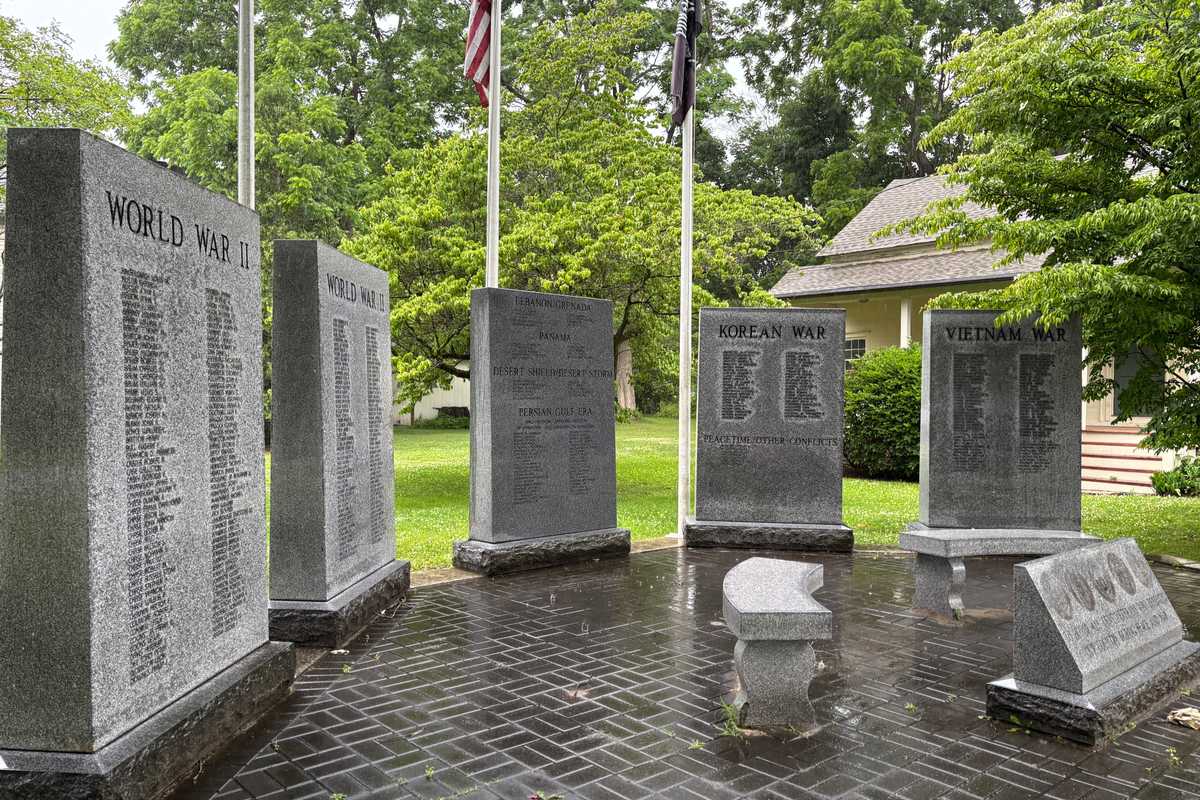
A proposal to move the Kent Veterans Monument from its current location next to the historic Swift House to Town Hall was tabled on Tuesday, June 16.
Alec Linden
KENT – For a second time, the Board of Selectmen tabled a proposal to move the Kent Veterans Monument from its current position next to the Swift House to Town Hall during a June 16 meeting, citing a need for more information.
Marty Lindenmayer, former first selectman and a member of the Kent Veterans Memorial Advisory Committee, outlined the plans to the BOS, explaining that the move is intended to place the commemorative plaza in what he described as a more convenient and serene location.
“Every event, every celebration and every recognition we do there is interrupted with Route 341 traffic,” he said, noting that tree growth and a lack of parking have also caused issues.
Currently located just east of the historic Swift House building on Route 341, the proposal would reposition the monument to a grassy area between the western facade of Town Hall and Kent Green Boulevard. The plan was approved by the Veterans Memorial Advisory Committee on May 15, but must receive the selectmen’s endorsement before it can move forward.
The monument was installed at its current site in 2009, and contains five plaques honoring soldiers who served in World War II, the Korean War, the Vietnam War, as well as additional military operations in Lebanon, Grenada, Panama, Operation Desert Storm and the broader Gulf War era. Lindenmayer said that it was the only option presented to the Committee at that point and that the time has come to rehome the monument in a location “more available to the townspeople and more presentable than where it is now.”
In an initial letter to the BOS on May 22, Lindenmayer noted that moving the monument would also disentangle it from the Swift House, which faces an uncertain future as a municipally-owned property.
The selectmen’s reactions to the proposal have been lukewarm. First Selectman Eric Epstein noted at both the June 16 meeting and a May 28 special meeting that residents had reached out with several concerns, including a lack of public input on the plans.
Selectman Lynn Worthington put her thoughts more bluntly: “I fear that it is just a few people that are against the Swift House and are using this as another opportunity to have another reason why we shouldn’t have the Swift House,” she said during the May 28 meeting.
“The reasons that they’re giving for moving it just don’t make a lot of sense to me,” she added, noting her skepticism that the Town Hall location would draw more pedestrians than on “one of the two major roads of our town.” Worthington also advocated for a public forum on the issue.
At the June 16 meeting, Epstein asked Lindenmayer to return with elevation and layout drawings for the proposed site before the Board could issue any decision.
Lindenmayer reported that the project price was estimated between $7,500 and $8,000 dollars with some volunteer prep work on the site, and that the Veterans Memorial Committee and American Legion Post were fundraising to offset costs.
He said a new monument for 44 veterans of the Revolutionary War from town, confirmed by both the Historical Society and Daughters of the American Revolution, had already been commissioned by the Legion, and is intended to be ready for viewing in time for July 4 celebrations. Ultimately, it is intended to join the five other plaques at the Veterans Monument.
“In conjunction with the 250th, I think it’s a great way to go forward,” he said.
Keep ReadingShow less
Rehab of Kent's defunct swimming pond will take time, officials say
Alec Linden
Jun 24, 2026

Cardinal Engineering Vice President Timothy Cermola points out the crumbling concrete lining of the defunct Emery Park swimming pond Wednesday, June 17.
Alec Linden
KENT – Efforts to restore Emery Park's long-closed swimming pond took a step forward last week, as engineers reported the decades-old foundation appears stronger than some expected. Even so, they said, it may be several summers before the swimming hole is back in working order.
Despite the longer than anticipated timeline, Parks and Recreation Commission Chair Rufus de Rham said during the June 17 meeting that the town remains focused on bringing back a place for residents to cool off.
“I know we have pipe dreams,” said De Rham, referring to long-term intentions to install a pavilion, upgrade the playground and even build an office for the Parks and Recreation Department at the park, among other proposed projects. “But the pond is our No. 1 mission here.”
Luckily, its bones are mostly solid, reported Cardinal Engineering Vice President Timothy Cermola. “The masonry and stone walls are probably sound,” he said of the foundation. Officials had feared the entire basin would need to be re-excavated.
However, “anything concrete that was laid on the stone masonry has to be removed,” he said, gesturing at the pool’s lining, which is cracked and crumbling in places. Cermola noted that the first focus of a recently-commissioned study will be to determine how much of the masonry is suitable to keep, noting that anything unstable or at risk of becoming so will have to be replaced. The current concrete is intended to be upgraded to a long-lasting, rebar-supported gunite lining.
The pond, a stream-fed concrete basin that was dug out to its current shape in the early 1960s, served the town as a cooling off spot before shutting down during the COVID-19 pandemic. Currently, the only public swimming opportunity in town is at Lake Waramaug State Park.
Plans to bring the pond back into working order have been in the works for years with ample public support. The town sent out an RFP for its restoration late last year, but it was repealed due to complications with federal funds for the project.
Since then, officials have shifted their approach, opting to bring on Meriden-based Cardinal Engineering to survey the site and develop a master plan for the park, meant to guide the swimming pond restoration and the longer term projects. Part of the plan will be bringing the park’s facilities, which span somewhat rugged terrain below a steep hillside, up to compliance with the Americans with Disabilities Act, a requirement in public parks.
“This is where the money is well spent,” Cermola said, though he noted it will be a significant undertaking. “This is a million dollar project,” he predicted.
While the foundational structure may be more intact than some had feared, the finished product may look quite different to what’s there now.
The general shape of the pond is subject to change, said Parks and Rec. Director Matt Frasher as he perched on a sloping wall inside the basin. The curved flooris likely to be restructured with straight-down flat walls at the pond’s edges for safety reasons, he said, and the overall depth may be reduced to five-feet.
A wide, oblong section that once accommodated 75-foot lanes for the local swim team may also be narrowed in the new design.
The town currently has $400,000 in capital funds available for the swimming pond restoration, as well as an additional $100,000 in funds from the American Rescue Plan Act which will expire this year. Another $100,000 in capital has already been allocated towards upgrading the playground.
The Cardinal engineers anticipate the master plan will be complete by the end of summer, which will then act as a blueprint for next steps.
As the group dispersed, Commissioners were satisfied by the discussion, despite the temporal setbacks. “We want to do it right,” said Chair De Rham. “That’s the biggest thing.”
“While we’re working on the pond first,” added member Keith Johnson, “it won’t interfere with anything in the future… that’s what the master plan ensures.”
Keep ReadingShow less
Norfolk opens Haystack Woods, net-zero affordable housing complex
Madi Long
Jun 24, 2026

Community members gather for a ribbon-cutting ceremony for Haystack Woods, Norfolk's newest affordable housing complex. It includes 10 homes.
Madi Long
NORFOLK — Community members gathered for a ribbon-cutting ceremony Monday, June 22, to celebrate the opening of Haystack Woods, Norfolk’s newly constructed affordable housing complex.
Kate Briggs Johnson, president of the Foundation for Norfolk Living, said she believes Haystack Woods is Connecticut’s first net-zero affordable homeownership community equipped with battery storage and electric vehicle chargers. A net-zero development generates as much renewable energy as it consumes over the course of a year.
Haystack Woods features 10 homes, including ranches, cape-style houses, and two-story builds, each with two to three bedrooms.
Two homes have been closed, five more are scheduled to close and three houses remain available. The three remaining homes will be sold for $261,000 and are three-bedroom houses for households below 80% the Average Median Income.
Each home within the complex features high-efficiency insulated construction and a dedicated solar array designed to generate its annual energy needs. The development has also earned LEED and National Green Building Standard certifications.
The community wasn’t built without struggle, Briggs Johnson said, as committee members spent an additional 12 months at PNZ and Wetlands Zoning meetings to transition the private road to a public road. This came with the help of the Norfolk Cemetery Association, which provided the easement to construct the road.
Jordan Seibert, a Haystack Woods homeowner, expressed her gratitude to the crowd.
“Like many people, I reached a point where homeownership felt increasingly out of reach,” she said. “I’m fortunate to be purchasing a home at a young age, giving me the chance to be comfortable, put down roots, and think long-term about my future.”
Prominent guests attended the ribbon-cutting, including Norfolk’s First Selectman Henry Tirrell; Lt. Governor Susan Bysiewicz; Ricky Jordan, manager of Energy Efficiency at Eversource; Margaret Warner, Senior Vice President at Northwest Community Bank; Libby Borden of the Norfolk Land Trust; Maria Horn, Connecticut State Representative; and Seila Mosquera-Bruno, the commissioner of CT Department of Housing.
Keep ReadingShow less
Want more of our stories on Google? Click here to make us a Preferred Source.
loading


The greatest game ever played?
James Speyer
This year’s NBA Finals, in which the New York Knicks beat the San Antonio Spurs to end a 53-year championship drought, was tense and tight throughout. Game Four, in which the Knicks overcame a 29-point second half deficit to win 107-106, is universally acknowledged to be the masterpiece of the series. But it was more than that: it was the greatest game ever played in the history of American team sports.
That’s a bold statement, for sure. But I don’t believe I’m suffering from recency bias. Nor am I saying this because I’m a 66-year-old lifelong Knicks fan who was wrapping up junior high school when they last won the title. Hear me out:
A truly great game requires the coming together of several elements. First, the stakes must be high, which eliminates games played during the regular season no matter how extraordinary they are. Playoff games are a must, preferably in the championship round.
Second, the drama must be of the highest order, which usually involves overcoming seemingly insurmountable odds in the form of a massive comeback. High drama certainly can come in other forms, such as Don Larsen’s perfect game in the 1956 World Series or Wilt Chamberlain’s 100-point game in 1962, but those are superlative individual achievements. What most sports fans consider a great game usually involves a thrilling team comeback.
Third, a great game should have an iconic, signature play, such as Bobby Thomson’s bottom-of-the-ninth home run to beat the Dodgers and advance to the 1951 World Series, or LeBron James’s full-court rundown to block Andre Iguodala’s layup to win the 2016 NBA Finals.
Game Four had it all. The stakes were massive. A Knicks win would put them up 3-1 in the series and in the catbird seat, given that only one team had ever come back from a 3-1 deficit to win the Finals. A Spurs win would, after their Game Three win, even the series at 2-2 and return the momentum and home-court advantage to them. To be sure, it was not an elimination game for either team. But it was critically important.
The comeback was insane. The Knicks were getting demolished. The Spurs were unstoppable. They made fourteen threes in the first half, a Finals record for any half. They led 76-49 at the half, the most first-half points ever scored by a road team in a Finals game. They led by 29 at the 9:40 mark of the third quarter. During the entire 2025-26 regular season and playoffs, no team had overcome a 29-point deficit, at any point in the game. At that point, the Knicks had a 0.4% shot at winning.
And then it happened, slowly at first, with the Knicks chipping away — hitting singles, as Jalen Brunson said after the game. By 9:33 of the fourth quarter they had cut nine points off the lead— but they were still down by 20, and still had only a 0.4% chance to win. In the last thirty years of playoff basketball, teams other than the Knicks were 3-751 when down by 20 or more in the fourth quarter.
In the next nine minutes the Knicks erased all but a point off the lead. And with two seconds remaining, OG Anunoby capped it all off with the greatest single play in Knicks history. In an astonishing display of athleticism and grace under pressure, OG swooped in from beyond the three-point line, soared over two Spurs defenders, and tipped in Jalen Brunson’s missed three-pointer for the win. The degree of difficulty was off the charts.
In that moment millions of hyperventilating Knicks fans lost their minds.
The Tip, as the play will forever be known, was, in Kareem Abdul-Jabbar’s eloquent words, “as beautiful an encapsulation of the majesty of sports as anything you’re ever likely to see. The seemingly impossible happened.”
The Tip completed the greatest comeback in NBA Finals history and the second greatest comeback in NBA playoff history (after the Clippers’ 31-point third-quarter comeback in the first round of the 2019 playoffs).
So there you have it: super-high stakes, an unprecedented comeback, and the most unforgettable of game-winning plays. Can any other game match that?
I don’t think so. Let’s look at some of the usual contenders.
The 1951 Giants game ending with Bobby Thomson’s home run — “the shot heard round the world” — was perhaps the most famous baseball game ever played. But that was not a World Series game (it was a playoff game to decide the National League championship), he hit it with one out, not two, and it helped the Giants overcome a three-run ninth-inning deficit — impressive but not in the same league as surmounting a 29-point disadvantage. What’s more, it was a pop fly that traveled just 315 feet — dramatic for sure, but not comparable to the stunning magnificence of OG’s play.
Tom Brady’s Patriots overcame a second-half 28-3 deficit to win the 2017 Super Bowl: the greatest comeback ever to win the championship. But it lacked an iconic last second, score-flipping, game-winning moment.
The helmet catch — David Tyree’s unbelievable grab of Eli Manning’s desperation pass to sustain the drive that allowed the New York Giants to beat the hitherto-undefeated Patriots in the 2008 Super Bowl — was amazing, but that game involved nothing like the Knicks’ comeback.
Game Six of the 1986 World Series is also a good contender, since it was an elimination game for the Mets and they came back in the bottom of the tenth with two outs, no one on base and losing 5-3.But they won that game on a wild pitch and the famous Bill Buckner error, and it’s hard to say that a game ending on miscues should be considered the greatest game ever.
Sports fans are a disputatious lot, and I’m certain good arguments can and will be put forth for other worthy contenders that I haven’t even mentioned. But right now nothing else comes to mind. So I’m just going to say it (again): the greatest game ever played in the history of American team sports took place in New York City at Madison Square Garden, the Mecca of hoops, on June 10, 2026.
James Speyer lives in Sharon. He is very happy.