Joy Brown’s retrospective celebrates 50 years of women at Hotchkiss

Joy Brown installing work for her show at the Tremaine Art Gallery at Hotchkiss.
Natalia Zukerman

Joy Brown installing work for her show at the Tremaine Art Gallery at Hotchkiss.
This year, The Hotchkiss School is marking 50 years of co-education with a series of special events, including an exhibition by renowned sculptor Joy Brown. “The Art of Joy Brown,” opening Saturday, Feb. 22, in the Tremaine Art Gallery, offers a rare retrospective of Brown’s work, spanning five decades from her early pottery to her large-scale bronze sculptures.
“It’s an honor to show my work in celebration of fifty years of women at Hotchkiss,” Brown shared. “This exhibition traces my journey—from my roots in pottery to the figures and murals that have evolved over time.”
Co-curated by Christine Owen, Hotchkiss ceramics instructor, and Joan Baldwin, curator of special collections, the scale and scope of the exhibition was inspired by a recent Ed Ruscha retrospective in Los Angeles. “I thought it would be incredible to showcase all these different aspects of Joy’s work,” said Owen, who has known Brown for over 30 years.
Brown’s father, a Presbyterian missionary and medical doctor, opened a hospital in Japan where Brown grew up and cultivated her love of clay. Her first apprenticeship was in Tomba, a region in Hyogo Prefecture known for its ancient pottery kilns and Tambayaki pottery. “There are thousands of years of continuous history of clay there and I was working with a 13th generation potter.” Brown recalled that as part of her early training, her teacher handed her a sake cup and said, “make these.” With no extra instruction given, Brown proceeded to make thousands of copies of the cup. Never fired, she realized that the pieces were an exercise. She explained, “You’re not really making something, you’re participating in a process that these things emerge from.” From there, she embarked on an apprenticeship with master potter Shigeyoshi Morioka. As part of the process she learned from Morioka, Brown has built a 30-foot-long wood-firing tunnel kiln on her property in Kent, Connecticut, where she fires her work once a year in an intensive month-long process. The fire’s natural interaction with the clay creates unique earth tones and ash patterns, highlighting the raw beauty of the material.
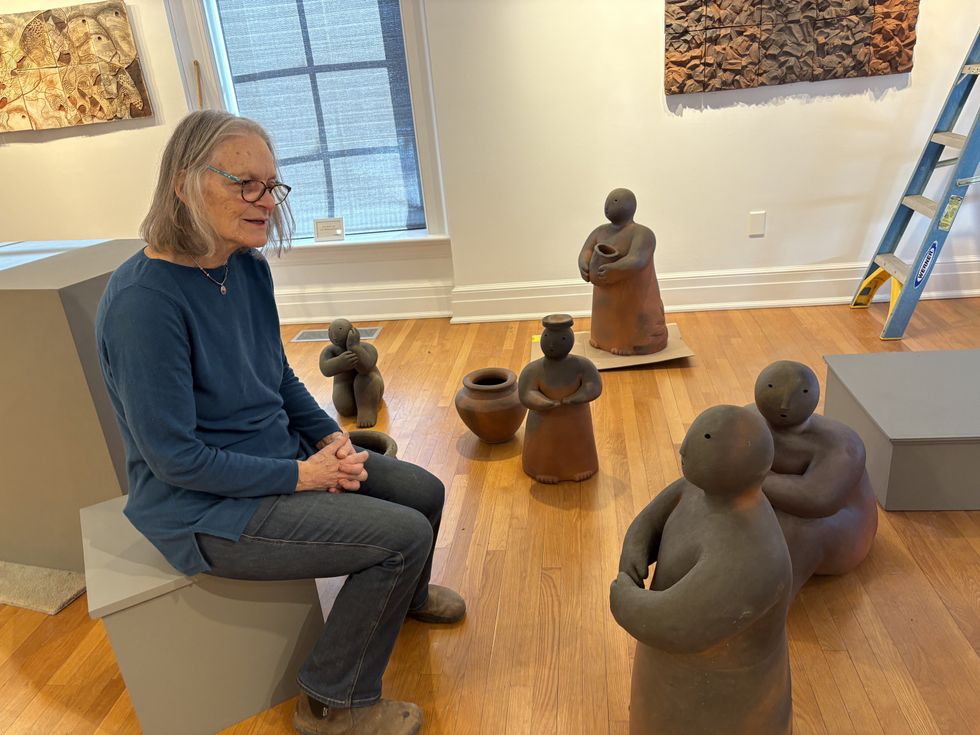
“I learned not just pottery but a whole way of life,” she recalled. “The work is a continuous process—like practicing a signature until it evolves into something uniquely yours.” Her figures, initially emerging as playful puppets, have since evolved into large-scale sculptures now found in public spaces from Shanghai to Broadway to Hotchkiss’s own campus.
Brown’s seven-foot “Sitter with Head in Hands” was installed near Ford Food Court in October, followed by “Recliner with Head in Hands” near Hotchkiss’s Main Building in November. She welcomes interaction with her sculptures, encouraging visitors to touch them and even dress them with scarves or hats. “These figures transcend gender, age, and culture,” Brown noted. “They’re kind of like when you’re 4 years old and you didn’t know or care what you were, you know? All of us meet in that field and I think people resonate with that.”
In conjunction with the exhibition, Hotchkiss will host a screening of “The Art of Joy Brown,” a documentary by Eduardo Montes-Bradley, followed by a panel discussion with the artist and filmmaker on March 6 in Walker Auditorium. Brown will also serve as an artist-in-residence, collaborating with students on special projects.
On being part of the celebration of women at Hotchkiss Brown said, “Fifty years ago, I was deep in the mountains of Japan, immersed in clay.” With a soft spoken and almost childlike quality, Brown spoke about and interacted with her pieces with curiosity, reverence and wonder.
“The practice of working with clay for all these years is grounding and centering for me. It challenges me,” she said. “The work forces me to put myself out there. It’s not just the making of the pieces that make me more whole, the pieces themselves become more present.”
Brown reflected on the retrospective nature of the show and shared that putting it together has been like looking at a family album. “It’s kind of like I’m seeing my whole life in front of me,” she said. “It’s humbling and makes me think about why I do what I do. It comes back to the idea of those thousands of sake cups, you know? We’re just here, being as present as we can be. We’re not making things, we’re participating in a process of being more present, and all that spirit is reflected in the work.”
“The Art of Joy Brown” opens Saturday, Feb. 22, and runs through April 6. For more information, visit www.hotchkiss.org.
This story has been updated to reflect a change in the scheduled opening date due to forecast extreme weather conditions.
The Community Closet at HVRHS is open for students to take clothes for any reason during the school day.
What started with one unexpected donation of clothes has grown into a quietly impactful resource for all students at HVRHS: the Community Closet. Now located in a spacious area above the cafeteria, the closet offers free clothing to any student for any reason.
The idea began a few years ago when a community member reached out to the former superintendent wondering if anyone at the school could benefit from used clothing that would otherwise go to waste. The superintendent then got in contact with Rachel Novak, the school social worker. “Once I had all those bags of clothes in my room, I was like, ‘I should put this in a space,’” Novak said. Her simple idea eventually became a full-sized closet accessible to all students.
From the beginning, Novak envisioned the closet as an inclusive space. “It’s open to anybody, it’s not just based on economic needs,” she said. Sustainability also plays a role. “Thinking about the environment, some students like to thrift and just get clothes that way,” Novak said.
After the initial donation, contributions continued to grow. “I reached out to our staff members and faculty,” Novak said. The most consistent donations come from the faculty at HVRHS and a few community members who learned about the closet. Finding teenage-appropriate clothes has been a challenge. “I get a lot of donations that are nice, but I don’t think teenagers would want to wear them,” Novak said.
Another ongoing obstacle has been awareness. Many students don’t know the closet exists at all. “That’s been the hard part,” Novak said. “Getting it out to the wider community of the school.” Novak is looking for students and staff to spread the word. “It helps because our school nurse knows and other faculty members,” she said. “When they know a student needs something, they just bring them up.”
Looking ahead, she hopes to promote the space more actively. “When we come back from this break, I do plan to … get fliers and all that up and going,” Novak said. There may even be an upcoming expansion — she has discussed the possibility of turning part of the area into a food pantry. “That would be more of a need-based system for students,” she said. “But right now, promoting it is where I’m at.”
The Community Closet is well-stocked currently. “Just because of the amount of clothes I have, I’m not accepting any more donations until I clear some stuff out,” Novak said. She is still willing to make room for more fashionable, teen-friendly items donated by students. “That way I’ll have more teenager approved clothes.”
Above all, she wants students to know that no one is limited to using the space. “Sometimes there’s a stigma around it … like, ‘I don’t need help. I don’t want to take away from anybody else that may need it,’” Novak said. Due to the amount of clothes, students should feel welcome to use the closet for any reason. Some students even grab items last minute for sports and activities. “It’s important for kids to know it’s for everyone.”
Whether a student wants to thrift clothes sustainably, forgot to pack clothes for an after-school practice, or is in need of a new outfit, the Community Closet is a resource for all.
Sophomore Eliana Lang enjoys her Housy Shack cookie.
Now in its second year, the Housy Shack is a hit among students. The special education department-run store that sells warm cookies, drinks and other snacks to students and teachers draws people to a room in the back hallway every time it’s open.
The smell of warm cookies welcomes visitors to the store with snacks, drinks and even Housy merchandise for sale. The cookies are definitely the favorite, sometimes lines go out the door to get one before they sell out.
The cookies are so popular that the store had to increase prices from 50 cents to a dollar and implement a four cookie per person maximum. The Shack sells about 40-100 cookies per day and has about 20-60 HVRHS customers visiting per day.
Julie Browning and Heather Strid, two of the HVRHS faculty members that help run the Shack, said their goal was to create real-world job experiences as well as real-world shopping experiences for students at HVRHS. “Learning the skills to work in the world can be taught in a classroom, but the lessons are more meaningful and valuable when they are applied in real work situations, which is what we create through the school store,” Browning said.
The original purpose for the store seems to be working, as several students are learning important skills. Students said the store taught them skills like counting money, checking inventory and cleanliness along with social skills and customer service that could help in the professional world after high school.

As the store quickly became a hit, organizers were faced with the challenge of finding funding. “When we started planning to start the school store two years ago we needed money to buy equipment, supplies and food to start it up but were not sure how to get it,” Browning said. “Mrs. Strid came up with the idea of applying for a grant from the 21st Century Fund to help us get started and they were so generous.” That grant has been crucial to the success and growth of the school store.
Not only does the Housy Shack benefit the special education department, students said it fosters a sense of community throughout the school. “School store cookies are my favorite thing ever. They brighten up my day,” said Eliana Lang, a sophomore at HVRHS. Dayana, one of the student staffers at the Housy Shack, said her favorite part of working in the school store is when students come in to make purchases. She enjoys talking to them and ringing up their orders on the cash register. The Housy Shack brings people together and offers the opportunity for students to connect with each other.
As the school year continues, the members of the school store look forward to expanding their inventory by creating and selling a variety of Housy merchandise — t-shirts, sweatshirts, water bottles, and more. “I have had several students put in requests for certain hats, key chains, etc. … so there will be more of that to come,” Browning said. Last school year, profits were all invested back into the school store. “This year we are hoping to make more of a profit and will look to use the money that we make for field trips, outings as well as opportunities to donate and give back to the community,” Browning said. They also would like to use the school store to fundraise for other causes. “Right now we are collecting donations for The Little Guild Animal Shelter, so if anyone has pet supplies they would like to donate please drop them off in exchange for a cookie,” Browning said.