Kent selectmen wade into wake surfing discussion

KENT — The fate of wake surfing on Lake Waramaug remains unclear, as a recent discussion at the Board of Selectmen’s March 5 regular meeting saw continued public disagreement over how to address the impacts of large-wake boats on the lake.

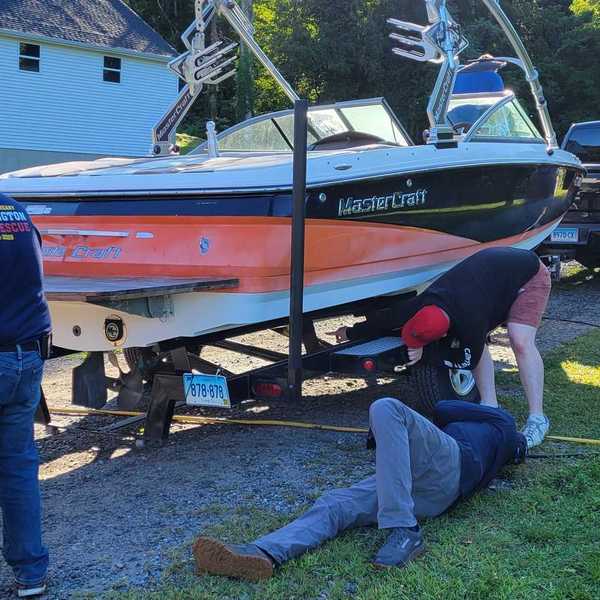
Modern wake surfing is a fairly new sport in New England, having only been popularized in the past decade or so. When wake surfing, participants attempt to surf a powerful boat’s wake at low speed with the goal being to ride the wave unassisted by a rope. Newer boats designed for wake surfing have large tanks in the stern that fill up to create weight, thus displacing water and creating a taller, stronger wave.

The meeting saw Keith Angell, chairman of advocacy nonprofit Lake Waramaug Friends, summarize a recent report the organization had commissioned to review a recently-completed controversial study contracted by the three municipalities in which the lake lies – Washington, Warren and Kent.

The review, which was conducted by South Carolina-based firm Water Environment Consultants, questioned several facets of the 2024 study by infrastructure security and environmental services company Terra Vigilis.

The third-party review critiqued several key recommendations for lake safety and health published in the study. For example, Terra Vigilis suggested that wake surf boats remain 500 feet from shore while operating in surf mode. The review noted that this number was largely unexplained, which was unusual considering most guidance across the country requires a 100- or 200-foot buffer rather than 500.

Angell acknowledged that the topic was sensitive to residents with close ties to the lake on both sides: “I want to recognize that this is an emotional issue,” he said to the Board. Angell explained that he has had “60 plus years playing in the lake,” and directs Lake Waramaug Friends with the intention of maintaining recreational enjoyment of the lake in a sustainable and responsible way.

During the public comment period, residents pushed back, with several alleging that wake surf boats may not be suitable for Lake Waramaug at all. Lakeside homeowner Bruce Birenboim, who has been vocal at past meetings in other towns, noted that the Water Environment Consultants report does not contradict a primary finding of the Terra Vigilis study that boats in surf mode produce a strong downwash that reaches up to 26 feet in depth.

Lifelong Lake Waramaug resident Jim Hicks expressed concern that downwash could disturb potentially dangerous substances on the lake floor. The poor water quality of the lake decades ago surfaced in several residents’ testimonials, with Hicks recounting that he was “honestly allergic to the lake” in the 1980s. He credited the work of residents and the Lake Waramaug Task Force, a nonprofit focused on protecting the lake’s ecology, in ensuring the nutrients that caused the harmful algal blooms of that period have remained trapped at the lake bottom.

“What we need is an acceptance that these machines are not good for the lake,” he asserted.

First Selectman Marty Lindenmayer emphasized that there are no regulations on wake surf boats currently in discussion. “The idea of getting together and finding the best way to move forward in a reasoned approach is what we all want to do,” he said.

Angell agreed, noting the difficulty of navigating the interests of recreators, who have purchased homes and boats with the expectation of access to the lake, alongside concerns over safety and ecology. “It’s a tricky dribble, as they say.”

“We all need to work together on this,” said Hicks. “That’s the way it should be.”

Latest News

To mow or not to mow?

To mow or not to mow?

A partially mowed meadow in early spring provides habitat for wildlife while helping to keep invasive plants in check.

Dee Salomon

Love it or hate it, there is no denying the several blankets of snow this winter were beautiful, especially as they visually muffled some of the damage they caused in the first place.There appears to be tree damage — some minor and some major — in many places, and now that we can move around, the pre-spring cleanup begins. Here, a heavy snow buildup on our sun porch roof crashed onto the shrubs below, snapping off branches and cleaving a boxwood in half, flattening it.

The other area that has been flattened by the snow is the meadow, now heading into its fourth year of post-lawn alterations. A short recap on its genesis: I simply stopped mowing a half-acre of lawn, planted some flowering plants, spread little bluestem seeds and, far less simply, obsessively pluck out invasive plants such as sheep sorrel and stilt grass. And while it’s not exactly enchanting, it is flourishing, so much so that I cannot bring myself to mow.

Keep ReadingShow less

Where the mat meets the market

Where the mat meets the market

Kathy Reisfeld

Elena Spellman

In a barn on Maple Avenue in Great Barrington, Kathy Reisfeld merges two unlikely worlds: wealth management and yoga, teaching clients and students alike how stability — financial and emotional — comes from practice.

Her life sits at an intersection many assume can’t exist: high finance and yoga. One world is often reduced to greed, the other to “woo-woo” stretching. Yet in conversation, she makes both feel grounded, less like opposites and more like two languages describing the same human need for stability.

Keep ReadingShow less
Capitol hosts first-ever staging of Civil War love story

Playwright Cinzi Lavin, left, poses with Kathleen Kelly, director of ‘A Goodnight Kiss.’

Jack Sheedy

Litchfield County playwright Cinzi Lavin’s “A Goodnight Kiss,” based on letters exchanged between a Civil War soldier and the woman who became his wife, premiered in 2025 to sold-out audiences in Goshen, where the couple once lived. Now the original cast, directed by Goshen resident Kathleen Kelly, will present the play beneath the gold dome of Connecticut’s Capitol in Hartford as part of the state’s America250 commemoration — marking what organizers believe may be the first such performance at the Capitol.

“I don’t believe any live performances of an actual play (at the Capitol) have happened,” said Elizabeth Conroy, administrative assistant at the Office of Legislative Management, who coordinates Capitol events.

Keep ReadingShow less
google preferred source

Want more of our stories on Google? Click here to make us a Preferred Source.

Hunt Library launches VideoWall for filmmakers

Yonah Sadeh, Falls Village filmmaker and curator of David M. Hunt Library’s new VideoWall.

Robin Roraback

The David M. Hunt Library in Falls Village, known for promoting local artists with its ArtWall, is debuting a new feature showcasing filmmakers. The VideoWall will premiere Saturday, March 28, at 6 p.m. with a screening of two short films by Brooklyn-based documentary filmmaker and animator Imogen Pranger.

The VideoWall is the idea of Falls Village filmmaker Yonah Sadeh, who also serves as curator. “I would love the VideoWall to become a place that showcases the work of local filmmakers, and I hope that other creatives in the area will submit their work to be shown,” he said.

Keep ReadingShow less

A bowl full of stars

A bowl full of stars

A bowl full of stones.

Cheryl Heller

There’s a bowl in my studio where pieces of the planet reside. I bring them home from travels, picking them up not for their beauty or distinction but for their provenance. I choose the ones that speak to me — the ones next to pyramids, along hiking trails, on city sidewalks or volcanic slopes.

I like how stones feel in my hand: weighty, grounding. I don’t mind them making my pockets and suitcase heavier. The bowl is about the size of an average carry-on. It has been years since it was light enough for me to lift.

Keep ReadingShow less
One-woman show brings Mumbet’s fight for freedom to Scoville Library

On March 29, writer, producer and director Tammy Denease will embody the life and story of Elizabeth Freeman, widely known as Mumbet, in two performances at the Scoville Library in Salisbury. Presented by Scoville Library and the Salisbury Association Historical Society, the performance is part of Salisbury READS, a community-wide engagement with literature and civic dialogue.

Mumbet was the first enslaved woman in Massachusetts to sue successfully for her freedom in 1781. Her victory helped lay the legal groundwork for the abolition of slavery in the state just two years later. In bringing Mumbet’s story to life, Denease does more than reenact history.

Keep ReadingShow less
google preferred source

Want more of our stories on Google? Click here to make us a Preferred Source.

google preferred source

Want more of our stories on Google? Click here to make us a Preferred Source.