Latest News
Now and then
Lonnie Carter
Feb 25, 2026
BISHOP FULTON J SHEEN swoops on to the stage to begin his telecast.Now and Then.
Today the feast of a favorite saint Agnes whom I revere
She promised herself as a Bride of Christ
Her beauty brought her suitors many rich
To each and every she said the same
I cannot be yours, kind sir,I am His
Her words displeased one special haughty sir
—-----------------
His name ProCopius,Pro Cop, you hear?
Defund the Cops? O no, only if masked or ICED
Only if they shot and spat out You Bitch
And said peaceful protestors were the ones to blame
Antifa, are they everywhere, no Big Biz
Is what you’re confusing, the CEOs, the cur
—------------------
Mark Scheissenberg, Jeff PayZos, Cook of the golden plate
These are the ones come courting, hats in hand
The worst of the worst to be deported to CECOT fate
We’ll send them off to Souza’s Lose-as Band
I have Agnes with a lamb to her breast
It has been shorn, the wool adorns me as a cape
She keeps the Faith with Minnesota and both meet the test
The future sees Obamas with each Agnes and Michelle an ape
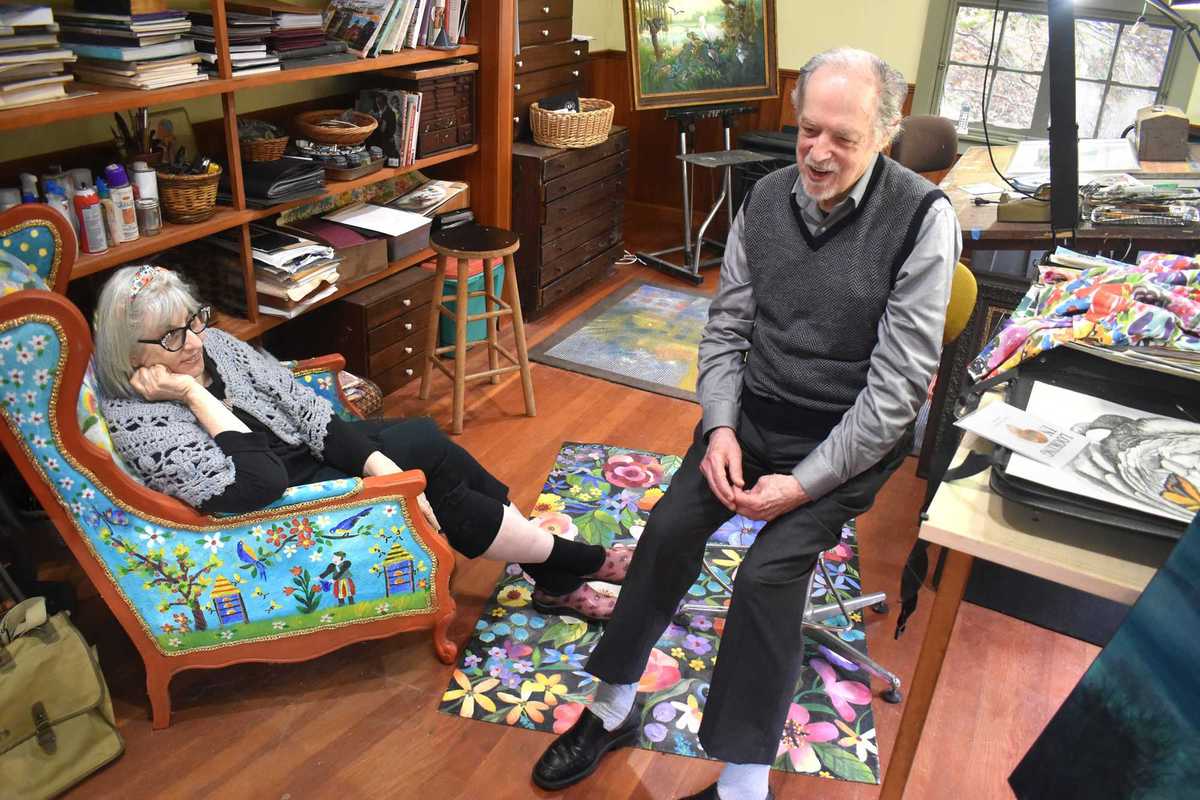
We see projected St. Agnes holding a lamb and the Obamas as Apes.
Lonnie Carter is a playwright, Obie winner and his signature play is “The Sovereign State of Boogedy Boogedy.”
Keep ReadingShow less

Want more of our stories on Google? Click here to make us a Preferred Source.
What is gunboat diplomacy without boats?
Bill Schmick
Feb 25, 2026
In December 2025, the president unveiled plans to revamp the U.S. Navy. He announced the construction of two new battleships, each costing between $10-$15 billion. It’s a start, but still only a drop in the bucket for reviving American shipbuilding.
Why is that important? First off, in commercial terms, almost 80% of global trade by weight is transported by ships. If you also consider the capabilities of our armed forces, you understand that nearly 90% of their supplies, equipment, fuel, ammo, and food are delivered by ships. In addition, if we encounter a national emergency, the Navy will depend on commercial shipyards to build warships and support ships, as well as to transport equipment and troops.
We learned this during World War II. At its height, the U.S. accounted for nearly 90% of global shipbuilding output. Today, that output has declined to a mere 0.2% of gross tonnage. What happened? Competition. After the war, the rest of the world needed to be rebuilt, much of it with American money, and the shipyards were among the areas that had been decimated.
Japan, for example, could offer lower labor costs, no union issues, brand-new shipyards, and prices that undercut American construction by as much as 60%. The fact that foreign steel production skyrocketed as well and was sold at a fraction of the U.S. price didn’t help either.
You know this, how? You might ask. As a kid in Philly in the early 50s, lots of neighborhood dads worked at the Philadelphia Naval Shipyard after the war. They made a good living then, since U.S. shipbuilding was still in its heyday. But the decline was rapid.
In the 1970s, the U.S. government attempted to reverse that slide with the Merchant Marine Act of 1970. Shipbuilders spent more than a billion dollars modernizing their yards and making capital improvements with government backing. America also asked the Japanese, now the world’s top shipbuilder, to introduce new techniques and practices to reinvigorate our moribund industry.
It worked. For a brief period, the U.S. became the second-largest commercial shipbuilder in the world, behind Japan. Many of these new ships were Liquefied Natural Gas carriers and oil tankers. However, the 1973 oil crisis put an end to that. The petroleum industry was on its knees, and demand for new ships dried up.
Despite that setback, our shipbuilding productivity improved in the years that followed. Meanwhile, foreign shipbuilders—especially the Chinese—improved even faster. In 2008, China surpassed Japan in shipbuilding output; by 2010, it overtook Korea to become the world’s largest shipbuilder.
By 2022, the U.S. had built just five ocean-going, commercial ships compared to China’s 1,794 and South Korea’s 734. Today, the U.S. Navy estimates that China’s shipbuilding capacity is 232 times that of the U.S. Even worse, it costs twice as much to build a ship in the U.S. as it does elsewhere.
Nine Asian and European carriers, organized into three cartels, now control 90% of the U.S. containerized shipping trade. To add insult to injury, one Chinese company produces 80% of all the ship-to-shore cranes in America. I could go on, but this is about shipbuilding, not about the Chinese, who also produce 95% of the shipping containers. The 2025 order book for new vessels indicated that China accounted for 75% of orders, followed by South Korea at 19%. Under these circumstances, how is Donald Trump going to make American shipbuilding great again?
Largely by following the tactics used by the U.S. in the Seventies. A new office of shipbuilding has been established and is again offering special tax incentives to develop the industry. Last year, the U.S. signed deals with three affiliates of Hanwha Group, the world’s third-largest shipbuilder. The $500 billion deal is earmarked for maritime investment. In 2024, Hanwha bought the Philly Shipyard for $100 million. This is the sad remnant of my boyhood Naval Yard. That yard closed in the 1990s, laying off thousands of South Philly workers.
Hanwha is sinking $5 billion into the shipyard to upgrade the site. It is also training what they hope will be a new generation of shipbuilders, while investing in robotic labor. Management estimates that, if they hit their target of 20 boats per year, the workforce could top 10,000. That’s a big “if.”
The administration and industry plan to focus on manufacturing LNG tankers, icebreakers, and naval vessels. An Italian company, Fincantieri Marinette Marine (FMM), based in Wisconsin, is already manufacturing naval vessels, LNG-fueled cruise ships, and other commercial vessels. The U.S. is working with the Italians to expand that enterprise. In addition, last year Finland and the U.S. agreed to spend $6.1 billion to produce 11 new icebreakers for the U.S., with the first due to be completed by 2028.
Trump’s gunboat diplomacy, whether in Iran, Venezuela, or who knows where, appears to be a strategic tool of his presidency. As such, it is vital that the U.S. commands the high seas. In an age of drone warfare, ships are vulnerable in both combat and commercial settings. It’s early days, but at least the administration recognizes the need to modernize this industry. The hope is that just maybe my grandson might see the day when Philadelphia could once again be noted for something other than cheese steaks.
Bill Schmick is a founding partner of Onota Partners, Inc., in the Berkshires.Bill’s forecasts and opinions are purely his own and do not necessarily represent the views of Onota Partners, Inc. (OPI).
Keep ReadingShow less
Letter to the Editor - January 26, 2026
Lakeville Journal
Feb 25, 2026
Opposition is not a governing program
The guest commentary in the Feb. 19 Journal, an absolute anti-Trump screed, had me wondering just how far one person can expand the gulf between what they believe and have opinions on and a connection to actual facts.
Really, Trump is worse than Capone? I’m surprised Hitler escaped the article. Trump is blowing up a bunch of lowlife drug smugglers who are purportedly just innocent civilians. It’s a battle in a war against a declared terrorist cartel. I contend that the drug deaths of hundreds of thousands of Americans deserve some aggressive countermeasures. And in that regard, look what’s happening with cartels in Mexico as I write this.
Furthermore, I ask, is withholding taxpayer money from institutions which allowed violent antisemitic takeovers actually an illegal shakedown?
Having said the above, I really laughed over the supposed conversion of the Department of Justice into an instrument of personal retribution by Trump. Ever heard of Jack Smith and the dismissed cases against Trump? In my opinion, THAT was a misuse of the DoJ.
After 10+ years of Trump Derangement Syndrome, I am sincerely asking if hating Trump is the extent of the governing program by the anti-Trump side.
Here are a few governing ideas to consider. How about: lowering taxes, no tax on overtime, tips and social security, securing the border, negotiating fair trade agreement around the world, trying to achieve peace through projecting strength in a dangerous world, and adopting simple voter ID laws? By the way, voter ID laws exist in all European, African and South American countries.
When the Democrats champion these policies, I’ll be with them, but no, they voted against them all. Oh right, it’s Trump who is doing or already did these things. It’s the policies that sway me, not the personalities. But let’s just hate on Trump. That’s the ticket — to nowhere!
Richard Shanley
Lakeville
Keep ReadingShow less
Turning Back the Pages - February 26, 2026
Norma Bosworth
Feb 25, 2026
125 years ago —
February 1901
Mr. G.E. Frink began placing steam heating apparatus in his Pharmacy in the Reed block Monday.
FALLS VILLAGE — First Selectman Kellogg has been engaged the past week in raising the large iron safe from the cellar of the Savings Bank, in order to get at the town records which are in the safe.
LIME ROCK — The roads are beginning to get into shape again. The town gang has scalped a few deep snow drifts and wagons can be used now.
The Connecticut Western News says that representatives from the New York Condensed Milk Co. have been in Canaan feeling the pulse of the farmers in regard to establishing a creamery in that place.
Master Francis Smith has taken a position at the Journal office. Master James Ellis who has been the printer’s devil the past year, will take a course in the Lakeville High Grade school and will also work for E.A. Eldridge.
100 years ago —
February 1926
Miss Harriet Fenton has accepted a position with the Connecticut Power Company in Canaan.
State Policemen Donald J. Geddes and Sergeant Brandt of the Canaan Barracks, acting on a bench warrant, raided The Arch Inn at Falls Village Thursday morning and confiscated a large quantity of liquor and arrested the proprietor, Edward J. House, whose establishment was raided earlier last week
50 years ago —
February 1976
Catherine E. Carlson, daughter of Mr. and Mrs. Robert E. Carlson of Kent, is valedictorian of the class of 1976, Housatonic Valley Regional High School. The salutatorian, Sheryl L. Stair, is the daughter of Mr. and Mrs. Morgan Schafer of Salisbury.
Lakeville firemen wearing masks and breathing apparatus put out a stubborn fire Saturday afternoon in a store room in the main building at The Hotchkiss School. The fire sent acrid smoke through the east wing of the administration building. As one fireman put it, the smoke was so dense that you needed radar to get though it.
In spite of the rain, the Salisbury Winter Sports Association cleared roughly $3,500 during the ski jump weekend, from the proceeds of the gate, dance, food booth and ads in the program.
FALLS VILLAGE — Two Dutch World War II comrades have been reunited in Falls Village after a separation of 31 years. Theodore Daalhuyzen of Main Street and Arie vanBommel of Undermountain Road and New York City met recently after vanBommel read a story about Daalhuyzen and his war experiences in The Lakeville Journal.
The North Canaan Volunteer Ambulance Corps has found new quarters in the old firehouse on Main Street in Canaan.
A new play by Cornwall playwright Lonnie Carter will be performed at the Walker Auditorium of The Hotchkiss School at 7:30 p.m. on Thursday, Friday and Sunday of this week. “Iz She Izzy or Is He Ain’tzy or Iz They Both,” a comedy, will be presented by the Hotchkiss Drama Department under the direction of Jennifer Barrows.
25 years ago —
February 2001
CORNWALL — After the Florida voting and election fiasco, it’s no wonder the whole country is looking a little more closely at the voting process. The Board of Selectmen’s meeting Tuesday morning started with a discussion about a communication the board received from the secretary of the state. The letter explains the possibility of new voting machines which will hopefully be utilized in all future elections. However, sometimes trying to fix something that isn’t broken is a bad idea. “Basically the whole board thinks it’s a mistake [to fund these new machines],” First Selectman Gordon Ridgway said, feeling they are unnecessary. “Even though our voting machines are old, they’re still working,” he said.
Reggie the Robot rolled down the main hallway at Housatonic Valley Regional High School last Friday. The six-week-old creation of students in David Lindsay’s robotics club is headed to Hartford, where it will compete in the 2001 FIRST Robotics Competition. This is the 10th year the contest has been held, but the first time that students from HVRHS will compete.
These items were taken from The Lakeville Journal archives at Salisbury’s Scoville Memorial Library, keeping the original wording intact as possible.
Keep ReadingShow less

Want more of our stories on Google? Click here to make us a Preferred Source.
loading


What exactly is hospice, anyway?
Mary Talbot
This is the first in a series of articles about hospice and end-of-life care in our region, covering topics ranging from the truth about morphine and pain management to knowing when it’s time for hospice care to preparing an advance directive. It is produced in collaboration with East Mountain House.
For most Americans, death is not an easy subject. Most of us avoid talking about it until we absolutely have to. In the same vein, hospice care is something many people know little about until they encounter it firsthand. Even the word “hospice” can spark a sense of dread.
But according to hospice experts, as well as the family and friends of people who have received hospice care, demystifying hospice—and having earlier conversations about how we want to spend our last months and weeks of life—can go a long way toward improving the end-of-life experience for both patient and loved ones.
Moreover, in a region with a high proportion of seniors and a growing number of people living with chronic and life-limiting illness, hospice is a service many local families will consider, and one worth understanding before it is urgently needed.
In the simplest terms, hospice is “just good care at the end of your life—making sure that your symptoms, especially pain, are well controlled and that you have the things available to you that you need,” said Eileen Rydel, a nurse and veteran hospice director who currently serves as a case manager for Visiting Nurses and Hospice of Litchfield County (VNHLC), which serves the northwest corner and Farmington Valley.
Hospice care is intended for people with a terminal illness whose doctors believe they are unlikely to live more than six months, and for whom curative interventions are no longer effective and, along with repeat hospital stays, will likely only cause more suffering.
Instead, hospice is devoted to wellbeing and day-to-day support, often in the patient’s home. “One of the goals is to keep people out of the hospital because that’s not a very comfortable place when you’re at the end of life,” said Rydel. “The focus is all on comfort and living well.”
Or, as Cristin Rich, a former hospice nurse and now executive director of East Mountain House, a new end-of-life care home in Lakeville, puts it: “it’s about quality of life at the end of life.”
Along with nurses, a hospice team typically includes a physician, a social worker, home health aides, a chaplain, and trained volunteers. Physical or occupational therapists may also be involved. Social workers help families think through practical and emotional questions while volunteers may come and sit with a patient so a caregiver can leave the house or rest.
Most days, Rydel is on the road, traveling from home to home to check on patients and their families, adjust medications, and offer advice. Some patients are stable and prefer minimal visits. Others, she said, “need much closer attention, especially at the very end. Then I may visit seven days a week.”
Hospice support for families and caregivers includes services such as respite care and bereavement counseling. Respite care provides the option for a short stay—up to five days—in a hospice-certified nursing home, hospital, or inpatient facility, allowing caregivers time to rest and recharge.
Medicare Part A covers all the costs of care from the hospice team — including nursing — as well as medications to treat pain and discomfort (from morphine to oxygen) and durable medical equipment like hospital beds, shower chairs, or lifts.
What isn’t covered is ongoing in-home care—someone to look after the patient day in and day out. That usually falls to a family member and/or a paid caregiver. “We have a home health aide on our team, and she’ll come out a couple times a week, but that 24-hour is a private expense,” said Rydel.
Fortunately, Rydel added, there are resources in our region to help pay for that care, such as grants for terminal cancer patients from The Jayne Lloyd Fund (through the Berkshire Taconic Community Foundation). VNHLC, too, currently has access to funds for helping struggling families cover private care and Connecticut Community Care, Inc. can support in-home help for people living on very low incomes.
There are several pervasive misconceptions that still prevent terminally ill people or their families from taking advantage of hospice care. Two of the most common are the belief that hospice means giving up and that medications used to treat pain hasten death. Rydel and Rich agree these beliefs often stem from the fact that hospice is introduced very late in an illness, reinforcing the association between hospice, medication, and death rather than comfort and support.
In fact, research has shown that many people live better—and sometimes longer—once they enter hospice care. And reams of studies have demonstrated that morphine and other pain medications, when appropriately administered, relieve suffering and improve quality of life rather than shorten it.
Moreover, hospice doesn’t mean no treatment. “If you’ve got a urinary tract infection, or you fall and break a bone, you’re going to be treated for that,” said Rich. “Everything is going to be palliated. Anything that affects comfort and quality of life hospice is going to be address.”
Another misconception is that once on hospice, always on hospice. But patients can leave anytime they choose. “Sometimes people decide they want to go to the hospital for a particular treatment that’s not part of hospice, or they leave for some other reason,” said Rich. “The point is that this is your decision, or a decision you make with your family.”
“I wish people were more open to talking about hospice earlier in the process of their illness or earlier in their life,” Rydel said. “I think it would make things much easier for them and for family.”
For Karen Whitley Bell, author of Living at the End of Living: A Hospice Nurse Addresses the Most Common Questions, the end of life, as difficult as it may be, “offers an opportunity to explore and rediscover a richer meaning in life.” And hospice, with its dedication to a patient’s dignity and comfort, can help make that possible.
To learn more about end-of-life care, even if hospice is not immediately needed, The National Hospice and Palliative Care Organization offers extensive info online local and visiting nurse and hospice organizations like VNHLC also can provide answers. The Lakeville Journal welcomes reader questions and ideas for future topics in this series.