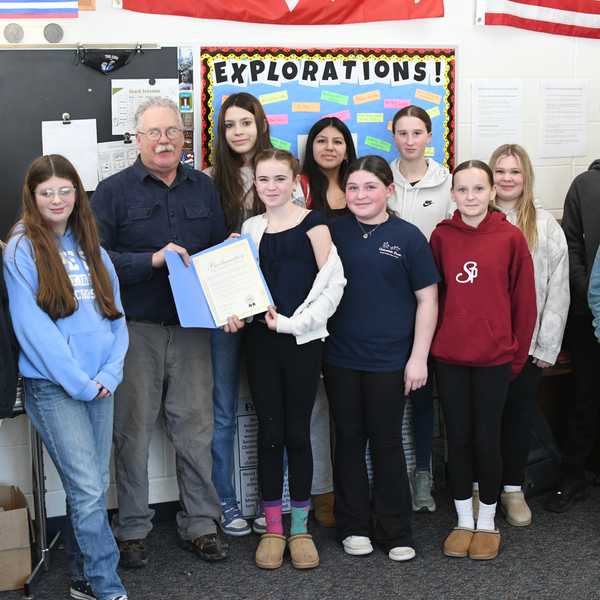
Student science learning spurs adults’ curiosity, concern

Student science learning spurs adults’ curiosity, concern
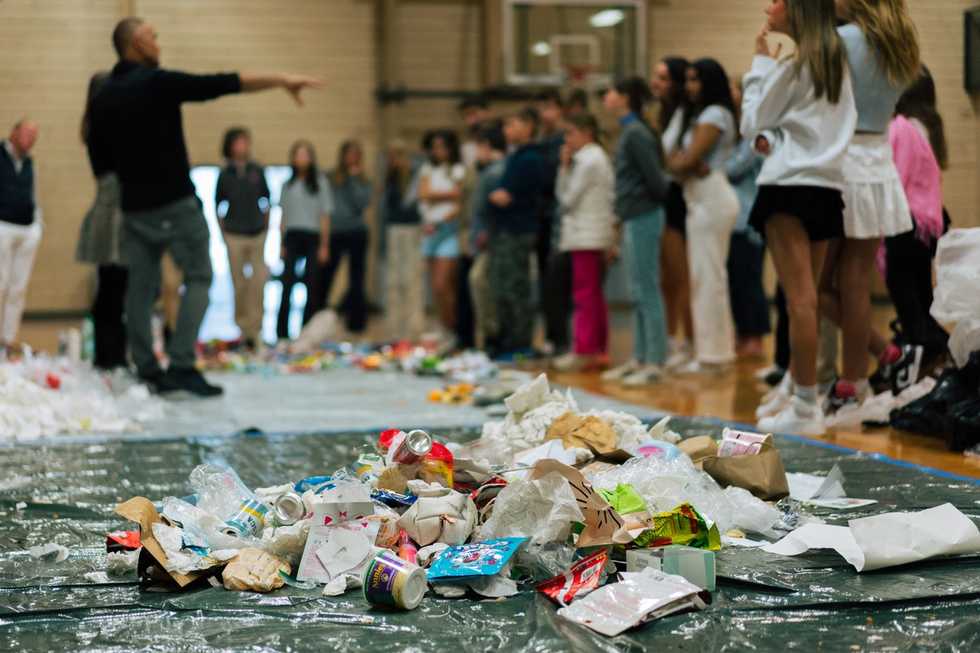
Indian Mountain School students conducted a ‘trash audit’ on April 3, sorting garbage from the campus to see what was thrown away over the course of just a few days, including plenty of snack wrappers — one-time food items  in permanent plastic wrapping. 
Photo by Sam Decock
MILLERTON —  On Tuesday, April 4, following an intense two days of hands-on research, some students from Indian Mountain School (IMS) in Salisbury, Connecticut, and about 55 parents and community members watched the film “Junk” at the Moviehouse in awe and some dismay. The question-and-answer session that followed revealed the depth and scope of the problems surrounding plastics waste—no longer confined to the ocean, if ever it was—as well as the need for each of us to step up and make changes at many levels.

The 2009 documentary short follows Marcus Eriksen, fellow sailor and marine scientist Joel Paschal, and unseen director/cinematographer Chris Jones, in a harrowing 2,600-mile voyage from California to Hawaii on a raft made of 15,000 water bottles lashed together with disused fishing nets and other plastic detritus, and topped with an old Cessna aircraft as a cabin.

Its name, “Junk,” cleverly refers to both its structure and its mission. The just-under-30 minute film, available for free on Vimeo, is an exhilarating and sobering watch. The background, updates and calls to action at this community event rounded out the presentation and the urgency of 5 Gyres and other organizations worldwide.

Scientists and adventurers

Tom Stewart, IMS’ director of sustainability, introduced Eriksen and Anna Cummins, a married couple who, in 2009, founded 5 Gyres, a non-governmental organization dedicated to ongoing research on ocean plastics and solutions to the growing problems associated with them. He hailed its years of hard work, groundbreaking research and positivism in sometimes extreme conditions, soon to be amply illustrated in the film.

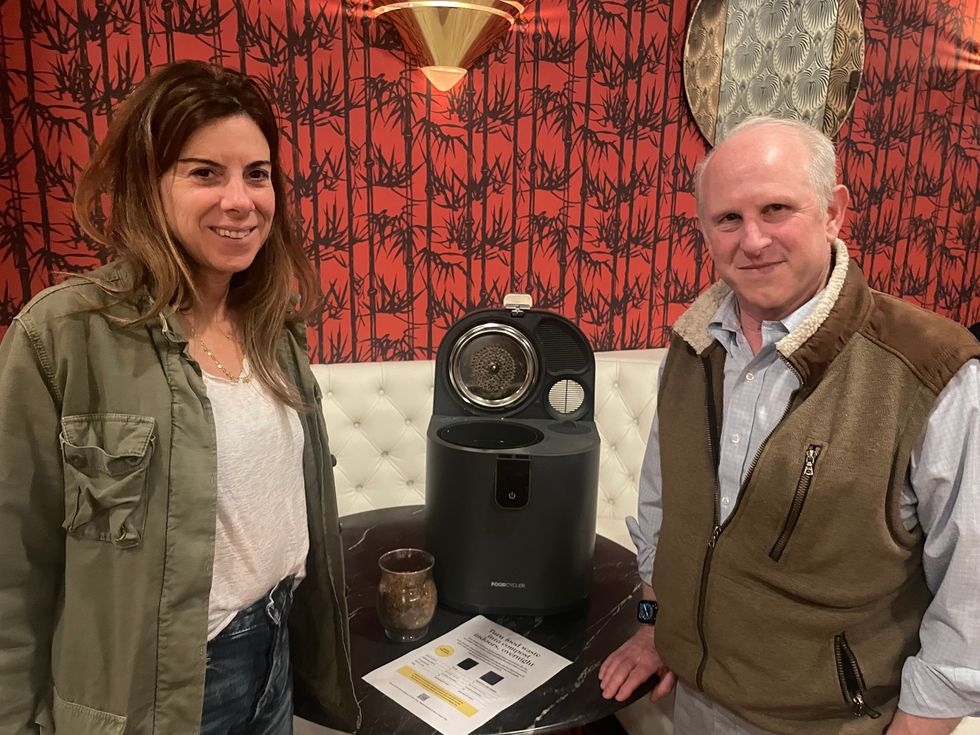
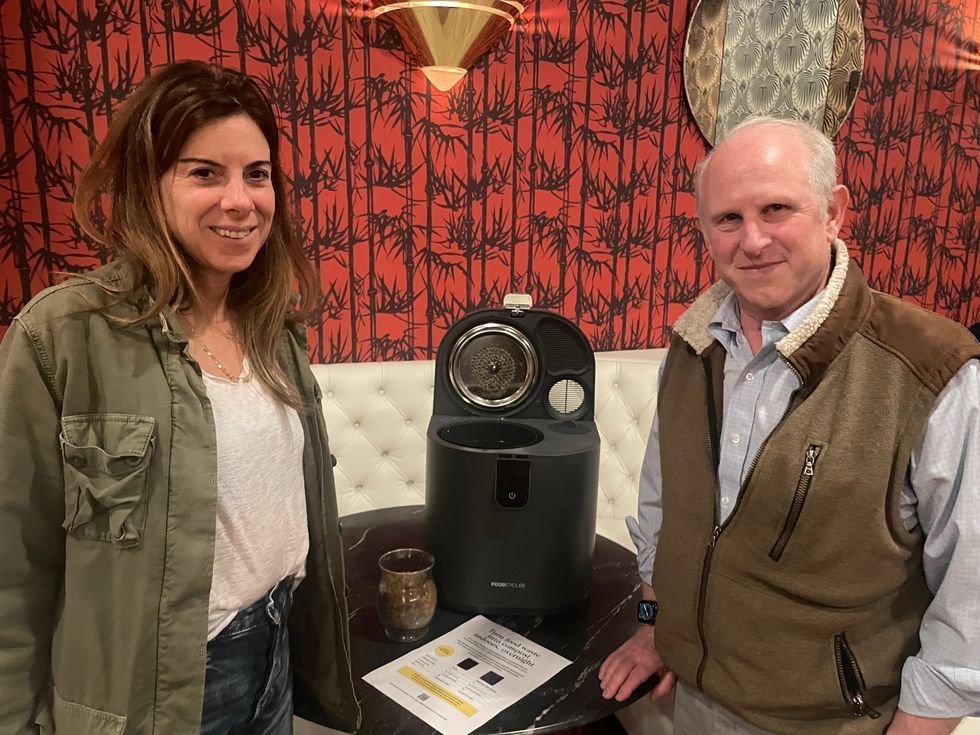
Stewart acknowledged IMS parents Sabra Clark and Andy Blumenthal for making the 5 Gyres visit possible, including the “scholar science” conducted at the school on April 3 and 4 and the evening at the Moviehouse. In the lobby, teen students sold bags of compost from IMS food waste, generated by machines also available for sale for home use.

Passing around a bottle of seawater clouded with plastic particles of various sizes, Eriksen provided some background. “The trip in the film was in 2008 and preceded the creation of 5 Gyres; we know so much more now about the global reach and the upstream origins of the problem,” among those: connections to war, our addiction to fossil fuels, and a certain intractability in our institutions, industries and politicians.

Eriksen served as a Marine in Iraq in 1991 and Cummins is an environmental scientist who has taken part in multiple expeditions to the major sites of plastics waste at sea and on land; both have documentation to back up their assertions.

When you throw it away, where is ‘away’?

In a peer-reviewed article published in early March, the current estimate of micro- and nanoplastics afloat in oceans is 170 trillion particles. So the five gyres in the world’s oceans—clockwise whirlpools of plastic waste—are no longer “trash islands”; it’s a case of plastic smog, said Eriksen. Wherever manta trawls (fine-mesh filters roughly shaped like manta rays) are submerged near the surface as seen in the film, thousands of particles of plastics are the main catch. Those particles, covered in toxins and bacteria, are consumed by fish, and the fish are consumed by humans.

But micro- (.5 mm or smaller) and nanoplastics (100 nanometers or less) are not only in oceans (and for the most part, they do not originate in the world’s bodies of water), but rather in our “throw-away society” on land, and our lack of foresight as to the “final home” of the long-lasting, basically indestructible plastics we are accustomed to. “When you throw something away, where is ‘away’?”

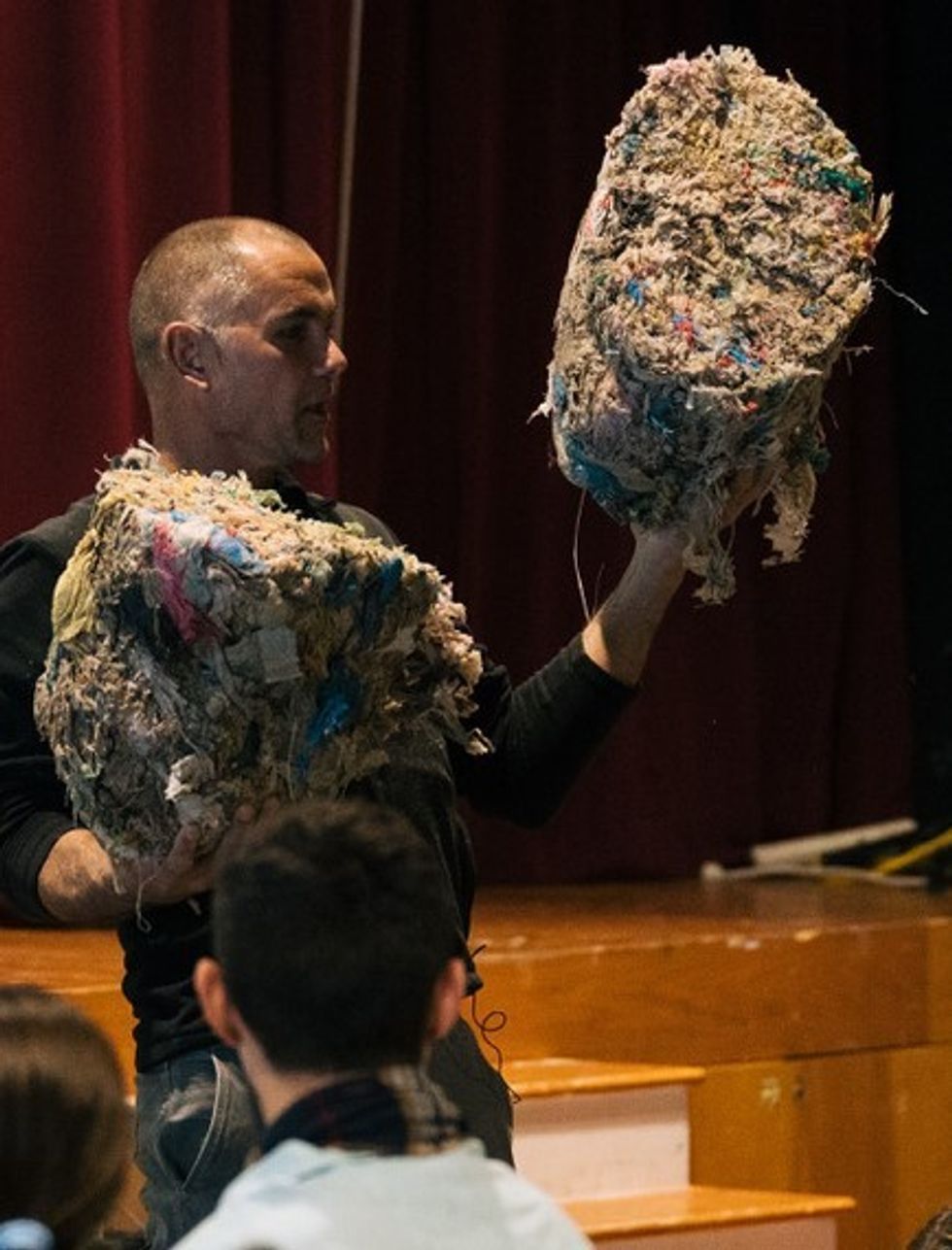
In a last memorable demonstration before the screening, Eriksen held up a camel bolus from Dubai, about the size of a sit-on exercise ball, cut in two. With many varied meanings, “bolus” here is a round mass found in the stomach of a camel; instead of food, it contains 2,000 plastic bags jammed in layers. The oil-rich Middle East has been using single-use plastic bags at least as long as in the U.S.; as with sea creatures and birds, herbivorous camels often view colorful, subtly moving objects to be food.

Negative externalities

The film’s epigraph is a quote from Cervantes: “So it isn’t the masses who are to blame for demanding rubbish, but rather those who aren’t capable of providing them with anything else.”

The phrase “negative externalities”—defined as “harm to a third party caused by doing business”—is repeated at several points in the film. Together with the epigraph, and proof that “evidence of US is everywhere”—statistics about the millions of microfibers our synthetic clothing sheds in washing machines, or simply as we move through our lives, to cite one example—the film propels thoughtful questioning. The first question from the audience was, “Apart from not using single-use plastics, what can we do?”

It starts with us

Eriksen admitted that the problem is significant, but pointed to historical examples of how public outcry has led to action and to marked improvements. He cited the addressing of the hole in the ozone layer by mandated decreases in the use of CFCs now becoming a problem again), and pointed to the Microbead-Free Waters Act during the Obama administration, and changes made to maritime laws after several beaches were ruined by tarry oil spills.

Cummins added that the question is a great one. “It takes steps, but it’s the best way to achieve changes,” she said, and went on to explain, “Bills work at state levels only if municipalities are first” to enact them, so to insist on local initiatives is the way to go. “We have a lot more power than we think,” she reminded the audience.

To the question of what to do about plastics already existing in our environment, Ericksen suggested using the glut to arouse public awareness. “You can give it a second life where possible, but ultimately, plastics will go to landfills,” and from there to rivers, oceans, the air and our bodies. Ideally, “We’d sequester it someplace safe while we figure out solutions.”

To the question, “Internationally, what are the differences between the five gyres?”,  the couple offered that, in the North Pacific, the plastics are mostly fishing gear; the North Atlantic is the bottle-cap gyre; in the southern hemisphere, there is less; yet, Cummins said, “every gyre is remarkably similar.”

Can we recycle our way out of this?

Recycling numbers can be discouraging. While paper, glass and metals generally find dependable markets for recycled materials, plastics have lagged behind, with rates of around 8%—and that mostly for No. 1 and No. 2 plastics—for several years now. More and more plastics are being produced yearly, and the industry shows no signs of slowing on its own, with a nearly 4% projected growth rate by 2030.

Why, someone asked, is such a small percentage of plastics recycled? Eriksen responded that “companies talk about ‘recyclable’ but not how, or it’s just not feasible economically.” Since it’s  cheaper for manufacturers to use “virgin plastics” made from new petrochemicals, they don’t use recycled, he said.

When measures or laws are put forth, he said, “companies resist tooth and nail; but if big companies do it, small companies will follow.” He noted that in Germany and now in Chile, as well, new laws dictate that “if you make the bottle, you must recycle the bottle,” taking the onus off the consumer to assure an eco-friendly afterlife to packaging and other plastics. New York state is currently debating similar extended producer responsibility laws.

One audience member asked how Cummins and Eriksen maintain hope. “Definitely, given the extent of problem, it is easy to spiral into overwhelm,” Cummins said, “but we’re still hopeful. There is a groundswell in every country, and lots of innovation.”

“The reuse economy will be big, and holds a lot of promise,” Eriksen added, along with a cautionary note. The changes mentioned before were made when people became aware and insisted on action by governments; but plastics are a bigger and more complex problem.

Concluding with measured optimism, Cummins spoke admiringly of the young people she and 5 Gyres have worked with. “I’m amazed at how much this next generation knows.” Eriksen, noting that thoughtful design and planning of systems is needed, added, “But it will take all of us demanding better stuff; that’s what makes change happen.”

“Junk” is available to watch online at vimeo.com/266598842 and www.junkraft.org/ holds more information about the project.

Indian Mountain School parent Amber De Gramont with IMS sustainability director Tom Stewart, with the ‘instant compost’ home model at the Moviehouse in Millerton on April 4. Photo by Deborah Maier

In a presentation to Indian Mountain School students on April 3, Marcus Eriksen of 5 Gyres holds up the two halves of a bolus made up of plastic bags found in a camel’s stomach. Photo by Sam Decock

Indian Mountain School parent Amber De Gramont with IMS sustainability director Tom Stewart, with the ‘instant compost’ home model at the Moviehouse in Millerton on April 4. Photo by Deborah Maier

Latest News

In remembrance:
Tim Prentice and the art of making the wind visible
In remembrance: Tim Prentice and the art of making the wind visible

There are artists who make objects, and then there are artists who alter the way we move through the world. Tim Prentice belonged to the latter. The kinetic sculptor, architect and longtime Cornwall resident died in November 2025 at age 95, leaving a legacy of what he called “toys for the wind,” work that did not simply occupy space but activated it, inviting viewers to slow down, look longer and feel more deeply the invisible forces that shape daily life.

Prentice received a master’s degree from the Yale School of Art and Architecture in 1960, where he studied with German-born American artist and educator Josef Albers, taking his course once as an undergraduate and again in graduate school.In “The Air Made Visible,” a 2024 short film by the Vision & Art Project produced by the American Macular Degeneration Fund, a nonprofit organization that documents artists working with vision loss, Prentice spoke of his admiration for Albers’ discipline and his ability to strip away everything but color. He recalled thinking, “If I could do that same thing with motion, I’d have a chance of finding a new form.”

Keep ReadingShow less
Laurie Fendrich and Peter Plagens:
A shared 
life in art 
and love

Laurie Fendrich and Peter Plagens at home in front of one of Plagens’s paintings.

Natalia Zukerman
He taught me jazz, I taught him Mozart.
Laurie Fendrich

For more than four decades, artists Laurie Fendrich and Peter Plagens have built a life together sustained by a shared devotion to painting, writing, teaching, looking, and endless talking about art, about culture, about the world. Their story began in a critique room.

“I came to the Art Institute of Chicago as a visiting instructor doing critiques when Laurie was an MFA candidate,” Plagens recalled.

Keep ReadingShow less
Strategic partnership unites design, architecture and construction

Hyalite Builders is leading the structural rehabilitation of The Stissing Center in Pine Plains.

Provided

For homeowners overwhelmed by juggling designers, architects and contractors, a new Salisbury-based collaboration is offering a one-team approach from concept to construction. Casa Marcelo Interior Design Studio, based in Salisbury, has joined forces with Charles Matz Architect, led by Charles Matz, AIA RIBA, and Hyalite Builders, led by Matt Soleau. The alliance introduces an integrated design-build model that aims to streamline the sometimes-fragmented process of home renovation and new construction.

“The whole thing is based on integrated services,” said Marcelo, founder of Casa Marcelo. “Normally when clients come to us, they are coming to us for design. But there’s also some architecture and construction that needs to happen eventually. So, I thought, why don’t we just partner with people that we know we can work well with together?”

Keep ReadingShow less