Thank you!
Your support is sustaining the future of local news in our communities.

In a world turned upside down by COVID-19, the ducks return

In a world turned upside down by COVID-19, the ducks return
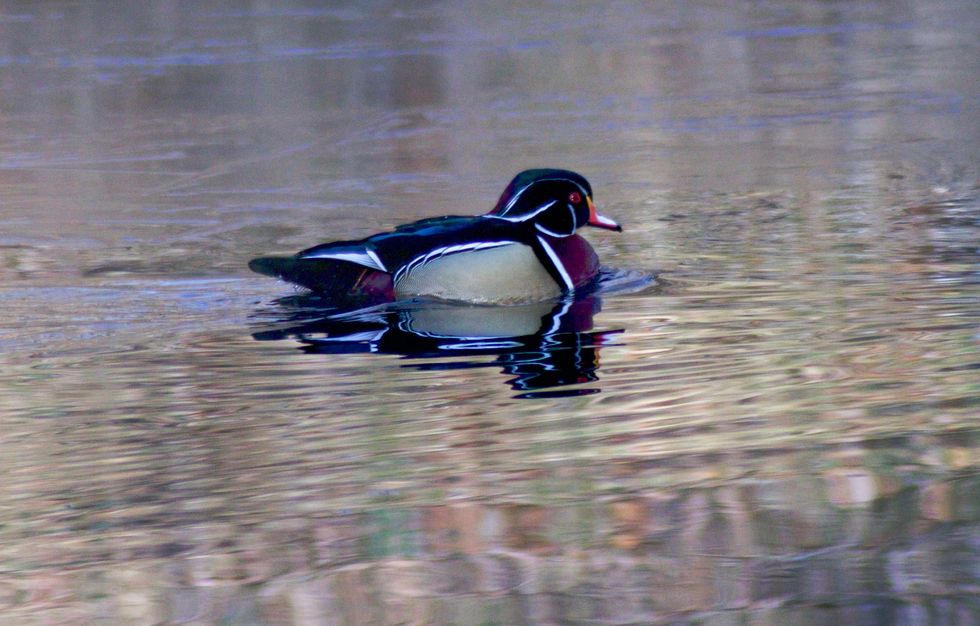
Migratory waterfowl are returning to the Northwest Corner, a herald of the arrival of spring weather. Look for wood ducks, such as this lone male. Photo by Michael Moschen

Previews of spring have been unveiling themselves through the steady arrival of migratory waterfowl species, particularly ducks, that are moving northward toward Canada and Alaska to breed.

Diving ducks such as Common Mergansers and Ring-necked Ducks can be readily spotted on freshwater bodies in the area, though Ring-necked ducks tend to prefer more sheltered ponds or lakes that are bordered by forest. Look for either species in small or large groups.

Common Merganser males are bright white, with dark green heads sporting a ragged crest, and pointed red bills, while the females have gray bodies and rust-colored heads.

Ring-necked Duck males have dark heads, necks and backs, with gray sides, while females are a more subtle mix of gray and brown.

Note that the ring on the neck of Ring-necked Ducks is almost never visible, but luckily their bills also have distinctive white “rings” at the base and the tip that differentiate the Ring-neck from the similar Lesser Scaup (also a northbound migrant) that has a solid-colored bill.

Various species of dabbling ducks are also moving north, with the brilliantly colored chestnut and emerald head of the male Green-winged Teal a delight to observe in marshes or shallow water bodies.

In addition to the migrants passing through, some resident ducks have arrived to breed here. Wood ducks are selecting mates and beginning to scout out nest sites in riparian tree cavities and nest boxes. You may have stumbled upon a pair along a pond’s edge and heard the distinctive “oowheak!” from the female as the pair frantically flew away. This species startles more easily than others, so approach with caution for closer observations if you don’t have binoculars.

Additionally, keep an eye out for the unmistakable male Hooded Mergansers, a resident diving duck, whose magnificent black and white crest captures the interest of both beginner birders and seasoned ones alike.       

Now is an undoubtedly exciting time to brush up on your waterfowl identification or learn a new bird, so consider making time to go explore your nearby ponds, lakes or rivers!


Bethany Sheffer is the naturalist at Sharon Aubudon.
The views expressed here are not necessarily those of The Lakeville Journal and The Journal does not support or oppose candidates for public office.

Latest News

‘So Little to Do,’ so much to discover at James Barron Art

Curator Deborah Goodman Davis reads the Emily Dickinson poem “The Grass So Little Has to Do.” Spencer Finch’s “Following Three Bees (Zinnias)” buzzes in the background.

Photo by Natalia Zukerman

“The Grass Has So Little to Do,” on view at James Barron Art in Kent, takes its title from Emily Dickinson’s poem “The Grass So Little Has to Do,” written in 1862:

“The Grass so little has to do—
A Sphere of simple Green—
With only Butterflies to brood
And Bees to entertain—”

Keep ReadingShow less

Marina Kotchoubey is not a woodworker

Marina Kotchoubey is not a woodworker

Marina Kotchoubey at the Ian Ingersoll Cabinetmakers showroom in West Cornwall.

Photo by D.H. Callahan

After 40-something years navigating the world of custom fine furniture, Ian Ingersoll was getting ready to retire. Starting off with a little dovetail stool that he sold at a shop in West Cornwall in the 1970s, he’d grown his skill and his business into something he — and the whole town — could be proud of. Shutting down that business was not an option.

Ingersoll built Ian Ingersoll Cabinetmakers, which produced mainly classical Shaker furniture, on passion: the passion he had to make a living through creative challenges and the passion of his employees, who all seem deeply in love with their craft.

Keep ReadingShow less
A legacy of giving at Norfolk Chamber Music Festival

One hundred and twenty years ago, Carl and Ellen Stoeckel commissioned New York architect E.K. Rossiter to design The Music Shed in Norfolk, Connecticut. After nearly a decade of entertaining their friends and neighbors with the finest music of the day, they built a permanent home for their beloved Litchfield County Choral Union.

The commission and full funding of the construction was not unheard of in an era when great fortunes led to public enrichment. Railroad tycoon John D. Rockefeller was instrumental in funding institutes of higher education. Steel baron Andrew Carnegie was building libraries all over the country, and famously said that a man who dies rich is a disgrace, challenging his peers to give their fortunes back to the people.

Keep ReadingShow less
google preferred source

Want more of our stories on Google? Click here to make us a Preferred Source.

Two unique exhibitions at Geary Gallery

Henry Klimowicz with his sculpture, “Partial Pillar 1”

Photo by D.H. Callahan

On Saturday, Aug. 1, Geary Gallery opened its doors in Salisbury for two unique shows in its first- and second-floor gallery spaces. Art lovers flooded both floors over the course of the afternoon, giving the events a vibrant feeling that enhanced the importance of the art.

On the first floor is a show by Chicago-born, Colorado-based photographer Summers Moore, titled “Lobitos: Pueblo Fantasma,” or “Lobitos: Ghost Town.” The work centers around her daughter’s current hometown in Peru. Moore herself found a home away from home in Colorado in the mid-1980s and encouraged her children to seek out new places outside of their comfort zones.

Keep ReadingShow less

Writer’s retreat in the woods

Writer’s retreat in the woods

Participants in a 2024 Great Mountain Forest Woodland Academy workshop at Yale Camp.

Photo by Mike Zarfos

Great Mountain Forest (GMF) will host its first Nature Writing Retreat at the historic Yale Camp in Falls Village from Aug. 7-9, 2026. Writers of all levels are invited to draw inspiration from one of New England’s most notable forest landscapes. GMF envisions the retreat becoming an annual event celebrating writing, conservation and the relationship between people and forests.

This immersive three-day retreat reflects on the legacy of Hal Borland, the American writer and New York Times nature columnist whose work was deeply connected to this landscape. The retreat explores how wilderness shapes language, strengthens close observation and fosters environmental consciousness.

Keep ReadingShow less
From Cornwall to Rome, Adam Van Doren at Berkshire Botanical Garden

Artist Adam Van Doren and curator Donna Hassler talk to a group of visitors at the Berkshire Botanical Garden. A Stephen Proctor vessel sits to their left.

Photo by Natalia Zukerman

This summer, the Berkshire Botanical Garden in Stockbridge has hosted “Grounded in Nature: Paintings by Adam Van Doren,” an exhibition exploring the intimate relationship between architecture and the natural world.

On view for only a few more weeks in the Leonhardt Galleries, the exhibition features more than 35 watercolor and oil paintings by the New York-based artist, architect, author and Yale professor, curated by art historian Donna Hassler, director emerita of Chesterwood. The works span three distinct places that have shaped Van Doren’s artistic practice: New York City, Cornwall, Connecticut, and his travels throughout Europe.

Keep ReadingShow less
google preferred source

Want more of our stories on Google? Click here to make us a Preferred Source.

google preferred source

Want more of our stories on Google? Click here to make us a Preferred Source.