TORRINGTON — Eight members of the Connecticut General Assembly met with the Northwest Hills Council of Governments (COG)and the Northwest Connecticut Chamber of Commerce at a “legisative breakfast” Thursday, Jan. 15, at the University of Connecticut’s Torrington campus.
Barkhamsted First Selectman Don Stein, chairman of the 21-town COG (which is an organization of the first selectmen of those towns), and First Selectman Barbara Henry of Roxbury presented four legislative priorities:
• Maintain state aid, in the form of popular grant programs such as the Small Town Economic Assistance Program (STEAP), Local Capital Improvement Program (LoCIP), and Town Aid Road (TAR). They also urged revising the Education Cost Sharing (ECS) formula and providing funding for state-mandated special education.
• Oppose new and reduce existing unfunded state mandates. Small municipalities in Connecticut have been complaining about this for years, and this year the COG is asking for legislation that requires a two-thirds majority vote of the Legislature “to pass additional unfunded mandates on to municipalities, particularly as they impact local educational budgets.”
The group also would like the Legislature to revise the prevailing wage law so that projects costing less than $1 million are not subject to the law.
• Promote job creation and regional economic development through a variety of state and regional programs, and “assure that more tourism marketing dollars are spent highlighting the attractions and cultural activities in the Northwest Hills region.”
• Protect public health and safety infrastructure, which includes: “adequate government reimbursement for hospital-based care;” keeping the Troop A and Troop B State Police barracks open and staffed; and cost controls for the resident trooper program, especially as regards town responsibility for paying overtime and fringe benefit costs.
Stein said he was encouraged by what he observed at a recent meeting with the leadership of the Legislature, saying, “They really want to work together.”
He said that the COG’s proposals were “always non-partisan, and I hope that spirit prevails.”
State Rep. Roberta Willis (D-64 ) began the legislators’ remarks by warning that “we are going into a tough year” with the state budget process.
“We are looking at a large deficit,” she said.
She said that all eight legislators at the meeting were committed to maintaining municipal aid and Education Cost Sharing .
“But I am not sure we will be able to keep that commitment this time around.”
She said Gov. Dannel P. Malloy’s major agenda item is transportation and infrastructure, and she said she would advocate for including funding to restore passenger rail service to northwest Connecticut.
State Rep. Jay Case (R-63) said he was particularly concerned about access to treatment for addiction. “It’s pretty disturbing that in order to get into the facility you have to be high.”
State Sen. Clark Chapin (R-30) said he was concerned about proposed storm water regulations from the Department of Energy and Environmental Protection (DEEP), which he described as “overly burdensome and costly to municipalities.”
State Sen. Kevin Witkos (R-8) said his best guess on Town Aid Road is that towns would receive the same amount as in the last budget, and said he was introducing a bill to require that when a department of state government changes a policy, and the change results in an unfunded mandate, the policy change would have to go before the Legislature’s regulatory review committee.
State Rep. Michelle Cook (D-65) singled out special education funding. “Special ed is the cost driver, and the funding does not equal the services” that school districts are required to provide.
She also said the agriculture education programs have not been funded at the same rate as other programs “for many years.”
State Rep. Bill Simanski (R-62) took a longer view. He said in his four years in the General Assembly the priorities of the towns he represents haven’t changed “because the Legislature hasn’t changed the excessive spending and excessive borrowing.
“We’re looking at a $1 billion deficit,” he said. “We have to work to see if we can get our financial house in order.”
He added he supported a “do no harm” approach to municipal aid and the two-thirds rule for unfunded mandates.
State Rep. John Piscopo (R-76) said he asked to be on the bonding subcommittee “because that’s where the action is.”
He said there will be a number of bills concerning the prevailing wage law, and he said he expected at least one of them to get to the public hearing stage.
He said he was “a little reserved” during the governor’s State of the State address, saying it seemed long on promises and short on details about how to pay for it all.
State Rep. Craig Miner (R-66) was the most outspoken of the eight. “It seems to me we need to get beyond bullet points and get to the systemic problems,” he began.
He was not sanguine about the prospects of the legislative session. Quite the contrary, in fact.
“Don’t count on us to do anything differently,” he said.
When the governor’s budget proposal arrives, “we will pick it apart, and nothing will change.”
Except this. “We will be more deceitful,” he said.
He asked that the elected officials in the room, when confronting a problem, “tell us what the impediment is and we’ll fix it. If we can’t, don’t elect us.”
Henry picked up on Miner’s theme during the question-and-answer period. She said that the state “demands more efficiencies from the towns.”
“We’re demanding more efficiencies from the state,” she continued. “You’ve got to stop the spending.”
Willis said it was frustrating to hear people ask for less spending from state government. “No one ever says how or where.”
“When you start adding up what the people in this room are asking for, you’re talking billions,” she said.
“It’s hard for us because we’re getting mixed messages.”
Pending in 2015
Here is a partial list of bills identified by the Northwest Connecticut Chamber of Commerce as being of special interest to the Northwest Corner:
• HB 0510 — Full funding of state special education reimbursement costs
• HB 05012 — Minimum budget requirements for towns that achieve efficiencies and lower costs
• HB 05072 — Modernization of prevailing wage laws (There are several bills on the prevailing wage law: HB 05073, HB 05074, HB 05075, HB 05076, HB 05078, HB 05079.)
• HB 05077 — Worker’s compensation and unemployment compensation reimbursements for employers in cases where benefits were paid to individuals found to have no claim to such benefits
• HB 05186 — Provide adequate compensation to hospitals providing free care to indigent persons without health insurance
• HB 05212 — A bill to make Connecticut a Right to Work state
• HB 05269 — A bill to limit property valuation increases resulting from revaluations.
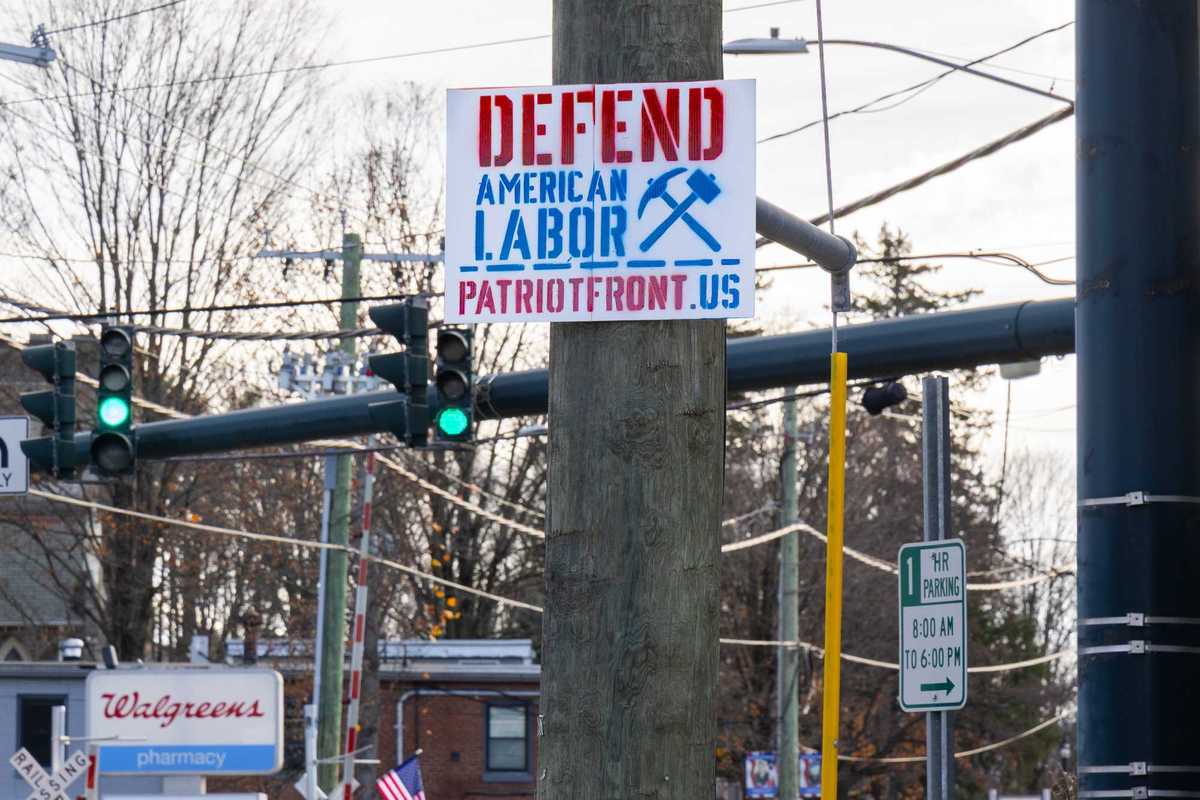
 Some residents painted over a Patriot Front sign that had been removed and plan tohang it back up to spread a message of positivity and community.Provided