For legislators, not much good news for year ahead

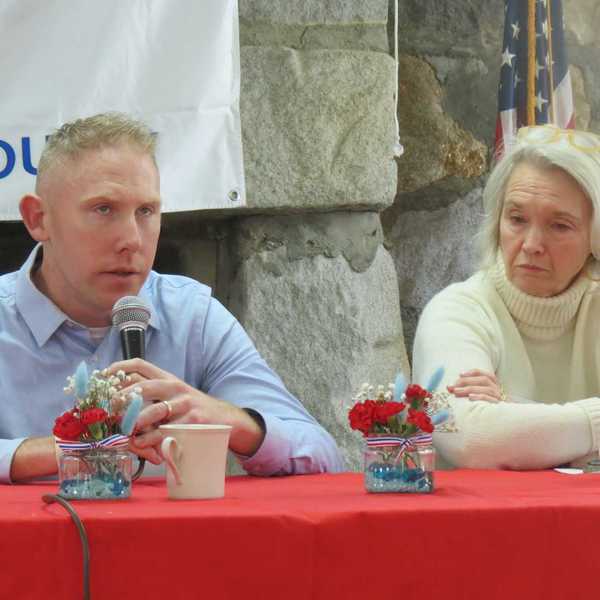
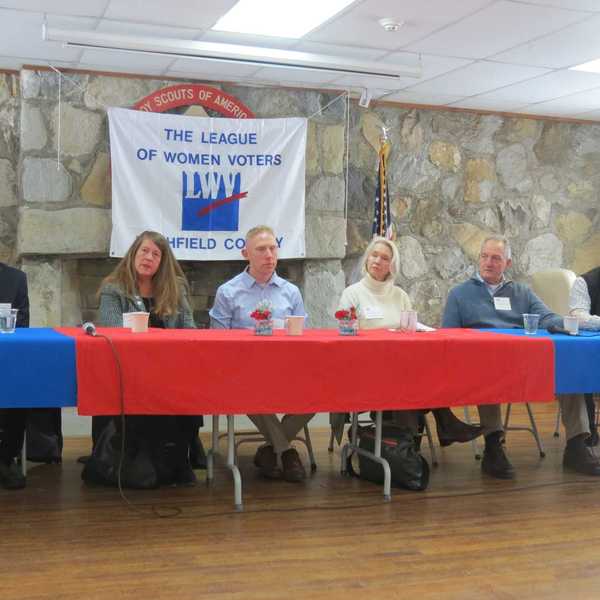
TORRINGTON — The Northwest Hills Council of Governments (COG) held a legislative breakfast at the Torrington campus of the University of Connecticut on Thursday morning, Jan. 21.

State Representatives Roberta Willis (D-64), Michelle Cook (D-65), Jay Case (R-63) and Bill Simanski (R-62) and state Senators Henri Martin (R-31) and Clark Chapin (R-30) attended, as did many (but not all) of the first selectmen from the 21 towns in the COG.

The prevailing mood was grumpy.

The COG’s stated legislative priorities are: Revise the thresholds for prevailing wage laws; repeal the municipal spending cap enacted by the Legislature in 2015; watch out for “sleeper bills.”

Martin led off. “We are not naysayers. We are realists. We can’t continue going down this path.”

He said the blame for “these dysfunctional budgets belongs to the majority party.”

He said that successful communities have lower taxes and less government spending. 

“That is the formula.”

Addressing the first selectmen and business people, he said they need to become more involved and develop “stronger relationships” with legislators.

He suggested that Gov. Dannel P. Malloy ask the department heads to identify “two or three regulations that are burdensome” and eliminate them.

But the primary issue for Martin is trust.

“We need to become more trustworthy,” he said. “We need to keep our promises.”

‘Lockbox’ or cookie jar?

Chapin followed, and continued in a similar vein. Pointing to the recent discussion of a constitutional amendment creating a transportation “lock box,” he said the only reason for even considering such a move is that “we are undisciplined, we can’t keep our hands off it.”

Chapin criticized the practice of  “sleeper bills” that are added to the implementer bill that actually funds the state government. 

He said legislators should not be able to resurrect bills in special session that failed to pass the regular session.

Simanski, a former first selectman in Granby, said the short session should be confined to budgetary matters.

He said legislators from the Northwest Corner need to make sure the region is not “left out of the mix” in transportation matters.

And he was one of several who noted, wryly, that no sooner had discussions of the transportation lockbox started than the Legislature took $35 million in transportation funds to help balance the overall state budget.

If there is to be a lockbox, he continued, “it must be defined.”

“What are ‘transportation-related expenses’? You can’t trust the Legislature on this.” He sketched out a scenario in which the lockbox was paying for salaries for Department of Transportation employees, or for the state’s fleet of vehicles.

Cost said his idea of a lockbox would be in the form of grants for each of the state’s nine COGs. 

“My concern is that the Northwest Corner gets forgotten,” he said. “I want the lockbox to help the roads I drive on every day.”

Cook said she will be focusing on education — particularly vocational and STEM programs.

But there is good news

Willis began her remarks by saying, “I guess it’s my job to be cheering.”

She said it is important to realize that Connecticut gets high ratings in education, quality of life and health-care outcomes.

And she made a broader point — that Connecticut taxpayers are accustomed to paying for services that other states do not offer.

She said that recent budget cuts to higher education in New Hampshire, if enacted in Connecticut, would leave taxpayers “outraged.”

Willis conceded the “deficit picture is not good.”

“But remember this is a current services budget,” meaning the projected deficits assume current spending levels. “We never do a current services budget.”

Willis said structural changes are needed, but added that critics fall short when it comes to identifying such changes.

After the opening remarks, Martin and Chapin had to leave. The other four legislators fielded questions and took comments from the audience.

The first asked how the state can prevent people and businesses from leaving the state — and made reference to the recent announcement that General Electric is moving to Boston.

Simanski said, “If you were faced with deficits in business, you would cut expenses. Unfortunately the legislative state of mind sees it as a revenue problem.” 

Tell them where to cut

Case, a member of the Appropriations Committee, was critical of that body’s approach. He said that when he asks how the Legislature is going to pay for a given line item, the response is, “Don’t worry, it’s in the budget.”

He said the committee should start with a spending goal and try to hit it, rather than creating a budget and then sending it to the next committee to figure out how to raise the needed revenue.

Cook said that education is a “huge cost driver — but everyone wants their own district. We need to regionalize education. I know it ruffles feathers.”

She said regional reorganization could save millions of dollars, but “local leaders are afraid to make that decision.”

This did not go over very well. Several people commented that school districts are already regionalized. Complaints about flat or reduced state education grants also made their way through the hubbub.

Cook pressed on. “We’ve got a school open for what, 80 students?”

Willis, seated next to her, said, “78.”

Cook said, “OK, 78 students. This has to be statewide. It’s not a Northwest Corner issue, it’s a state issue.”

Willis said, “What are people willing to give up? I’m not hearing it. You have to help us. You want us to cut, then tell us where.”

The Connecticut General Assembly meets from January to June in odd-numbered years (such as 2015) and from February to May in even-numbered years (such as 2016). In theory, the short sessions such as the one this year are only for budget planning and emergency issues.

Latest News

Living art takes center stage in the Berkshires

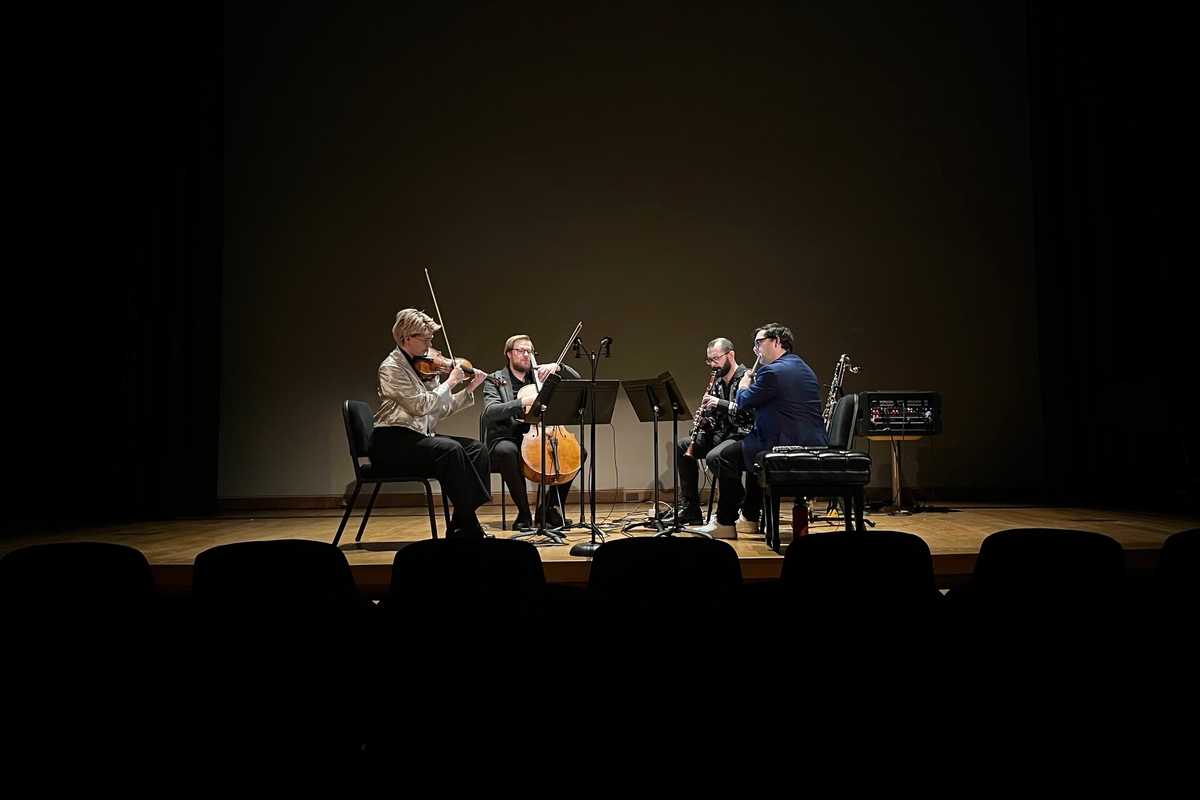
Contemporary chamber musicians, HUB, performing at The Clark.

D.H. Callahan

Northwestern Massachusetts may sometimes feel remote, but last weekend it felt like the center of the contemporary art world.

Within 15 miles of each other, MASS MoCA in North Adams and the Clark Art Institute in Williamstown showcased not only their renowned historic collections, but an impressive range of living artists pushing boundaries in technology, identity and sound.

Keep ReadingShow less
Persistently amplifying women’s voices

Francesca Donner, founder and editor of The Persistent. Subscribe at thepersistent.com.

Aly Morrissey

Francesca Donner pours a cup of tea in the cozy library of Troutbeck’s Manor House in Amenia, likely a habit she picked up during her formative years in the United Kingdom. Flanked by old books and a roaring fire, Donner feels at home in the quiet room, where she spends much of her time working as founder, editor and CEO of The Persistent, a journalism platform created to amplify women’s voices.

Although her parents are American and she spent her earliest years in New York City and Litchfield County — even attending Washington Montessori School as a preschooler — Donner moved to England at around five years old and completed most of her education there. Her accent still bears the imprint of what she describes as a traditional English schooling.

Keep ReadingShow less
Jarrett Porter on the enduring power of Schubert’s ‘Winterreise’
Baritone Jarrett Porter to perform Schubert’s “Winterreise”
Tim Gersten

On March 7, Berkshire Opera Festival will bring “Winterreise” to Studio E at Tanglewood’s Linde Center for Music and Learning, with baritone Jarrett Porter and BOF Artistic Director and pianist Brian Garman performing Franz Schubert’s haunting 24-song setting of poems by Wilhelm Müller.

A rejected lover. A frozen landscape. A mind unraveling in real time. Nearly 200 years after its premiere, “Winterreise” remains unnervingly current in its psychological portrait of isolation, heartbreak and existential drift.

Keep ReadingShow less
google preferred source

Want more of our stories on Google? Click here to make us a Preferred Source.

A grand finale for Crescendo’s 22nd season

Christine Gevert, artistic director, brings together international and local musicians for a season of rare works.

Stephen Potter

Crescendo, the Lakeville-based nonprofit specializing in early and rarely performed classical music, will close its 22nd season with a slate of spring concerts featuring international performers, local musicians and works by pioneering composers from the Baroque era to the 20th century.

Christine Gevert, the organization’s artistic director, has gathered international vocal and instrumental talent, blending it with local voices to provide Berkshire audiences with rare musical treats.

Keep ReadingShow less

Leopold Week honors land and legacy

Leopold Week honors land and legacy

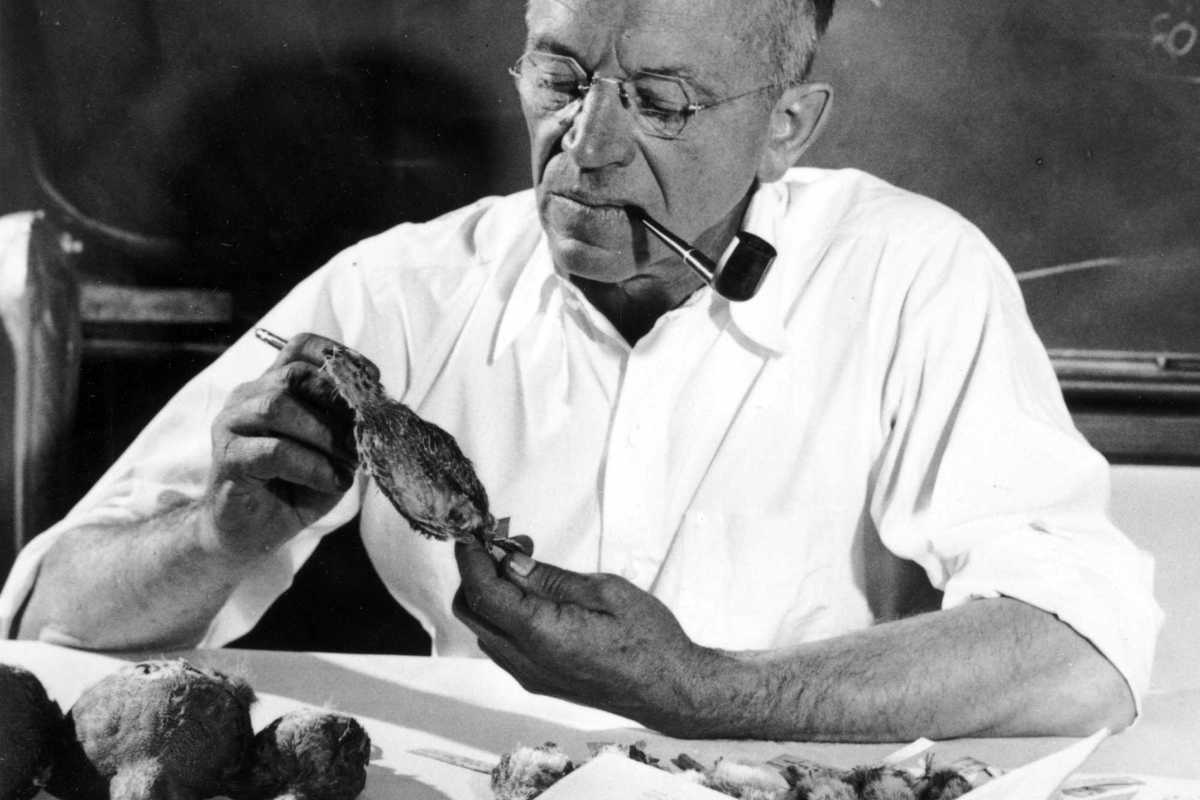
Aldo Leopold in 1942, seated at his desk examining a gray partridge specimen.

Robert C. Oetking

In his 1949 seminal work, “A Sand County Almanac,” Aldo Leopold, regarded by many conservationists as the father of wildlife ecology and modern conservation, wrote, “There are some who can live without wild things and some who cannot.” Leopold was a forester, philosopher, conservationist, educator, writer and outdoor enthusiast.

Originally published by Oxford University Press, “A Sand County Almanac” has sold 2 million copies and been translated into 15 languages. On Sunday, March 8, from 3 to 5 p.m. in the Great Hall of the Norfolk Library, the public is invited to a community reading of selections from the book followed by a moderated discussion with Steve Dunsky, director of “Green Fire,” an Emmy Award-winning documentary film exploring the origins of Leopold’s “land ethic.” Similar reading events take place each year across the country during “Leopold Week” in early March. Planning for this Litchfield County reading began when the Norfolk Library received a grant from the Aldo Leopold Foundation, which provided copies of “A Sand County Almanac” to distribute during the event.

Keep ReadingShow less

Erica Child Prud’homme

Erica Child Prud’homme

WEST CORNWALL — Erica Child Prud’homme died peacefully in her sleep on Jan. 9, 2026, at home in West Cornwall, Connecticut, at 93.

Erica was born on April 27, 1932, in Doylestown, Pennsylvania, the eldest of three children of Charles and Fredericka Child. With her siblings Rachel and Jonathan, Erica was raised in Lumberville, a town in the creative enclave of Bucks County where she began to sketch and paint as a child.

Keep ReadingShow less
google preferred source

Want more of our stories on Google? Click here to make us a Preferred Source.
google preferred source

Want more of our stories on Google? Click here to make us a Preferred Source.