Thank you!
Your support is sustaining the future of local news in our communities.

More than coffee at Best Damn Espresso

More than coffee at Best Damn Espresso

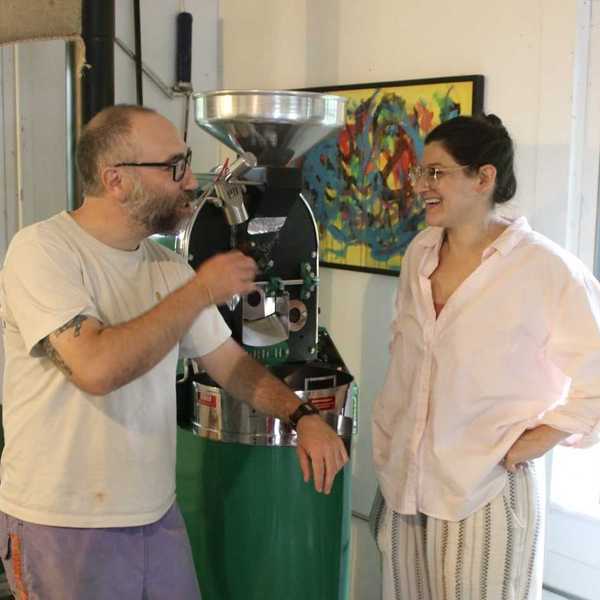
Owners Asio and Angela Highsmith

Provided
Coffee means community, It’s a big part of the hospitality vision that my wife and I want to bring to the world.
— Asio Highsmith, Co-owner

Asio Highsmith, co-owner of the bright red espresso truck in Great Barrington, greets patrons with the kind of warmth and energy that can change the trajectory of a day. There is laughter, conversation and a genuine sense of connection. And the coffee is amazing. It’s clear that Best Damn Espresso’s popularity has as much to do with people as it does with espresso.

Despite becoming one of the Berkshires’ most recognizable small brands, its owners maintain a surprisingly low profile, focusing more on their craft than on self-promotion. “We didn’t move up here to be on Front Street,” said Highsmith. “We came because we love nature and wanted to start a new chapter of our lives.” That chapter began after years spent in New York City.

Asio’s wife Angela, a California native drawn to nature, had spent years bringing their children to the Berkshires. The family already owned property there, and the pandemic simply accelerated the move they were already considering. Their son summed up the family’s feelings best when he was 5 years old. “He said, ‘I want to be in a place where there’s more trees than people,’” Angela recalled.

The move wasn’t motivated by business ambitions. In fact, neither Asio nor Angela intended to become entrepreneurs again. “We came up here for the outdoors and for the beauty,” Angela said. The espresso truck emerged almost by accident. When old café equipment began taking over their basement, Angela suggested putting it on a truck.

“That’s exactly what happened,” Asio laughed. What began as a practical idea soon evolved into something much larger.
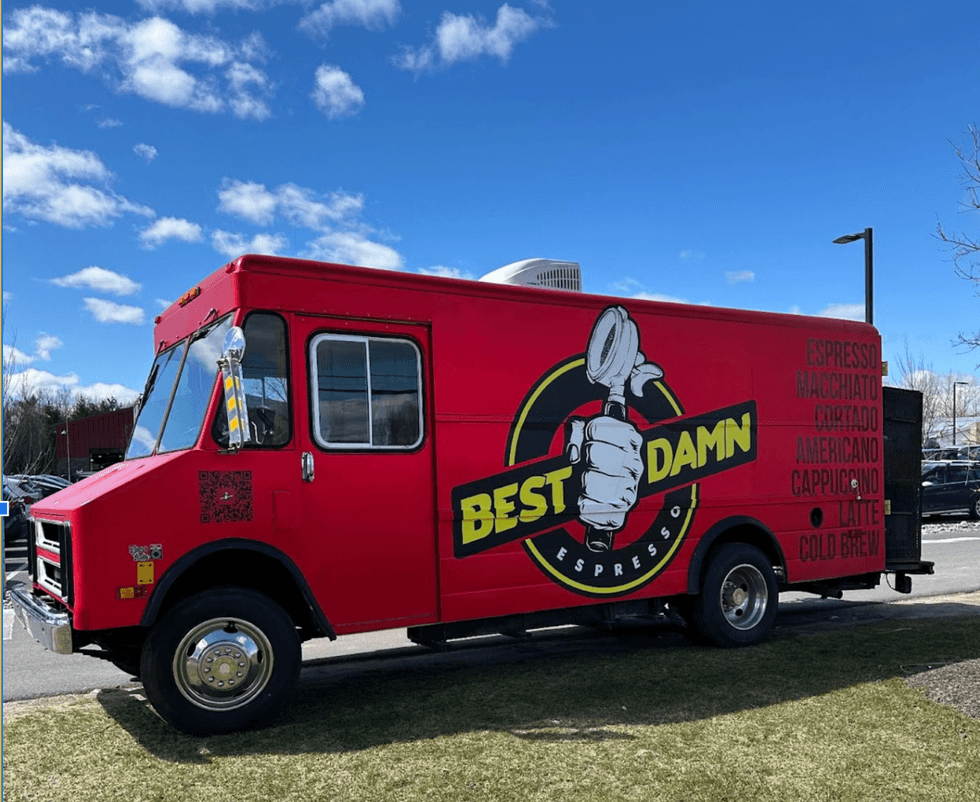
To find out where the Best Damn Espresso truck will be on any given morning, text ‘BDE’ to 844-659-1203Provided

Asio brings decades of hospitality experience to the business. A lifelong bartender and mixologist, he approaches espresso the same way a master cocktail maker approaches a drink — with precision, intention and respect for the craft.

“Coffee means community,” he said. “It’s a big part of the hospitality vision that my wife and I want to bring to the world.” For Asio, every drink matters. “My motto is one drink at a time,” he said. “I focus on what’s in front of me.”

That philosophy extends beyond the espresso machine. Customers aren’t simply buying a beverage; they’re entering an experience shaped by two people who view hospitality as an act of service. “Food is magic. Coffee is magic,” Asio said. “It’s an exchange of great energy.”

Angela, who often works the front of the truck, describes the customer relationship in similar terms. “When someone comes to the truck, you’re hosting them,” she said. “You’re entertaining them. You’re giving them exactly what they want.”

Despite doing almost no traditional marketing, Best Damn Espresso has developed a devoted following throughout the region. Asio attributes that growth to consistency rather than promotion. “Advertising is overrated if your product is mid,” he said.

The name itself — Best Damn Espresso — is intentionally bold. Many businesses would hesitate to make such a claim. Asio sees it differently. “It’s actually me challenging myself,” he explained. “Every time I look at that truck, I see ‘Best Damn Espresso.’ The aspiration for being great at what we do happens every day.” That relentless pursuit of quality appears to resonate with customers.

Four years after launching, the company has expanded from a single truck to multiple units. Yet despite the growth, Asio and Angela remain focused on maintaining the same personal connection that defined the business from the beginning. They have also become unexpected pioneers in the local food-truck scene. “There wasn’t really a food truck presence in Great Barrington before we started,” Asio said. Today, several food trucks operate in the area, some inspired by their success. “The benefit is inspiring someone,” he said.

To receive daily updates on the truck’s location, customers can text “BDE” to 844-659-1203.
Latest News

Millerton owes its name to a transient engineer
Photo Courtesy North East Historical SocietySidney G. Miller, the engineer that helped build the railroad through Millerton, is the village’s namesake but never lived there.

The arrival of the railroad in the Town of North East in 1851 is heralded as the moment Millerton came into being — ushering in a boom period for the area that transformed it from a sparsely populated farming community into a hub of commerce.

That moment was brought about by Sidney Greene Miller and his associate civil engineers in their work as contractors for the New York and Harlem Railroad. After his work, Millerton quickly grew from an insignificant hamlet in North East to the center of the town’s activity within just 25 years.

Keep ReadingShow less
Millerton’s fire department marks 134 years of battling blazes

Millerton Fire Co. members monitor a fire at the Brown Cup Diner on Route 22. The diner would later be completely destroyed by the fire.

Archive photo

Millerton’s volunteer fire department has spent more than 130 years protecting the village, a legacy that began after a fire ravaged and destroyed a prominent hotel in 1891.

North East Fire District Commissioner Dave Vandebogart, who serves as the fire company’s historian, is himself a third-generation member of the Millerton Fire Company. He said Millerton’s rapid growth after the arrival of the railroad spurred the need for an organized fire department.

Keep ReadingShow less
New pool and poolhouse expected to open next year

A rendering of the planned pool and poolhouse shows a shallow, ramped entrance allowing access for people with disabilities.

Illustration Provided

Plans for the long-awaited community pool and poolhouse at Eddie Collins Memorial Park are moving into the construction phase, with village officials aiming to open the facility by summer 2027.

The Village Board of Trustees hopes to hold a ceremonial groundbreaking in July as part of Millerton’s 175th anniversary celebration. With contracts for electrical, plumbing and mechanical work now approved, construction is expected to begin in August.

Keep ReadingShow less
google preferred source

Want more of our stories on Google? Click here to make us a Preferred Source.

Documentary film about railroad resurfaces after 40 years

Filmmaker Philip Milano of Dover Plains holds the Scotch U-matic cassette containing his original 1970s documentary about the Harlem Valley Transportation Association.

Aly Morrissey

Long before the bustling Harlem Valley Rail Trail hosted runners, walkers and cyclists, a historic railroad ran through Millerton, connecting rural towns to New York City. The eventual dismantling of the railroad was met with criticism and pushback from residents.

That chapter of local history comes alive in a resurfaced documentary film that had been tucked away in an attic in Dover Plains for more than 40 years.

Keep ReadingShow less
Millerton’s early days brought huge change to the community
Courtesy U.S. Library of Congress

The Village of Millerton was founded a decade before the Civil War during a time when railroads were transforming rural economies, the nation was expanding westward and tensions over slavery were mounting.

The first 25 years of Millerton reflected that era of rapid change, characterized by an almost overnight transformation from farmland to being a railroad hub.

Keep ReadingShow less
Kingston Guards bring baseball back to the basics

The Kingston Guards and the Bovina Dairymen

Schuyler Meyer
These aren’t your standard gym rats trying to relive their high school or college glory.

The Kingston Guards are playing ball the way it used to be played. To be specific, they’re playing baseball by the rules of 1864, the last full season before the Civil War. To them, it’s a purer form of the game, devoid of constant rule changes and all that pesky equipment like gloves, helmets and catchers’ masks. Sure, there are umpires, but they’re really there more to settle arguments than make actual calls.

The whole game feels less aggressive and more friendly. In fact, many of the players on the Guards and other teams in the vintage baseball scene came from softball leagues that had simply become too competitive. These aren’t your standard gym rats trying to relive their high school or college glory. More often, they’re history buffs looking for something a little more athletic than the synchronized marching of Civil War reenactments — though, to be fair, some of them are still Civil War reenactors.

Keep ReadingShow less
google preferred source

Want more of our stories on Google? Click here to make us a Preferred Source.

google preferred source

Want more of our stories on Google? Click here to make us a Preferred Source.