Airlines and passengers alike are buffeted by everything from weather to war. Long lines at the security gates, cancelled or delayed flights, war, weather, and the stock market have hurt both commercial carriers and their human cargoes.
March had not been good for either airline or its passengers. More than 12,500 U.S. flights were delayed by storms in some cases on. Daily basis as storms buffeted the East Coast and other locales. American Airlines, Southwest, and Delta delayed or canceled 45% of flights in a recent week. This is nothing out of the ordinary. Severe weather this winter has become just another liability for both carriers and passengers.
As the U.S.-Israeli war with Iran began, conflict forced the cancellation of more than 52,000 flights to and from the Middle East. Since then, airlines that once relied on flying over Iran and other Gulf states must find alternative routes to their destinations. Geopolitical strife seems to be cropping up wherever you look (or fly over). What was once an efficient and finely tuned worldwide aviation travel network is now at risk of becoming a patchwork of fragmenting connections and workarounds.
As a result, not only are airplanes burning more fuel since they are forced to travel longer distances, but flights are getting longer and longer to get from point A to point B. Not only does this eat into carriers’ profitability, but it also adds to the woes of your typical passengers. The price of flights is rising along with oil, making it harder to travel long distances, even if one is lucky enough to catch a flight.
Geopolitical conflicts have become a nightmare for travelers.Thousands have been stranded in the Middle East, and before that by the Venezuela/U.S. raids, and let’s not forget the past four years of ongoing conflict between the Russia and Ukraine war.
Adding insult to injury, depending upon the airport, air travelers were encountering long airport security lines, some of which snaked out to the sidewalks surrounding the airport. Many major airports were experiencing nearly 3 hours in TSA lines, causing massive delays and missed flights during peak hours. Delays of at least 1 hour were reported in Atlanta, New Orleans, Charlotte, and Houston.
The culprit was the partial federal shutdown of Homeland Security funding, which had led to staffing difficulties at the Transportation Security Administration. Security personnel, until this week, had not received a paycheck for weeks. The U.S. Senate is still squabbling over funding.
The president sent his ICE agents to help but reports were that they were simply making matters worse. Finally, Trump ordered the head of Homeland Security to find the money and pay the TSA workers. He did. Readers might wonder why Trump had not simply done that in the first place.
Like consumers, airlines are also grappling with higher energy prices. A sharp spike in jet fuel costs have decimated profits. Since the start of the war, the global average price of jet fuel has soared 58%, based on International Air Transport Association data. Since then, it has almost doubled. Fuel accounts for 20-25% of airline operating costs, and average prices have risen from $2.50 before the crisis to $4.57 per gallon now. Although some airlines hedge, many do not, and hedging often covers only part of their fuel needs.
Advance purchase fares more than doubled for transcontinental flights in the first week of the war. Fares to the Caribbean jumped 58% and 43% to Florida. Several airlines, mostly in the Asia-Pacific region, have either increased fares or announced fuel surcharges. Air India, for example, tacked on a $50 ticket charge for all flights to Europe, North America, and Australia. Cathay Pacific doubled fuel surcharges starting March 18th.
U.S. airlines on domestic flights are prohibited from levying a separate fuel surcharge. Instead, they include fuel costs in the overall ticket price. Flyers can expect ticket prices to increase this summer unless oil prices drop back to pre-war levels in the next week or so. In the meantime, expect premium add-ons like seat upgrades, extra legroom seats, checked bags, or priority boarding to be adjusted upward.
Airline stocks have dropped sharply since the Iran war, driven by higher fuel costs and flight disruptions. U.S. airlines have generally underperformed the market this year, reflecting persistent concerns about weaker demand and limited pricing power. The industry also faces elevated labor costs and ongoing pilot shortages.
However, in recent days, some brave-hearted traders have been buying the dip in this area. Airline management says revenues are still increasing in both international and domestic travel, despite the challenges they face. Delta Airlines, American Airlines, and United Airlines all raised their revenue outlooks for the year. Consumer demand is still robust, they say, despite the long lines, added expense, and frustration.
Some airlines are now warning that they will be cutting back flights on less travelled and therefore less profitable routesAnalysts are warning that the higher oil prices climb and the longer they remain elevated, the greater the risk that flyers will pull back, and with them, the airlines’ stock prices.
Bill Schmick is a founding partner of Onota Partners, Inc., in the Berkshires.Bill’s forecasts and opinions are purely his own and do not necessarily represent the views of Onota Partners, Inc. (OPI).None of his commentary is or should be considered investment advice.


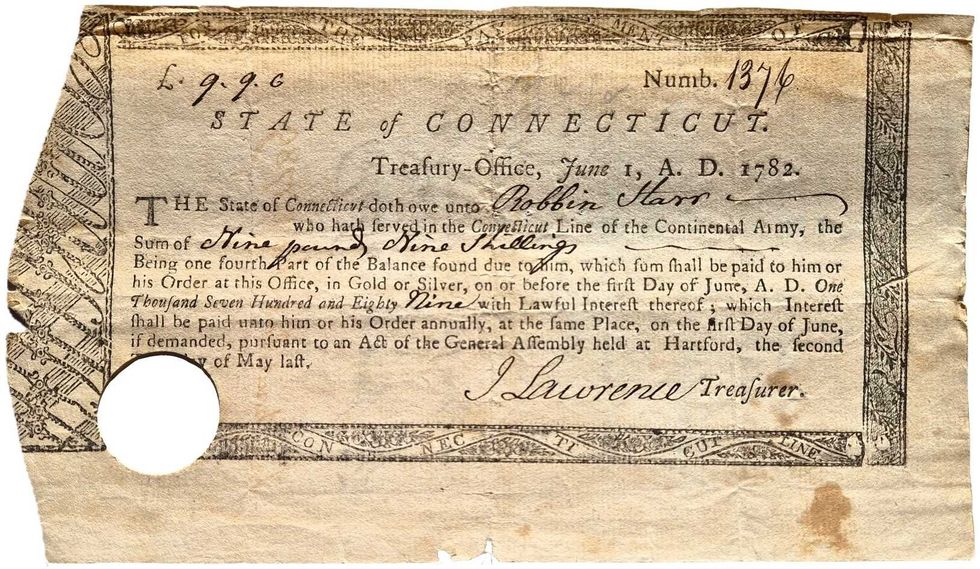 Pay Bill for Robin Starr’s service in the Continental Army.Courtesy the Alex Breanne Corporation
 John Mills speaking at Quinnipiac University.Courtesy the Alex Breanne Corporation
 Stephanie Saetta,with her rescue dog George and Blue (left), a shepherd mix awaiting his forever home.Madi Long
 Blue, a 7 year-old Shepard mix, is waiting for his forever home. Madi Long