Paley’s Farm Market opens season, signaling start of spring

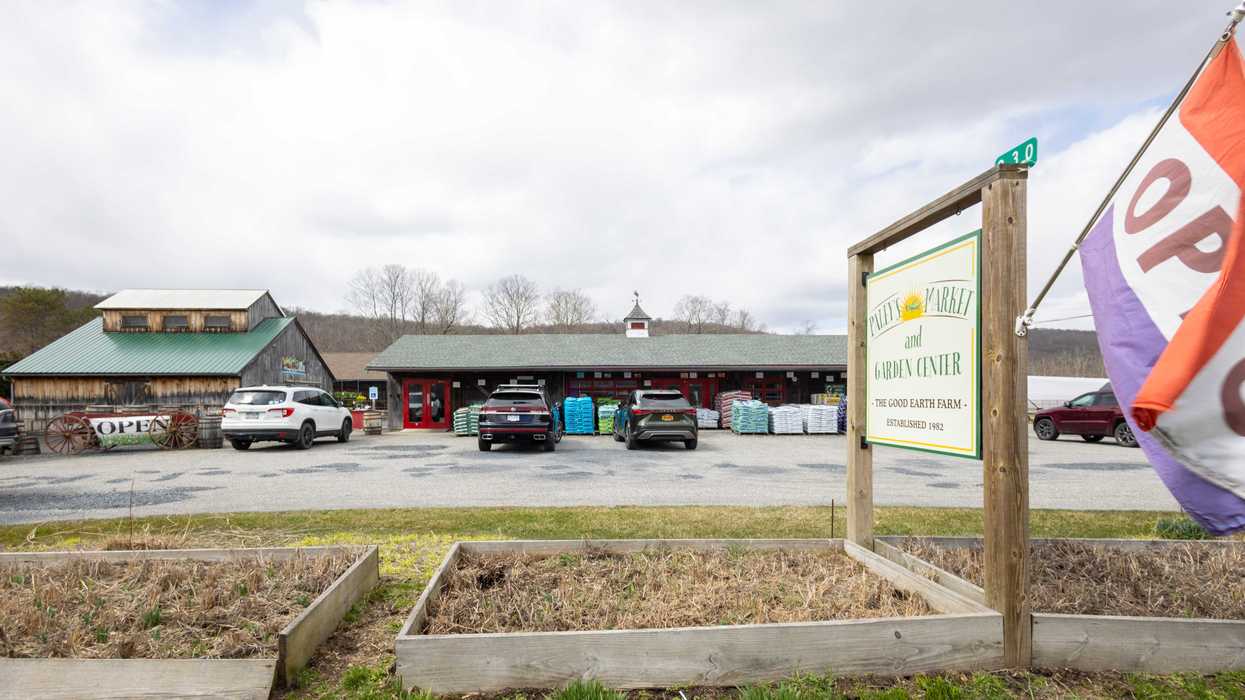
Paley’s Farm Market on Amenia Road in Sharon opened for the 44th season on Saturday, March 28. Opening day drew a steady crowd.
Aly Morrissey

Paley’s Farm Market on Amenia Road in Sharon opened for the 44th season on Saturday, March 28. Opening day drew a steady crowd.
SHARON – For many local residents, spring doesn’t truly begin until Paley’s Farm Market opens its doors, and customers turned out in force for its 44th season opening on Saturday, March 28.
Located on Amenia Road in Sharon, Paley’s is a seasonal destination for residents of New York and Connecticut and, over the past four decades, has evolved from a locally grown produce center into a full-scale garden center, farm market and fine food market.
Despite a chilly start to the day, the opening drew a steady crowd, with a full parking lot and early signs of the busy season ahead.
“It’s been going really well,” said owner Sarah Coon, who purchased the business from her brother in 2019. “It’s chilly, but we’ve had a nice turnout. The sun’s out, and that always helps.”
Mimi Harson of Sharon and Anette Cantilli of Millbrook shared an outing together to purchase flowers and plants for their deck pots.
“It’s exciting, we love Paley’s,” Cantilli said of the opening day as she filled her car trunk with pansies.
Behind the scenes, opening day is the culmination of months of preparation – much of it beginning long before winter has fully loosened its grip.
“We open our first greenhouse in early February, and that’s when the fun begins,” Coon said. “We start planting pansies then, and once you open that greenhouse, you’re committed. It’s like having a bunch of babies out there – you have to make sure nothing goes wrong.
This year’s opening comes after a particularly snowy winter that, just weeks ago, left the property covered in large mounds of snow.
“I looked around and thought, ‘I don’t know if we’re going to be able to open on time,’” Coon said. “There was snow everywhere. It was hard to even imagine. But here we are.”
Early spring offerings include rows of colorful pansies grown from seed, along with cold-tolerant vegetable starts, herbs and Easter-ready planters designed for patios and entryways. Bulbs such as daffodils and tulips are also available, along with seeds, soil and gardening supplies.
“It’s not too early,” she said of the growing season. “You can start seeds indoors now, even just on a windowsill. And if it doesn’t work, you can always come back and getplants.”
While the market’s popular prepared foods and grocery offerings will arrive later in the season, the early weeks focus on planting and preparation. Dry goods are expected in the coming weeks, followed by a gradual buildout of the full market.
New this year, Paley’s has partnered with Homegrown National Park, a national initiative promoting the use of native plants. The collaboration will help customers more easily identify native species to incorporate into their gardens.
“We think it’s going to be good for our staff and our customers,” she said. “It makes it easier for people to mix native plants into what they’re already doing.
Paley’s typically operates through mid-October, employing up to a dozen staff members at the height of the season, along with part-time and retired workers who assist with planting and maintenance.
For many, the opening marks more than just the start of a business cycle – it’s a seasonal ritual.
“We all need a little color right now,” Coon said. “And a little warmth. It’s coming.”
Patrick L. Sullivan
The snow is mostly gone, the mud is flowing, the stocking trucks are rolling and that means only one thing: it’s tackle fondling time!
Yes, it’s that happy time of year when we dig out all the gear we carefully cleaned and stowed away back in November.
What’s that? You left it all in the car until you had to help Aunt Edna move? And now it’s piled up in the garage?
Never mind that. What’s important is getting ahead of it,starting now.
Reels: Take the spools off and blast them with a can of compressed air. Then deploy a Q-tip to get the stubborn stuff. Then deploy something long and pointy to get the little bits of cotton that came off the Q-tip.
Lines: Clip off the old leader. It’s no good. Pull the fly line of the reel and clean it with something. There are many commercial products available. The Rio line cleaner seems to work pretty well, but it goes fast. I use a weak solution of Dawn dish soap and warmish water and a clean sponge or two, so I can see just how much yick comes off the line. Then I give it a shot of some stuff called Albolene, which is used for removing heavy theatrical makeup. It also functions as a line dressing and costs much less than actual line dressings.
Rods: I check guides and ferrules, and give everything a wipe with a chamois cloth or something similar. Then I start emailing people I barely know looking for someone who repairs rods.
I have something like 60 fly rods, and they are a pain in the neck to store. But I had a brain wave over the winter and bought four kitchen garbage cans. Ignoring the lids, I arranged them in a corner of my living room and to my delight found I can corral most of the rods in such a way that I can actually find the one I want.
It works very well. If the cans had an Orvis or Simms logo on them I could sell them for $85 apiece as a “modular rod storage system.”
Flies: What you absolutely don’t want to do is buy more fly boxes because the giant cardboard box filled with fly boxes is still in the back of the car and you can’t remember what’s in any of them so it’s better to just buy new flies and boxes and use those, reserving the joy of sorting through the old boxes for the summer when you’re at the summer camp that has a nice big table. Whatever you do, don’t do this. Oh, excuse me, that must be the Amazon guy at the door with my new boxes and flies.
Waders and boots: I have a dedicated wader rack where I hang them up. This is an improvement over my old method, which was to leave them in the car in a crumpled heap all winter. Check for leaks by taking a small flashlight and running it over the seams from the inside of the waders. If you see pinholes then it’s time to deploy Aquaseal. There are wader repair kits that have small tubes of Aquaseal and patches that can be cut to fit. Do not buy a big tube of Aquaseal unless you plan to use it very quickly, otherwise the big expensive tube turns to stone in a matter of days. That’s why the tubes in the kits are small. Ask me how I know this.
Check boot laces and replace if necessary. Paracord is your friend here, if you’re on a tight budget and don’t mind using a lighter to create an aglet. Look for missing studs and replace. Clean the soles with an old toothbrush. Do this outside. Ask me how I know this, too.
Note: Thanks for all the kind inquiries as to my new right hip. I am pleased to report that Ye Surgeon took me off the Injured Reserve list a couple of weeks ago, and as soon as things settle down a bit on the run-off, I will be back in action for the first time since September 2025.
Lakeville Journal
The Pasquale Grasso Trio performs at 7:30 p.m. April 4 at The Stissing Center in Pine Plains. The Italian-born guitarist, a rising jazz star and winner of the Wes Montgomery International Jazz Guitar Competition, is known for his virtuosic, piano-like style. A frequent collaborator with vocalist Samara Joy, he has performed at major festivals worldwide and is supporting his 2025 release “Fervency.” Tickets at thestissingcenter.org
Patrick L. Sullivan
SALISBURY — At a special meeting Thursday, March 26, the Board of Finance voted to send the proposed spending plans for 2026-27 to a public hearing Monday, April 27, at 7:30 p.m. at Town Hall.
Salisbury Central School principal Stephanie Magyar said “this is the easiest update I’ve ever given.” She said the final number came in some $23,000 less than the initial presentation, bringing the increase down from$339,528 (4.92%) to $316,367 (4.59%) for a total budget of $7,213,515.
First Selectman Curtis Rand said the town budget proposal’s bottom line is the same, but he and Comptroller Joe Cleaveland made some changes, most notably for an employee pension fund.
“We ended up in the same place, but just shifted things around,” Rand said.
The selectmen’s budget proposal is $9,617,825, an increase of $412,723 or 4.40%.
The town and school budgets are developed separately but together determine the overall tax impact on residents.

Want more of our stories on Google? Click here to make us a Preferred Source.
Alec Linden
SHARON — Residents will be asked at a town meeting on April 16 to decide whether to join a nascent regional waste authority, as towns across the Northwest Corner consider a coordinated response to uncertainty over the future of a key disposal facility.
The proposal centers on the Torrington Transfer Station, where Sharon and other municipalities send household waste for consolidation and shipment to disposal sites.
The Northwest Regional Recovery Authority was formed in 2025 by the city of Torrington in anticipation of a change in oversight at the facility, as the state Department of Administrative Services prepares to end its temporary management of operations at the end of June.
While Sharon has a contract through June 2027 at the transfer station, it is not yet clear who will operate the facility after the state steps back, or whether existing arrangements will continue unchanged under new management.
“There’s a lot of gray area with the Torrington Transfer Station, so this gives us hopefully another option come July 1,” First Selectman Casey Flanagan said.
Regional response
The NRRA, supported by the Northwest Hills Council of Governments, is seeking legislative approval in Hartford to transfer ownership of the facility to a multi-town public authority that would oversee and operate the site on behalf of participating municipalities.
Supporters say the structure would allow towns to retain public control over a facility that serves as a regional hub for municipal solid waste, while providing more stability in pricing and long-term planning.
Salisbury, Goshen and Torrington have already joined the group, while other towns in the Northwest Hills region are weighing similar action. Cornwall is scheduled to vote on its own ordinance to join on April 17, one day after Sharon’s meeting.
Town finances
Also on the April 16 agenda is a proposal to establish a $7 million financing arrangement to support projects in Sharon’s 10-year capital plan.
The financing would function as a flexible line of credit, allowing the town to borrow funds as needed for infrastructure projects.
First Selectman Casey Flanagan said the structure would give the town more flexibility in timing expenditures while maintaining access to favorable interest rates.
The town reached out to four banks and selected NBT Bank, which the town already has a relationship with.The proposal still requires approval from the Board of Finance and a town vote before it can take effect.
The Selectmen will also ask voters to approve the use of state Local Capital Improvement Program (LoCIP) funds for several projects.
That includes $20,000 to support updates to the town’s Plan of Conservation and Development, a state-required long-range planning document that guides zoning and land use.
An additional $99,998 in LoCIP funding would be used to complete resurfacing work on Boland Road and West Woods Road No. 1, where base paving was completed last year.
Voters will also be asked on April 16 to approve the town’s audited financial statements for fiscal year 2025.
Patrick L. Sullivan
Crystal Palmer Andrade, left, is congratulated on her induction to the Sigma Theta Tau honor society by Lori Martone-Roberts, professor of the practice of nursing at Wheaton College.
FALLS VILLAGE — Crystal Palmer Andrade of Falls Village, a member of the Class of 2027 at Wheaton College in Massachusetts, has been inducted into the college’s chapter of Sigma Theta Tau, the international honor society recognizing excellence in nursing.
Palmer Andrade, who is pursuing a Bachelor of Science in Nursing, earned membership in the honor society through outstanding academic achievement and a demonstrated commitment to the nursing profession.
Sigma Theta Tau International honors students who have shown superior academic performance, leadership potential, and a dedication to advancing health care. Membership is by invitation and is among the highest forms of recognition for nursing students.
Wheaton’s nursing program combines a strong liberal arts foundation with hands-on clinical experience, preparing graduates to deliver compassionate, evidence-based care.
Students also benefit from the college’s state-of-the-art simulation center and opportunities for experiential learning in a variety of health care settings.
“Being inducted into Sigma Theta Tau reflects both academic excellence, leadership, and a deep commitment to caring for others,” said Colette Diejuste Ph.D., RN, Dean of Nursing at Wheaton College. “We are proud of Crystal for achieving this distinction.”
Patrick L. Sullivan
From left, Peter Vermilyea, Russell Shorto and Rhonan Mokriski on March 27.
FALLS VILLAGE — Russell Shorto, author of “Revolution Song,” said his goal in writing the book was to tell the stories of the “lived experience” of six individuals from marginalized groups in the context of the American Revolution.
Shorto appeared with history teachers and fellow authors Peter Vermilyea of Housatonic Valley Regional High School and Rhonan Mokriski of Salisbury School at the Salisbury Forum on Friday, March 27, at HVRHS.
In picking the six subjects, Shorto said, “I sort of auditioned dozens.”
He wanted a diverse group, including an African and a Native American.
What he did not want were wealthy “white men wearing wigs.”
Finding primary source material on such people was a challenge. In the case of one of the subjects, Venture Smith, there was an autobiography, as told to a white newspaper editor and published in 1798 as “A Narrative of the Life and Adventures of Venture, a Native of Africa: But Resident above Sixty Years in the United States of America.”
Shorto said Smith “was all about money.” Having purchased his own freedom, he then set about earning enough to buy the freedom of his wife and sons.
Smith also bought slaves of his own, and was dismayed when they ran away.
Vermilyea noted the complexity of Smith’s story. For example, at one point, Smith had to decide whether to buy his wife or his children out of slavery.
Shorto said he thought Smith was above all a pragmatist, determined to make the best of the situation.
Another character in “Revolution Song” is Abraham Yates, a white shoemaker, entrepreneur and politician from Albany, New York. Shorto said Yates was influenced by Enlightenment philosopher John Locke and was an early proponent of the colonies breaking from Great Britain.
“Then they win, and he immediately turns.”
Yates was an anti-Federalist, backing the rights of New York state against a central government, and opposed the ratification of the Constitution.
And luckily for Shorto, there was a lot of material available on Yates.
Shorto said he wanted to avoid a history that concentrated on figures who are heroes in the popular imagination.
And he thought it important to tell the entire life stories of the six subjects, even allowing for inevitable gaps in the historical record.
“I wanted the whole life because the Revolution was a big event, but maybe not the biggest.”
Asked about the title, Shorto said he wanted to keep it short and punchy, having run into problems with a previous book, “The Island at the Center of the World,” about the period when New York was New Amsterdam and controlled by the Dutch.
“People kept coming up to me and saying they loved the book, what was it, The Center Island or the World of the Island or…” he said to laughter from the audience.
Shorto’s appearance was the result of a collaboration between the Scoville Memorial Library, the Salisbury Association, the Salisbury Forum, and Troutbeck Symposium, plus the Salisbury Commemorates 250 committee–in connection with Connecticut 250- all dedicated to observing and celebrating the 250th anniversary of the signing of the Declaration of Independence in 1776.

Want more of our stories on Google? Click here to make us a Preferred Source.

Want more of our stories on Google? Click here to make us a Preferred Source.